Drebbel, a firm established in 2011 as a technology broker, uses this deck to introduce Byrssa Market, a proposed digital marketplace for European fintech private equity. The deck highlights a shift from current services—market research, lead generation, and sales consulting—toward a future state involving a unified market infrastructure. Byrssa aims to provide a transparent platform for private equity issuance and trading, utilizing blockchain and STO specialization to make private equity 'digital and liquid.' While the deck clearly defines its mission to become the 'Forum Digitalum Romanum'…
Key takeaways
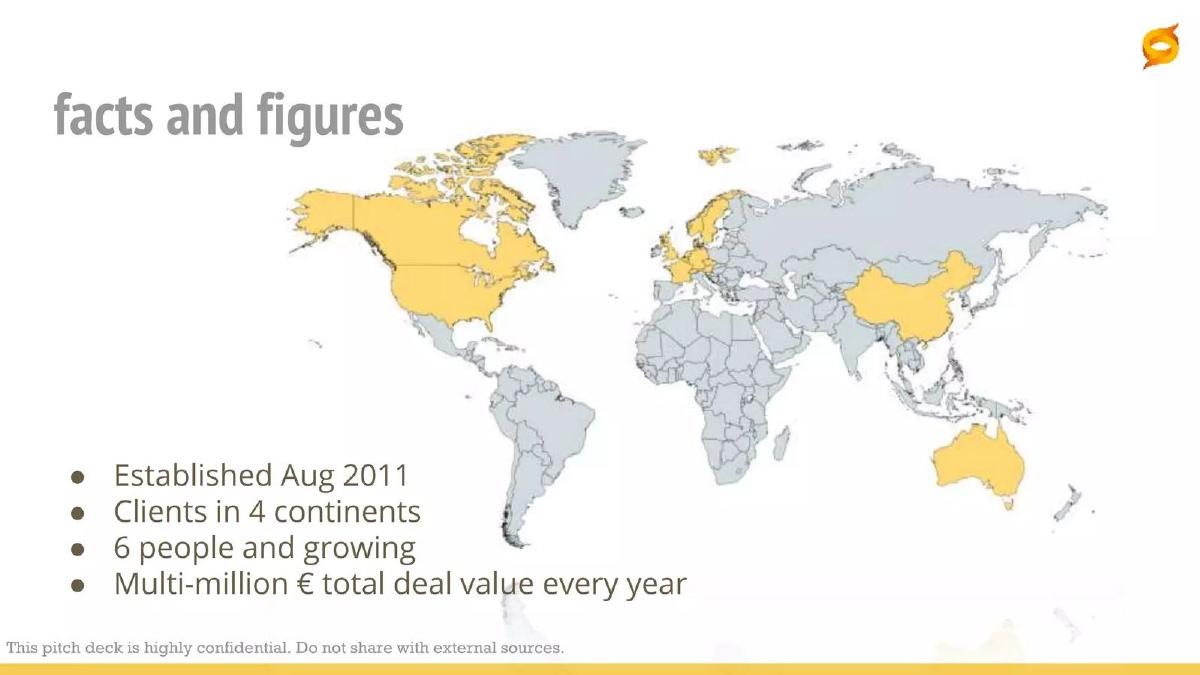
- Drebbel was established in 2011 and currently operates as a technology broker focused on sales revenue generation (Slide 1, 2).
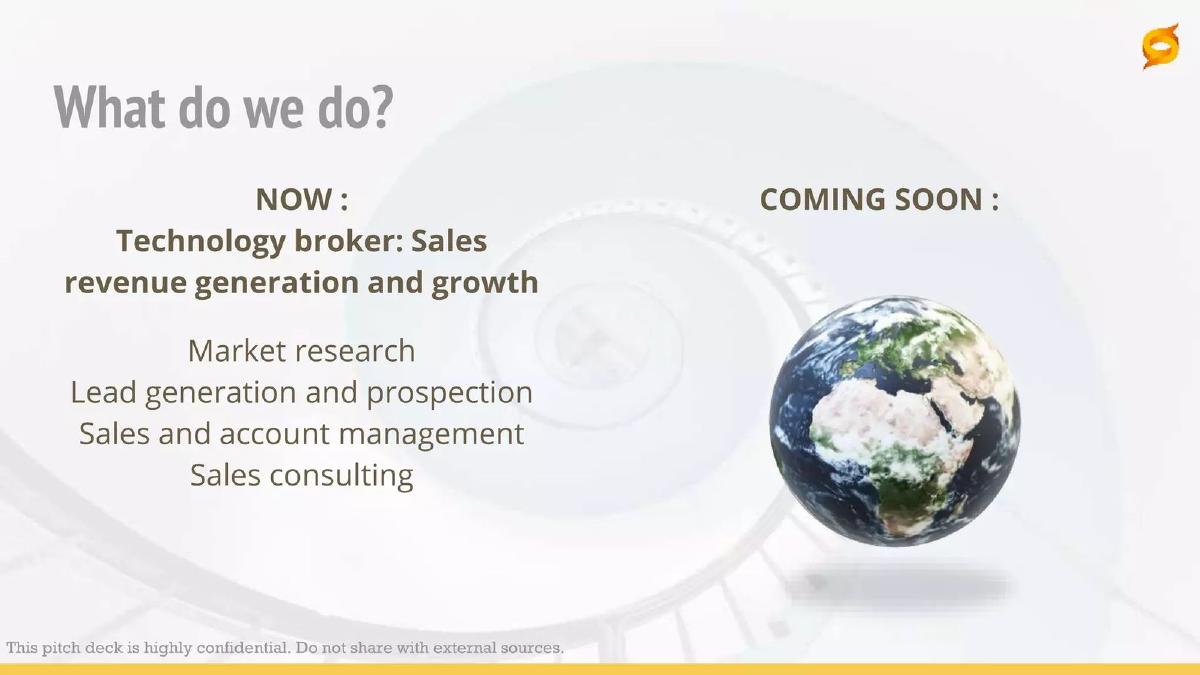
- The Byrssa Market is positioned as a 'coming soon' expansion to the existing brokerage business (Slide 2).
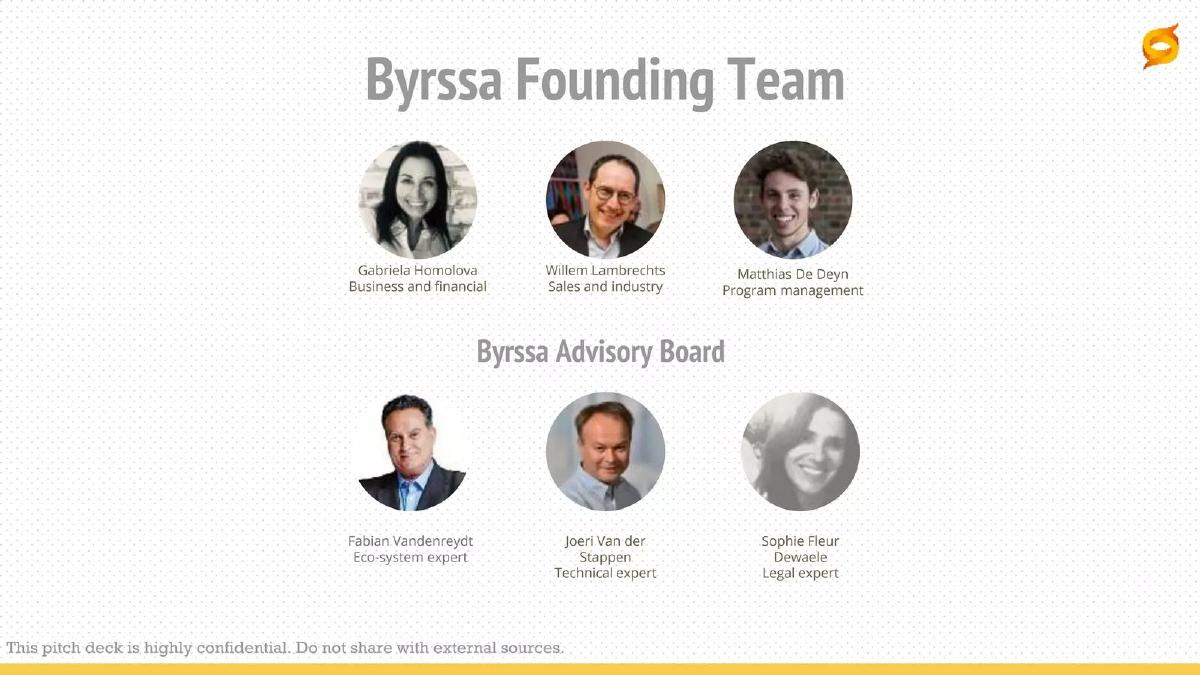
- The founding team consists of Gabriela Homolova, Willem Lambrechts, and Matthias De Deyn, supported by a three-person advisory board (Slide 3).
- The platform intends to use blockchain and smart contracts to enable disintermediation in the finance sector (Slide 4).
- Byrssa Market components are categorized into Free, Standard, and Premium tiers, covering functions like KYC, Issuance, and Investment (Slide 5).
- The stated mission is to unite the European fintech ecosystem on a single market infrastructure (Slide 6).
- Technological differentiators include a no-code data-fabric and a built-for-purpose blockchain specialized for Security Token Offerings (Slide 7).
- The deck omits a specific funding request, financial projections, and a detailed competitive landscape analysis.
Drebbel Byrssa Market: A Conceptual Leap from Brokerage to Blockchain
The Drebbel Byrssa Market pitch deck represents a company at a crossroads. Established in 2011, Drebbel has a decade of history as a technology broker, but this presentation is focused on a new, ambitious product: Byrssa. The deck attempts to bridge the gap between a service-based consulting business and a scalable fintech infrastructure platform. However, it leans heavily on conceptual frameworks and mission statements rather than the empirical data typically required for a late-stage or even a sophisticated seed-stage raise.
Slide 1: Title and Identity
The cover slide introduces Drebbel as 'Technology Brokers' with the tagline 'Generating cash for fintechs.' It notes the company was established in 2011. The branding is professional but understated, and the 'highly confidential' footer suggests this was intended for a targeted group of investors rather than a broad public release. The age of the company (10+ years at the time of the deck's likely creation) is a double-edged sword; it suggests stability but also raises questions about why a pivot to a new market platform is happening now.
Slide 2: The Pivot from 'Now' to 'Soon'
Slide 2 defines the current state versus the future vision. Currently, Drebbel provides market research, lead generation, prospection, and sales consulting. The 'Coming Soon' section is represented by a globe, implying the Byrssa Market. This slide is critical because it establishes that the company is moving from a human-capital-intensive service model to a scalable technology product model. However, it does not explain how the existing brokerage business will support or integrate with the new marketplace.
Slide 3: The Byrssa Founding Team and Advisors
The team slide lists three founders and three advisors. Gabriela Homolova handles business and financial aspects, Willem Lambrechts focuses on sales and industry, and Matthias De Deyn manages programs. The advisory board covers ecosystem, technical, and legal expertise. While the roles are clear, the slide lacks 'social proof'—there are no logos of previous companies worked for, no educational credentials, and no specific achievements listed for any individual. In fundraising, the 'why this team' is as important as the 'what,' and this slide provides only the 'who.'
Slide 4: Industry Trends and Disintermediation
This slide uses standard industry graphics to illustrate the shift toward data-centricity, artificial intelligence, and blockchain. The most important element here is the 'Disintermediation' graphic, which contrasts a 'Traditional Transaction Model' (involving intermediaries and custodians) with a 'Blockchain Model' (using smart contracts and automation). This sets the stage for Byrssa’s value proposition: removing friction and cost from private equity transactions through technology.
Slide 5: Byrssa Market Components
Slide 5 provides a functional hierarchy of the platform. It uses a color-coded system to denote Free, Standard, and Premium features. Free components include registration and basic content. Standard components (green) include profiling, data search, analytics, communications, and data access. Premium components (yellow) are the core value drivers: KYC (Know Your Customer), Issuance, Investment, Reference Data, and a Bulletin Board. This is the closest the deck gets to a business model, suggesting a tiered subscription or per-transaction fee structure, though specific pricing is not mentioned.
Slide 6: The Mission Statement
The mission is stated in four bullet points. The most ambitious is the goal to 'Unite the whole European fintech eco-system on one single market infrastructure.' The deck uses the phrase 'Forum Digitalum Romanum' to describe its vision of a central meeting place for European fintech. While the mission is clear, it is entirely qualitative. There are no KPIs or milestones mentioned to indicate how close they are to achieving this 'leader and frontrunner' status.
Slide 7: Technological Differentiators
This slide answers the question 'So what IS new?' It reiterates the European focus and the 'all-in-one' approach (Discovery to Deal). Technically, it claims a 'no-code Data-fabric' and a 'built-for-purpose blockchain' that is 'STO specialized.' The promise that 'Private Equity gets digital and liquid' is the primary hook for investors. However, there is no mention of whether this technology is proprietary, under development, or licensed from a third party.
Slide 8: Contact Information
The final slide provides a contact email for Willem Lambrechts. It features a generic 'Thank You' note and an architectural image. Like many slides in this deck, it is visually clean but lacks a final 'closing' argument or a summary of the investment opportunity.
What Works in This Deck
Clear Vertical Focus: By narrowing the scope to 'European Fintech,' the founders avoid the trap of trying to build a marketplace for everything. This specialization makes the 'all-in-one' approach more believable. · Logical Progression: The deck moves well from the company's history (brokerage) to the industry problem (intermediaries) to the proposed solution (Byrssa). · Tiered Feature Set: Slide 5 effectively communicates the complexity of the platform and hints at a sophisticated revenue model without needing a wall of text.
What Is Missing
The Ask: There is no slide indicating how much money Drebbel is seeking or what the valuation expectations are. · Market Sizing: There is no mention of the Total Addressable Market (TAM). How many European fintechs are there? What is the annual volume of private equity issuance in this sector? · Financials and Traction: For a company established in 2011, the absence of historical revenue or even a 'number of clients served' metric is a significant red flag. Investors need to see that the brokerage business provides a viable launchpad for the marketplace. · Competitive Landscape: The deck assumes Byrssa is entering a vacuum. It does not address existing players like Seedrs, Crowdcube, or institutional private equity platforms. · Product Roadmap: Since Byrssa is 'Coming Soon,' a timeline of development milestones (MVP, Beta, Launch) is essential but missing.
Founder Takeaways
Founders should look at this deck as a 'Vision Deck' rather than a 'Fundraising Deck.' It succeeds in painting a picture of a future state but fails to provide the evidence required to get there. Strongly consider including a slide that bridges your current service revenue to your future product revenue; if you are using consulting fees to bootstrap a platform, that is a compelling story that should be told explicitly. Avoid using generic industry graphics (like those on Slide 4) without adding your own data or insights on top of them. Finally, if you are a 10-year-old company, you must address your 'legacy'—explain why now is the right time for this evolution and how your decade of experience gives you an unfair advantage over a brand-new startup.
Frequently asked questions
- What is the primary business model of Drebbel according to the deck?
- Drebbel currently operates as a 'Technology broker' providing sales revenue generation, market research, lead generation, and sales consulting. The deck indicates a transition toward launching 'Byrssa Market,' which is described as a digital marketplace for private equity issuance and trading. The revenue model for Byrssa appears to be tiered, offering Free, Standard, and Premium subscription levels for various platform components.
- What technologies does Byrssa Market intend to utilize?
- The platform plans to leverage 'newest technology developments,' specifically highlighting artificial intelligence and blockchain. Slide 7 specifies the use of a 'no-code Data-fabric' and a 'built-for-purpose blockchain' that is specialized for Security Token Offerings (STOs). The goal of this tech stack is to facilitate the disintermediation of traditional transaction models involving intermediaries and custodians.
- Who are the key individuals behind the Byrssa project?
- The founding team includes Gabriela Homolova (Business and financial), Willem Lambrechts (Sales and industry), and Matthias De Deyn (Program management). They are supported by an advisory board featuring Fabian Vandenreydt (Eco-system expert), Joeri Van der Stappen (Technical expert), and Sophie Fleur Dewaele (Legal expert). No specific past company successes or professional backgrounds are detailed beyond these titles.
- What is the specific market focus for Byrssa?
- Byrssa is explicitly focused on the European fintech ecosystem. Its mission is to unite this specific vertical on a single market infrastructure. The deck emphasizes a 'vertical all-in-one approach' that covers discovery, research, outreach, matching, and deal-making, specifically aimed at making private equity in the European fintech space more digital and liquid.
- What critical information is missing from this pitch deck?
- The deck lacks several standard fundraising components. There is no 'Ask' slide detailing how much capital is being raised or how it will be used. Furthermore, there are no financial projections, historical revenue data for the existing brokerage business, or specific market size metrics (TAM/SAM/SOM). A competitive analysis comparing Byrssa to existing private equity platforms or secondary markets is also absent.