Dotty AR, an Australian-based entity (Dotty Digital PTY LTD), presents a focused case for enterprise-grade augmented reality (AR) telepresence. The deck highlights a clear shift from consumer-facing AR to high-value industrial applications such as remote repairs and virtual training for the oil, gas, and mining sectors. With a team rooted in mechatronics and subsea robotics, the company leverages technical credibility to court major partners like Autodesk and ODG. While the market projections of $150 billion by 2020 date the deck significantly, the fundamental approach to solving communicatio…
Key takeaways
- The company identifies a $150 billion total AR/VR market opportunity by 2020, citing Digi-Capital as a source (Slide 4).
- Dotty AR targets specific heavy industries including Oil, Gas, Mining, and Engineering firms for remote operations and on-site repairs (Slide 2).
- The deck lists significant pilot interest or implementations with major brands like Royal Dutch Shell, Rio Tinto, and Sony (Slide 5).
- A specific user-conversion target is identified for Shell, aiming for 5,000 Dotty users out of 32,000 total employees (Slide 5).
- Traction includes a collaboration agreement with ODG for a native Android app and full internal support from Autodesk (Slide 7).
- The founding team consists of mechatronics engineers with backgrounds in subsea robotics and the energy sector (Slide 8).
- The company identifies a high-likelihood risk of cash burn at the end of a 2-year runway, mitigated by sales-focused funding (Slide 9).
- The 'Use of Funds' slide requests a total of $500,000, with 30% ($150,000) allocated to Software Development for a V2.0 release (Slide 10).
Executive Summary and Legal Framework
Slide 1: Disclaimer
The deck opens with a standard, text-heavy non-disclosure agreement and disclaimer. It identifies the legal entity as Dotty Digital PTY LTD, an Australian company. The presence of a signature line for the recipient indicates this was intended for controlled, one-on-one distribution rather than a broad public blast. It establishes the 'Private & Confidential' footer that persists throughout the presentation.
Market Positioning and Problem Definition
Slide 2: Target Market - Enterprise Clients
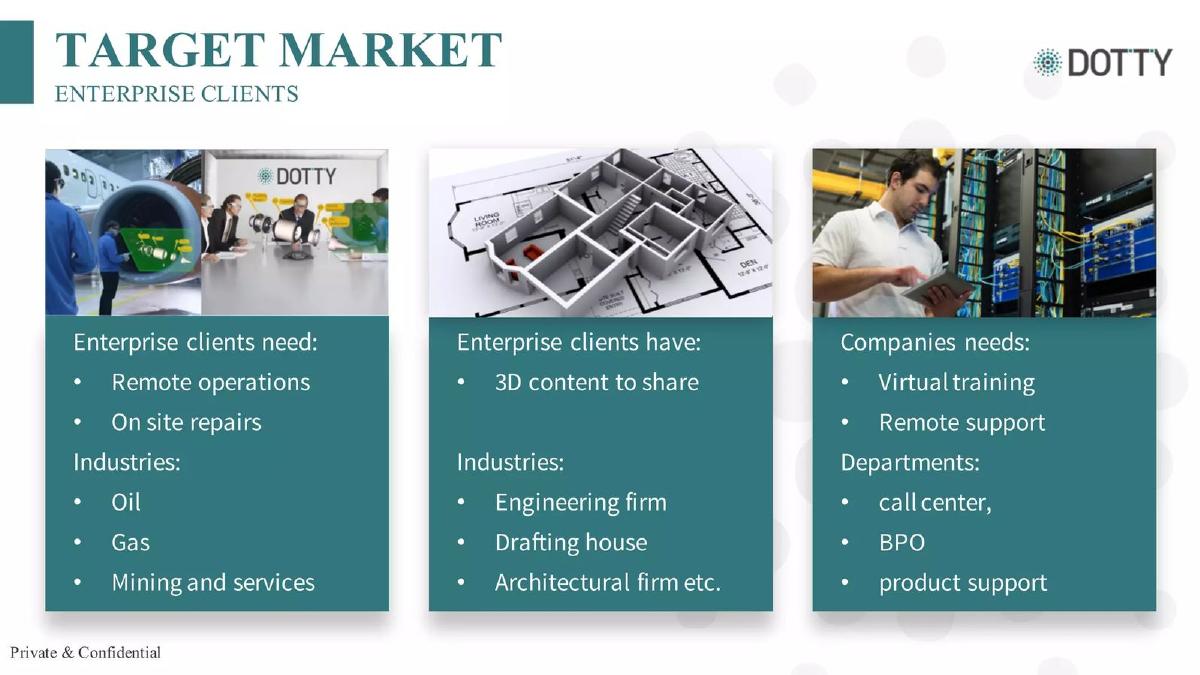
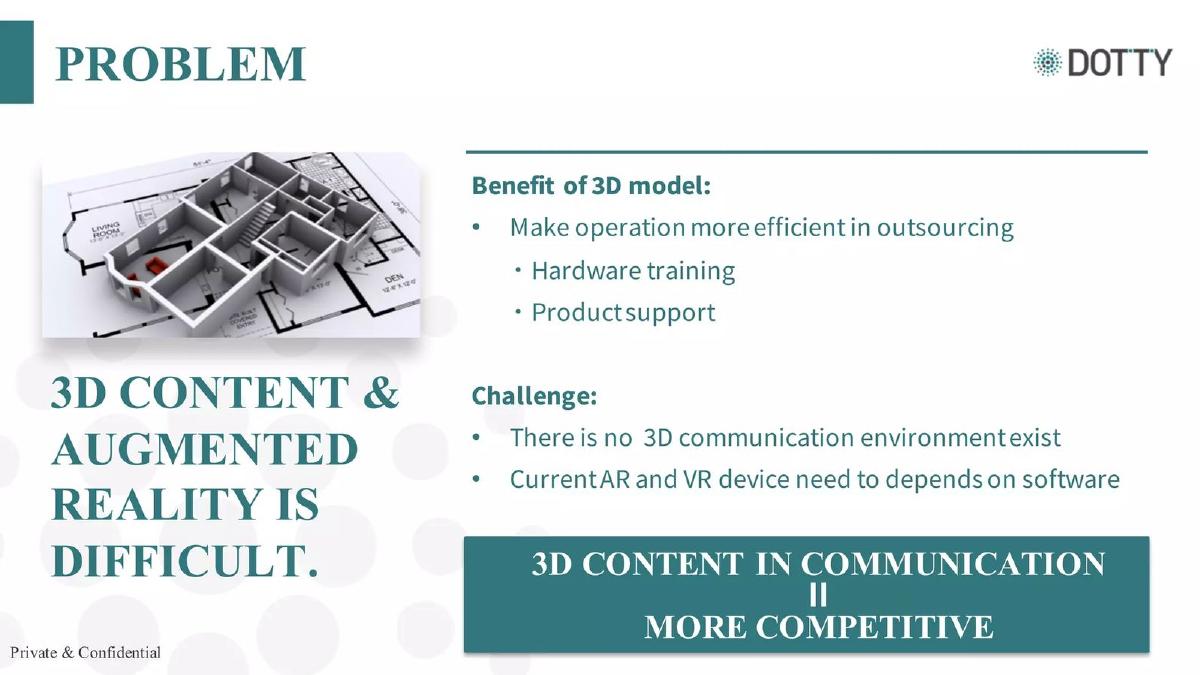
This slide segments the target audience into three distinct categories. First, heavy industries like Oil, Gas, and Mining, which require remote operations and on-site repairs. Second, design-heavy firms such as engineering, drafting, and architectural houses that already possess 3D content but need sharing mechanisms. Third, service-oriented departments like call centers and BPOs that require virtual training and remote support. This segmentation demonstrates that the founders are looking beyond simple 'cool factor' AR and focusing on utility-driven enterprise needs.
Slide 3: Solution - Dotty Telepresence Suite
The solution slide is visual, featuring a split-screen image. On the left, a technician wears AR glasses while working on a jet engine; on the right, a group of executives in a boardroom view the same engine components as 3D holograms. The slide includes a 'Click to Watch Video' call to action, which is a common tactic to prove the technology's functionality. The branding 'Dotty Telepresence Suite' suggests a software-as-a-service (SaaS) or platform play rather than a hardware play.
Market Opportunity and Validation
Slide 4: Market Analysis - Opportunity
Dotty AR uses third-party data to validate the market size. Citing Digi-Capital, they project a $150 billion total market by 2020. The breakdown—$120 billion for AR and $30 billion for VR—clearly explains why the company is focused on the former. The slide argues that because AR can be deployed on existing mobile and tablet devices, the addressable market is effectively the entire mobile user base. However, the 2020 date indicates this deck was likely produced around 2016.
Slide 5: Market Analysis - Current Pilot Implementations
This is a high-impact slide that lists logos of major global corporations, including Shell, Rio Tinto, Sony, and Foxtel. Rather than just showing logos, the slide provides specific 'Potential Dotty Users' metrics. For example, it notes that while Royal Dutch Shell has 32,000 employees, Dotty is targeting a specific subset of 5,000 users. This level of granularity suggests a realistic bottom-up sales approach rather than a vague 'everyone will use it' claim.
Product Mechanics and Traction
Slide 6: Unique Selling Proposition (USP)
The USP slide uses a flow diagram to explain the value chain: Create 3D content, display it on the telepresence tool, and establish efficient communication. The ultimate outcomes are listed as remote training, better product understanding, and increased sales. This slide bridges the gap between the technical 'how' and the business 'why,' focusing on the ROI for the enterprise client.
Slide 7: Traction - Customers, Partners & Media
Traction is divided into three pillars. Under 'Customers,' they list pairings like 'Luxottica - Oakley' and 'Dof Subsea - Shell,' indicating specific project contexts. The 'Partners' column is particularly strong, citing a collaboration agreement with ODG (a major AR hardware player at the time) and a meeting at PTC HQ. The media section mentions an O'Reilly book on enterprise AR, which adds significant industry credibility to the founders.
The Team and Operational Risks
Slide 8: Team & Remuneration
The team slide highlights three key executives. Wes McCombe (CTO) and Russell Considine (CEO) are both Mechatronics Engineers, which is a highly relevant discipline for industrial AR. Their experience with Shell Philippines and the energy sector aligns perfectly with the target market identified in Slide 2. Ajay Shah (Sales) provides the business balance, with a background in large-scale fundraising ($240MM) and government initiatives. The inclusion of 'Remuneration' in the title is unusual, though the slide itself focuses on biographies.
Slide 9: Key Risks & Mitigation Strategies
This is a sophisticated addition rarely seen in early-stage decks. The company uses a grid to rank risks by likelihood and impact. They candidly admit that 'Cash burn at end of 2 yr runway' is a high-likelihood risk. Their mitigation strategy for a financial market crash—arguing that crashes favor IT efficiency tools—is a classic defensive pitch. This slide builds trust by showing the founders are thinking about what could go wrong, not just the best-case scenario.
Financial Ask and Allocation
Slide 10: Use of Funds
The final slide provides a detailed breakdown of a $500,000 'Year 1 Start-up Costs' requirement. It is exceptionally specific, listing items down to 'Accounting and Book-keeping' ($3,600) and 'Insurance' ($2,000). The bulk of the capital is earmarked for Software Development V2.0 ($150,000) and Sales Wages ($120,000). This transparency allows an investor to see exactly how their capital will be deployed to reach the next milestone, which they define as building a '$2M pipeline within 12 months.'
What Works and What is Missing
What Works: The deck excels at industry-specific targeting. By focusing on mechatronics and heavy industry, Dotty AR avoids the 'generalist' trap that many AR startups fall into. The traction slide is backed by credible names and specific dates, and the risk matrix shows a high level of professional maturity. The 'Use of Funds' is one of the most detailed examples in the sector, providing clear line items for every dollar requested.
What is Missing: There is a lack of clear unit economics or a pricing model. While they mention 'upsells' and 'commercialisation features' in the use of funds, they don't explain how much a typical enterprise license costs. Additionally, the deck lacks a competitive landscape slide. In a crowded AR field, failing to mention competitors like ScopeAR or Daqri (at the time) is a notable omission. Finally, the exit strategy is only briefly mentioned as a mitigation for cash burn, rather than a primary goal.
Founder's Guide: What to Copy
The Pilot User Breakdown: Founders should copy the way Slide 5 breaks down 'Total Employees' versus 'Potential Users.' It shows investors that you understand your 'beachhead' market within a large organization and aren't just chasing vanity metrics.
The Risk Matrix: Slide 9 is a masterclass in proactive communication. By identifying risks like 'Operations & process malfunction' and assigning a specific executive (CTO) to be responsible for the mitigation, the founders demonstrate operational readiness.
Specific Use of Funds: Avoid 'General Working Capital' as a primary bucket. Copy the granularity of Slide 10, which even accounts for travel expenses and server licenses. This level of detail makes the $500,000 ask feel calculated rather than guessed.
Frequently asked questions
- What specific problem is Dotty AR solving for enterprise clients?
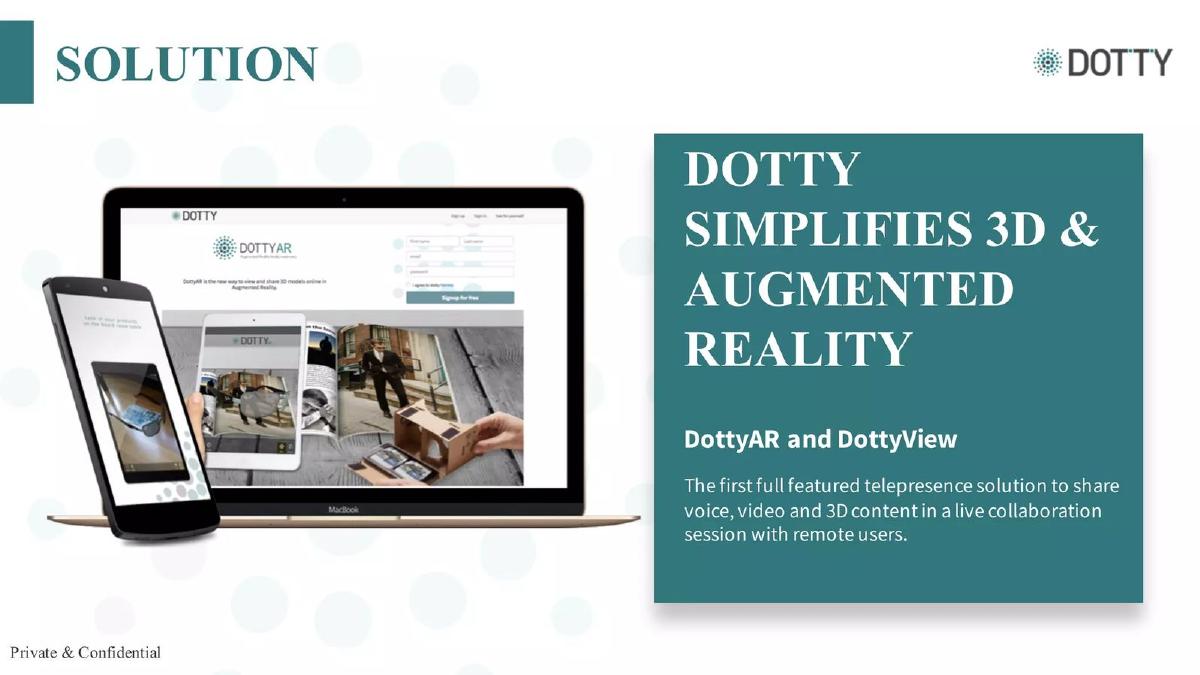
- Dotty AR addresses the need for remote operations and on-site repairs in complex industrial environments. According to Slide 2, enterprise clients often have 3D content but lack efficient ways to share it for virtual training, remote support, and product support. Their 'Telepresence Suite' (Slide 3) allows remote experts to guide on-site technicians using AR overlays, reducing the need for travel and minimizing downtime in sectors like mining and oil.
- How does the company justify its market size and timing?
- The deck relies on 2015-era projections from Digi-Capital, suggesting the AR/VR market would reach $150 billion by 2020, with AR taking the lion's share at $120 billion (Slide 4). They argue that AR's addressable market is equivalent to the mobile/tablet market, benefiting from hundreds of millions of existing users and rapid economic growth in the hardware sector.
- What is the current status of their partnerships and traction?
- As of the deck's publication, Dotty AR claimed 'Full internal support' from Autodesk and a collaboration agreement with ODG for a native Android app (Slide 7). They also mentioned a pending collaboration with PTC following a meeting at PTC HQ in July 2016. Their customer list includes high-profile names like Luxottica, Transcom, and Rio Tinto, though the depth of these relationships is described as 'pilot implementations' (Slide 5).
- Who are the key members of the leadership team?
- The leadership is technically oriented. CTO Wes McCombe is a Mechatronics Engineer with a background in subsea robotics and 3D printing. CEO Russell Considine is also a Mechatronics Engineer with experience managing multi-million dollar projects in the energy sector. Ajay Shah leads Sales and Business Development, bringing an MBA and experience raising $240 million in the affordable housing sector (Slide 8).
- What are the primary financial requirements and risks mentioned?
- The company is seeking $500,000 to cover one year of start-up costs (Slide 10). The largest allocations are for software development ($150k) and sales wages ($120k). A key risk identified in Slide 9 is the 'high' likelihood of cash burn at the end of a two-year runway, which they plan to mitigate by focusing funds on sales to achieve a 'tangible value creation for optional exit on asset alone.'