Global Water First (GWF) positions itself as a solution to the $118B annual funding gap in global water access by utilizing a decentralized, revenue-generating enterprise model rather than traditional philanthropy. The deck focuses on the 'Small Water Enterprise' (SWE), where GWF provides equipment via a 5-year lease to local operators. The model is highly detailed, providing per-liter unit economics ($0.09/liter sales price) and a clear transition from water services in Phase 1 to power and internet hubs in Phase 2. While the deck excels at operational transparency and impact forecasting—pro…
Key takeaways
- The company identifies a massive $118B annual funding gap in the global effort to achieve SDG 6.1 by 2030 (Slide 3).
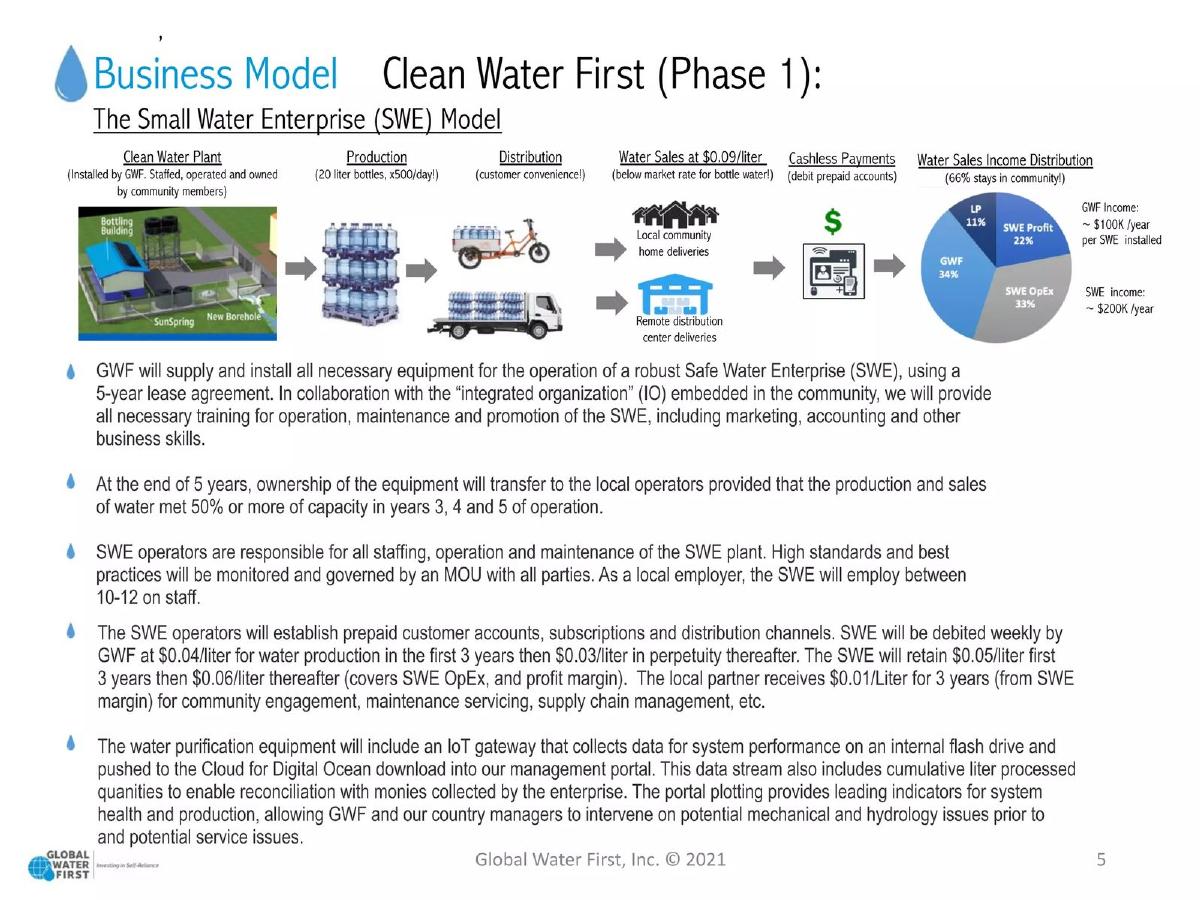
- The business model relies on a 5-year lease agreement where ownership of equipment eventually transfers to local community operators (Slide 5).
- Unit economics are precisely defined: water is sold at $0.09/liter, with GWF taking a $0.04/liter debit for the first three years (Slide 5).
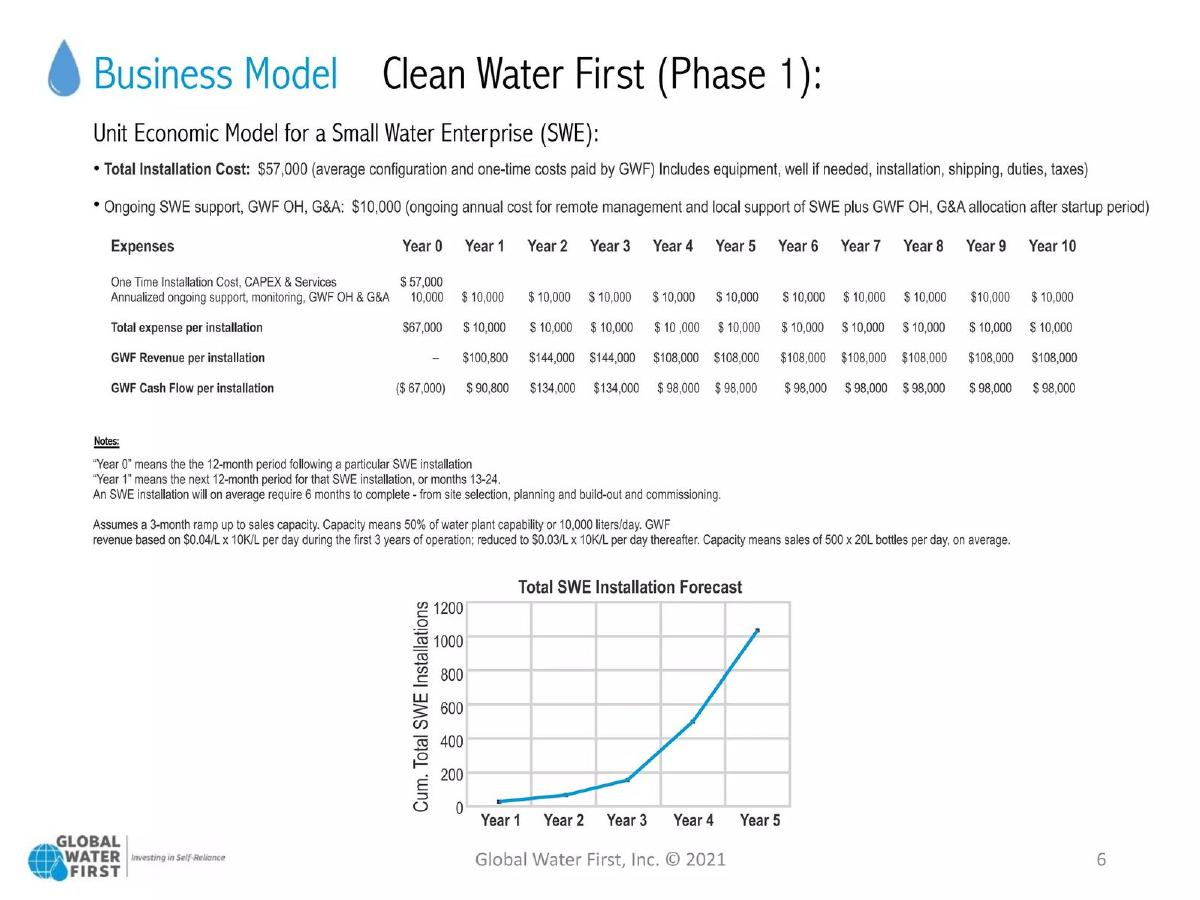
- A typical Small Water Enterprise (SWE) is projected to generate $46,020 in annual net income at 50% capacity, rising to $77,220 after three years (Slide 7).
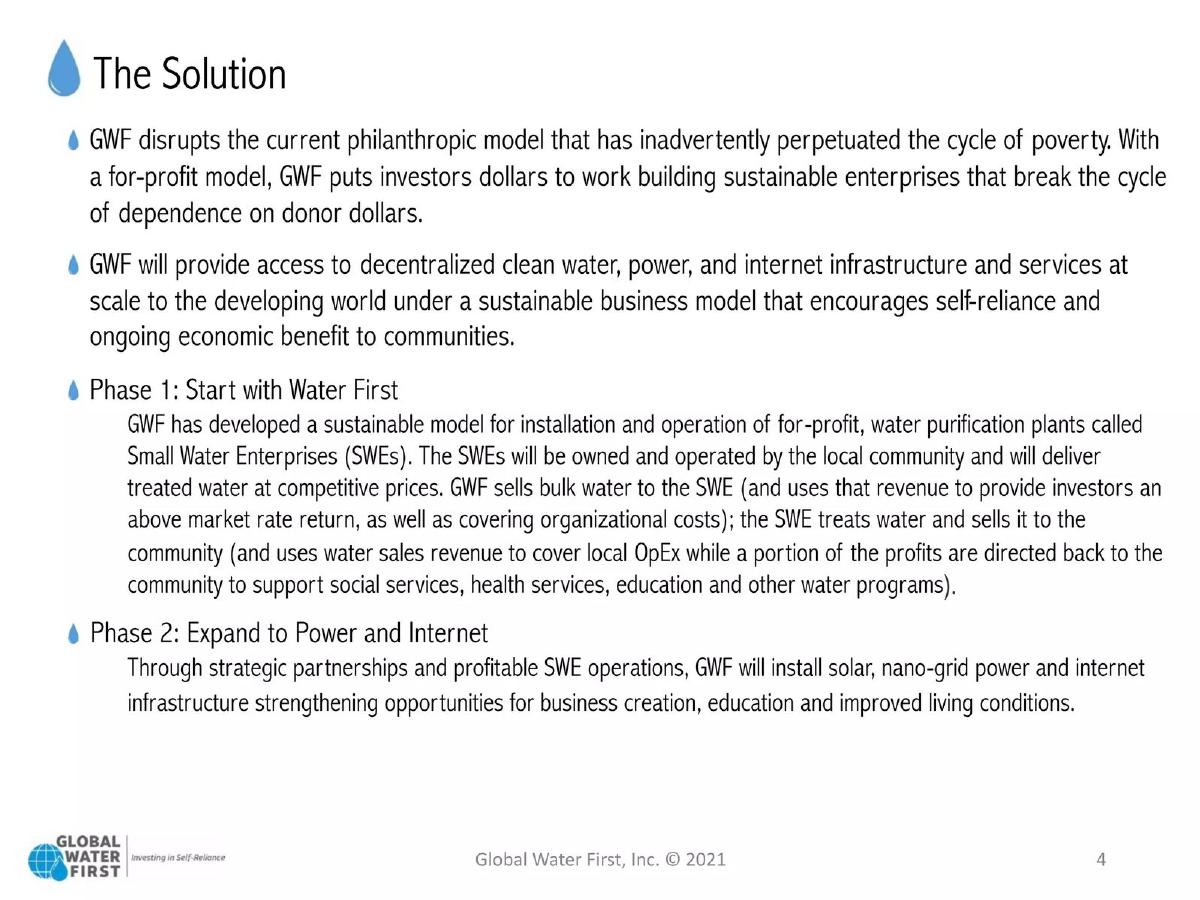
- Phase 2 of the model expands services to include smart nanogrids and internet services, funded by SWE profits and strategic partners (Slide 9).
- Traction is evidenced by installations in Juba, South Sudan (August 2021) and Kabojja village, Uganda (September 2021) (Slide 11).
- The company is seeking a $2 million Seed round via a SAFE to fund 6 SWE installations and realize income by month 9 (Slide 17).
- Impact projections are aggressive, scaling from 30,000 people provided with clean water in Year 1 to over 8.1 million by Year 5 (Slide 19).
Executive Summary: The Infrastructure-as-a-Service Approach to Social Impact
Global Water First (GWF) presents a compelling hybrid model that sits at the intersection of infrastructure development and social entrepreneurship. The deck, dated late 2021, argues that traditional philanthropy and NGO models are failing to scale due to a lack of operational and financial sustainability. Their solution is the Small Water Enterprise (SWE), a decentralized, locally-operated utility model that provides clean water, and eventually power and internet, to underserved communities in Sub-Saharan Africa and Latin America.
Slide 1: Title and Mission
The cover slide introduces Global Water First with a clear, descriptive subtitle: "Reducing generational poverty and health risks with sustainable, decentralized enterprises providing clean water, internet and nano-grid power services." The visual identity is established with a water-themed world map and the tagline "Investing in Self-Reliance," which signals to investors that this is a market-based solution rather than a charity.
Slide 3: Defining the $118B Problem
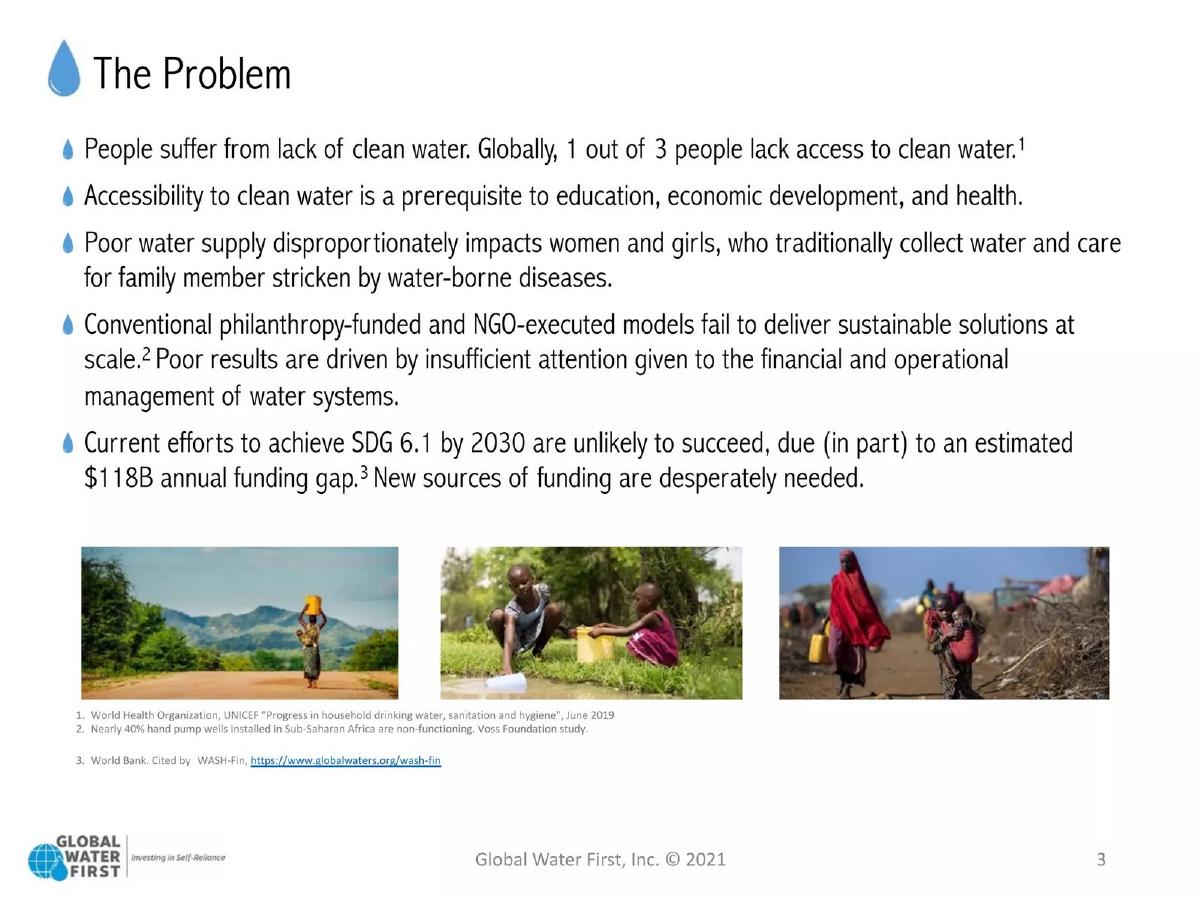
The problem slide uses data from the WHO, UNICEF, and the World Bank to frame the crisis. It notes that 1 out of 3 people globally lack access to clean water and highlights that nearly 40% of hand pump wells in Sub-Saharan Africa are non-functioning. Crucially, it identifies an "estimated $118B annual funding gap" to reach UN Sustainable Development Goal 6.1. By quantifying the gap, GWF justifies the need for a new, revenue-driven model that can attract private capital.
Slide 5: The Small Water Enterprise (SWE) Business Model
This is the most critical slide in the deck, detailing the "Phase 1" operational flow. GWF supplies and installs equipment under a 5-year lease. The revenue split is clearly visualized in a pie chart: 66% of income stays in the community (33% OpEx, 22% SWE Profit, 11% Local Partner), while 34% goes to GWF. The slide specifies that GWF debits $0.04/liter for the first three years, dropping to $0.03/liter thereafter. This level of granularity in unit economics is rare in early-stage decks and provides significant comfort regarding the project's viability.
Slide 7: SWE Business and Operations Overview
GWF provides a full Pro Forma Income Statement for a single SWE unit. Based on 50% system capacity (10,000 liters per day), the enterprise generates a monthly net income (EBIDTA) of $0.295 per liter, resulting in an annualized income of $46,020. After three years, as debt costs decrease, this rises to $77,220. The slide also includes a process matrix covering everything from "Bottle Cleaning" to "Data Collection," showing a well-thought-out operational plan.
Slide 9: Phase 2 Expansion - Nanogrids and Internet
The deck looks beyond water to total utility provision. Phase 2 involves installing "Smart Nanogrids" and internet services. A 3D architectural render shows a "Smart Water & Power Hub" connected to homes, schools, and business incubators. This expansion is intended to be funded by SWE profits and strategic partners, suggesting a long-term play to become a primary utility provider for rural regions.
Slide 11: Traction and Global Footprint
Traction is demonstrated through specific geographic milestones. The deck claims two active installations in Juba, South Sudan (August 2021) and Kabojja, Uganda (September 2021). It also details a partnership with Humanity Helping Sudan and the launch of "734 Water." The mention of an "enterprise in a box" shipping to Ethiopia in November 2021 shows a standardized, scalable deployment strategy.
Slide 13: Competitive Landscape
GWF categorizes competitors into four groups: NGO-supported kiosks, major bottled water providers (Pepsi, Coke, etc.), locally-treated bulk water, and free but unsafe local sources. Their stated advantage is providing water at "1/3 to 1/2 the cost of competitive, safe bottled water" while exceeding US EPA standards with 99.999% purity.
Slide 15: The Advisors
Interestingly, the deck lacks a management slide, opting instead for a list of seven high-profile advisors. These include Thomas Deng Mahmoud Schumann (Water Security expert), Jack Barker (inventor of the SunSpring technology used by GWF), and Manyang Kher (a former "Lost Boy" of Sudan and social entrepreneur). While the advisors are impressive, the absence of the core execution team—CEO, COO, CTO—is a notable omission that investors would likely flag.
Slide 17: The Ask and Use of Funds
The financial request is explicit: a $2 million Seed round via a SAFE, followed by a $7 million Series A at month 18. The use of funds for Year 1 is dominated by CapEx (38%) and Salaries/Benefits (18%). By Years 2 and 3, CapEx increases to 54%, indicating a shift from building the organization to deploying hardware. The milestones are clear: 6 SWE installs by month 12 and profitability by month 35.
Slide 19: Impact Forecasting
The final content slide quantifies the social return on investment. GWF projects scaling from 30,000 people served in Year 1 to 8,120,000 people by Year 5. Similarly, they forecast job creation growing from 48 to nearly 13,000 employees. These figures are massive and serve to appeal to impact-focused investors.
What Global Water First Does Well
The deck's greatest strength is its transparency regarding unit economics. By breaking down the cost per liter and the exact revenue share between the company and the local community, GWF moves the conversation from "doing good" to "running a business." The inclusion of a full Pro Forma for a single unit (Slide 7) allows investors to stress-test the assumptions immediately. Furthermore, the two-phase roadmap provides a clear path to increasing the Average Revenue Per User (ARPU) by layering power and data services on top of the existing water infrastructure.
What is Missing from the Deck
The most glaring omission is the core management team. While the advisors are world-class, advisors do not run the day-to-day operations of a startup. Investors need to know who is responsible for the logistics of shipping containers to Ethiopia or managing the weekly debits from local operators. Additionally, there is very little information on the "IoT gateway" mentioned in Slide 5. For a decentralized model to work at the scale of 8 million people, the software layer for monitoring and payments is as important as the water filters, yet it receives minimal attention here.
Founder's Takeaway: Copy the Unit Economic Clarity
Founders building in the social impact or hardware space should study Slide 5 and Slide 7. Many impact decks fail because they are too vague about how the money actually moves. GWF avoids this by showing exactly how a $0.09 liter of water is divided. This level of detail transforms a "charitable idea" into an "investable infrastructure project." However, founders should ensure they don't hide their core team behind an advisor slide; investors back people, not just boards of directors.
Frequently asked questions
- What is the primary revenue model for Global Water First?
- GWF operates a lease-to-own model for Small Water Enterprises (SWEs). They install purification equipment and provide training under a 5-year lease. Revenue is generated through a weekly debit of $0.04 per liter produced for the first three years, which drops to $0.03 per liter in perpetuity thereafter. The local operator retains the remainder of the $0.09 per liter sales price to cover OpEx and profit.
- How does the company plan to scale beyond water services?
- The deck outlines a 'Phase 2' starting in Year 3 or later. Using profits from SWE operations and strategic partnerships, GWF intends to install decentralized Smart Nanogrids and internet services. This transforms the water kiosks into 'Water & Power Hubs' that can provide electricity to homes, schools, and business incubators.
- What specific traction has Global Water First achieved?
- As of late 2021, GWF had two active installations: one in Juba, South Sudan, and another in Kabojja, Uganda. They also detailed an 'enterprise in a box' configuration for Ethiopia, designed to fit into a 40-foot shipping container, with additional systems planned for Liberia, Guatemala, and Brazil for 2022.
- What are the financial requirements and milestones for the current round?
- GWF is raising a $2 million Seed round using a Y Combinator SAFE form. The primary milestones for this capital are to complete 6 SWE installations by month 12 and reach revenue generation by month 9. This is intended to lead into a $7 million Series A round at month 18.
- Who is leading the company according to the deck?
- The deck does not include a standard 'Founders' or 'Management Team' slide. Instead, it features an 'Advisors' slide with seven individuals, including water security experts, engineers, and social impact entrepreneurs. Notable figures include Jack Barker, inventor of the SunSpring purification system, and Manyang Kher, founder of 734 Coffee.