GymHit’s 2018 pitch deck is a study in extreme brevity, consisting of only seven slides. Despite the lack of traditional sections like a formal 'Ask,' detailed financial projections, or a competitive landscape, the company successfully raised $850,000. The deck relies heavily on high-level market figures—citing a $105B industry—and clear traction markers, including $25,000 in Monthly Recurring Revenue (MRR) and over 148,000 users. By contrasting a visually 'antiquated' legacy system against their own clean, 'intuitive' dashboard, GymHit positioned itself as a necessary modernization tool for…
Key takeaways
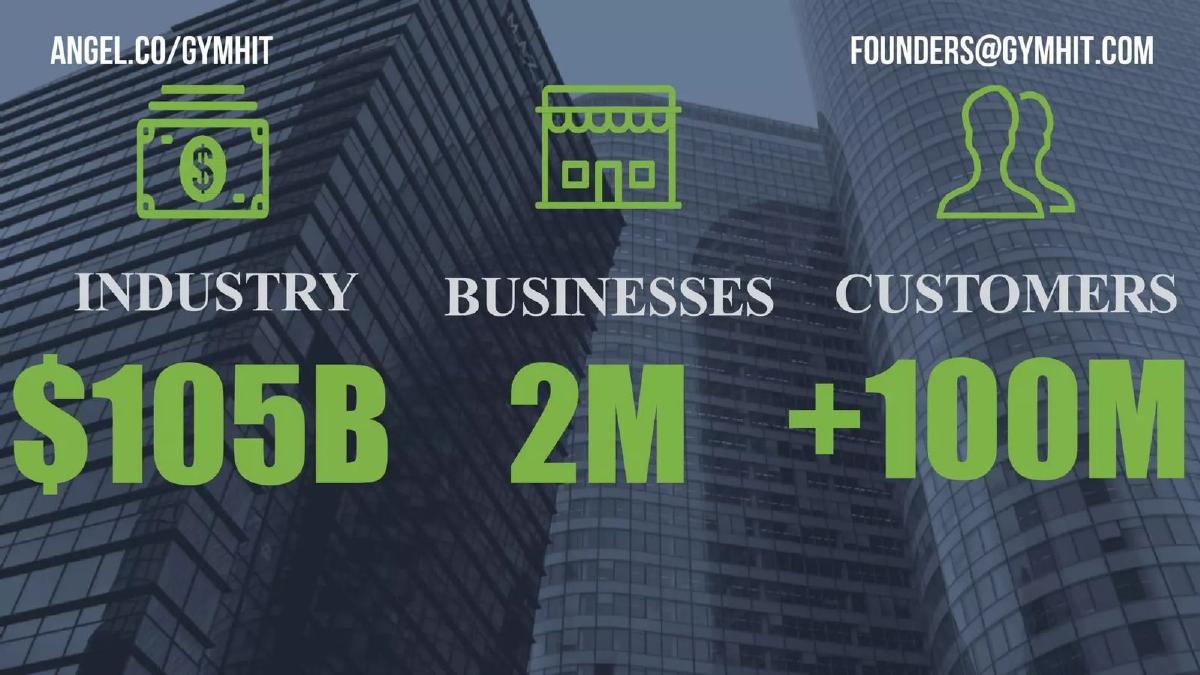
- The deck identifies a massive total addressable market of $105B with 2 million businesses and over 100 million customers on Slide 2.
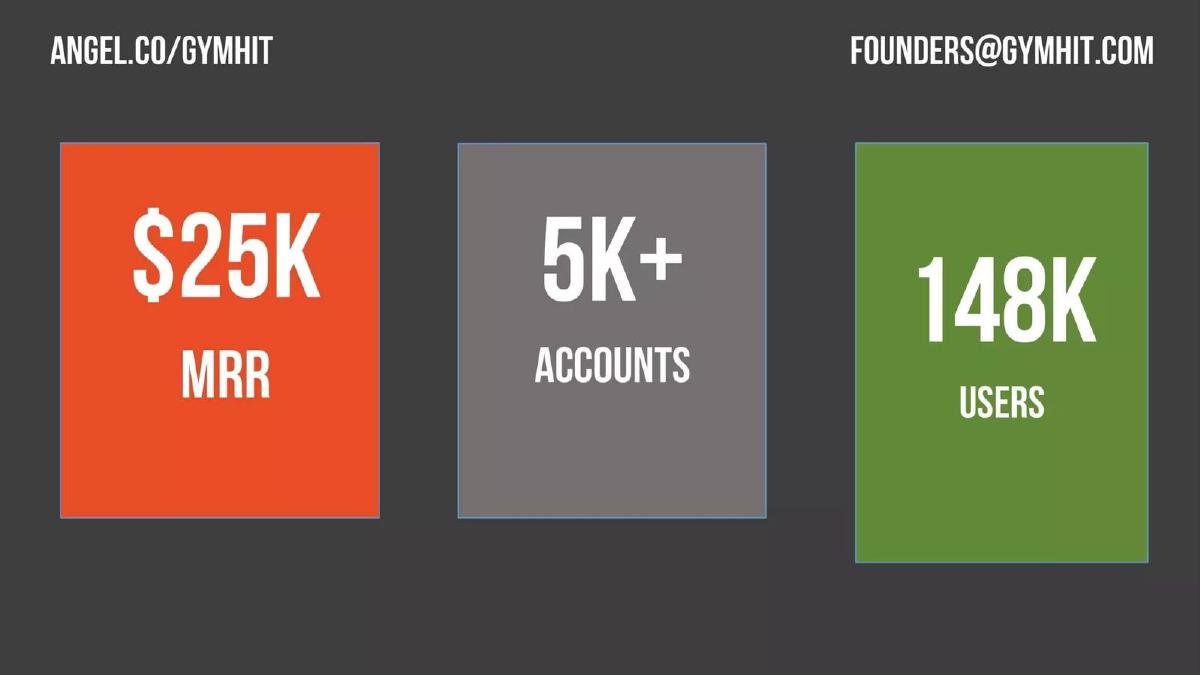
- Traction is the deck's strongest point, reporting $25K MRR, 5K+ accounts, and 148K users on Slide 6.
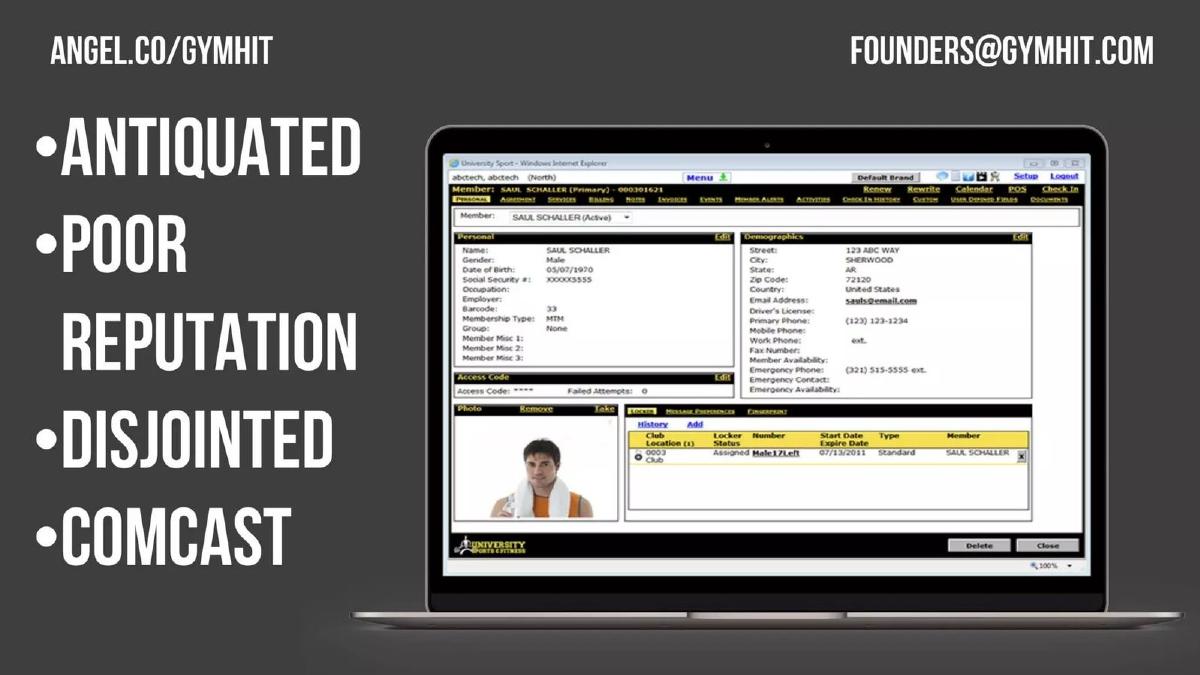
- The 'Problem' is illustrated on Slide 4 using a screenshot of a legacy Windows Internet Explorer interface described as 'antiquated' and 'disjointed.'
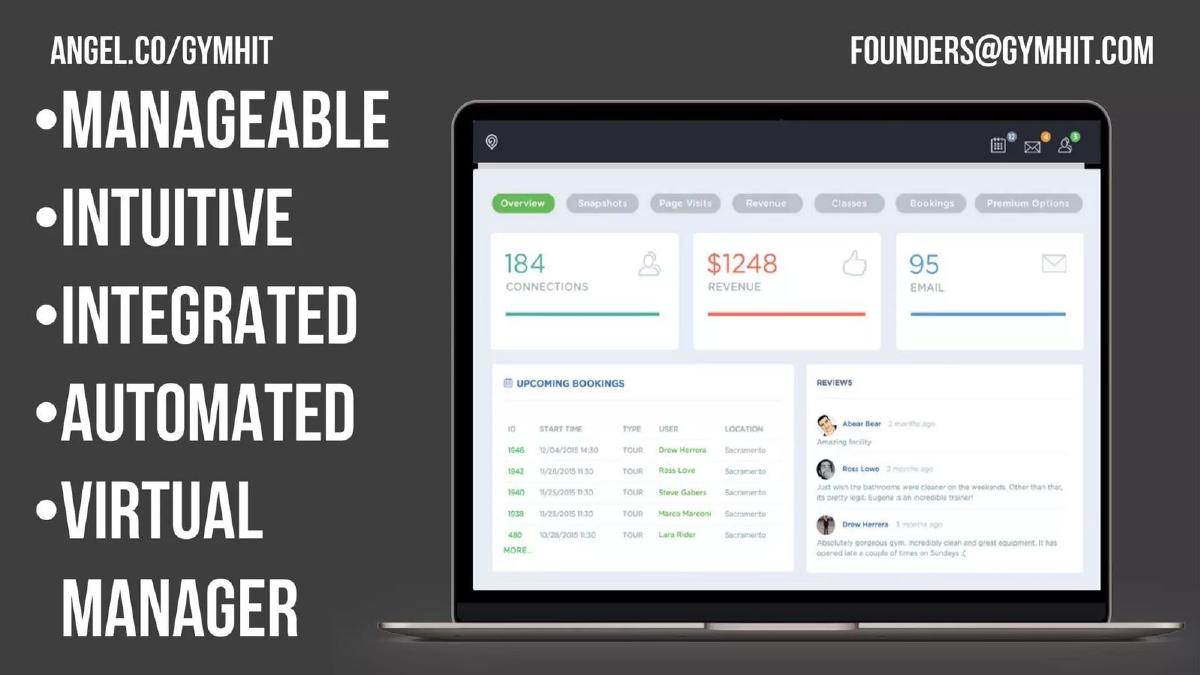
- The 'Solution' on Slide 5 highlights five core attributes: Manageable, Intuitive, Integrated, Automated, and Virtual Manager.
- The team slide (Slide 3) introduces six key members including a CEO, COO, CRO, CMO, PM, and Dev, but lacks professional biographies or past company exits.
- The deck completely omits a formal 'Ask' slide, leaving the specific funding goal and use of proceeds unstated within the presentation.
- There is no mention of competitors, unit economics (CAC/LTV), or a roadmap for future product development.
- The presentation uses a consistent call-to-action by placing the Angel.co link and founder email on nearly every slide.
The 7-Slide Strategy: GymHit’s Minimalist Pitch
GymHit entered the fundraising market in 2018 with a deck that defies the standard 15-to-20-slide convention. At just seven slides, this presentation is a lean, high-level overview designed to spark interest through traction and market scale rather than exhaustive detail. The company, which provides a management platform for gyms and personal trainers, focuses on the stark contrast between legacy software and modern SaaS design.
Slide 1: Title and Positioning
The opening slide establishes GymHit as an "All-in-one management platform for the fitness world." It features a clean logo and immediate contact information, including an Angel.co link and a founder email address. The background imagery of a desk with a typewriter and notebooks suggests a transition from old-school administrative work to digital efficiency, though the branding remains focused on the "Software" descriptor under the main logo.
Slide 2: Market Opportunity
Slide 2 presents the macro-opportunity using three massive figures: a $105B industry, 2M businesses, and +100M customers. This slide serves to validate the fitness sector as a venture-scale market. By highlighting the number of businesses (2 million), GymHit defines its potential B2B customer base, while the 100 million customers represent the end-users who would interact with the software indirectly through bookings and payments.
Slide 3: The Team
The team slide features headshots for six individuals: Gabriel Gomez (CEO), Nicholas Trosko (COO), Dane Matheson (CRO), Trever Gregory (CMO), Polina Marchenko (PM), and Thomas Kwan (Dev). While the slide identifies the roles, it provides no context regarding their 20 years of industry experience mentioned in the catalogue listing. In a 7-slide deck, space is at a premium, and the founders chose to prioritize faces over resumes.
Slide 4: The Problem (Legacy Systems)
This slide is a classic "Before" shot. It features a laptop screen showing a cluttered, Windows Internet Explorer-based management interface. The bullet points on the left are blunt: Antiquated , Poor Reputation , Disjointed , and Comcast . The inclusion of "Comcast" is likely a metaphorical jab at the poor customer service and monopolistic frustration associated with legacy fitness software providers. The visual evidence of a 2011-era interface effectively communicates the need for a modern solution.
Slide 5: The Solution (GymHit Dashboard)
The "After" shot appears on Slide 5, showcasing the GymHit dashboard. The UI is clean, featuring cards for "Connections" (184), "Revenue" ($1248), and "Email" (95). It also shows a list of upcoming bookings and customer reviews. The text highlights five key value propositions: Manageable , Intuitive , Integrated , Automated , and Virtual Manager . This slide directly answers the frustrations presented on the previous slide by showing a centralized, aesthetically pleasing command center for gym owners.
Slide 6: Traction and Metrics
This is the most critical slide in the deck for a company raising a "Later" stage round (as categorized in the catalogue). It displays three large boxes: $25K MRR , 5K+ Accounts , and 148K Users . These figures prove that the product is not just a concept but has achieved significant market fit. The $25,000 monthly recurring revenue provides a concrete baseline for valuation, while the user count suggests a high volume of activity within the platform.
Slide 7: Contact and Closing
The final slide is a simple contact page featuring CEO Gabriel Gomez's name, the website, a phone number, and the founder email. The background image shows individuals using battle ropes in a gym, reinforcing the industry focus. Notably, there is no "Ask" slide—no mention of the $850,000 target or how the funds will be used to scale the $25K MRR.
What Works in This Deck
Visual Contrast: The comparison between the "antiquated" legacy system on Slide 4 and the clean GymHit dashboard on Slide 5 is the strongest narrative element. It requires no explanation; the visual clutter of the old system versus the white space of the new one tells the story of modernization perfectly.
Hard Metrics: By putting the $25K MRR and 148K users front and center on Slide 6, GymHit removes the guesswork for investors. These are strong signals for a 2018-era seed or early-series round, showing that the team can execute and acquire users.
Brevity: While often a risk, the 7-slide format ensures that an investor can digest the entire pitch in under 60 seconds. It acts as a high-conversion teaser that forces a follow-up meeting to get the remaining details.
What Is Missing
The Ask: The most glaring omission is the funding request. Investors need to know how much capital is being sought and what the milestones for that capital will be. Without an 'Ask' slide, the deck feels more like a sales presentation than a fundraising tool.
Business Model: There is no explanation of how GymHit makes money. While $25K MRR is mentioned, the deck doesn't specify if this comes from monthly SaaS subscriptions, transaction fees on payments, or a per-trainer model. The catalogue listing mentions "vertically integrating certification agencies and supply chain logistics," but none of this future vision appears in the slides.
Competition: The fitness SaaS space is crowded (e.g., Mindbody, Zen Planner). GymHit does not address how it wins against these incumbents or why its "Virtual Manager" approach is a defensible moat.
What a Founder Should Copy
The 'Problem' Visualization: Founders building in 'unsexy' legacy industries should copy the tactic of showing a screenshot of the current, terrible solution. It immediately builds empathy for the customer's pain point.
Persistent Contact Info: GymHit includes the Angel.co link and email on almost every slide. This ensures that if a single slide is screenshotted or shared, the path back to the founders is always visible.
Focus on Traction: If you have revenue, lead with it. GymHit doesn't hide its metrics in a complex chart; it uses large, bold text that is impossible to miss. For a company at this stage, traction is the most persuasive argument available.
Frequently asked questions
- How much did GymHit raise with this deck?
- According to catalogue facts from pitchdeckhunt.com, GymHit raised $850,000 in 2018. The deck itself does not state the amount being raised or the terms of the round, which is an unusual omission for a standard pitch deck.
- What was GymHit's revenue at the time of this pitch?
- Slide 6 of the deck explicitly states that GymHit had reached $25,000 in Monthly Recurring Revenue (MRR). This figure is presented alongside other traction metrics like 5,000+ accounts and 148,000 users.
- Who are the key members of the GymHit team?
- Slide 3 identifies the leadership team: Gabriel Gomez (CEO), Nicholas Trosko (COO), Dane Matheson (CRO), Trever Gregory (CMO), Polina Marchenko (PM), and Thomas Kwan (Dev). The deck does not provide their professional backgrounds or industry experience.
- What specific problem does GymHit solve?
- GymHit targets the 'antiquated' and 'disjointed' nature of existing fitness management software. Slide 4 uses a screenshot of a legacy system to highlight poor user interfaces and fragmented workflows, positioning GymHit as a modern, integrated alternative.
- What is missing from the GymHit pitch deck?
- The deck is missing several standard components: a competitive analysis, a detailed business model/pricing slide, financial projections, a go-to-market strategy, and a specific funding request (the 'Ask'). It functions more as a high-level teaser than a comprehensive business plan.