OutboundEngine presents a compelling case for a mature growth-stage investment, reporting $23 million in ARR and a robust 75%+ gross margin as of June 2019. The deck effectively positions the company in a 'Goldilocks' zone of the market: more automated than a traditional agency, yet more service-oriented than 'do-it-yourself' platforms like HubSpot or Wix. By targeting a massive market of 23.8 million SMBs with a 'done-for-you' content strategy, they demonstrate clear product-market fit and a proven direct selling motion. While the deck is heavy on product features and light on specific futur…
Key takeaways
- The company reported $23M ARR with 75%+ gross margins at the time of the 2019 presentation (Slide 2).
- OutboundEngine identifies a specific target market of 23.8 million small-to-medium businesses (Slide 2).
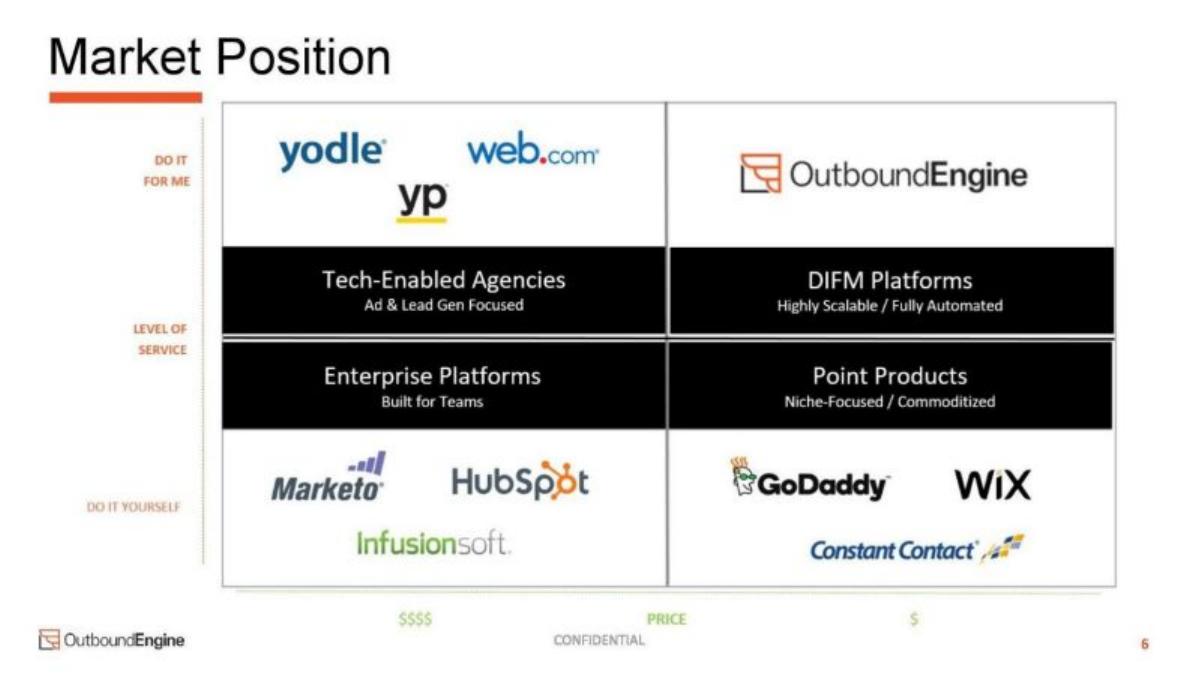
- The platform differentiates itself as a 'DIFM' (Do It For Me) platform, contrasting with 'DIY' tools like GoDaddy or Wix (Slide 6).
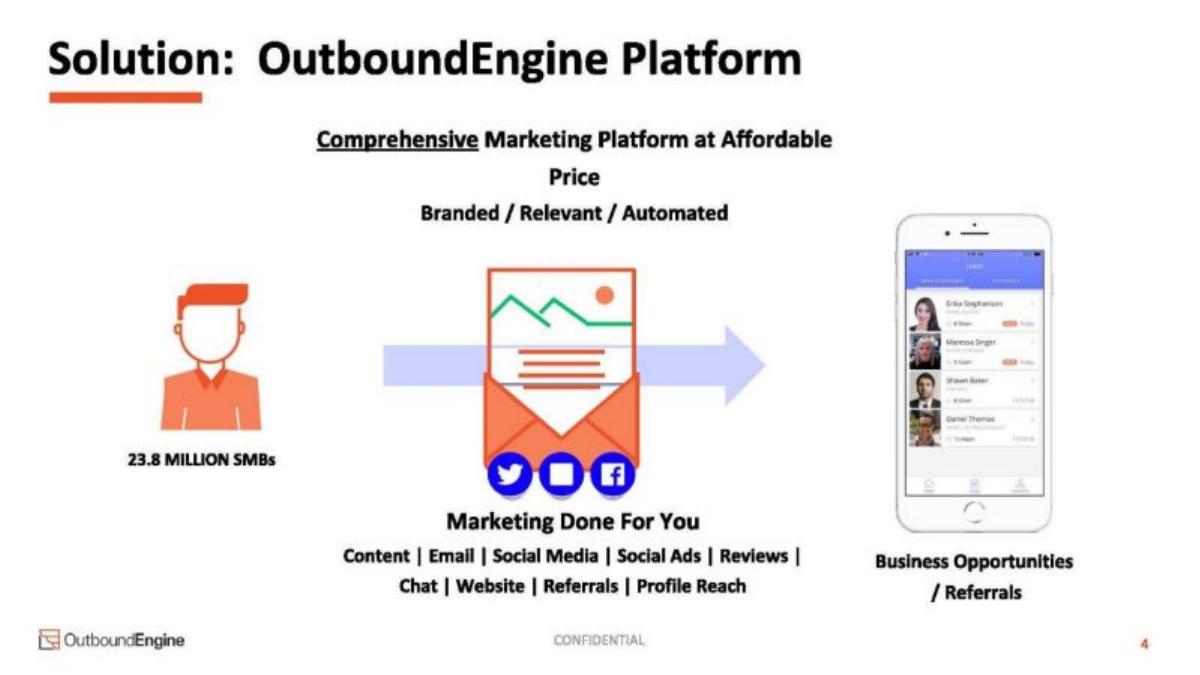
- The product suite is comprehensive, covering email, social media, reviews, referrals, and live chat (Slide 4).
- Pricing is tiered across three packages: Essential ($199/mo), Value ($299/mo), and Premium ($449/mo) (Slide 19).
- The company utilizes a 'white glove' approach to customer success to maintain its 10,000-customer base (Slide 2).
- A detailed product roadmap shows a transition from industry-specific content to industry-agnostic content by 2020 (Slide 20).
- The deck highlights a mobile-first 'Sales Enablement' app for real-time prospect engagement (Slide 18).
Executive Summary and Investment Highlights
Slide 1: Title Slide
The deck opens with a clean, professional title slide dated June 2019. The branding is consistent, featuring the OutboundEngine logo and a straightforward title: 'Introduction to OutboundEngine.'
Slide 2: Investment Highlights
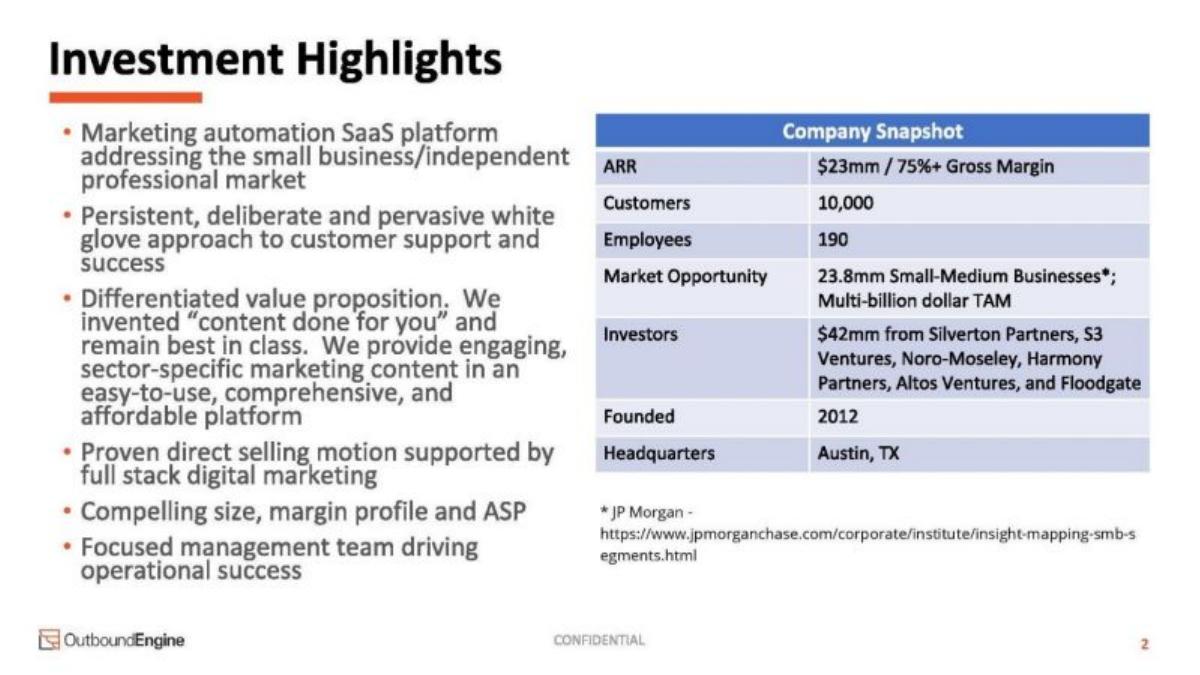
This is the most data-dense slide in the deck, providing a 'Company Snapshot' that establishes immediate credibility. Key figures include $23mm ARR , 75%+ Gross Margin , and 10,000 Customers . It notes the company was founded in 2012 and is headquartered in Austin, TX. The slide also lists $42mm in previous funding from notable investors including Silverton Partners, S3 Ventures, and Floodgate. The market opportunity is defined as 23.8mm SMBs, citing JP Morgan research.
The Problem and Market Positioning
Slide 3: The Customer
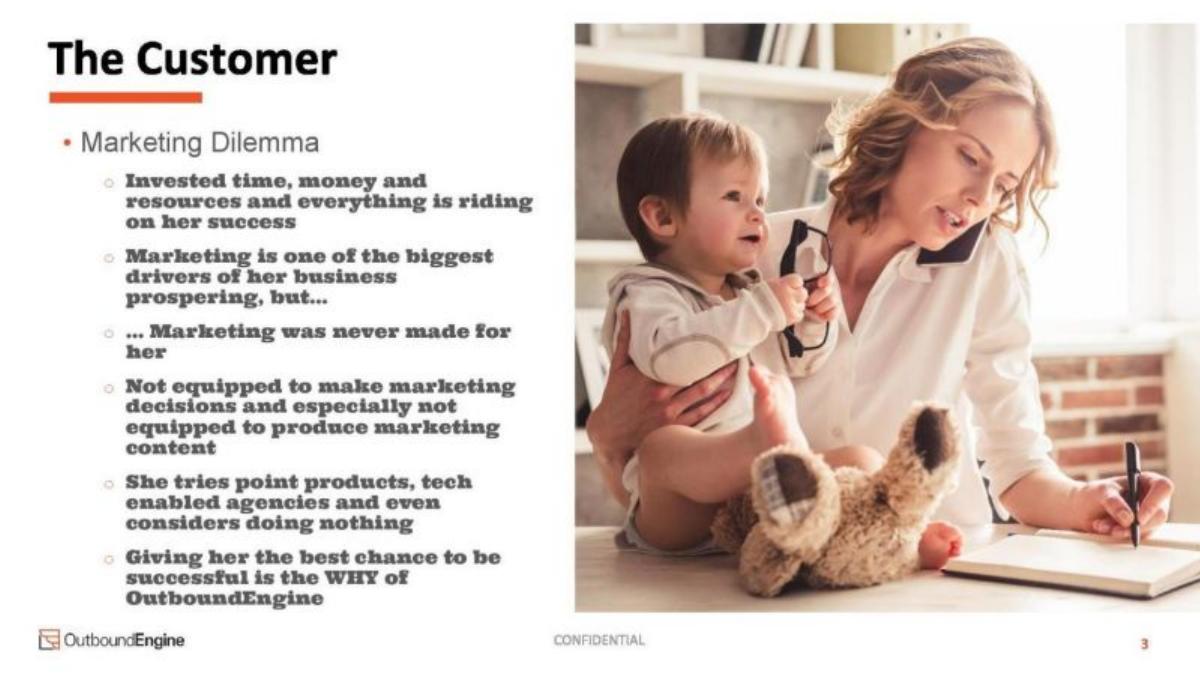
OutboundEngine defines its target persona through the 'Marketing Dilemma.' The slide uses imagery of a busy mother/professional to illustrate that while marketing is a driver of business success, the customer is 'not equipped to make marketing decisions and especially not equipped to produce marketing content.' This sets up the need for a 'done-for-you' solution.
Slide 4: Solution: OutboundEngine Platform
The solution is presented as a comprehensive, affordable, and automated platform. It lists the core pillars: Content, Email, Social Media, Social Ads, Reviews, Chat, Website, Referrals, and Profile Reach. The goal is to turn 23.8 million SMBs into 'Business Opportunities / Referrals.'
Slide 5: Value Proposition
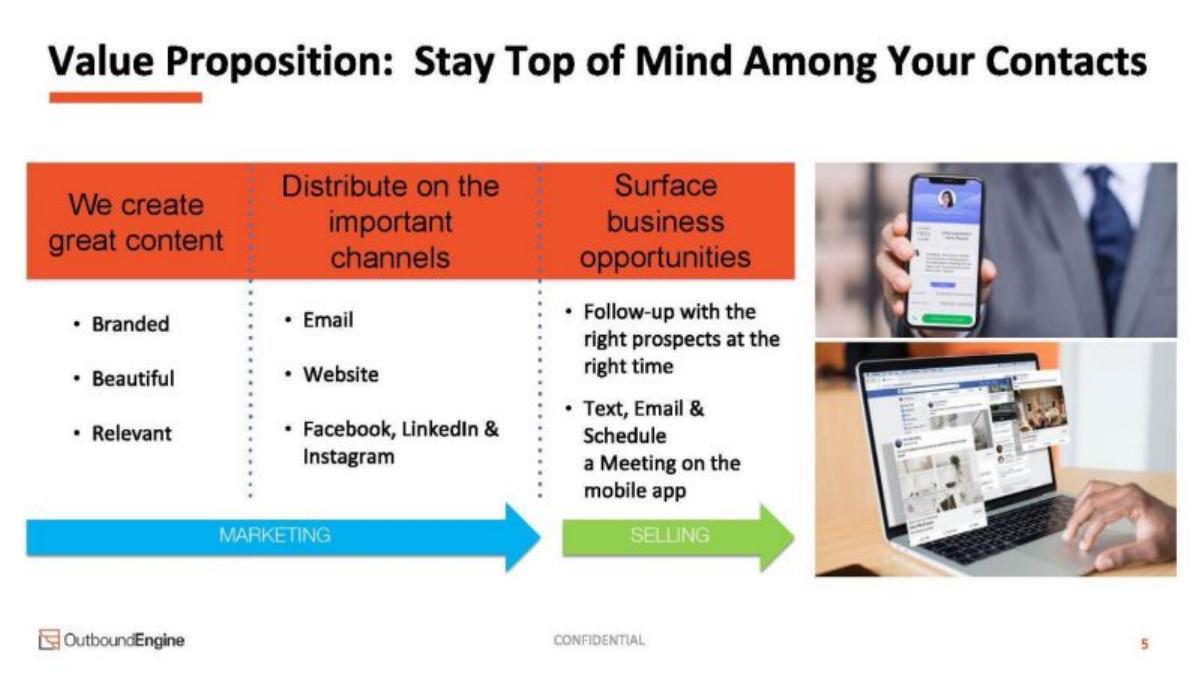
This slide breaks down the workflow into three steps: 'We create great content,' 'Distribute on the important channels,' and 'Surface business opportunities.' It visually distinguishes between 'Marketing' (the automated content) and 'Selling' (the follow-up actions taken by the user on the mobile app).
Slide 6: Market Position
This 2x2 matrix is a classic teardown component. OutboundEngine positions itself in the top-right quadrant: 'DIFM Platforms' (Do It For Me) that are 'Highly Scalable / Fully Automated.' It contrasts itself against 'Tech-Enabled Agencies' (Yodle, Web.com) which are expensive, and 'Point Products' or 'Enterprise Platforms' (GoDaddy, Wix, HubSpot, Marketo) which require high user effort.
Slide 7: Compelling Value (Feature Comparison)
A detailed checklist compares OutboundEngine against eight competitors, including Mailchimp, Constant Contact, and HubSpot. OutboundEngine claims to be the only one offering 'Vertical Created Content' and 'Do It For Me' services across the entire stack. Interestingly, it marks 'Contact/Lead Scoring' as a 2019 addition and 'Intelligently Curated Content' as a 2020 goal.
Product Deep Dive
Slide 8: Product Overview
A simple transition slide marking the beginning of the technical and functional deep dive into the platform.
Slide 9: Core Email Content
This slide emphasizes that content creation is the 'hardest part of marketing.' It highlights that OutboundEngine employs professional writers, editors, and designers in their Austin HQ. They deliver two newsletters every month based on '6+ years of data.'
Slide 10: Website
The platform includes a mobile-responsive website feature with integrated forms and optional live chat. The visual shows a clean, modern real estate site as an example of the output.
Slide 11: Social Media Posts
Visual examples of automated posts for Facebook and LinkedIn are shown. The content is tailored to the user's industry (e.g., real estate) to maintain engagement without user intervention.
Slide 12: Social Ads
This slide covers the 'Generate New Business' aspect. It mentions that creative testing and optimization are 'done for you' on Facebook and Instagram, utilizing look-alike audiences based on the user's existing contact list.
Slide 13: Review Engine
OutboundEngine includes a reputation management tool that integrates with Yelp, Google Reviews, Facebook, and Zillow. It allows users to request reviews from contacts and track competitors.
Slide 14: Referral Engine
To drive organic growth, the platform runs quarterly sweepstakes (with prizes supplied by OutboundEngine) to encourage the user's contacts to provide referrals.
Slide 15: Profile Reach
This feature focuses on local SEO and directory accuracy. It claims direct integration to 70+ sites to fix duplicate profiles and prevent unauthorized changes to business listings. A screenshot shows an '87% Inaccurate Listings' alert to demonstrate the value prop.
Slide 16: ReadyChat
The 'ReadyChat' feature is described as 'Smarter Chat. Human Touch.' It uses a mix of automation and human representatives to qualify prospects based on specific scripts, delivering 'quality results' to the business owner.
Slide 17: Dashboard
The user-facing dashboard provides campaign performance tracking (opens/clicks), contact notifications, and a marketing calendar. The imagery shows a laptop displaying the analytics interface.
Slide 18: Mobile App
The 'Sales Enablement' mobile app is highlighted as the hub for real-time conversations. Features include one-touch response templates, notifications for phone and watch, and a business card reader.
Business Model and Growth
Slide 19: Clear, Effective and Affordable Packages
The pricing slide shows three tiers: Essential ($199/mo) , Value ($299/mo) , and Premium ($449/mo) . The tiers scale based on the number of contacts (500 to 10,000) and the number of 'specialty content blocks' included.
Slide 20: Product History and Roadmap
This timeline shows the company's evolution from 2012 to 2020. It tracks two parallel growth paths: the number of industries served (growing from 1 to 15) and the size of the content team (growing from 1 writer to a Studio Director with 5 editors and 187+ freelance writers). It culminates in the 2020 goal of 'Industry Agnostic Content.'
Slide 21: Closing Slide
A standard closing slide with a call to action to browse more pitch decks at bestpitchdeck.com.
What OutboundEngine Does Well
The deck is exceptionally strong at market positioning . By creating the 'DIFM' (Do It For Me) category on Slide 6, they effectively neutralize the threat of cheaper 'DIY' tools. They aren't just selling software; they are selling the result of software plus professional labor. This justifies their higher price point ($199/mo vs. the $20/mo a small business might pay for a basic email tool).
The credibility markers are also handled well. Leading with $23M ARR and a list of high-profile investors on Slide 2 immediately signals that this is a de-risked growth-stage opportunity rather than a speculative seed-stage bet. The inclusion of a detailed product roadmap (Slide 20) shows a logical progression of the business, proving they can successfully enter and dominate new verticals.
What is Missing from the Deck
Despite the high-level success metrics, the deck is missing several key components for a growth-stage fundraise:
The Team Slide: There is no slide detailing the founders or the executive leadership team. While '190 employees' is mentioned, investors at this stage want to see the pedigree of the people steering the ship. · Unit Economics: For a SaaS business with 10,000 customers, metrics like LTV (Lifetime Value), CAC (Customer Acquisition Cost), and Churn are vital. The deck mentions a 'white glove' approach, which often implies higher churn if not managed well, or higher CAC. These numbers are absent. · The Ask: The deck does not explicitly state how much capital is being raised or how it will be allocated (e.g., 40% Sales, 30% R&D). We know from external data it was $14M, but it's not on the slides. · Financial Projections: There are no forward-looking financial charts showing the path from $23M ARR to $50M or $100M.
Founder's Guide: What to Copy
The 'Company Snapshot' Table: Slide 2 is a masterclass in efficiency. If you have good numbers, don't hide them. Putting ARR, margins, customer count, and total funding on one of the first slides sets a high-confidence tone for the rest of the presentation.
The 2x2 Matrix with a Twist: Instead of the standard 'Competitor A vs. Competitor B' chart, OutboundEngine uses 'Level of Service' vs. 'Price.' This allows them to group competitors into logical buckets (Agencies, Enterprise Platforms, Point Products) and explain why they are the only occupant of their specific niche.
Visualizing the Roadmap: Slide 20 is an excellent way to show 'how we got here.' By mapping the growth of their internal content team alongside their industry expansion, they demonstrate that their scaling is intentional and supported by operational infrastructure, not just code.
Frequently asked questions
- What is OutboundEngine's core business model?
- OutboundEngine operates a SaaS-based marketing automation platform specifically for SMBs and independent professionals. Unlike self-service tools, they provide 'content done for you,' including professional writing, design, and automated distribution across email and social media. They charge a monthly subscription fee ranging from $199 to $449 based on the number of contacts and features used.
- How does OutboundEngine differentiate itself from competitors like HubSpot?
- On Slide 6, OutboundEngine positions itself as a 'DIFM' (Do It For Me) platform. They argue that enterprise platforms like HubSpot and Marketo are built for teams and require significant 'Do It Yourself' effort. OutboundEngine targets the 'Marketing Dilemma' of small business owners who lack the time or expertise to produce their own content.
- What are the key financial metrics disclosed in the deck?
- As of June 2019, the company disclosed $23 million in ARR, 75%+ gross margins, and a customer base of 10,000. They also noted a staff of 190 employees and a total of $42 million in prior capital raised from institutional investors.
- What industries does OutboundEngine serve?
- The product roadmap on Slide 20 shows a history of vertical expansion. They started with promotional products in 2012, moved into real estate, insurance, and mortgage in 2014, and expanded to home services and others. By 2018, they served 15 total industries, with plans to become industry-agnostic by 2020.
- What is missing from this pitch deck?
- The deck lacks a specific 'Ask' slide detailing how much they are raising in this specific round (though catalogue facts state $14M). It also omits detailed unit economics like CAC (Customer Acquisition Cost), LTV (Lifetime Value), or churn rates, which are standard for a growth-stage SaaS company. There is also no slide dedicated to the individual backgrounds of the management team.