OurHealthMate’s 2013 pitch deck is a masterclass in brevity, using just 9 slides to articulate a complex marketplace problem in the Indian healthcare sector. The deck successfully highlights a massive $200B market opportunity while showcasing significant early traction, including $2.5M in transactions and $400K in revenue. By focusing on the lack of transparency and the prevalence of cash-only payments (87%), the founders positioned their platform as a necessary bridge between patients, payers, and providers. While the deck lacks a formal 'Ask' slide or detailed unit economics, the strength o…
Key takeaways
- The problem is framed around extreme market inefficiency, citing that 87% of healthcare payments in India are cash-only (Slide 2).
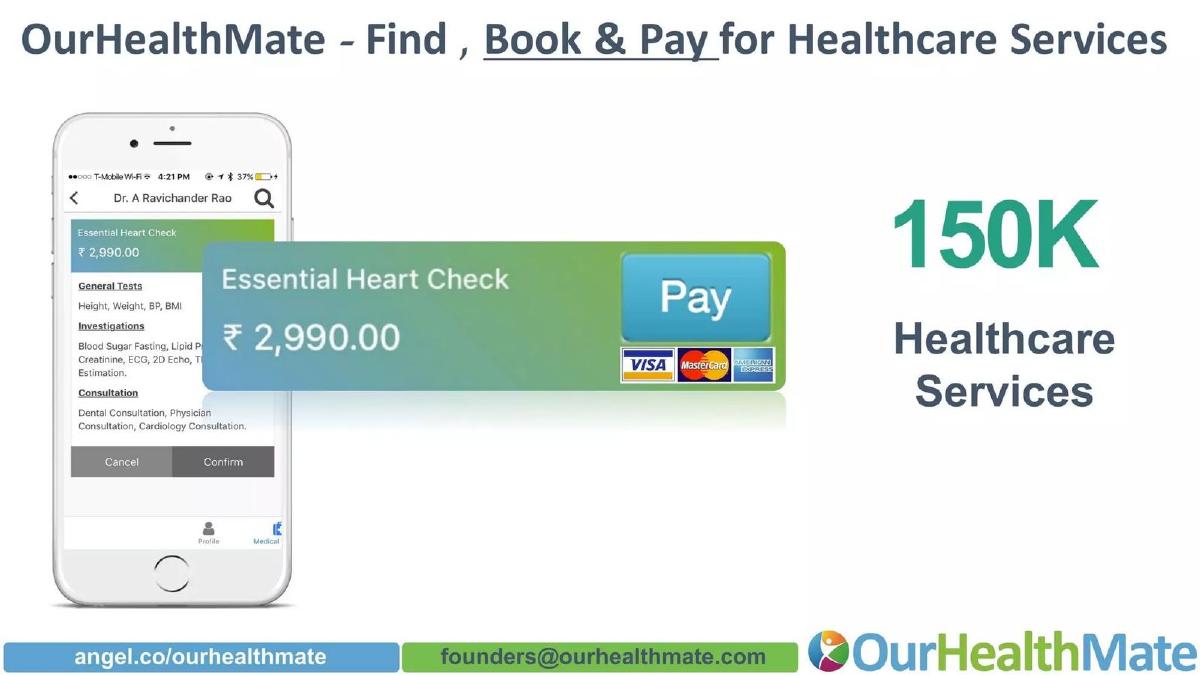
- The platform manages a supply side of 26,000 verified doctors and 150,000 healthcare services (Slides 3-4).
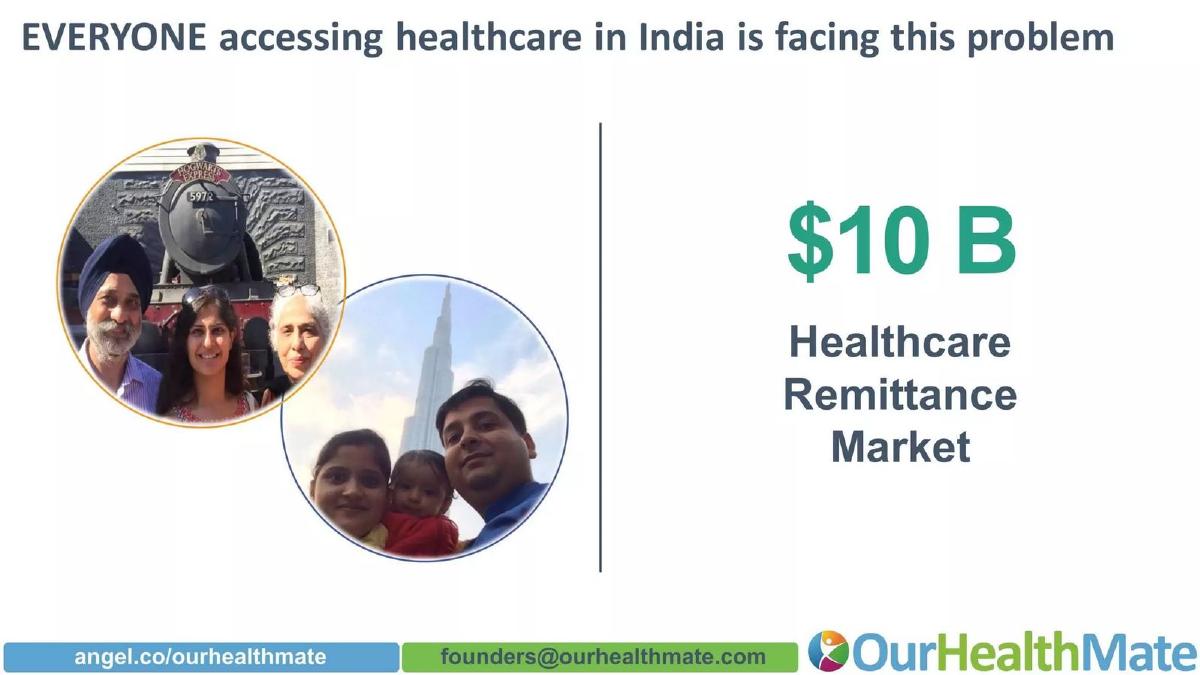
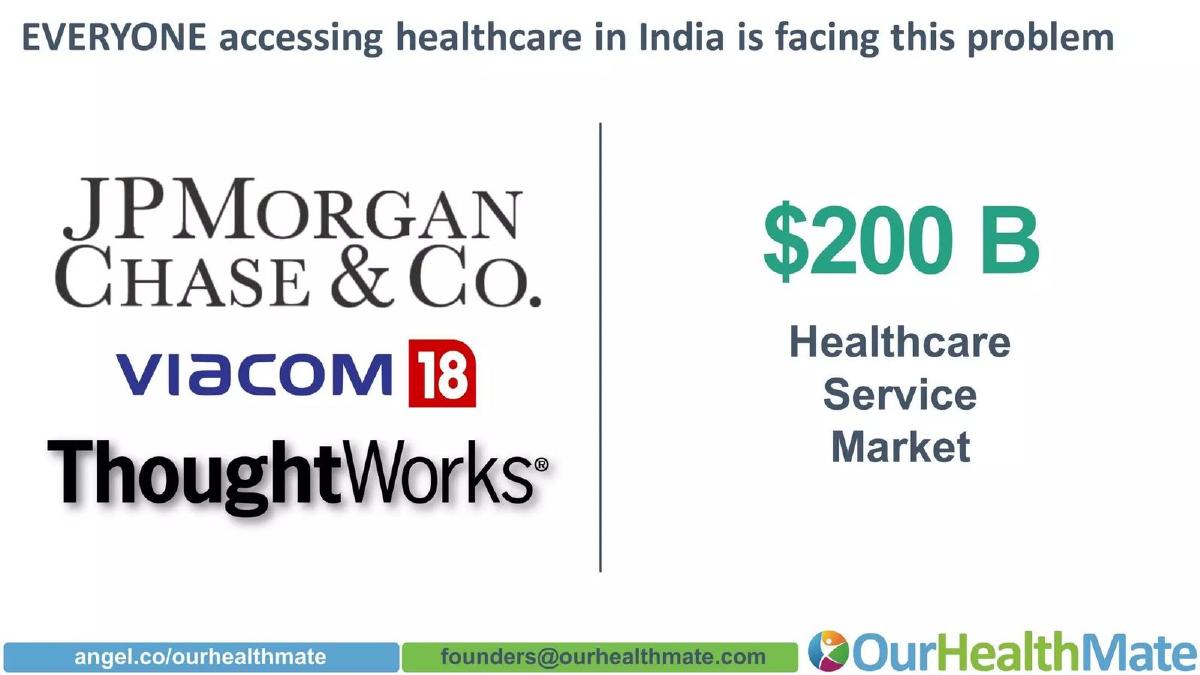
- Market sizing is split into two distinct opportunities: a $10B healthcare remittance market and a $200B total healthcare service market (Slides 5-6).
- Traction is demonstrated through a Month-over-Month revenue chart peaking at $95K for July 2017 (Slide 7).
- The business model is validated by $2.5M in total transaction volume and $400K in total revenue (Slide 7).
- The team slide emphasizes pedigree and past success, noting two exits to major corporations like Intel (Slide 8).
- The deck completely omits a specific funding ask, valuation, or use of funds (Slide 9).
- Enterprise validation is implied through the inclusion of logos like JPMorgan Chase and Viacom 18 on the market slide (Slide 6).
Introduction: A Lean Approach to a Massive Market
The OurHealthMate pitch deck from 2013 is a concise 9-slide presentation that focuses on the digital transformation of the Indian healthcare sector. At the time of this deck, the company was positioning itself as a bridge between patients, payers, and providers in a market characterized by fragmentation and a lack of trust. Despite its brevity, the deck managed to secure $2,000,000 in funding by leaning heavily on three pillars: a massive addressable market, proven revenue traction, and an experienced founding team with a history of exits.
Slide 1: Title and Value Proposition
The cover slide introduces OurHealthMate as a "Healthcare platform connecting Patients, Payers & Providers." It is a standard introductory slide that clearly defines the three-sided nature of their marketplace. The branding is clean, and the inclusion of the URL suggests a focus on a web-first or platform-agnostic approach to healthcare management.
Slide 2: The Problem - Inefficiency and Fraud
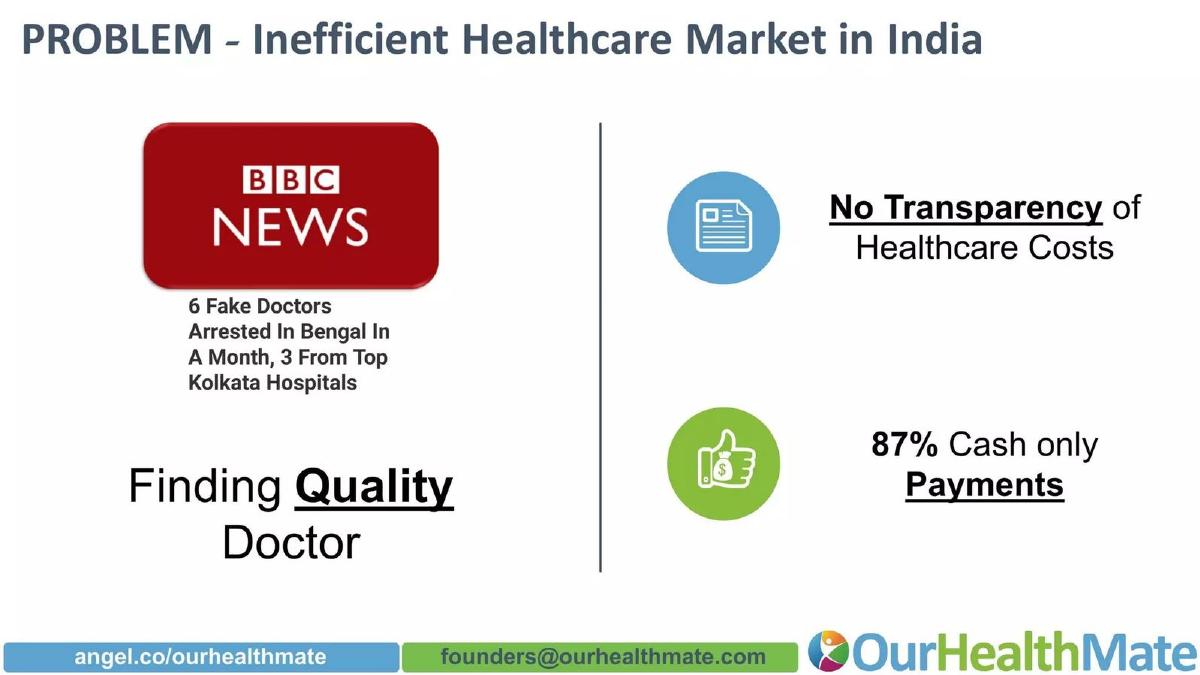
Slide 2 identifies the "Inefficient Healthcare Market in India." The founders use a high-impact visual—a BBC News headline about fake doctors in Bengal—to establish a desperate need for verification. They list three specific pain points: Finding Quality Doctors , No Transparency of Healthcare Costs , and 87% Cash only Payments . This slide effectively establishes that the current system is not just inconvenient, but fundamentally broken and untrustworthy.
Slides 3-4: The Solution and Supply-Side Scale
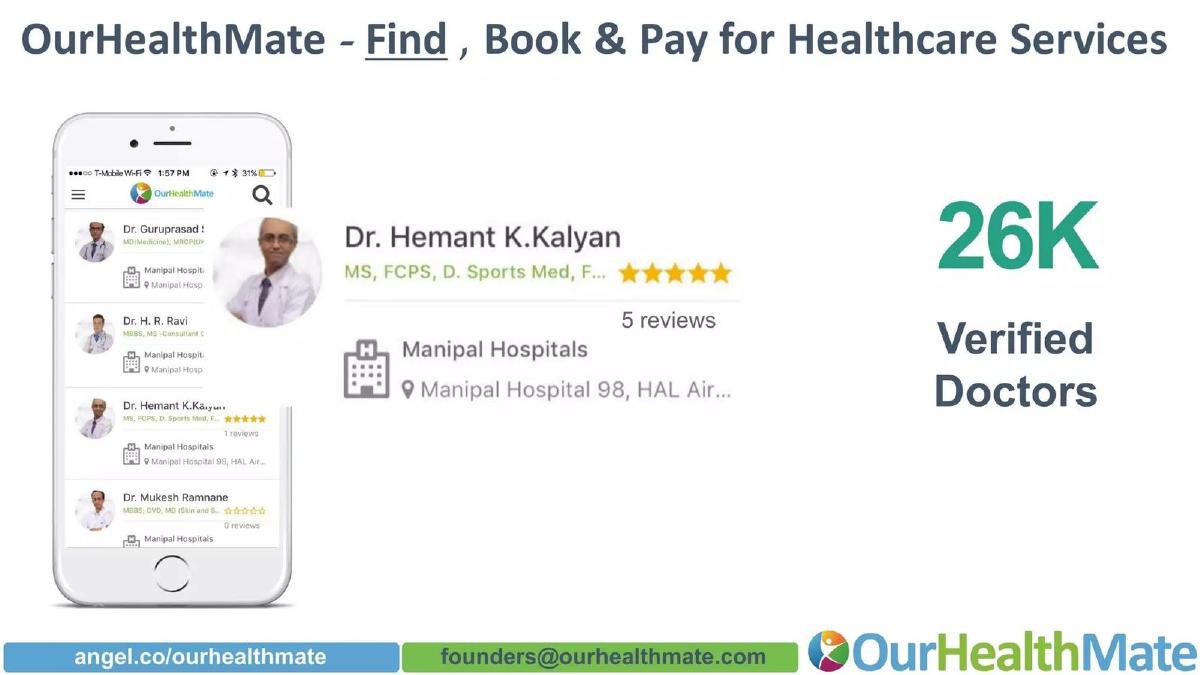
The solution is presented through the lens of the product's capabilities: "Find, Book & Pay for Healthcare Services." Slide 3 showcases a mobile interface featuring a verified doctor (Dr. Hemant K. Kalyan) with a 5-star rating and 5 reviews. The key metric here is 26K Verified Doctors . Slide 4 continues this by showing the payment interface for an "Essential Heart Check" priced at ₹2,990.00, highlighting 150K Healthcare Services available on the platform. These slides prove that the company has already solved the 'cold start' problem of a marketplace by securing significant supply.
Slides 5-6: Market Sizing - Remittance vs. Services
The deck breaks the market into two distinct opportunities. Slide 5 focuses on the $10 B Healthcare Remittance Market , using photos of families to humanize the data. This addresses the specific use case of the Indian diaspora paying for family healthcare back home. Slide 6 expands the scope to the $200 B Healthcare Service Market . Interestingly, this slide includes logos for JPMorgan Chase, Viacom 18, and ThoughtWorks. While not explicitly stated as clients on this slide, their placement next to the market size suggests an enterprise-level target or existing partnerships.
Slide 7: Traction and Revenue Growth
This is the 'money slide.' It features a line graph titled "Revenue - MoM" (Month-over-Month) showing a clear, albeit slightly volatile, upward trend from July 2016 to July 2017. The graph culminates in a $95K monthly revenue figure. To the right, the deck highlights two cumulative figures: $2.5M In Transactions and $400K In Revenue . This distinction is crucial as it shows the platform's take rate and the total volume of economic activity it facilitates.
Slide 8: The Team - Proven Exit History
The team slide features Abhinav (CEO), Ayush (CTO), Sanjay (COO), and Siddharth (Head of Biz. Dev.). Rather than listing long bios, the slide uses logos of former employers (University of Virginia, Citi, Raymond, Credit Suisse, Intel, Mahindra) to establish credibility. The most important text on this slide is: "Two successful exits by the management team to INTEL & HB SARL." For a pre-seed or seed-stage investor, this significantly de-risks the investment by proving the founders know how to build and sell a company.
Slide 9: Conclusion and Contact
The final slide repeats the traction metrics— $2.5M In Transactions and $400K In Revenue —alongside the company logo and contact email. It serves as a summary of the company's current state but notably lacks a call to action or a specific funding request.
What Works in the OurHealthMate Deck
1. Clear Market Segmentation: By separating the $10B remittance market from the $200B general service market, the founders show they understand the specific niches that will drive early adoption (expats paying for parents) versus long-term scale (the entire Indian population).
2. Evidence of Supply: Claiming 26,000 verified doctors and 150,000 services is a massive signal for a 2013-era startup. It shows that the hard work of business development and onboarding has already begun, making the platform a viable utility rather than just a concept.
3. Pedigree and Exits: In early-stage fundraising, the team is often more important than the idea. Explicitly stating that the team has already exited to a buyer as reputable as Intel is a powerful motivator for investors who are looking for "founders who have done it before."
4. Visualizing the Problem: Using a BBC headline about fake doctors immediately creates a sense of urgency and moral necessity for the product. It moves the conversation from "this is a nice app" to "this is a safety requirement for a billion people."
What is Missing from the OurHealthMate Deck
1. The Ask: There is no slide indicating how much money the company is looking to raise, the terms of the round, or what the specific milestones are for the next phase of growth. This is a significant omission for a pitch deck intended for investors.
2. Competitive Landscape: The deck operates as if OurHealthMate is the only player in the space. In a market as large as India, investors would want to see how they compare to local incumbents or other emerging health-tech platforms.
3. Unit Economics: While the deck shows total revenue and transactions, it doesn't explain the cost of acquiring a customer (CAC) or the lifetime value (LTV). Without these, it is difficult to judge the long-term sustainability of the growth shown on Slide 7.
4. Product Roadmap: The deck shows what the product does today (Find, Book, Pay), but it doesn't explain where the platform is going. Is there a plan for telemedicine? Insurance integration? Electronic health records? The future vision is left to the imagination.
What a Founder Should Copy
1. The "Problem" Slide Format: Use a mix of third-party validation (like the BBC headline) and hard statistics (the 87% cash figure). This combination of emotional/social proof and logical data is very persuasive.
2. Traction vs. Transaction: If you are a marketplace, always show both Gross Merchandise Volume (GMV) and actual Revenue. OurHealthMate does this well by showing the $2.5M vs. $400K. It prevents confusion about how much money the company is actually keeping.
3. Minimalist Team Slide: Don't write paragraphs about your founders. Use logos for education and past employers, and highlight the single most impressive achievement (in this case, the exits) in bold, large text.
4. Consistent Branding: The deck uses a consistent color palette (blue and green) and a clean footer on every slide with the company's AngelList profile and contact email. This makes the deck feel professional and easy to navigate.
Frequently asked questions
- What was the primary problem OurHealthMate aimed to solve?
- The deck identifies the 'Inefficient Healthcare Market in India' as the core problem. Specifically, it points to a lack of transparency in costs, the difficulty of finding quality (verified) doctors—citing a BBC news report on fake doctors—and the fact that 87% of payments are cash-based, which creates friction for both local patients and those sending money from abroad.
- How did OurHealthMate demonstrate traction in this deck?
- Traction is presented through three primary metrics: transaction volume, revenue, and supply-side growth. The deck claims $2.5M in total transactions and $400K in revenue. A MoM growth chart shows revenue climbing from under $10K in July 2016 to $95K in July 2017, indicating a strong upward trajectory leading into the fundraise.
- What is the 'Healthcare Remittance' market mentioned in the deck?
- This refers to the $10B market of people (often expats or family members living in different cities/countries) sending money specifically to cover the medical expenses of relatives in India. OurHealthMate positions itself as a secure way to pay for these services directly rather than sending cash, ensuring the funds are used for verified medical care.
- Who are the key members of the OurHealthMate team?
- The leadership team includes Abhinav (CEO), Ayush (CTO), Sanjay (COO), and Siddharth (Head of Biz. Dev.). The deck highlights their collective experience with major institutions like Citi, Credit Suisse, and Mahindra, and specifically notes that the management team has two successful exits to Intel and HB SARL.
- What is missing from the OurHealthMate pitch deck?
- The deck is missing several standard components: a 'The Ask' slide (how much they are raising), a 'Use of Funds' breakdown, a detailed 'Competition' slide, and 'Unit Economics' (CAC/LTV). It also lacks a clear roadmap of what the company intends to build or achieve in the next 12-24 months.