The 401(k) Foster pitch deck, originating from a 2011 Startup Weekend Denver event, serves as a time capsule for early fintech concepts. The deck attempts to solve the communication gap between financial advisors and retail investors by providing a 'resource for financial advisors.' While the visual style is dated and leans heavily on clip-art metaphors, the core value proposition—simplifying complex 401(k) terminology for the average worker—remains a relevant problem in the wealth management space. However, the deck suffers from significant structural omissions common in hackathon-style pitc…
Key takeaways
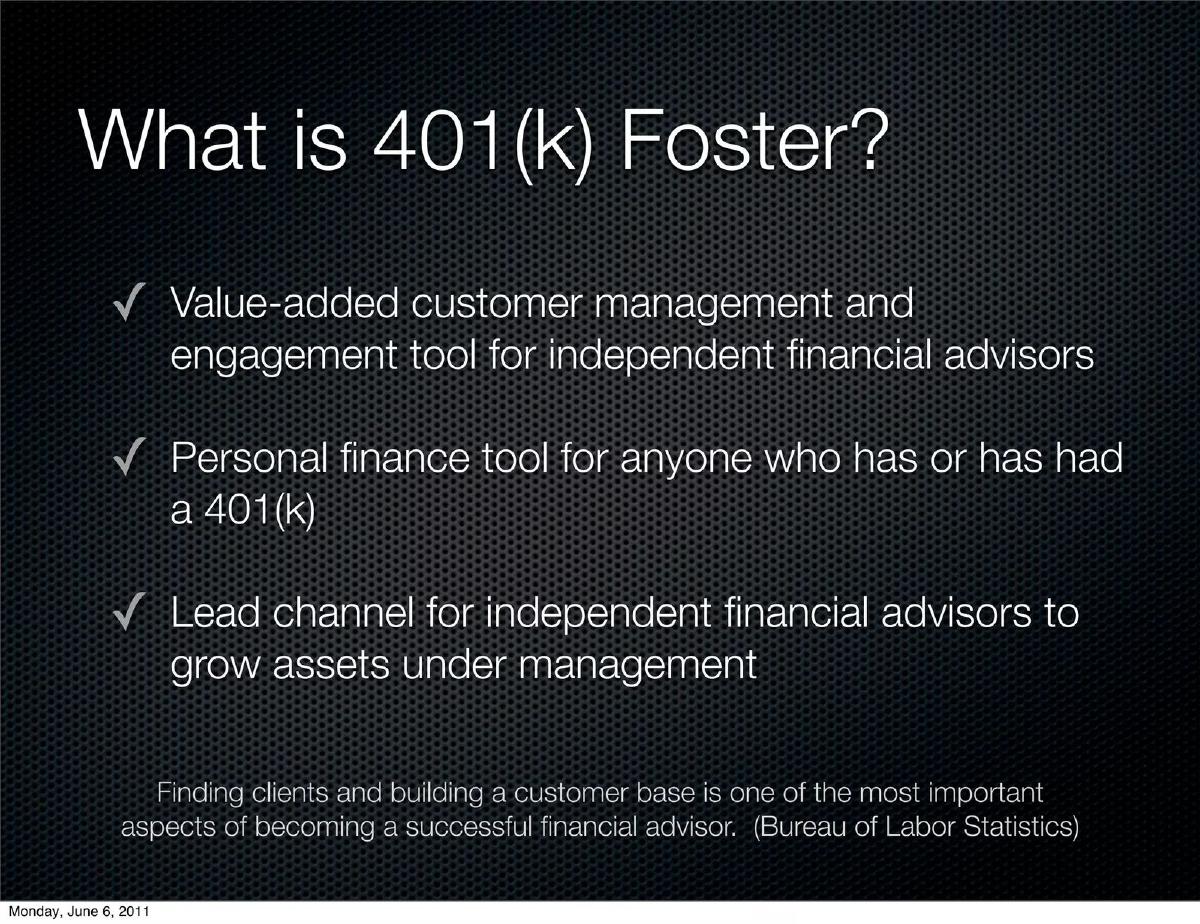
- The company positions itself as a dual-sided platform: a resource for financial advisors and a personal finance tool for 401(k) holders (Slide 1, Slide 5).
- The deck uses a 'Mint meets Salesforce' analogy to explain its product category, though it does not detail specific integrations (Slide 2).
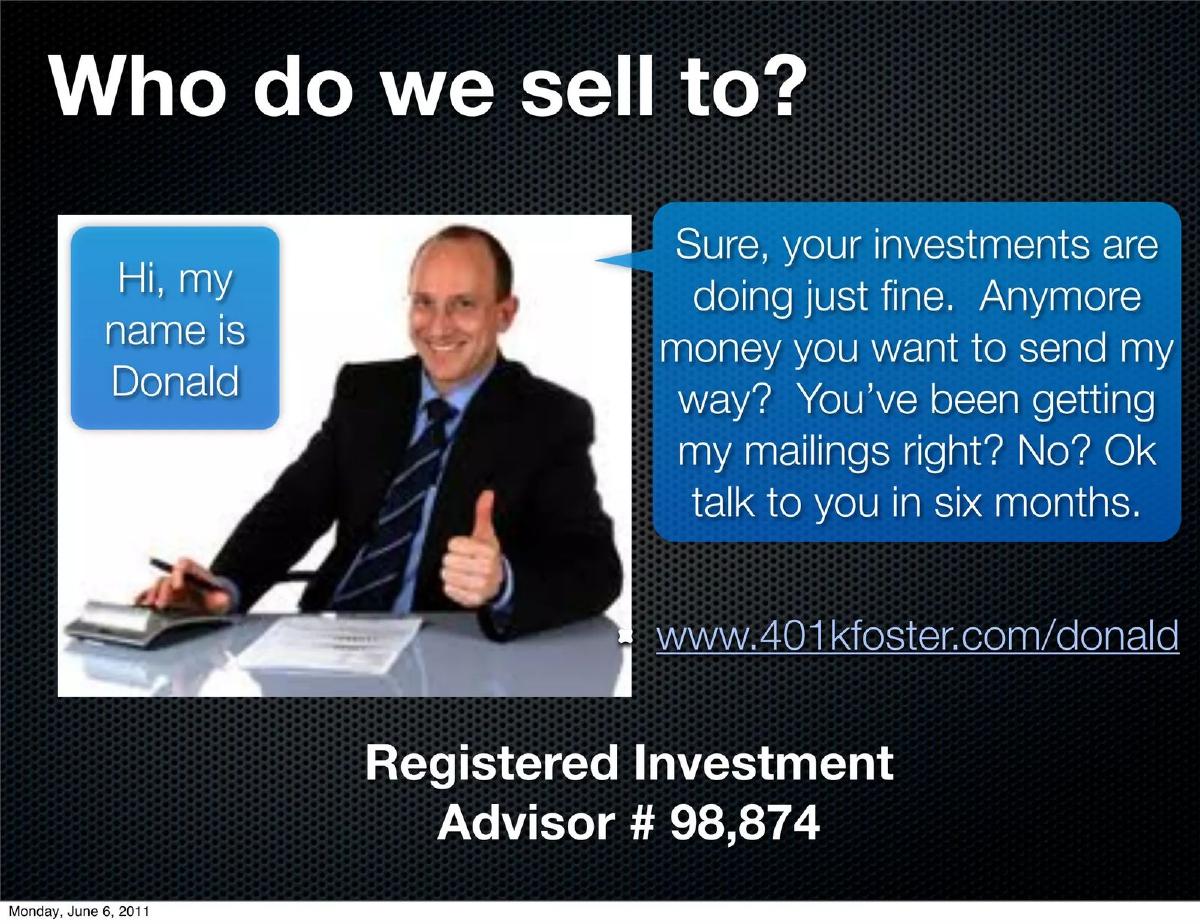
- The target customer is identified as the 'Registered Investment Advisor,' with a specific persona named 'Donald' representing a market of 98,874 advisors (Slide 3).
- A secondary educational portal, 'whatthehellisa401k.com,' is proposed as a free information resource to drive community engagement (Slide 5).
- The current engagement process is characterized as inefficient, using a quote describing it as 'flooded with shit, all sorts of shit' (Slide 6).
- Product benefits are framed through three pillars: Added Value, Manage, and Grow (Slides 4, 7, 8).
- The deck completely omits a team slide, financial projections, unit economics, and a specific capital request.
- The monetization strategy for the consumer-facing educational portal is stated as 'Free,' but the advisor-side revenue model is not defined (Slide 5).
Executive Summary: The Startup Weekend Context
The 401(k) Foster pitch deck is a product of Startup Weekend Denver, dated June 6, 2011. As is typical for 54-hour hackathon projects, the deck focuses heavily on the 'pain point' and the 'vision' rather than the rigorous financial modeling expected in a Series A or even a formal Seed round. The presentation uses a 17-slide structure (9 provided here) to argue that the retirement savings industry is broken due to a lack of communication and education.
Slide 1: Title and Positioning
The cover slide introduces the brand '401(k) Foster' with the tagline 'you and your clients...together.' It explicitly identifies the product as 'a resource for financial advisors.' The branding includes the Startup Weekend Denver logo, signaling its origin as a prototype developed during a competition. The visual theme—a dark, perforated metal background—is consistent throughout the deck, a common aesthetic choice for the early 2010s.
Slide 2: The High-Concept Analogy
Slide 2 contains no text, only the logos for Mint and Salesforce. In the context of a pitch, this is a shorthand way to explain the business model: it is a CRM (Salesforce) for financial advisors that features the user-friendly interface and data aggregation of a personal finance tool (Mint). By using these two giants, the founders attempt to anchor the investor's understanding of the product's utility without needing deep technical explanations.
Slide 3: The Target Customer Persona
The deck identifies its primary user on Slide 3: 'Who do we sell to?' It introduces a persona named 'Donald,' a Registered Investment Advisor. The slide includes a speech bubble representing the current, flawed state of advisor-client relations: 'Sure, your investments are doing just fine. Anymore money you want to send my way? You’ve been getting my mailings right? No? Ok talk to you in six months.' Crucially, the slide cites a specific market figure: 'Registered Investment Advisor # 98,874.' This suggests a total addressable market (TAM) of nearly 100,000 individual professionals in the US at the time of the pitch.
Slide 4: The Value Proposition
Slide 4 is a transition slide with the text 'added value.' It serves to pivot the presentation from the problem (disengaged advisors) to the solution (the 401(k) Foster platform). It lacks specific details, acting as a placeholder for a verbal explanation of how the software improves the advisor's workflow.
Slide 5: The Consumer-Facing Portal
Slide 5 introduces a specific product component: 'WHAT THE HELL IS A 401(k)?' and the associated URL ' This is described as a 'Personal finance tool for anyone who has or has had a 401(k).' The features listed include an 'Information portal with language & understandable examples' and 'Discussion Boards for Community.' The slide claims the benefit is that 'You reconnect with your money.' Notably, it states '401kFoster Monetization: Free,' which implies this is a top-of-funnel lead generation tool rather than a direct revenue driver.
Slide 6: The Current Engagement Process
Slide 6 uses a black-and-white photo of an advisor meeting with a couple to illustrate the 'Current Engagement Process.' Speech bubbles show the clients thinking 'What the hell is a 401(k)?' and 'Tea time?' while the advisor thinks 'Tee time?' This highlights the disconnect in priorities and understanding. The slide includes a jarring, uncensored quote at the bottom: '"flooded with shit, all sorts of shit,"' presumably a quote from a customer discovery interview describing the current state of financial paperwork or information overload.
Slide 7: Efficiency and Management
Slide 7 contrasts two states. On the left, a 'No 401(k) Foster' sign is paired with an image of a person buried in a stack of papers labeled 'On the brink of collapse.' On the right, the 401(k) Foster logo is paired with the Mr. Clean mascot and the phrase 'Aww...much better.' The central word is 'Manage,' with 'efficiency' written below. This slide is purely metaphorical, arguing that the software cleans up the administrative mess of managing retirement accounts.
Slide 8: Growth and Scaling
Slide 8 focuses on the word 'Grow.' It uses a visual metaphor of a small child (labeled with a 'No 401(k) Foster' sign) facing off against a massive sumo wrestler (labeled with the 401(k) Foster logo). This implies that using the platform gives the advisor a competitive advantage, allowing them to 'punch above their weight' or dominate the market. Like Slide 7, this slide relies on imagery rather than data to make its point.
Slide 9: The Closing Image
The final slide provided is a full-page version of the 'Donald' advisor photo from Slide 3, showing him giving a thumbs-up. This is likely the 'Q&A' slide, though it contains no contact information or specific call to action. It reinforces the persona of the happy, successful advisor who uses the product.
What Works in This Deck
Clear Persona: The deck does an excellent job of identifying exactly who the customer is (Donald the RIA) and what his specific daily frustrations are. · Simple Messaging: By using the 'Mint + Salesforce' analogy, the founders avoid getting bogged down in the complexities of ERISA law or 401(k) regulations, focusing instead on the user experience. · Problem Identification: The 'What the hell is a 401(k)?' angle is a strong emotional hook. It identifies a genuine gap in financial literacy that advisors are often too busy to fill.
What Is Missing
The Team: There is no mention of who is building this. In a Startup Weekend context, the 'hacker, hipster, hustler' composition is vital, but it is absent here. · Business Model: While they mention the consumer portal is free, they never explain how 'Donald' pays. Is it a SaaS fee? A percentage of Assets Under Management (AUM)? A per-seat license? · Product Screenshots: For a tool that promises to be 'Mint for 401(k)s,' the lack of a single mockup or wireframe is a significant omission. The deck relies entirely on clip-art and logos. · The Ask: The deck never specifies what it needs to move forward. There is no request for capital, partners, or beta testers. · Competition: The deck ignores existing players in the 401(k) space, such as BrightScope or traditional plan providers like Fidelity, who were already moving toward digital portals in 2011.
Founder's Takeaway
For founders today, this deck serves as a reminder of the importance of narrative over decoration . While the clip-art and metaphors are dated, the narrative arc—Problem, Persona, Solution, Benefit—is sound. However, a modern pitch must back up these metaphors with evidence . If you claim your tool provides 'efficiency,' you must show a screenshot of the dashboard that creates that efficiency. If you claim a market of 98,874 advisors, you must explain your strategy for capturing them. Finally, never omit the Team Slide ; investors fund people, especially at the earliest stages where the product is still just a 'Startup Weekend' prototype.
Frequently asked questions
- What is the primary problem 401(k) Foster aims to solve?
- The deck identifies a breakdown in communication and engagement between Registered Investment Advisors (RIAs) and their clients. Slide 3 illustrates an advisor who only speaks to clients every six months, while Slide 6 highlights the confusion clients feel, asking 'What the hell is a 401(k)?' The startup aims to provide tools that make this relationship more efficient and educational.
- How does the company plan to acquire users?
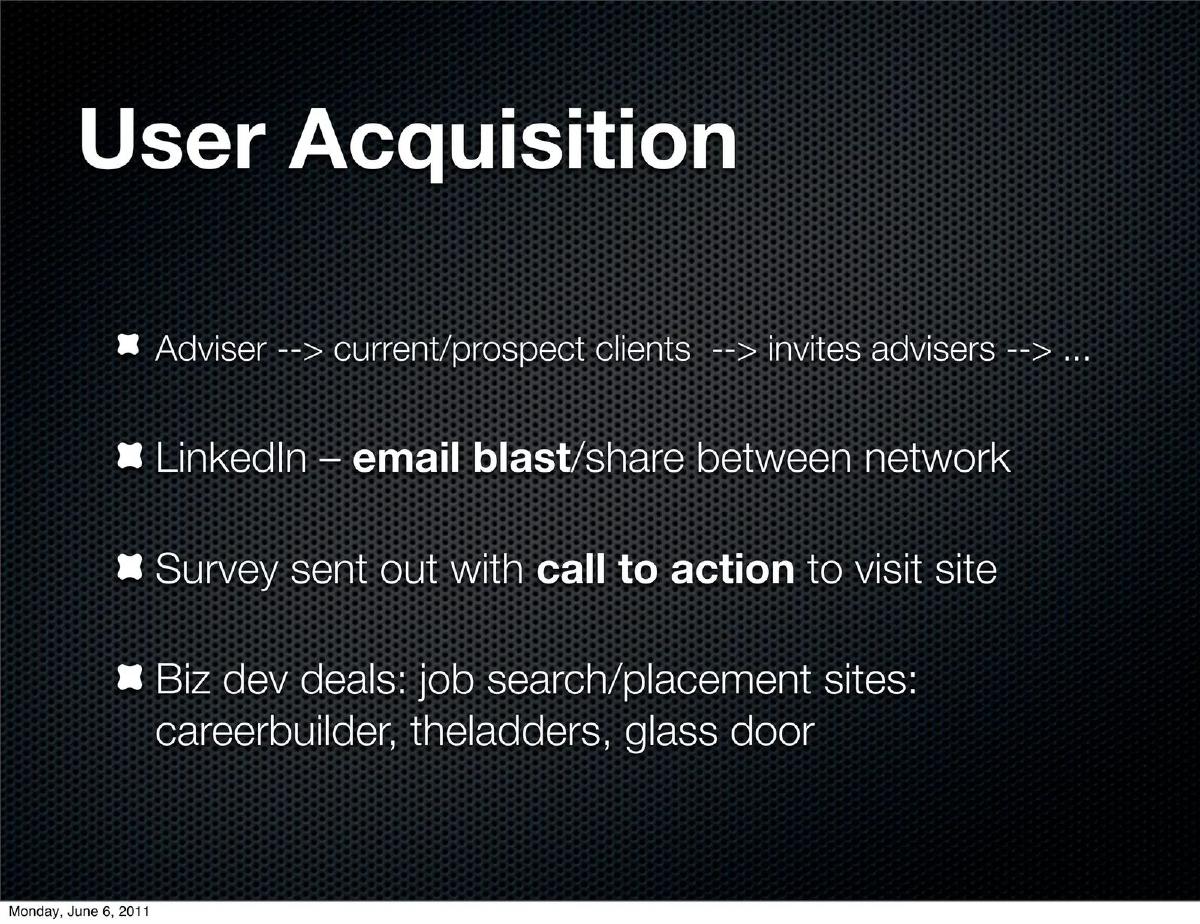
- The strategy involves a top-down and bottom-up approach. They target the 98,874 Registered Investment Advisors (Slide 3) as paying customers. Simultaneously, they offer a free educational portal at 'whatthehellisa401k.com' to attract individual 401(k) holders through information and discussion boards, potentially creating a lead generation funnel for the advisors (Slide 5).
- What is the significance of the Mint and Salesforce logos?
- Slide 2 uses these logos as a 'high-concept pitch.' It suggests that 401(k) Foster combines the consumer-friendly financial tracking and visualization of Mint with the professional relationship management and CRM capabilities of Salesforce. This tells investors the product is a B2B tool with a high-quality B2C user experience.
- Is there a clear revenue model in the deck?
- No. While Slide 5 explicitly states that the '401kFoster Monetization' for the consumer portal is 'Free,' it does not provide pricing tiers, subscription costs, or licensing fees for the Registered Investment Advisors who are identified as the primary buyers. The deck focuses on 'Efficiency' and 'Growth' rather than specific dollar-in, dollar-out mechanics.
- What are the most critical elements missing from this pitch?
- The deck is missing almost all standard investment metrics. There is no mention of the founding team's expertise, no competitive analysis against other 401(k) management tools, no roadmap for product development, and no 'Ask' slide detailing how much money they are raising or how it will be spent.