Jobmento is a 9-slide demo day deck that outlines a pivot from automated Natural Language Processing (NLP) career mentoring to a crowdsourced, bounty-based job search platform. The founders, self-described 'NLP enthusiasts,' identified that existing job boards lack a proper interface, making hiring feel like 'looking for a needle in a haystack.' Their solution allows job seekers to set cash rewards for 'mentors' who successfully find them a position. While the deck identifies a clear pain point in recruitment efficiency, it lacks critical investor data including team biographies, market size…
Key takeaways
- The company originated as a group of NLP enthusiasts attempting to automate career mentoring through job offer analysis before pivoting to a human-powered model (Slide 2).
- The core problem identified is the 'lack of proper interface' between resume sites and job boards, leading to a time-consuming search process (Slide 3).
- The platform operates on a dual-sided bounty system where seekers set rewards and mentors hunt for cash (Slide 4).
- Jobmento claims to have a working prototype available at jobmento.com, though no screenshots of the interface are provided in the deck (Slide 5).
- The business model is a transaction fee approach where the platform keeps a 'small percentage' of the cash reward paid by the job seeker (Slide 8).
- Growth strategy is entirely dependent on job seekers utilizing their existing social networks to publish resumes as an 'advertising channel' (Slide 8).
- The deck completely omits a team slide, failing to name the founders or detail their specific technical or industry expertise (Omission).
- There is no financial 'ask' or mention of how much capital the company is seeking to raise (Omission).
Slide-by-Slide Teardown
Slide 1: Title
The deck opens with a minimalist title slide featuring the company name, Jobmento , and the tagline "Crowdsourcing job search." The branding is non-existent, utilizing a simple blue-to-black gradient background. While the tagline clearly defines the category, it fails to convey a unique value proposition or the specific mechanism of the crowdsourcing.
Slide 2: Our journey
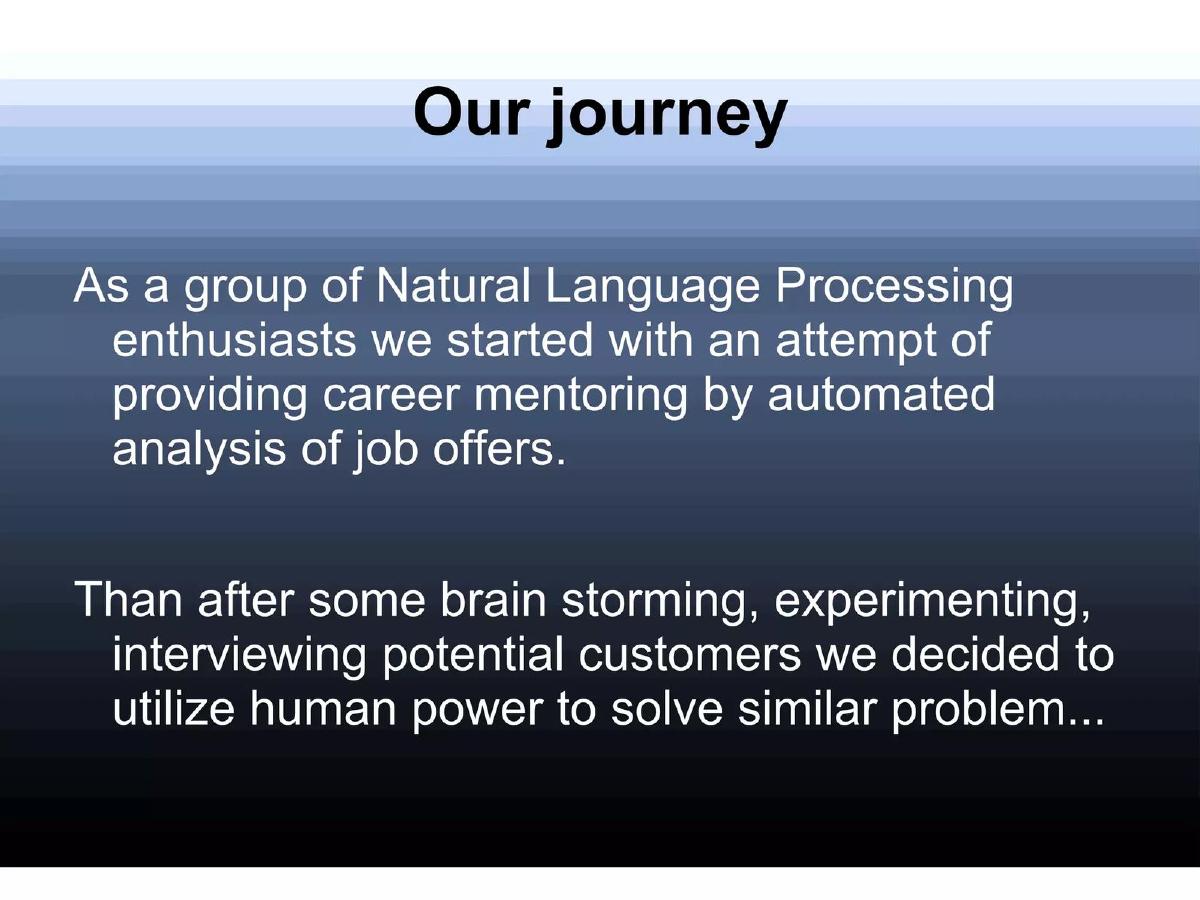
This slide provides the origin story of the startup. The founders identify themselves as a "group of Natural Language Processing enthusiasts." They admit to a pivot, stating they started with "automated analysis of job offers" but, after customer interviews, decided to "utilize human power to solve similar problem..." This is a rare moment of honesty in a pitch deck, showing a willingness to move away from a purely technical solution toward a market-driven one, though it raises questions about why the NLP approach failed.
Slide 3: Some context
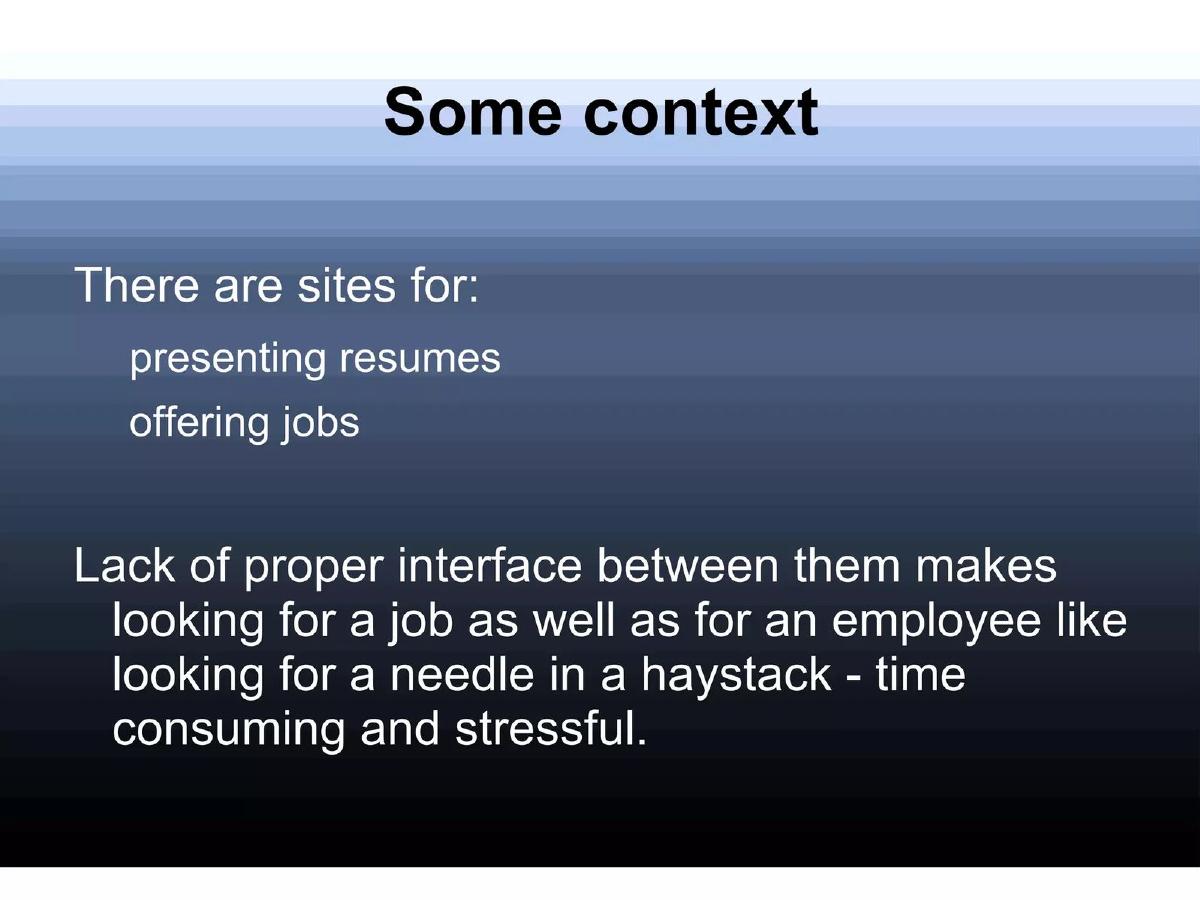
The "Context" slide serves as the problem statement. It notes that while sites exist for resumes and job offers, the "lack of proper interface between them" makes hiring "like looking for a needle in a haystack." The slide uses qualitative descriptors like "time consuming and stressful" but lacks quantitative data on the cost of a bad hire or the average time-to-fill for a position, which would strengthen the urgency of the problem.
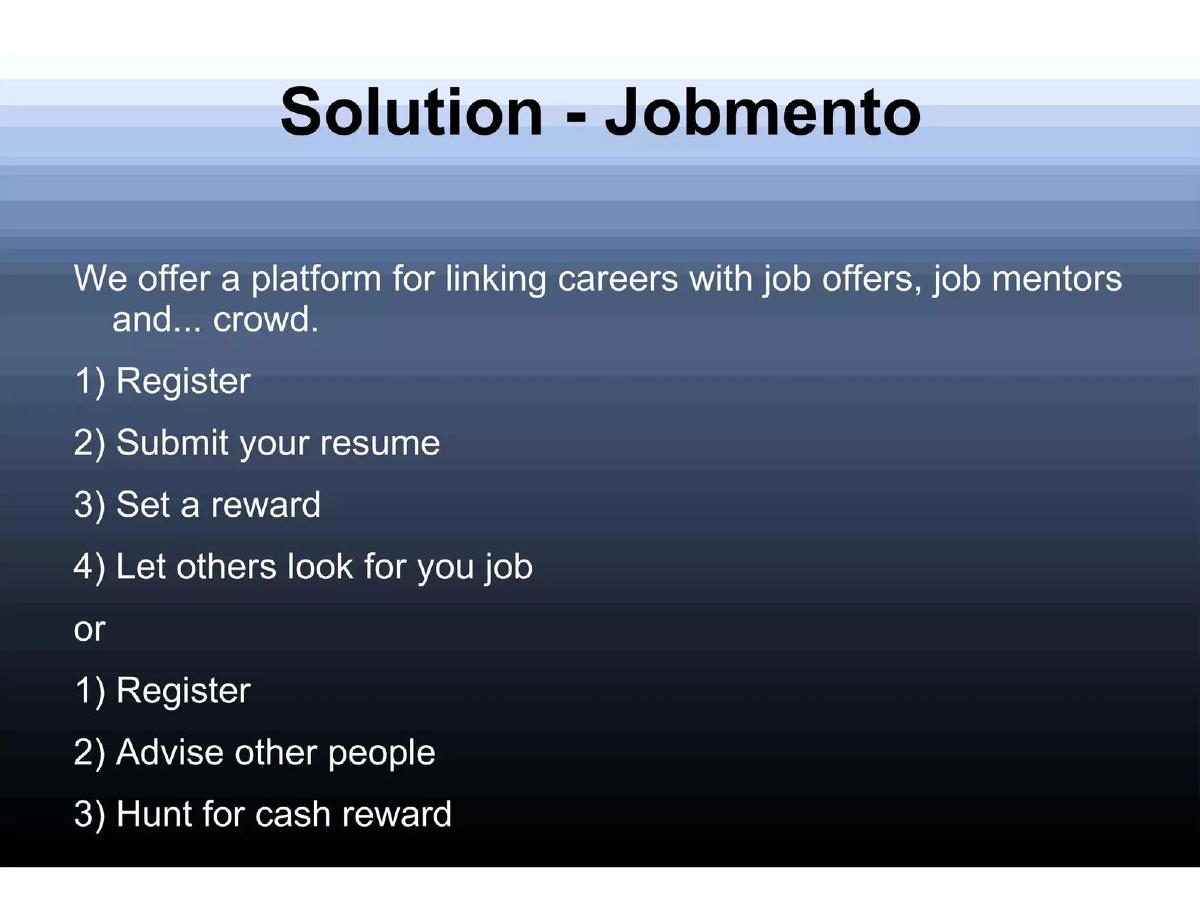
Slide 4: Solution - Jobmento
The solution is presented as a two-sided marketplace process. For the Job Seeker , the steps are: 1) Register, 2) Submit resume, 3) Set a reward, and 4) Let others look for your job. For the Mentor/Hunter , the steps are: 1) Register, 2) Advise other people, and 3) Hunt for cash reward. This clearly defines the "bounty" mechanic of the platform. However, the slide is text-heavy and lacks any visual representation of the user experience.
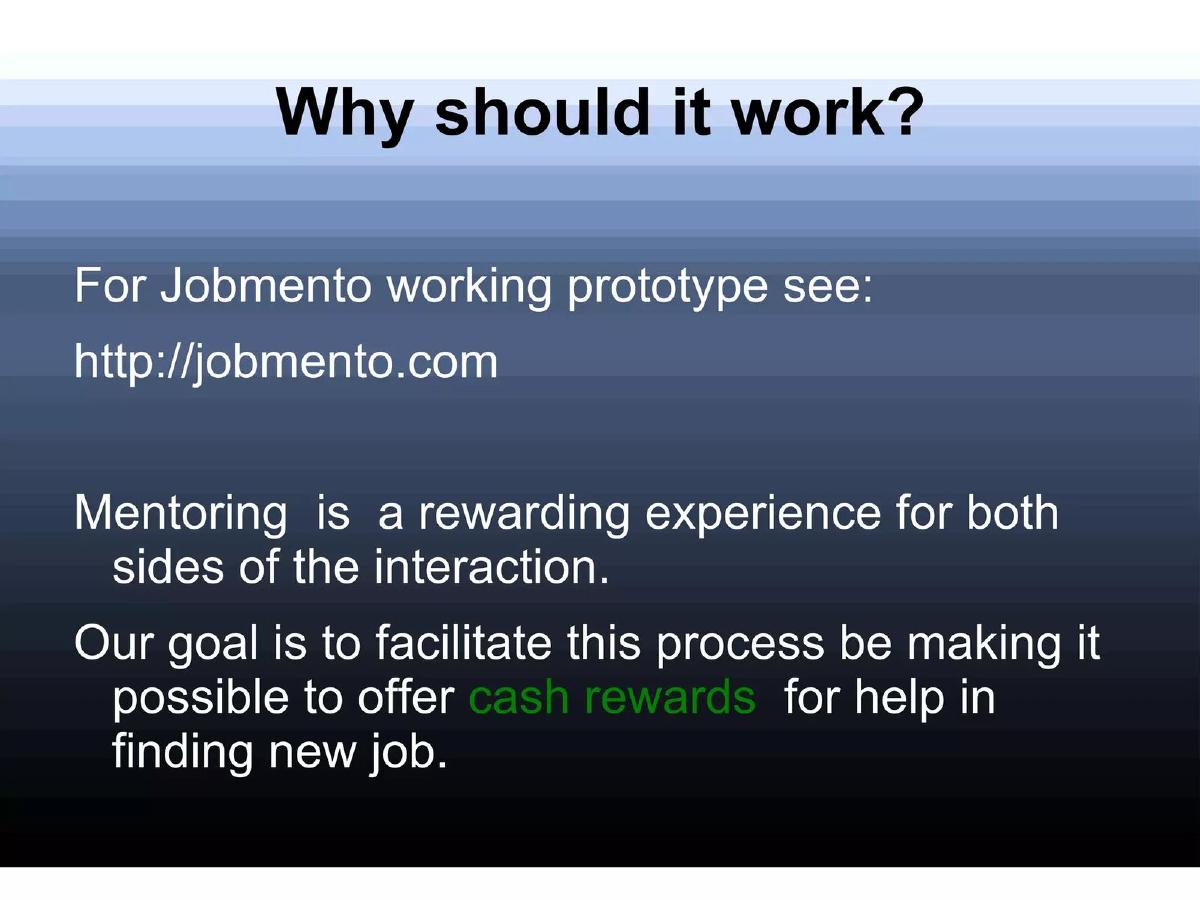
Slide 5: Why should it work? (Part 1)
This slide points to a "working prototype" at jobmento.com . It argues that mentoring is a "rewarding experience for both sides" and that the platform's goal is to facilitate this by "making it possible to offer cash rewards." The phrase "cash rewards" is highlighted in green, emphasizing the financial incentive as the primary driver of the platform's utility.
Slide 6: Why should it work? (Part 2)
Continuing the justification, this slide claims the model works by "utilizing person's own social network" as well as a "network of mentors and help seekers." This suggests a viral loop where users bring their own networks into the Jobmento ecosystem. It does not, however, explain how Jobmento will prevent users from simply bypassing the platform to avoid the fee once a connection is made.
Slide 7: What are we currently doing?
This acts as a status or traction slide, though it contains no hard numbers. The team is "running experiments regarding customer interest," "developing the website," and "implementing payment methods." The use of four dots (....) at the bottom of the slide is unprofessional and suggests an incomplete thought or a lack of further milestones to share.
Slide 8: Business model
The revenue model is straightforward: "job seekers pay cash rewards" and "Jobmento keeps a small percentage." The slide identifies "a critical mass of job seekers and mentors" as the key resource. The strategy to build this mass is to encourage seekers to use their existing social networks. This is a high-risk strategy, as it relies on users doing the marketing work for the platform without a clear incentive beyond the hope of finding a job.
Slide 9: Contact us
The final slide provides a generic info@ email address and the website URL. There are no names, phone numbers, or social media links. It maintains the minimalist, almost anonymous tone of the rest of the deck.
What Works
Clear Pivot Narrative: The founders are transparent about moving from an automated NLP tool to a human-centric marketplace. This shows adaptability and a focus on customer feedback. · Simple Monetization: The transaction-based business model is easy to understand and directly tied to the value created (a successful job match). · Defined Roles: The deck clearly distinguishes between the two sides of the marketplace (seekers and mentors) and what actions each must take.
What is Missing
Team Slide: This is the most glaring omission. Investors fund people, especially at the demo day stage. Not knowing who the "NLP enthusiasts" are is a significant red flag. · Market Size (TAM/SAM/SOM): There is no mention of the size of the recruitment market or the specific niche of referral-based hiring they are targeting. · Competitive Landscape: The deck mentions "sites for presenting resumes," but it doesn't address direct competitors like LinkedIn, Hired, or other referral-bounty platforms. · Financial Ask: The deck does not state how much money the company is looking to raise or what milestones that capital will help them achieve. · Visuals/Product Screenshots: For a company claiming to have a working prototype, the total lack of screenshots or a demo video makes the product feel theoretical.
Founder Takeaways
Don't hide the team. Even if you are a first-time founder, your background as an "NLP enthusiast" needs to be backed by a name and a LinkedIn profile. Investors need to know why you are the right person to build this specific marketplace.
Quantify the problem. Saying job searching is "stressful" is a subjective observation. Stating that the average corporate job opening receives 250 resumes and takes 42 days to fill provides a concrete metric that your solution can aim to improve.
Show, don't just tell. If you have a working prototype, include a high-fidelity screenshot. It proves the product exists and gives investors a sense of the user experience you are building.
Address the 'Leaky Bucket' problem. In a marketplace where users are encouraged to use their own social networks, you must explain how you will prevent them from taking the transaction offline to avoid your fee. This is a common challenge for bounty-based platforms and should be addressed in the business model or product section.
Frequently asked questions
- What is Jobmento's primary value proposition?
- Jobmento aims to solve the inefficiency of traditional job boards by crowdsourcing the search process. Instead of relying on algorithms, job seekers offer a cash bounty to 'mentors' or 'hunters' who successfully match them with an employer. The platform facilitates this transaction and takes a percentage fee, theoretically leveraging personal social networks to find hidden opportunities that automated systems might miss.
- How does the platform plan to acquire users?
- According to slide 8, the company plans to build a 'critical mass' by encouraging job seekers to share their resumes via their own social networks. They view the publication of a resume on Jobmento as a 'good advertising channel.' However, the deck does not provide a paid acquisition strategy or details on how they will attract the 'mentors' necessary to fulfill the bounties.
- What technical background do the founders have?
- Slide 2 identifies the founders as a 'group of Natural Language Processing enthusiasts.' While this suggests a background in data science or AI, the deck does not list specific names, previous companies, or academic credentials. This is a significant omission for a demo day deck, as investors typically prioritize team pedigree at the early stage.
- Is there evidence of product-market fit in the deck?
- The deck mentions that the team performed 'brain storming, experimenting, [and] interviewing potential customers' (Slide 2) and is currently 'running experiments regarding customer interest' (Slide 7). However, there are no specific metrics, such as user count, number of successful placements, or total bounty volume, to prove that the market desires this specific reward-based model.
- What are the biggest risks identified in this teardown?
- The primary risks are the lack of a clear 'moat' and the reliance on a 'critical mass' that is difficult to achieve in a crowded HR-tech market. Additionally, the deck lacks a competitive analysis against established referral platforms or LinkedIn. The absence of a team slide and a specific financial ask makes it difficult for an investor to evaluate the execution risk or the intended use of funds.