Being Health successfully raised $5.4M in Seed funding in 2024 to address the post-pandemic mental health crisis through an integrated clinical model. The 17-slide deck positions the company in the 'white space' between telemental health platforms (like BetterHelp), functional medicine (like Parsley Health), and novel treatment providers. By combining traditional psychiatry and psychotherapy with acupuncture, functional medicine, and ketamine therapy, Being Health aims to capture a share of the $280.5 billion U.S. mental health spending market. The deck is notable for its heavy emphasis on cl…
Key takeaways
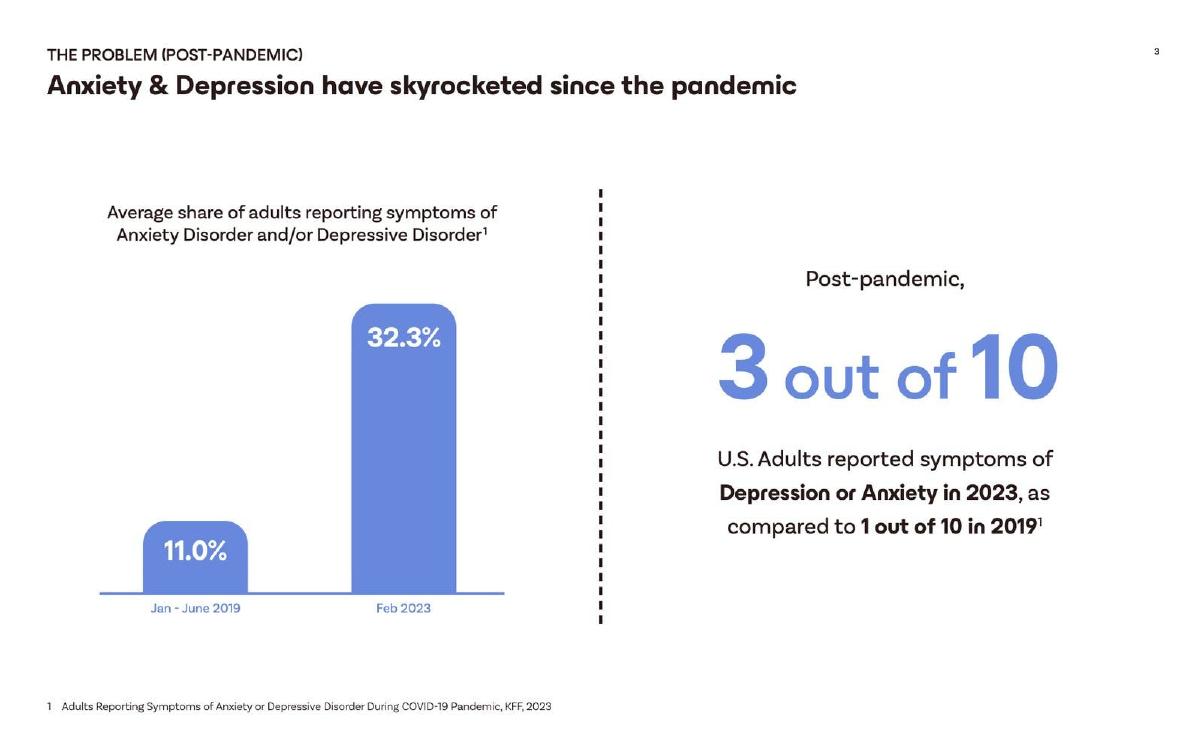
- U.S. adults reporting symptoms of depression or anxiety rose from 1 out of 10 in 2019 to 3 out of 10 in 2023 (Slide 3).
- The company targets a massive market, citing $280.5 billion in total U.S. mental health and substance use disorder expenditures in 2020 (Slide 7).
- Ketamine therapy is highlighted as a core 'novel treatment' with a 64% response rate within 24 hours of the first infusion (Slide 9).
- Being Health differentiates itself by operating at the intersection of four quadrants: Novel Treatments, Wellness, Telemental Health, and Functional Medicine (Slide 11).
- The physical footprint is central to the model, starting with a 16-treatment suite clinic in Manhattan (Slide 10).
- The team is highly credentialed, featuring a Cornell-trained board-certified psychiatrist as Co-Founder and a Chairman who previously led a $20B global supply chain conglomerate (Slide 13).
- The deck lacks any mention of revenue models, customer acquisition costs, or specific financial milestones.
- There is no 'Ask' slide detailing how the $5.4M in Seed funding will be allocated beyond the initial Manhattan clinic.
Executive Summary: The Clinical Authority Play
Being Health’s 17-slide deck is a masterclass in positioning a service-based business as a high-growth healthcare platform. Raised in 2024, the $5.4M Seed round—as reported by Business Insider—reflects investor appetite for 'whole person' care in a post-pandemic world. The deck relies heavily on two pillars: the undeniable scale of the mental health crisis and the deep clinical expertise of the founding team. By focusing on 'novel treatments' like ketamine, Being Health differentiates itself from the crowded field of therapy-only apps, positioning itself instead as a sophisticated medical provider capable of handling complex cases that traditional toolkits fail to solve.
Slides 1-3: Establishing the Macro Urgency
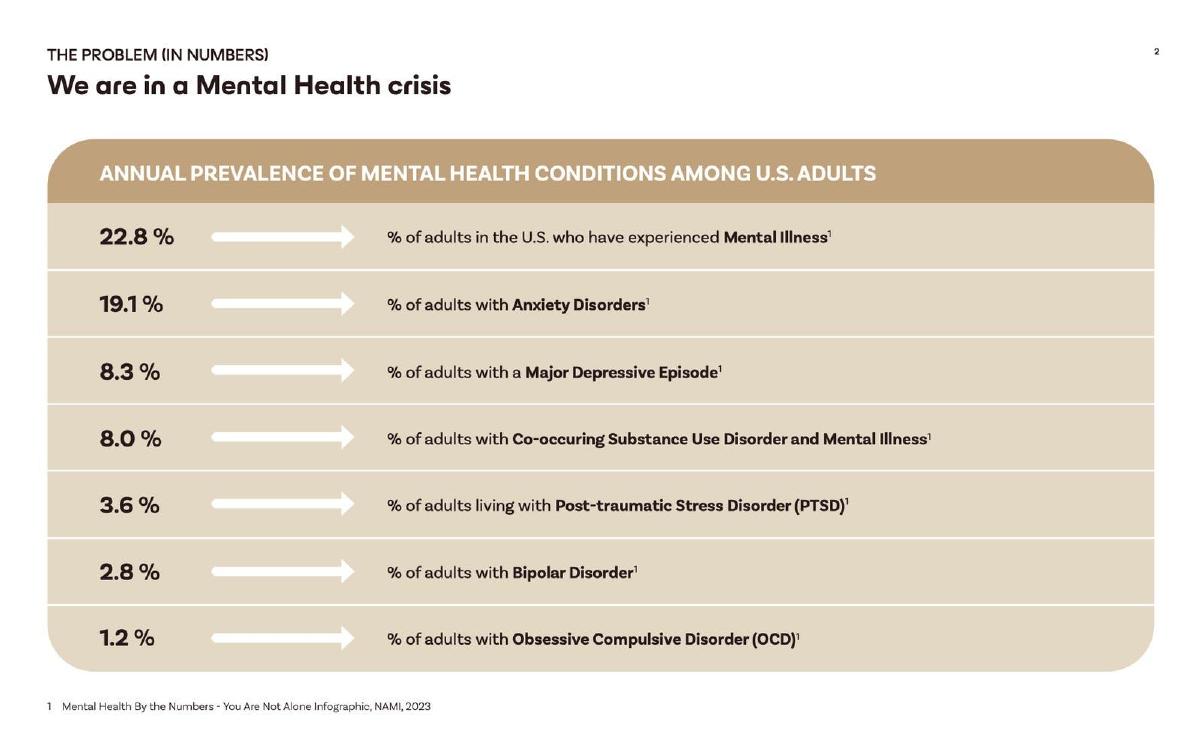
The deck opens with a minimalist title slide and immediately pivots to the 'Problem.' Slide 2 and Slide 3 use stark data to frame the opportunity. Specifically, Slide 3 notes that the average share of adults reporting symptoms of Anxiety or Depressive Disorder jumped from 11.0% in 2019 to 32.3% in February 2023. By stating that '3 out of 10' U.S. adults are now symptomatic, the founders establish that the market is not just large, but actively expanding due to the tailwinds of the pandemic. This is a classic 'Why Now?' argument that justifies the need for new infrastructure.
Slides 4-6: The Solution and Integrated Model
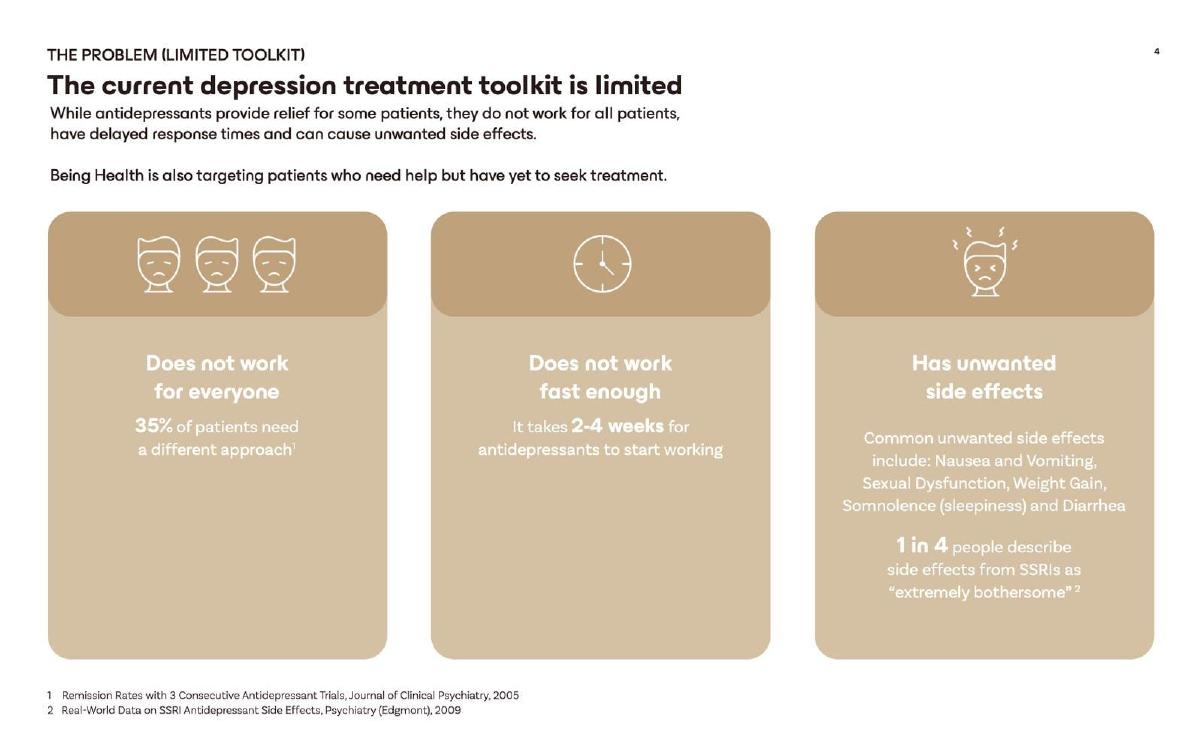
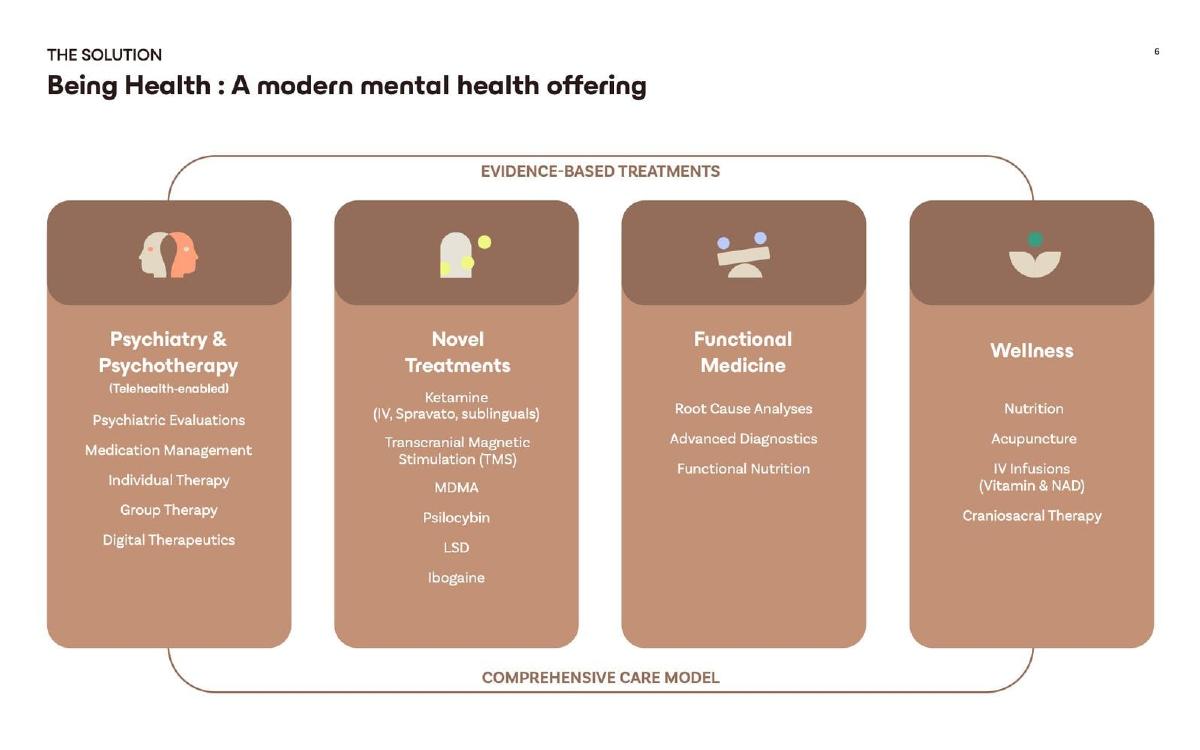
Slide 4 argues that the 'current depression treatment toolkit is limited,' setting the stage for Slide 5’s introduction of Being Health. The solution is described as a 'modern Mental Health practice' that integrates five distinct disciplines: Psychiatry, Psychotherapy, Novel Treatments, Functional Medicine, and Wellness. Slide 6 breaks these down further, listing specific services like acupuncture and functional medicine alongside traditional psychiatry. This slide is critical because it signals to investors that Being Health is looking to capture multiple revenue streams per patient, moving beyond the low-margin hourly therapy model.
Slides 7-9: Market Size and the 'Novel' Frontier
Slide 7 quantifies the financial opportunity, citing $280.5 billion in total U.S. mental health spending in 2020. It also highlights the 'economic burden' of Major Depressive Disorder, which rose to $326 billion in 2018. Slide 8 and Slide 9 focus on the 'Evolving Landscape' of novel treatments. Slide 9 is particularly data-dense, showing the FDA trial status for MDMA, Psilocybin, LSD, and Ibogaine. It highlights Ketamine—which is currently available—as having a 64% response rate within 24 hours. This positions Being Health as a 'future-proof' platform: they are building the physical and clinical infrastructure today to be the primary delivery mechanism for the next generation of psychedelic-assisted therapies tomorrow.
Slides 10-11: Physical Footprint and Competitive White Space
Slide 10 introduces the 'First clinic in Manhattan with 16 treatment suites.' This is a pivotal moment in the deck where the business model shifts from theoretical to tangible. The 16-suite capacity suggests a high-volume clinical operation. Slide 11 uses a four-way Venn diagram to illustrate 'White Space.' Being Health places itself at the intersection of Telemental Health (BetterHelp, Talkiatry), Novel Treatments (Mindbloom), Wellness (Zeel, WTHN), and Functional Medicine (Parsley Health). The claim is clear: competitors are siloed; Being Health is integrated.
Slides 12-16: The People Behind the Practice
A significant portion of this deck—nearly 25%—is dedicated to the team. Slide 13 features Co-Founder Dr. Allie Sharma, a Cornell-trained psychiatrist, and Chairman Haim Dabah, who brings massive scale experience from Li & Fung. Slides 14 and 15 list the clinical team, including Nurse Anesthetists, Acupuncturists, and Nutritionists. Slide 16 rounds this out with a Senior Advisory Board. For a Seed round in healthcare, this level of clinical 'overkill' is a feature, not a bug. It reassures investors that the company can navigate the complex regulatory and safety requirements of administering treatments like ketamine.
Slide 17: The Conclusion
The deck ends on a simple 'Thank you' slide with a press contact email. Notably, there is no 'Ask' slide in this version of the deck, which is common in decks released to the public or press post-round, though it leaves the specific use of the $5.4M to the reader's imagination.
What Being Health Does Well
Clinical Credibility: The deck does an exceptional job of establishing 'Medical Authority.' By listing specific degrees (L.Ac, CNS, CRNA, MD) and prestigious institutions (Cornell, Mount Sinai, NYU Langone), they distance themselves from 'wellness' startups that lack clinical rigor. This is essential when your business model involves controlled substances and medical procedures.
Visual Clarity: The design is clean, professional, and uses a calming color palette appropriate for a healthcare company. The data visualizations on Slides 3, 7, and 9 are easy to digest at a glance, which is vital for keeping a VC's attention during a first read.
Strategic Positioning: The 'White Space' diagram on Slide 11 is the strongest strategic slide in the deck. It identifies well-known, successful companies in adjacent spaces and explains exactly why Being Health is different. It turns the 'integrated' buzzword into a visual competitive advantage.
What is Missing from the Deck
Unit Economics: There is no mention of how much it costs to acquire a patient (CAC) or the expected Lifetime Value (LTV). For a business with high overhead (a 16-suite Manhattan clinic), investors need to see the path to profitability. How many sessions per month are required to break even on the lease and clinical staff?
The 'Ask': The deck omits the funding goal and the milestones the team intends to hit with the capital. While we know from external reports they raised $5.4M, a pitch deck should ideally outline how that money buys them 18-24 months of runway or a specific number of new clinic openings.
Technology Integration: While they mention 'virtual and in-person services,' the deck is light on the 'tech' part of the startup. Is there a proprietary patient portal? Does their data integration lead to better outcomes? Without this, the business looks more like a traditional medical practice than a scalable venture-backed platform.
Lessons for Founders
Lead with the 'Why Now': Being Health uses the post-pandemic mental health statistics to create a sense of urgency. If your industry has undergone a massive shift in the last 3-5 years, make that the foundation of your problem slide. · Map the Ecosystem: Don't just list competitors; categorize them. The Venn diagram approach used here is much more effective than a standard 'check-box' grid because it shows the philosophy of the business, not just a list of features. · Leverage Clinical Data: If you are in a regulated space, use peer-reviewed data. Citing response rates for ketamine (Slide 9) with footnotes to medical journals builds trust that marketing copy cannot replicate. · Team is Traction: In the absence of early revenue or user numbers, your team’s pedigree is your primary form of traction. Being Health leaned into this by giving their clinicians as much space as their executives.
Frequently asked questions
- What is the core business model of Being Health?
- Being Health operates as an integrated mental health practice. Unlike purely digital platforms, it combines a physical clinic (starting in Manhattan) with virtual services. Their model integrates traditional psychiatry and psychotherapy with functional medicine, nutrition, acupuncture, and novel treatments like ketamine to provide 'whole person' care.
- How does Being Health justify the use of novel treatments like ketamine?
- Slide 9 provides clinical data to support ketamine therapy, noting a 64% response rate for symptom improvement and a rapid response time of 1-2 hours. They also point to the 'evolving landscape' where other novel treatments like MDMA and Psilocybin are currently in Phase II and III FDA trials, positioning Being Health as a ready infrastructure for these future rollouts.
- Who are the primary competitors identified in the deck?
- Slide 11 maps the competitive landscape. They list Mindbloom and Numinus in the 'Novel Treatments' space, Talkiatry and BetterHelp in 'Telemental Health,' Parsley Health in 'Functional Medicine,' and Zeel or WTHN in 'Wellness.' Being Health claims the center spot, arguing that no other player integrates all four categories.
- What is missing from the Being Health pitch deck?
- The deck is missing several standard venture components: a clear 'Ask' slide, financial projections, unit economics (such as the cost to build a clinic vs. expected patient lifetime value), and a detailed go-to-market strategy beyond the first Manhattan location. It functions more as a clinical and vision-alignment document than a financial one.
- Why did Being Health raise $5.4M at the Seed stage?
- While the deck doesn't explicitly state the use of funds, the mention of a 16-suite Manhattan clinic on Slide 10 suggests significant capital expenditure. Building physical medical infrastructure, hiring a multi-disciplinary clinical team (psychiatrists, nurse anesthetists, acupuncturists), and navigating healthcare regulations requires more upfront capital than a pure software startup.