The beehiiv seed deck is a masterclass in founder-market fit and competitive positioning. By leveraging their history at Morning Brew—a newsletter acquired for $75M—founders Tyler Denk and Benjamin Hargett positioned beehiiv not just as another SaaS tool, but as the democratization of professional-grade publishing tech. The deck identifies a specific 'vulnerability' in the market leader (Substack): a 10% revenue tax that penalizes scale and a lack of advertising support. With a dual-revenue model combining tiered SaaS pricing and a 20% ad network fee, beehiiv projected $7.35M in ARR within 18…
Key takeaways
- The founders leverage their background building the tech for Morning Brew, which resulted in a $75M acquisition (Slide 3).
- The deck identifies a specific market gap: creators at scale are 'penalized' by the business models of existing platforms (Slide 3).
- A dedicated 'Vulnerable Market Leader' slide uses social media screenshots to prove that high-earning creators are unhappy with Substack's 10% fee (Slide 7).
- The business model is a hybrid of tiered SaaS pricing (starting at $0 for up to 1,000 subscribers) and a 20% share of ad revenue (Slides 12-14).
- Financial projections target profitability within 12 months and $7.35M ARR by month 18 (Slide 15).
- The 'Formula' slide compares beehiiv to a combination of Webflow, Medium, Substack, LiveIntent, Morning Brew, and Netflix (Slide 11).
- At the time of the deck, the company had 7 verbal commits from creators with up to 85,000 subscribers (Slide 18).
- The original fundraising ask was for $1.3M to cover 18 months of runway and 10 hires (Slide 20).
The beehiiv Teardown: A Masterclass in Competitive Positioning
The beehiiv seed deck is a 20-slide presentation that successfully raised $2.6M in 2021. It is a highly tactical deck that focuses on a specific 'wedge' in the market: the dissatisfaction of high-earning creators with existing newsletter platforms. By leveraging the founders' pedigree at Morning Brew, the deck builds immediate credibility and presents a clear path to disrupting the creator economy landscape.
Slides 1-2: The Hook and Mission
The deck opens with a minimalist title slide featuring the beehiiv logo. Slide 2 immediately defines the company's value proposition: 'beehiiv is the best platform for creators to build, grow, and monetize their audience via email newsletters.' This is a classic 'one-liner' that sets the stage for the problem and solution to follow.
Slide 3: Why beehiiv?
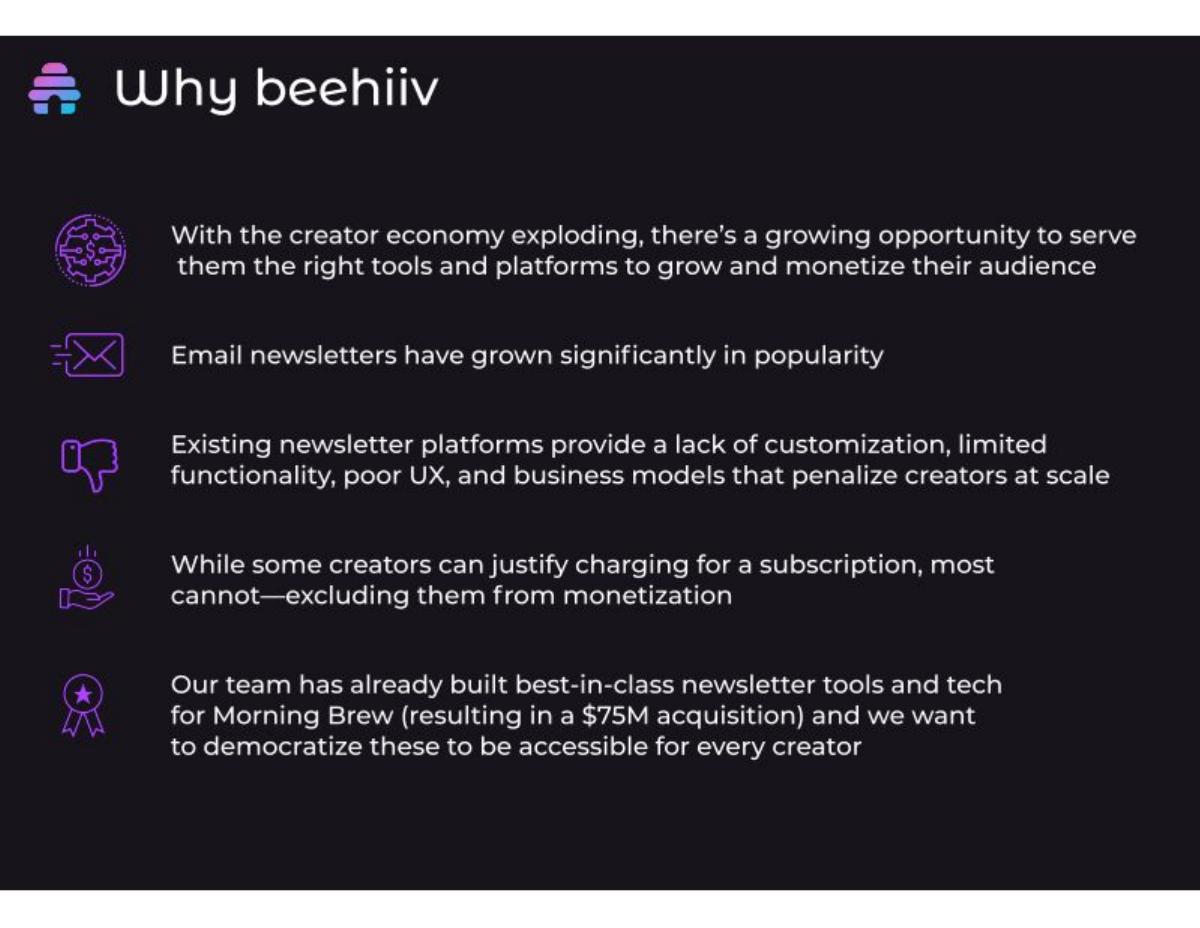
Slide 3 establishes the 'Why Now.' It notes that the creator economy is 'exploding' and that email newsletters have grown significantly in popularity. Crucially, it introduces the primary pain point: 'Existing newsletter platforms provide a lack of customization, limited functionality, poor UX, and business models that penalize creators at scale.' The slide ends with a credibility booster, mentioning the team's history building tools for Morning Brew, which resulted in a $75M acquisition.
Slides 4-5: The Landscape and Market Heat
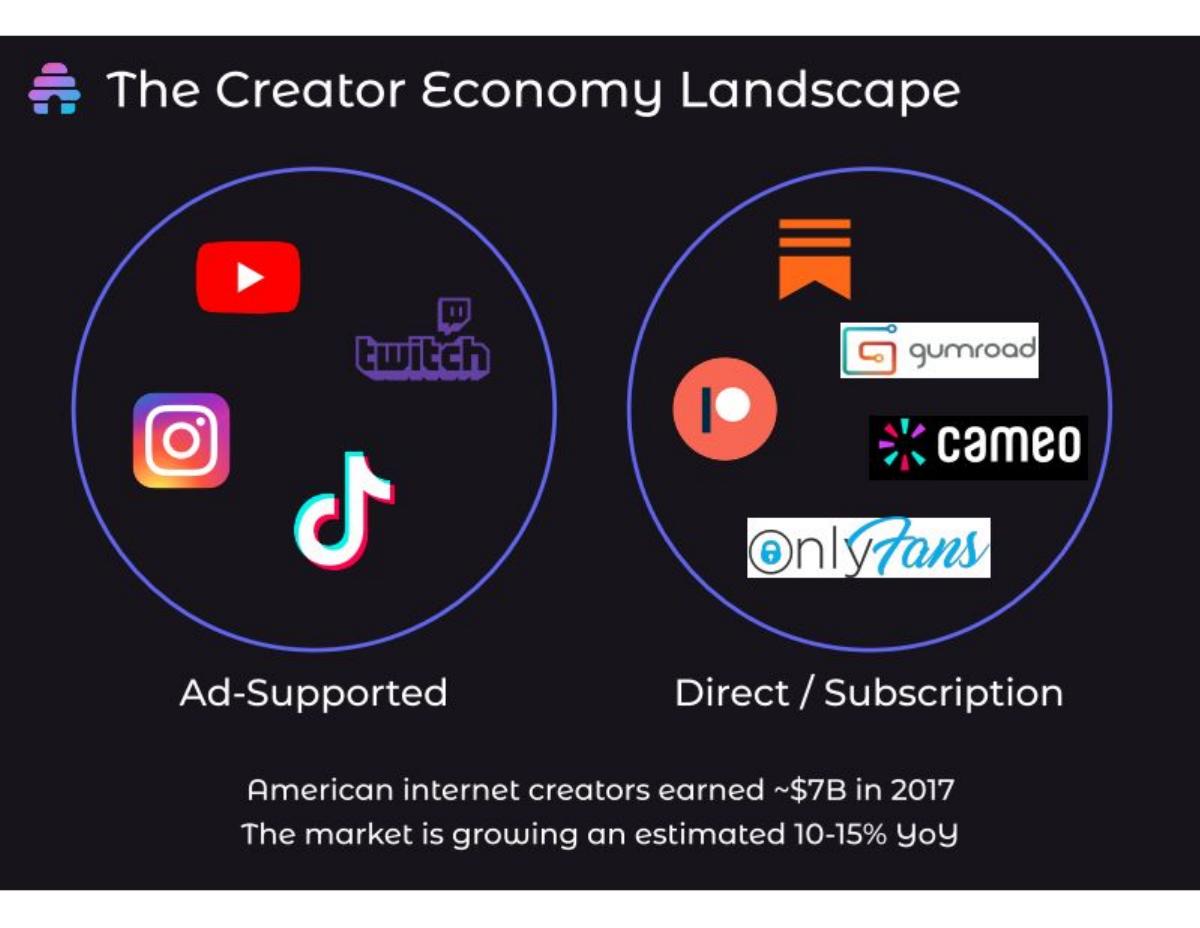
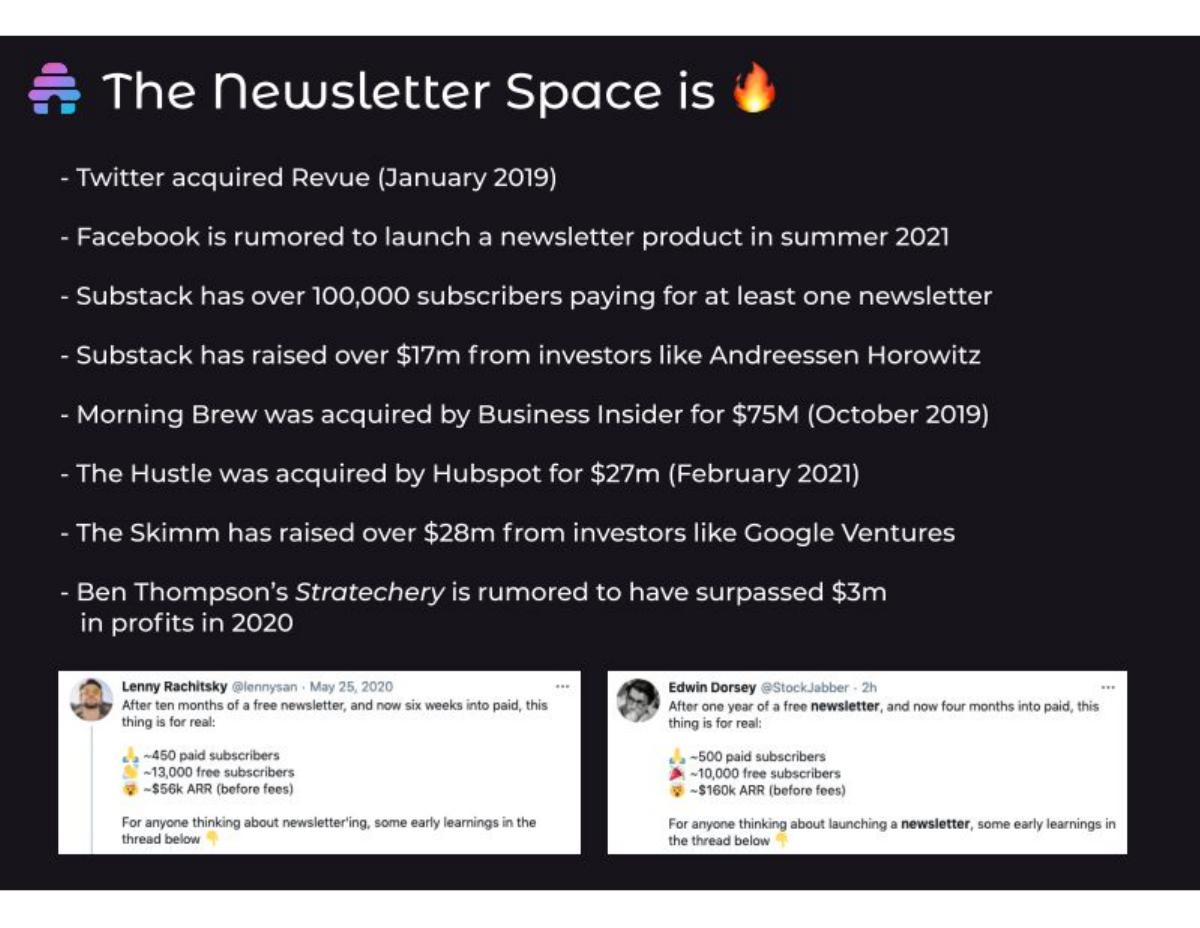
Slide 4 categorizes the creator economy into 'Ad-Supported' (YouTube, Instagram, TikTok, Twitch) and 'Direct / Subscription' (Patreon, Substack, OnlyFans, Cameo). It cites that American creators earned ~$7B in 2017 with 10-15% YoY growth. Slide 5, titled 'The Newsletter Space is [Fire Emoji],' lists recent industry milestones, including Twitter's acquisition of Revue, Substack's $17M raise, and The Hustle's $27M acquisition by HubSpot. It also includes screenshots of creators sharing their ARR, proving the financial viability of the medium.
Slides 6-7: Competitive Analysis and The Vulnerable Leader
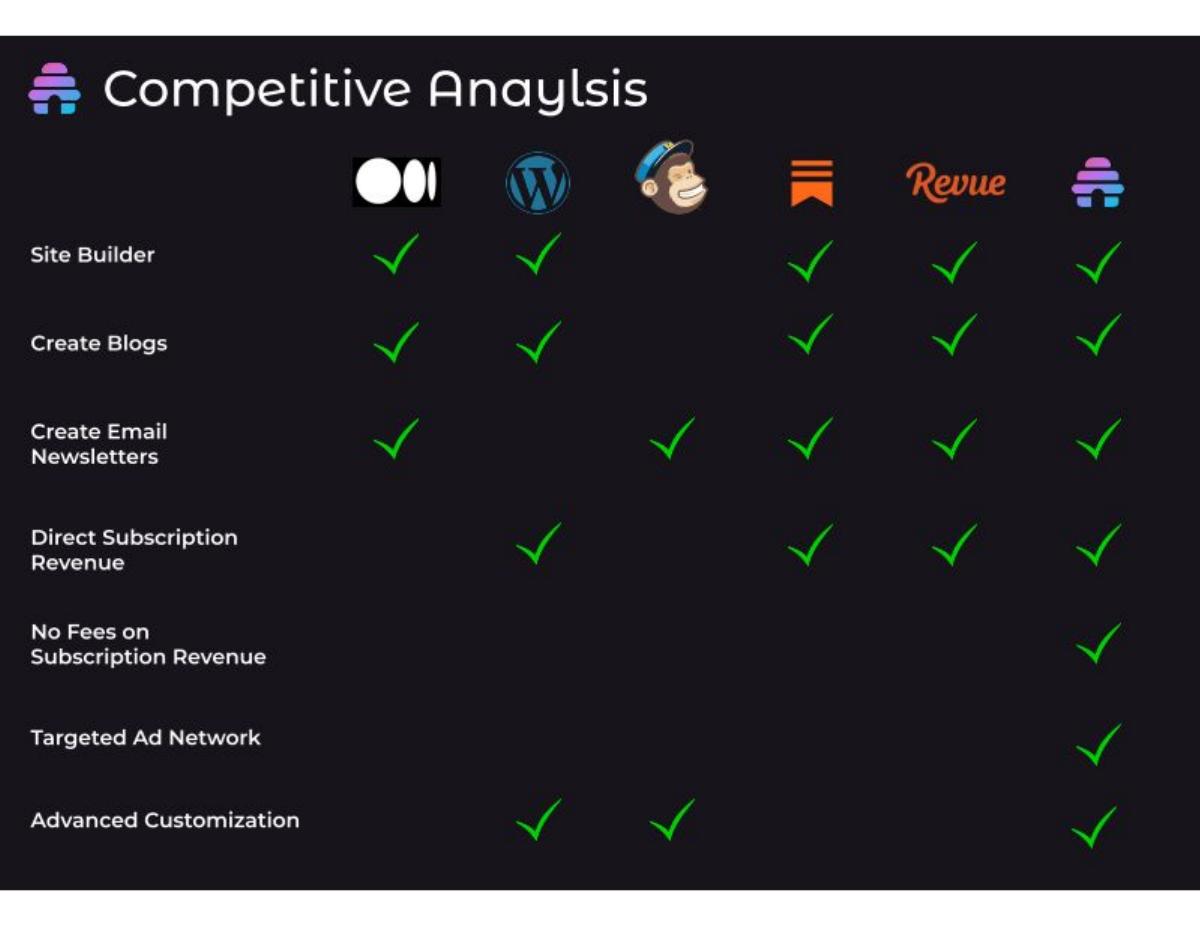
Slide 6 is a standard feature comparison grid. Beehiiv checks every box, including 'No Fees on Subscription Revenue,' 'Targeted Ad Network,' and 'Advanced Customization,' which are shown as missing from competitors like Substack, Revue, and Mailchimp. Slide 7 is the most aggressive and effective slide in the deck. Titled 'Vulnerable Market Leader,' it features screenshots of tweets and articles from creators like Andrew Wilkinson and Benedict Evans criticizing Substack's 10% fee and lack of growth tools. This slide turns a competitor's strength (market dominance) into a weakness (unhappy power users).
Slide 8: The Advertising Opportunity
Slide 8 focuses on 'Appetite For Email Advertising.' It highlights LiveIntent, which reached $52M in revenue in 2019, but argues that native ads (which beehiiv supports) are more effective than programmatic banners. It points out that sourcing ads is currently 'time-intensive and not scalable' for individual creators, setting up beehiiv's ad network as the solution.
Slides 9-11: The Product and 'The Formula'
Slide 9 uses a pyramid graphic to show how beehiiv 'democratizes' resources like web development, data analysis, finance, engineering, sales, and growth. Slide 10 breaks down 'Primary Features' into four categories: Create (no-code), Monetize (subscriptions + ads), Analyze (advanced attribution), and Grow (referral programs). Slide 11, 'The Formula,' uses a mathematical analogy, stating that beehiiv equals the best parts of Webflow, Medium, Substack, LiveIntent, Morning Brew, and Netflix.
Slides 12-14: The Business Model
The business model is split across three slides. Slide 12 introduces the hybrid SaaS + Ad Network approach. Slide 13 provides 'Sample Pricing' for the SaaS side, showing a free tier for up to 1,000 subscribers, followed by tiers ranging from $39 to $649 per month. Slide 14 explains the Ad Revenue model: advertisers target demographics, creators opt-in, and beehiiv takes a 20% share. An example shows a $25 CPM on a 20,000 list size resulting in $100 for beehiiv and $400 for the publisher.
Slides 15-17: Projections and Product Demo
Slide 15 shows a bar chart of costs, revenue, and operating profit over 18 months. The targets are specific: profitability within 12 months and $7.35M ARR by month 18. Slides 16 and 17 provide 'Demo' screenshots of the dashboard and editor, showing a clean, data-heavy interface that looks more professional than the minimalist competitors.
Slides 18-20: Timeline, Team, and Fundraising
Slide 18 shows a timeline from October 2020 to August 2021, noting that they had 7 verbal commits from creators during the closed beta. Slide 19 introduces the team: Tyler Denk (Google, Morning Brew) and Benjamin Hargett (Morning Brew, N2 Publishing). They are described as 'Two technical cofounders' and 'Subject matter experts.' Slide 20 closes with the 'Fundraising' ask: $1.3M for 18 months of runway, assuming 10 hires and coverage of scaling costs like SendGrid and AWS.
What Works in the beehiiv Deck
Founder-Market Fit: The mention of the Morning Brew acquisition (Slide 3 and 19) is the strongest possible signal that this team knows how to build and scale newsletter technology. · Specific Competitive Targeting: Instead of being 'better' than everyone, they focus on being 'fairer' and 'more powerful' than Substack specifically. Using actual customer complaints (Slide 7) is a brilliant way to validate their roadmap. · Dual Revenue Streams: Combining SaaS (predictable) with an Ad Network (upside) makes the business model more resilient and attractive to investors looking for venture-scale returns.
What is Missing from the beehiiv Deck
Unit Economics: While the deck shows tiered pricing and ad splits, it does not explicitly detail Customer Acquisition Cost (CAC) or Lifetime Value (LTV) projections, though this is common for early seed rounds. · Churn Assumptions: The financial projections (Slide 15) show aggressive growth but don't detail the expected churn rates for creators, which is a significant factor in SaaS platforms. · Detailed Ad Network Mechanics: Slide 14 explains the revenue split, but not how beehiiv plans to attract the 'Advertisers' side of the marketplace at scale.
Founder Takeaways: What to Copy
The 'Formula' Slide: Slide 11 is an excellent way to explain a complex product by referencing well-known successful companies. It helps investors categorize the startup quickly. · Social Proof as Validation: Using screenshots of tweets from industry influencers (Slide 7) is much more convincing than a founder simply stating that 'competitors are bad.' · Clear Pricing Tiers: Providing a specific table of pricing (Slide 13) shows that the founders have done the math on their revenue model and aren't just guessing.
Frequently asked questions
- What is beehiiv's primary competitive advantage according to the deck?
- The deck emphasizes founder-market fit. The team previously built the custom newsletter stack for Morning Brew, which sold for $75M. They argue that existing platforms like Substack lack customization and native ad networks, whereas beehiiv offers 'best-in-class' tools like referral programs and advanced analytics out of the box, which were previously only available to large media houses.
- How does beehiiv plan to make money?
- Beehiiv uses a dual-revenue stream. First, a SaaS model with tiered monthly pricing based on subscriber count, ranging from $39/month for 1,000-5,000 subscribers to $649/month for up to 250,000. Second, an optional ad network where beehiiv takes a 20% share of revenue from ads they source for the creators.
- Why does the deck focus so much on Substack?
- Substack is positioned as the 'Vulnerable Market Leader.' The deck uses screenshots of prominent creators complaining about Substack's 10% revenue cut and lack of integrations. By highlighting these specific pain points, beehiiv positions itself as the logical migration destination for 'full-fledged media outfits' that have outgrown Substack's simple feature set.
- What were the projected financials at the time of the seed round?
- Slide 15 outlines an ambitious growth trajectory. The company projected reaching profitability within the first 12 months of operation. By month 18, they aimed for over $7.35M in Annual Recurring Revenue (ARR) and more than $250,000 in monthly profit, supported by a team of approximately 10 hires.
- What was the initial fundraising goal versus the actual outcome?
- Slide 20 lists a 'Fundraising' goal of $1.3M for a pre-seed round to provide 18 months of runway. However, according to catalogue facts, the company successfully raised $2.6M in a seed round in 2021, effectively doubling their initial target behind strong investor interest from VCs like Social Leverage and various high-profile angels.