Beatdapp’s Demo Day deck is a study in social proof and market validation. With only 12 slides (6 provided for analysis), the company avoids technical jargon in favor of massive industry logos and high-level financial figures. They identify a $4.5 billion problem in the music industry, specifically targeting the complexities of tracking royalties across 600+ streaming platforms. The deck is notable for its 'Advisors' slide, which features the 22nd Prime Minister of Canada, signaling a level of political and regulatory weight rarely seen in early-stage startups. While the provided slides lack…
Key takeaways
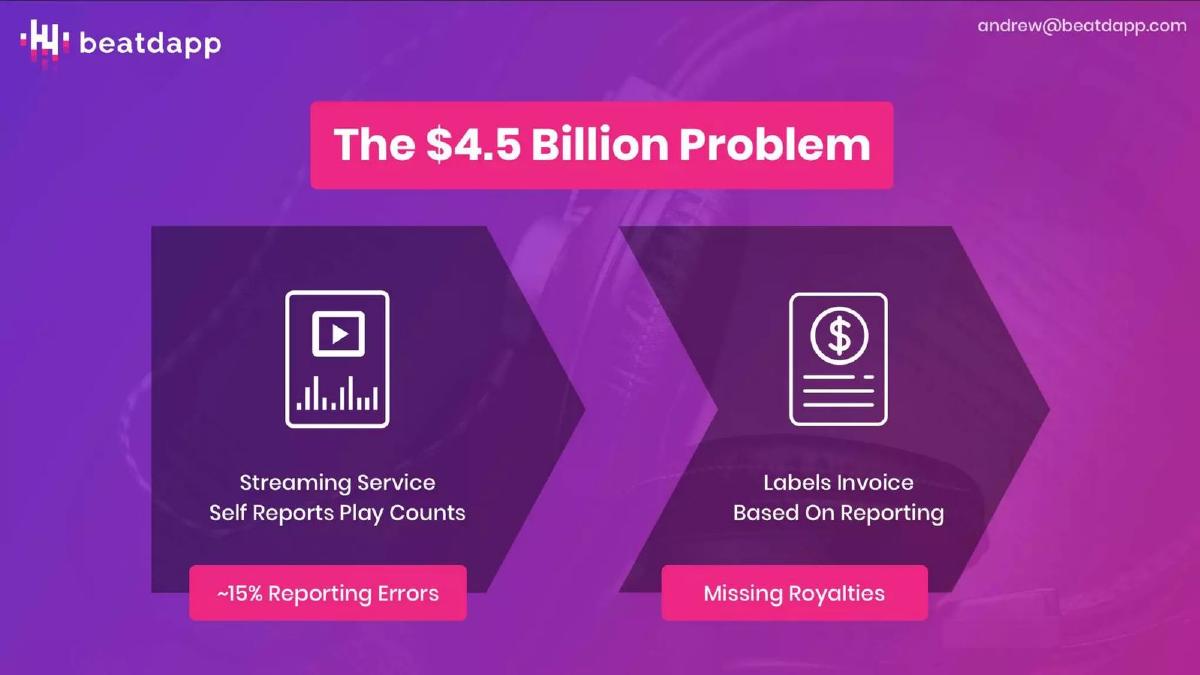
- The company frames its market opportunity as solving a $4.5 billion problem for the music industry on slide 1.
- Beatdapp highlights the scale of the ecosystem by citing over 600 streaming platforms, including global giants like Spotify, YouTube, and Tencent's QQ Music on slide 2.
- Slide 3 and slide 4 leverage significant industry logos, including Entertainment One, Warner Music, and TuneCore, to demonstrate market traction.
- The company claims a $25M pipeline on slide 4, indicating a strong sales motion or potential contract value.
- Revenue or fee structures are hinted at on slide 5, mentioning 1% of annual royalties in North America and 3% internationally.
- The advisory board on slide 6 includes Stephen J. Harper, the 22nd Prime Minister of Canada, providing extreme institutional credibility.
- The deck omits a traditional 'Team' slide in the provided set, opting instead to lead with high-profile advisors.
- There is no mention of the specific technology (e.g., blockchain or AI) used to solve the stated problem within these slides.
The Credibility Play: Beatdapp’s Demo Day Strategy
Beatdapp’s presentation is a quintessential Demo Day deck. It is designed to be viewed on a large screen while a founder speaks, meaning it is light on text and heavy on visual anchors. The primary goal of this deck is not to explain the 'how,' but to prove the 'who' and the 'how much.' By the time an investor reaches the final slide of this set, they are meant to be impressed by the sheer scale of the logos and the political weight of the advisors.
Slide 1: The Hook
The title slide sets a bold stage: "Solving a $4.5B problem for the music industry." This is a classic top-down market sizing approach. It doesn't define the problem as 'fraud' or 'inefficiency' explicitly in the text, but the $4.5B figure is a specific enough number to pique interest. The branding is clean, using a purple-to-pink gradient that fits the modern tech aesthetic. The inclusion of a contact email (andrew@beatdapp.com) in the top right corner of every slide is a smart tactical move for a Demo Day environment where investors might be snapping photos of the screen.
Slide 2: The Ecosystem Scale
Slide 2 highlights the complexity of the market. It states there are "600+ Streaming Platforms" and displays logos for major global players. Notably, it includes Western giants like YouTube, Spotify, Peloton, and Tidal , but also places significant emphasis on Asian markets with QQ Music, KuGou, KuWo, and Gaana . This tells the investor that Beatdapp is thinking globally and understands that the music industry's fragmentation is a worldwide issue, not just a North American one.
Slide 3: Artist and Label Validation
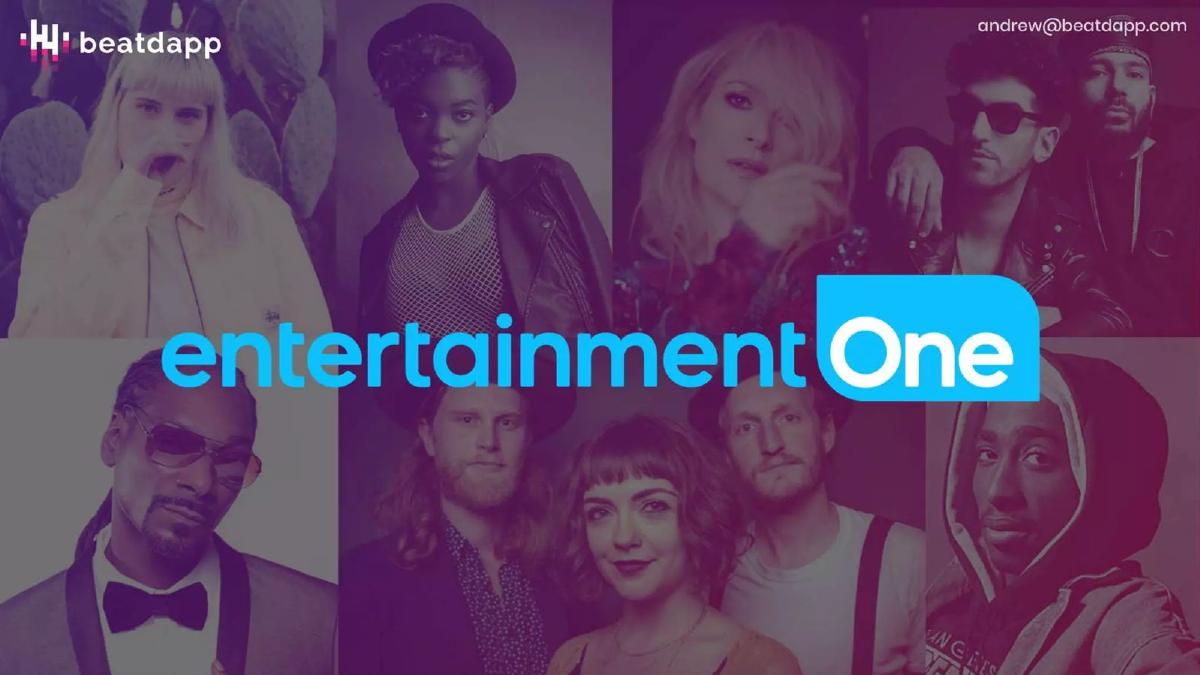
This slide is a pure 'social proof' play. By placing the Entertainment One logo over a collage of famous artists—including Snoop Dogg and Tupac Shakur —Beatdapp is borrowing the equity of these legendary brands. It suggests that their technology is either already being used to manage these massive catalogs or that they have the necessary relationships to enter these high-stakes environments. There is no explanatory text here; the images do the talking.
Slide 4: The $25M Pipeline
For a startup, 'Pipeline' can be a vague term, but Beatdapp attaches a specific dollar amount to it: "$25M Pipeline." The logos underneath are heavy hitters: Warner Music, TuneCore, The Orchard, T-Series, and Saregama . T-Series and Saregama are particularly important as they represent the massive Indian music market. This slide serves to transition the deck from 'this is a big problem' to 'we have significant commercial interest from the biggest players in the game.'
Slide 5: The Revenue Model
Slide 5 is the most data-rich slide in the set, though it remains minimalist. It shows two maps with percentage figures: "1% annual royalties" for North America and "3% annual royalties" for International. This implies a performance-based or volume-based pricing model. The higher percentage for international markets likely reflects the increased complexity and higher rates of fraud or leakage in those regions. It gives investors a clear path to understanding how that $4.5B problem translates into Beatdapp’s top-line revenue.
Slide 6: The Heavyweight Advisors
The final slide in this set is perhaps the most striking. Most startups list former Google engineers or mid-level VPs as advisors. Beatdapp lists Stephen J. Harper, the 22nd Prime Minister of Canada . This is accompanied by Sarah Scott (Universal Music Group), James Villeneuve (Diplomatic background), and Barry Shrum (Music Hall of Fame). This slide is designed to signal that Beatdapp has the 'adults in the room' and the political capital to navigate the notoriously litigious and protective music industry. It moves the company from 'tech startup' to 'institutional infrastructure' in the eyes of the viewer.
What Works in This Deck
Extreme Social Proof: The use of a former Prime Minister and major label logos creates an immediate sense of legitimacy that most seed-stage companies lack. · Global Perspective: By including Indian and Chinese streaming platforms, they demonstrate an understanding of where the next billion music consumers are coming from. · Visual Clarity: The deck is not cluttered. Each slide has one job and one message, which is ideal for a Demo Day format. · Clear Value Prop: Even without a detailed product walkthrough, the '1% vs 3%' slide clearly explains the economic value they provide to rights holders.
What Is Missing
The Team: While the advisors are impressive, the actual founders are not featured in these slides. Investors fund teams, not just advisors. · The Technology: There is no mention of how they actually solve the problem. Is it a blockchain ledger? A machine learning fraud detection engine? A manual auditing service? The 'how' is entirely absent. · Unit Economics: While we see the 'take rate' (1-3%), we don't see the cost to acquire a customer (CAC) or the lifetime value (LTV), which are critical for evaluating a SaaS or fintech business. · The Ask: There is no slide detailing how much money they are raising or what they plan to do with the capital.
Founder Takeaways
Use Logos Strategically: Beatdapp doesn't just list logos; they categorize them by 'Pipeline' and 'Platforms.' This gives the logos context beyond just 'people we've talked to.'
Leverage High-Level Advisors: If you have a high-profile advisor, give them their own slide. The presence of a former head of state is a powerful 'de-risking' signal for investors who might be wary of the music industry's complexity.
Simplify the Revenue Model: The '1% and 3%' slide is a masterclass in simplifying a complex business model for a quick pitch. It tells the investor exactly how the company makes money without needing a spreadsheet.
Design for the Medium: This deck is clearly built for a presentation, not for a 'send-ahead' PDF. Founders should remember that a Demo Day deck needs to be visual because the audience is listening to the speaker, not reading the slides.
Frequently asked questions
- What is the primary problem Beatdapp is trying to solve?
- According to slide 1, Beatdapp is 'solving a $4.5B problem for the music industry.' While the specific mechanics aren't detailed in the text, the context of 'annual royalties' on slide 5 and the list of streaming platforms on slide 2 suggests the company focuses on royalty tracking, auditing, or fraud detection within the music streaming ecosystem.
- How does Beatdapp plan to generate revenue?
- Slide 5 provides the clearest indication of their business model, showing '1% annual royalties' for North America and '3% annual royalties' for International markets. This suggests a percentage-based fee structure tied to the volume of royalties they process, audit, or recover for their clients.
- Who are Beatdapp's key partners or targets?
- Slide 4 lists several major entities in their '$25M Pipeline,' including Warner Music, TuneCore, The Orchard, T-Series, and Saregama. Slide 3 also prominently features Entertainment One (eOne) alongside images of artists like Snoop Dogg and Tupac Shakur, implying a relationship with major catalogs.
- What makes their advisory board unique?
- The advisory board is exceptionally high-profile for a startup. Slide 6 features Stephen J. Harper (22nd Prime Minister of Canada), Sarah Scott (Former Chief Counsel at Universal Music Group), James Villeneuve (Former Canadian Consul General to LA), and Barry Shrum (General Counsel for the Songwriters Music Hall of Fame). This suggests a strategy focused on regulatory navigation and top-tier industry legal expertise.
- Is there a specific 'Ask' or funding goal in the deck?
- The provided slides do not include a funding 'Ask' or a use of funds slide. As this is a Demo Day deck, such information is often delivered verbally or reserved for the full 12-slide version. The current set focuses entirely on market size, traction, and credibility.