BeautyDate presents a lean, 8-slide pitch deck that prioritizes market scale and immediate traction. Operating in Brazil—the world's third-largest beauty market—the company addresses a highly fragmented industry of 600,000 salons. The deck's strongest asset is its traction slide, which showcases a staggering 84% month-over-month growth rate, scaling from 558 appointments in January to over 1 million by the end of 2016. While the deck successfully establishes the 'why now' and 'what' through clear B2B and B2C value propositions, it is notably silent on unit economics, revenue models, and a spe…
Key takeaways
- Brazil is ranked as the third-largest beauty market globally, trailing only the USA and China (Slide 2).
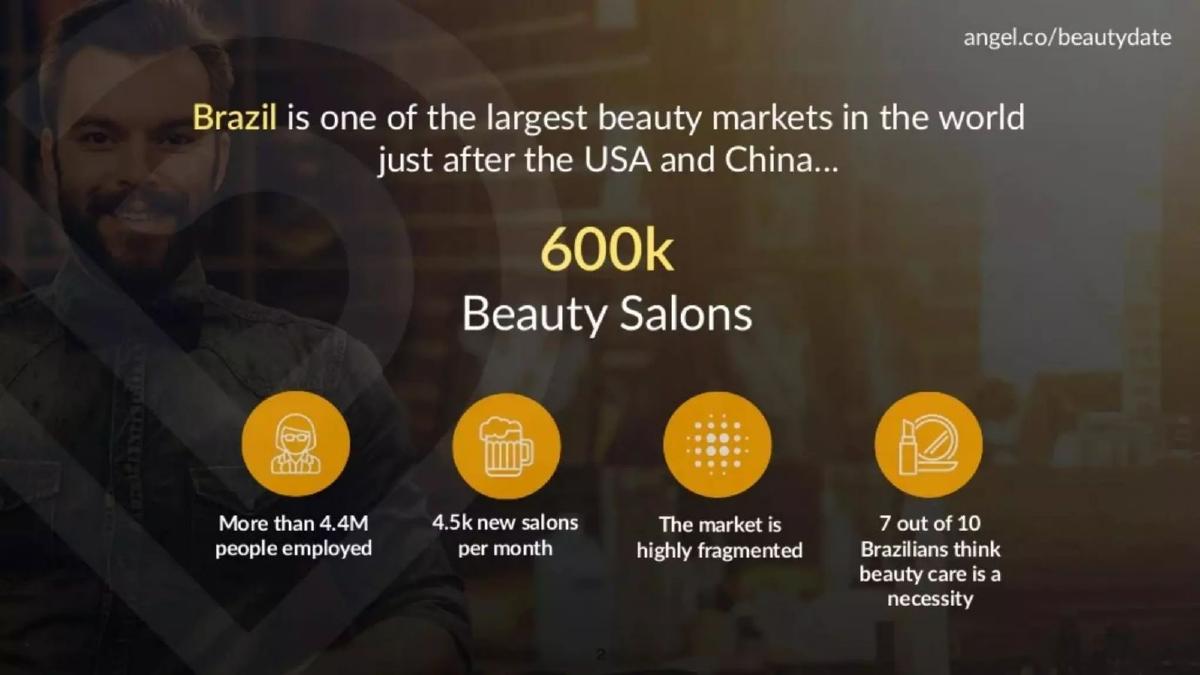
- The market is characterized by extreme fragmentation, with 600,000 beauty salons and 4.5k new salons opening monthly (Slide 2).
- BeautyDate reports a significant growth milestone of 84% Month-over-Month (MoM) increase in appointments (Slide 6).
- The platform scaled from 558 appointments in January to a projected 1 million appointments by the end of 2016 (Slide 6).
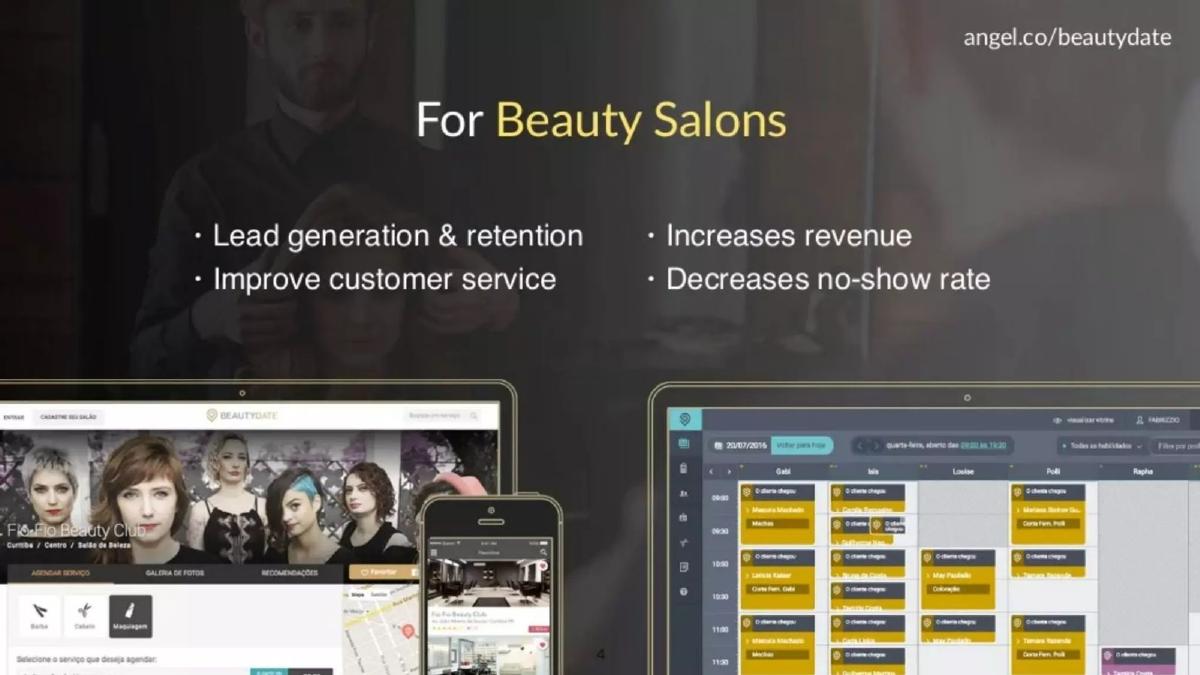
- The B2B value proposition focuses on lead generation, revenue increases, and decreasing no-show rates for salons (Slide 4).
- The company has already secured backing from institutional investors Valor Capital Group and IBG (Slide 7).
- The team has scaled to 76 employees, led by CEO & Founder Alexandre Kleis (Slide 7).
- The deck lacks a formal 'Ask' slide detailing the amount of capital sought or the intended use of funds (Slide 8).
The BeautyDate Pitch Deck: High-Velocity Traction in a Fragmented Market
BeautyDate's 8-slide deck is a masterclass in brevity, focusing almost exclusively on market size and growth velocity. In the venture capital world, traction often speaks louder than complex financial modeling, and BeautyDate leans heavily into this philosophy. By 2011, the company was positioning itself as the dominant digital layer for Brazil's massive beauty industry. This teardown examines how they used a lean narrative to highlight a massive opportunity.
The Market Opportunity (Slides 1-3)
Slide 1: Title Slide The deck opens with a clear, minimalist title slide. It identifies BeautyDate as a "Brazilian marketplace for beauty services." This immediately grounds the investor in the geography and the business model. The inclusion of the Angel.co URL suggests this deck was used for online fundraising or as a follow-up to an initial digital contact.
Slide 2: Market Scale This is a critical slide for any international startup. It establishes that Brazil is not a niche market but the third-largest beauty market in the world, following only the USA and China. The figures are compelling: 600,000 beauty salons, 4.4 million people employed in the sector, and 4.5k new salons opening every month. The most important qualitative stat here is that "7 out of 10 Brazilians think beauty care is a necessity," which suggests a recession-proof demand for the service.
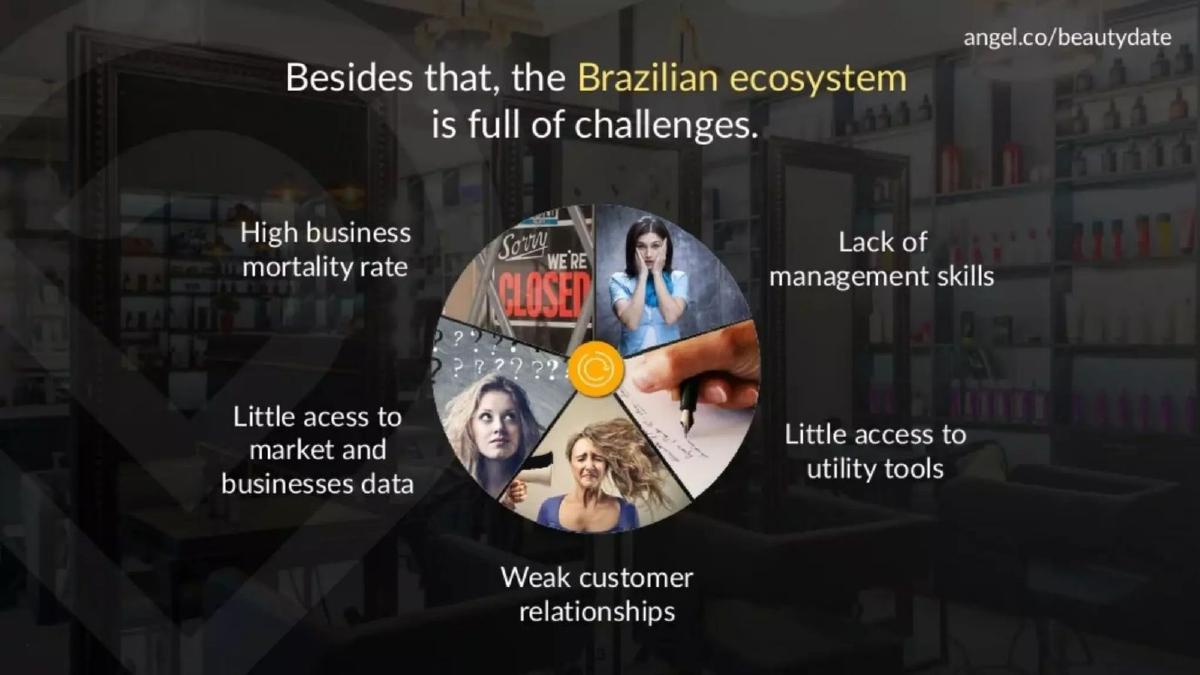
Slide 3: Ecosystem Challenges Having established the size of the market, Slide 3 identifies the pain points. It uses a circular graphic to list five challenges: high business mortality rate, lack of management skills, little access to utility tools, weak customer relationships, and little access to market data. This slide effectively sets up the "Solution" by showing that the current market is large but fundamentally broken and inefficient.
The Solution and Product (Slides 4-5)
Slide 4: Value for Beauty Salons (B2B) Slide 4 transitions into the product. It lists four key benefits for salons: lead generation & retention, improved customer service, increased revenue, and decreased no-show rates. The slide includes screenshots of a web-based management dashboard and a mobile view. The dashboard appears to be a multi-column calendar, indicating that BeautyDate is not just a booking site but a core operational tool for the salon owners.
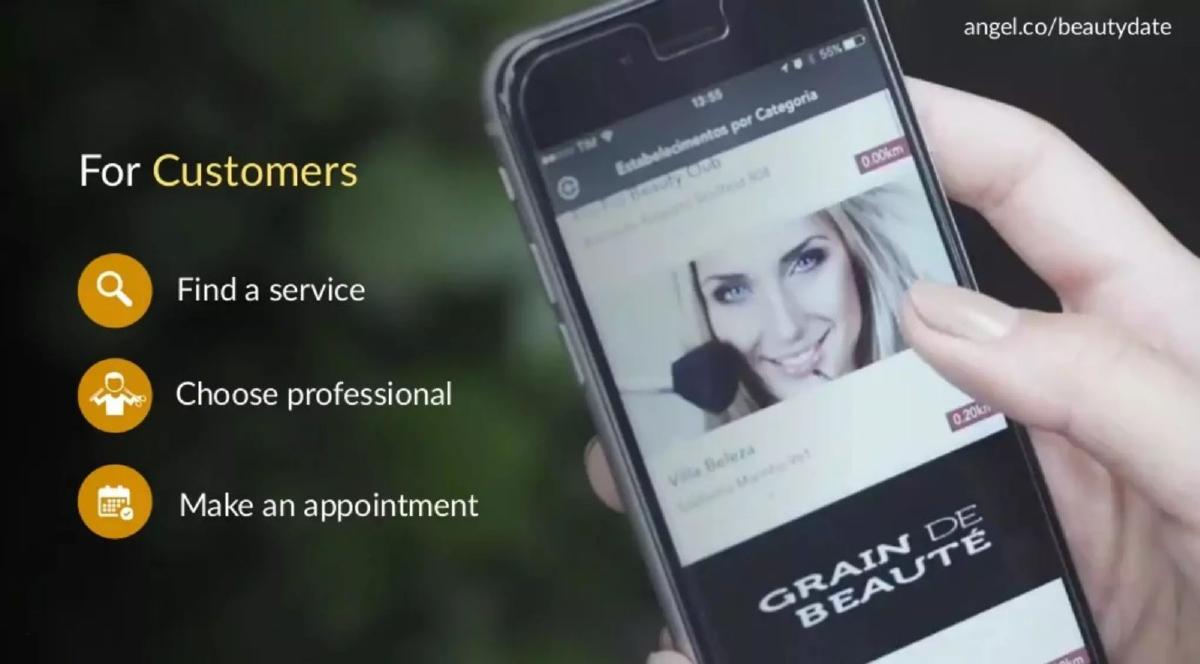
Slide 5: Value for Customers (B2C) The consumer side of the marketplace is simplified into three steps: find a service, choose a professional, and make an appointment. The visual shows a smartphone app with a clean UI, displaying salon names like "Villa Beleza" and "Grain de Beauté." This slide confirms the dual-sided nature of the marketplace, emphasizing ease of use for the end consumer.
Traction and Team (Slides 6-8)
Slide 6: The Traction Curve This is the most important slide in the deck. It shows a bar chart of appointments from January to July, with a projected leap to 2016 year-end. The headline figure is "84% MoM" (Month-over-Month) growth. The numbers move from 558 appointments in January to 22,125 in July, and finally a projected 1 million by the end of 2016. This exponential growth curve is designed to create a sense of urgency and FOMO (fear of missing out) for investors.
Slide 7: Team and Investors The team slide reveals a significant operation: "We have a team of 76 people." It highlights four key executives: Alexandre Kleis (CEO & Founder), Emerson Vendruscolo (CFO), Adilson Carvalho (CTO), and Bruno Medeiros (CBO). Below the team, it lists two major investors: Valor Capital Group and IBG. The presence of Valor Capital is a major trust signal, as they are well-known for backing top-tier Brazilian tech companies.
Slide 8: Closing The final slide is a repeat of the team photo used as a background in previous slides, providing contact information (founders@beautydate.com) and the website URL. Notably, there is no "Ask" slide here—no mention of how much money is being raised or what the valuation is. This suggests the deck may have been intended as a teaser or that the specific terms were reserved for private discussion.
What Works in the BeautyDate Deck
1. Market Contextualization: For investors outside of Brazil, Slide 2 is essential. It doesn't just say the market is big; it ranks it against the US and China, providing a global frame of reference that makes the opportunity feel massive and worth the risk.
2. Growth Velocity: The 84% MoM growth figure on Slide 6 is the "hero metric." By focusing on appointments rather than revenue (which might be smaller in the early stages), the company demonstrates massive user adoption and market fit.
3. Dual-Sided Value: The deck clearly separates the benefits for the salon (revenue/management) from the benefits for the consumer (convenience). This shows a deep understanding of the marketplace dynamics required to scale.
What is Missing from the BeautyDate Deck
1. Revenue Model: There is absolutely no mention of how BeautyDate makes money. Do they take a commission per booking? Do they charge a SaaS fee to salons? Do they sell advertising? This is a glaring omission for a "Later" stage deck.
2. Competitive Landscape: The beauty booking space is notoriously crowded (e.g., Booksy, Treatwell). The deck fails to mention any competitors or explain why BeautyDate has a defensible moat in the Brazilian market specifically.
3. Unit Economics: With a team of 76 people, the burn rate must be significant. Investors would want to see the Customer Acquisition Cost (CAC) versus the Lifetime Value (LTV) to ensure the growth shown on Slide 6 is sustainable and not just bought with venture dollars.
4. The Ask: A pitch deck is a tool to raise money. Failing to include a slide that specifies the amount sought, the milestones it will fund, and the current runway is a missed opportunity to drive the conversation toward a close.
What a Founder Should Copy
1. The 'Problem' Visual: Slide 3 is a great example of how to categorize fragmented market problems. Instead of a long list of bullet points, the circular graphic makes the challenges feel interconnected and systemic, which justifies a platform-level solution.
2. Use of Social Proof: If you have big-name investors like Valor Capital, put them on the team slide. It immediately elevates the perceived quality of the founders and the business.
3. Focus on the North Star Metric: BeautyDate chose "Appointments" as their North Star. It’s a clean, easy-to-understand metric that proves the platform is being used. Founders should identify their one most impressive growth metric and give it its own high-impact slide.
Final Thoughts
The BeautyDate deck is a high-energy, traction-focused presentation. It succeeds in proving that there is a giant market in Brazil and that they are capturing it at a blistering pace. However, the lack of financial detail and competitive positioning makes it a "teaser" deck rather than a complete investment memorandum. For a later-stage round, a founder would need to supplement this with a robust data room covering the missing economic and competitive details.
Frequently asked questions
- What is the primary problem BeautyDate is solving?
- BeautyDate targets the inefficiencies in the Brazilian beauty ecosystem. As shown on Slide 3, the market suffers from high business mortality, a lack of management skills among salon owners, weak customer relationships, and limited access to market data. By providing a digital marketplace and management tools, they aim to professionalize a highly fragmented industry of 600,000 salons.
- How does BeautyDate demonstrate product-market fit?
- The deck uses a 'hockey stick' growth curve on Slide 6 to demonstrate fit. It highlights an 84% month-over-month growth rate in appointments during 2016. Starting at just 558 appointments in January, the platform reached 22,125 by July and projected 1 million by the end of the year, suggesting rapid adoption by both salons and consumers.
- What are the key features for salon owners?
- According to Slide 4, the platform provides salons with lead generation, customer retention tools, and improved customer service. Visually, the slide shows a sophisticated scheduling dashboard that helps managers track appointments across multiple professionals, which the company claims decreases no-show rates and increases overall revenue.
- Who are the investors behind BeautyDate?
- Slide 7 identifies two key institutional investors: Valor Capital Group and IBG (International Beauty Group). Valor Capital is a prominent cross-border venture fund, which adds significant credibility to the startup's ability to scale within and potentially beyond the Brazilian market.
- What critical information is missing from this deck?
- The deck is missing several standard components: a business model slide (explaining how they make money), a competitor analysis, unit economics (CAC/LTV), and a clear 'Ask' slide. While it mentions a team of 76 people, it does not provide the professional backgrounds or previous successes of the executive leadership team.