How beauty, skincare and salon startups present the problem in a pitch deck: name the shopper or salon, what goes wrong at the shelf or the booking.
Beauty Startup Problem Slide: Real Pitch Deck Examples
Eight problem slides from beauty, skincare, grooming and salon startups, shown in full, compare whether each slide names who struggles, what goes wrong, and gives evidence.
TL;DR
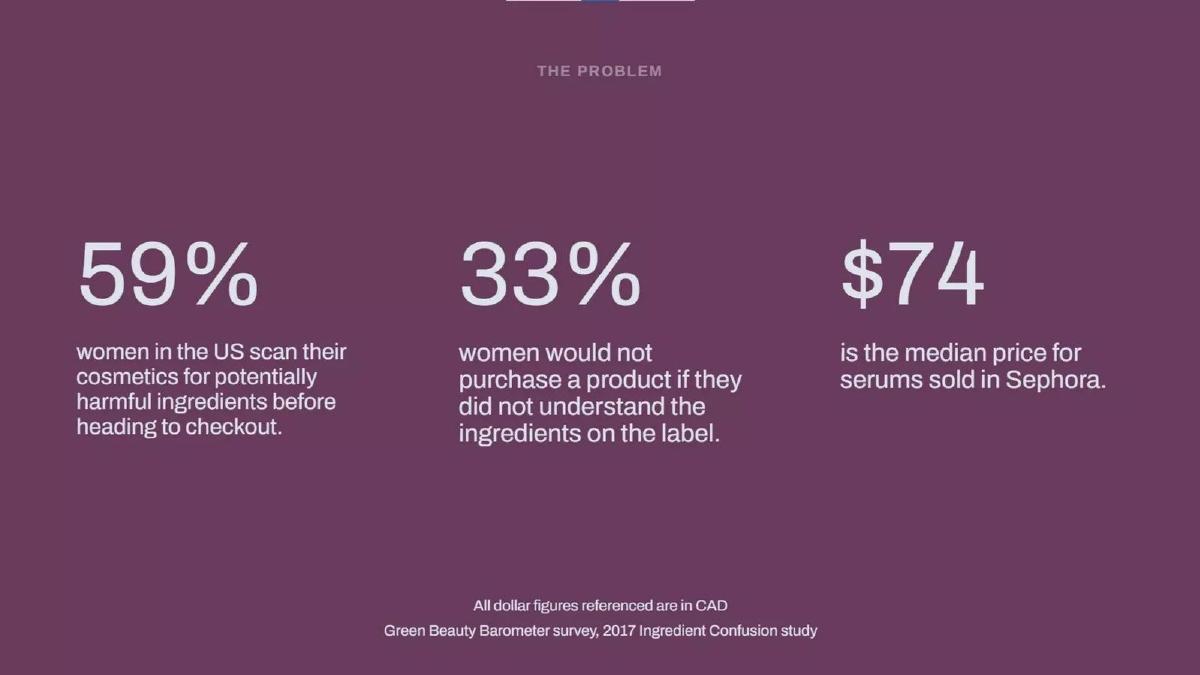
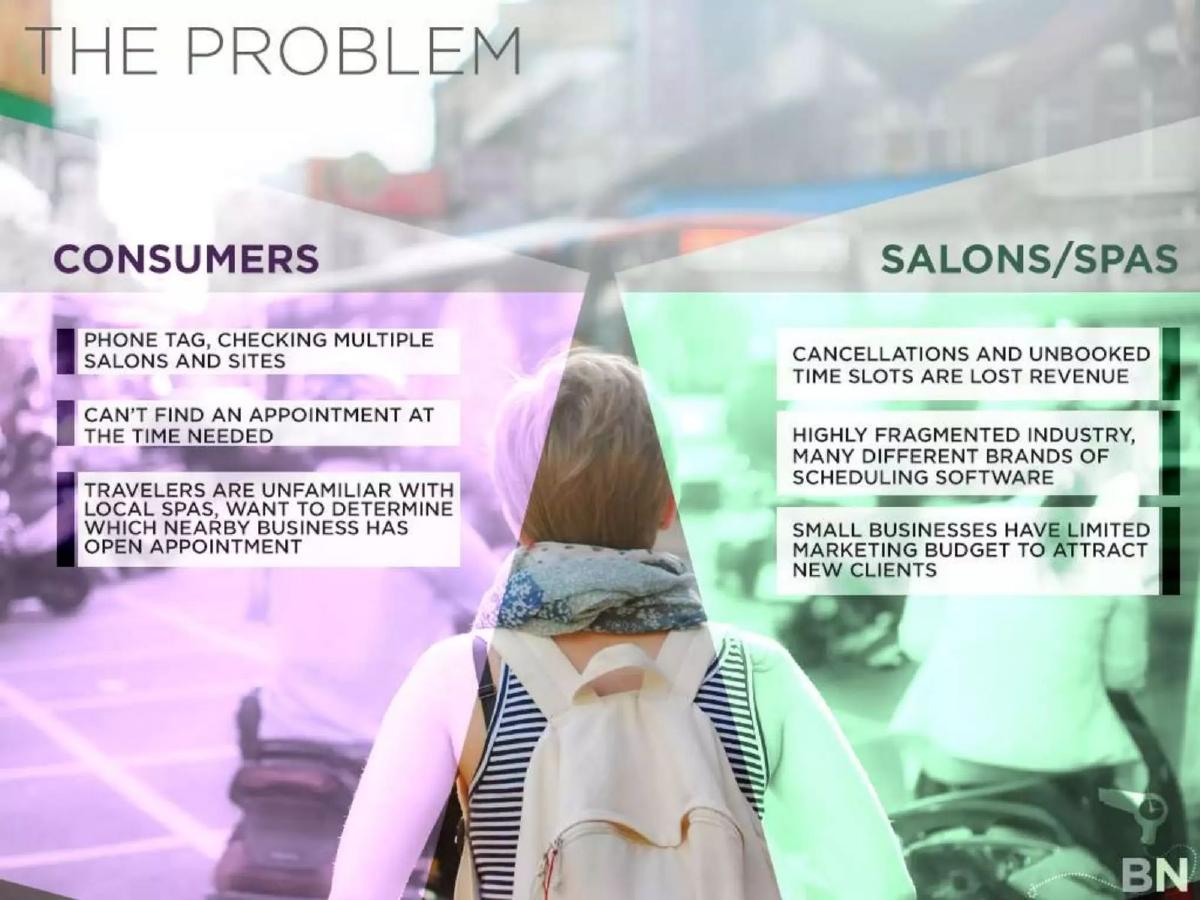
A beauty problem slide has to go past "products contain chemicals" to a shopper or salon with a specific difficulty. The stronger slides name the moment and source it. Three Ships gives three figures from named surveys: "59% women in the US scan their cosmetics for potentially harmful ingredients before heading to checkout", "33% women would not purchase a product if they did not understand the ingredients on the label" and "$74 is the median price for serums sold in Sephora". BeautyNow splits the problem between consumers ("Can't find an appointment at the time needed") and salons ("Cancellations and unbooked time slots are lost revenue"). Beautyfyn's three generic headings, "Includes chemicals", "High prices", "Low quality", with no figure or customer, are the weaker pattern.
Beauty problem slides from real pitch decks
Each example shows the exact stored slide above its analysis and links to the full teardown. Claims are as shown on the slides; we have not verified them.
Three Ships problem slide — slide 3
Natural skincare. Three large figures on a plain background with sources in the footer.
Three Ships deck, slide 3. Exact stored slide matched to this analysis.
Our analysis: The strongest slide here: three sourced numbers that together describe a shopper who worries about ingredients and pays a lot for natural products.
Evidence and limitation: Three figures with named sources.
What a founder can adapt: Use three figures that each correspond to something your product fixes.
Supporting analysis
What the deck claims: "The Problem." "59% women in the US scan their cosmetics for potentially harmful ingredients before heading to checkout." "33% women would not purchase a product if they did not understand the ingredients on the label." "$74 is the median price for serums sold in Sephora." Footer: "All dollar figures referenced are in CAD." "Green Beauty Barometer survey, 2017 Ingredient Confusion study."
Presentation choice: Each figure sets up part of the solution: clear labels and a lower price.
When it does not fit: Mixing US survey data with CAD prices; say which market each number describes.
Salon and spa booking. Two columns, consumers and salons, over a street photo.
BeautyNow deck, slide 3. Exact stored slide matched to this analysis.
Our analysis: Both sides of the booking problem, each in the words of the person who has it.
Evidence and limitation: No figures.
What a founder can adapt: For a two-sided product, give each side three pains that mirror each other.
Supporting analysis
What the deck claims: "The Problem." Consumers: "Phone tag, checking multiple salons and sites." "Can't find an appointment at the time needed." "Travelers are unfamiliar with local spas, want to determine which nearby business has open appointment." Salons/Spas: "Cancellations and unbooked time slots are lost revenue." "Highly fragmented industry, many different brands of scheduling software." "Small businesses have limited marketing budget to attract new clients."
Presentation choice: The empty slot is the same problem seen from both sides, which is exactly what a booking marketplace fixes.
When it does not fit: Add one number: the share of slots left unbooked, or how many calls it takes to book.
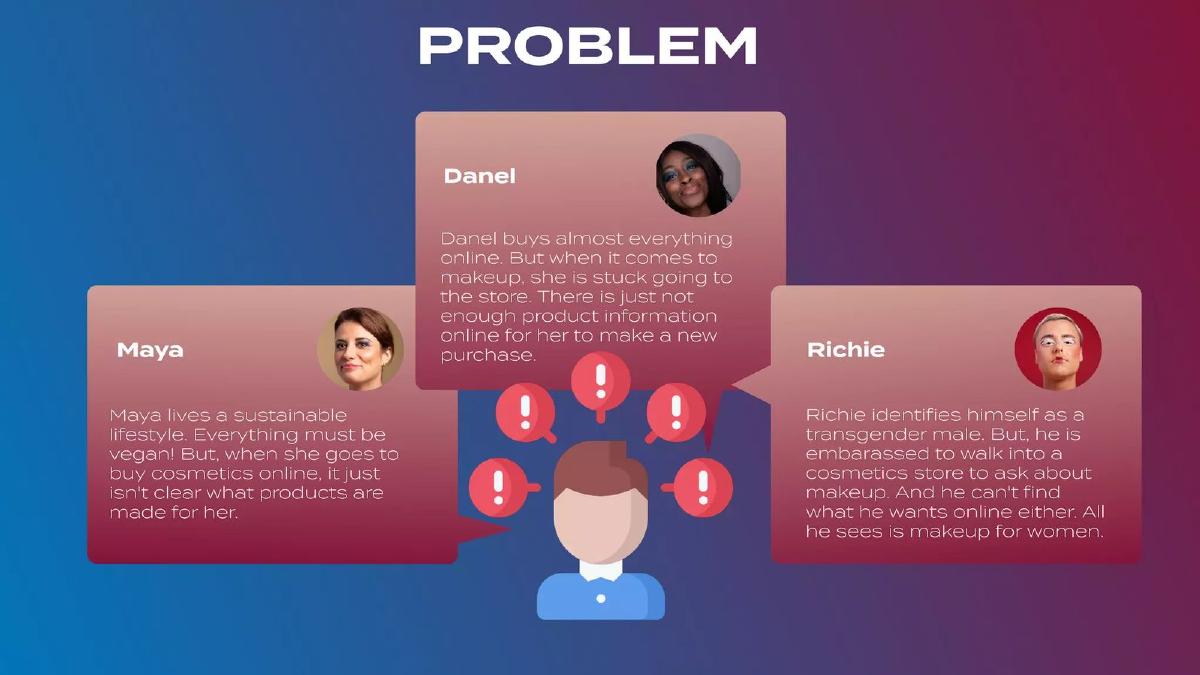
Inclusive cosmetics shopping. Three named personas around a confused shopper icon.
Blended deck, slide 2. Exact stored slide matched to this analysis.
Our analysis: Three shoppers, three different reasons they can't buy makeup online.
Evidence and limitation: No figures.
What a founder can adapt: If you use personas, give each one a different blocker your product removes.
Supporting analysis
What the deck claims: "Problem." Danel: "buys almost everything online. But when it comes to makeup, she is stuck going to the store. There is just not enough product information online for her to make a new purchase." Maya: "lives a sustainable lifestyle. Everything must be vegan! But, when she goes to buy cosmetics online, it just isn't clear what products are made for her." Richie: "identifies himself as a transgender male. But, he is embarrassed to walk into a cosmetics store to ask about makeup. And he can't find what he wants online either."
Presentation choice: Each persona adds a segment (online-first, vegan, trans) without repeating the same point.
When it does not fit: Say how many shoppers each persona represents.
Bauz deck, slide 2. Exact stored slide matched to this analysis.
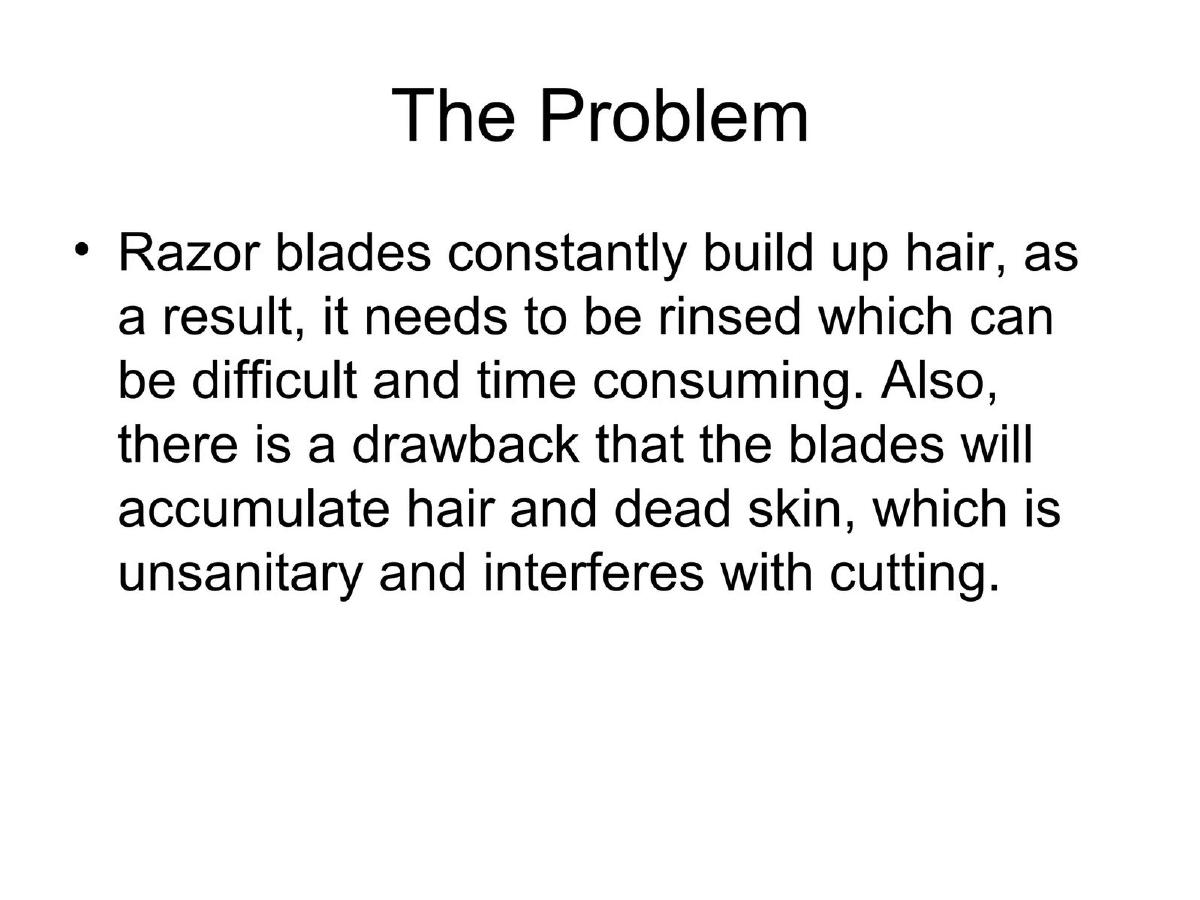
Our analysis: A specific, physical problem anyone who shaves recognises: clogged blades.
Evidence and limitation: No figures.
What a founder can adapt: Describe the exact moment the product fails today.
Supporting analysis
What the deck claims: "The Problem." "Razor blades constantly build up hair, as a result, it needs to be rinsed which can be difficult and time consuming. Also, there is a drawback that the blades will accumulate hair and dead skin, which is unsanitary and interferes with cutting."
Presentation choice: It describes the moment (rinsing mid-shave) and two consequences (hygiene, cutting).
When it does not fit: One paragraph in large type; a photo of a clogged blade would say it faster.
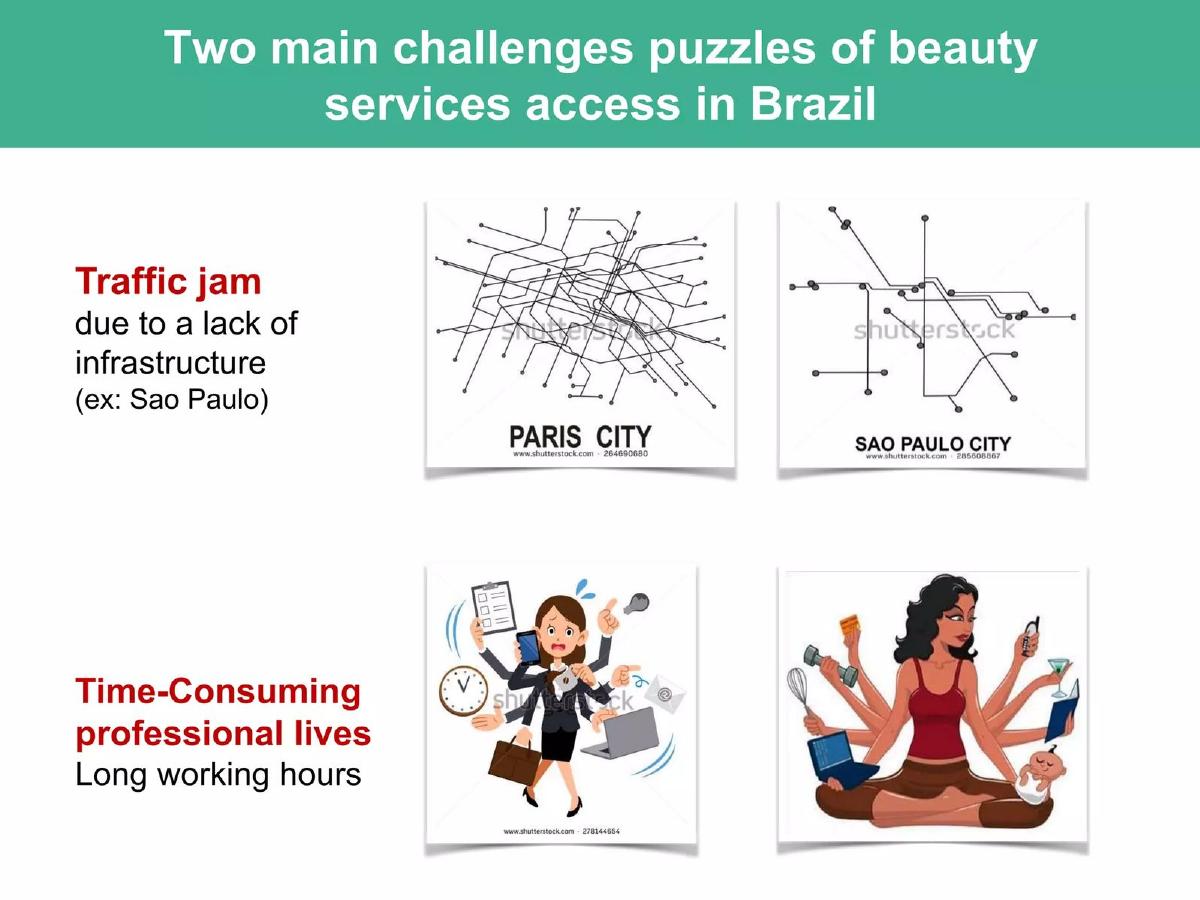
At-home beauty services in Brazil. Two challenges, each illustrated.
Belezen deck, slide 4. Exact stored slide matched to this analysis.
Our analysis: It explains why women can't get to a salon: traffic and working hours, the two things home visits fix.
Evidence and limitation: Metro maps of Paris and São Paulo as a comparison; no figures.
What a founder can adapt: Name the obstacles between the customer and the service, not the service's flaws.
Supporting analysis
What the deck claims: "Two main challenges puzzles of beauty services access in Brazil." "Traffic jam due to a lack of infrastructure (ex: Sao Paulo)." "Time-Consuming professional lives. Long working hours."
Presentation choice: The side-by-side metro maps make the infrastructure point visually.
When it does not fit: Stock illustrations with watermarks visible; use your own or none.
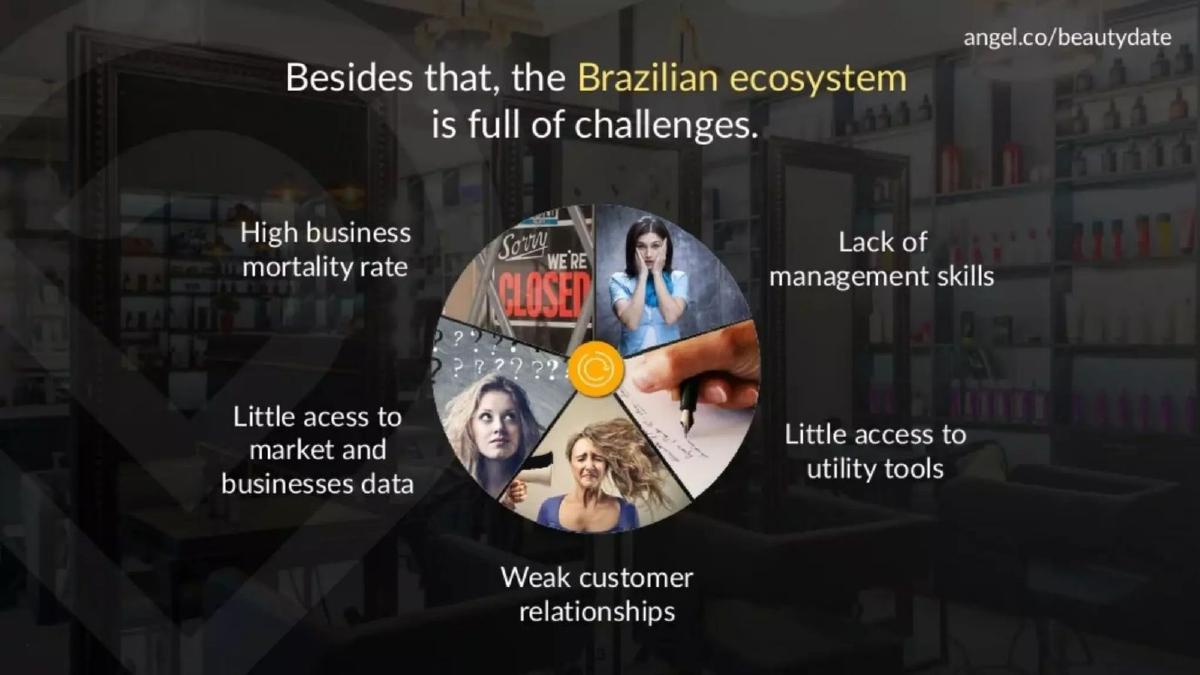
Salon management software in Brazil. Five challenges around a photo wheel.
BeautyDate deck, slide 4. Exact stored slide matched to this analysis.
Our analysis: It names the salon owner's problems, but five short labels with no figure read as a list.
Evidence and limitation: No figures.
What a founder can adapt: Pick the two challenges your software fixes and give each a figure.
Supporting analysis
What the deck claims: "Besides that, the Brazilian ecosystem is full of challenges." "High business mortality rate." "Lack of management skills." "Little access to market and businesses data." "Little access to utility tools." "Weak customer relationships."
Presentation choice: "High business mortality rate" is a strong opener if it has a number.
When it does not fit: "Besides that" assumes the previous slide; each slide should stand alone.
Natural skincare from Kashmiri produce. A text box with five labelled paragraphs.
Nature Alchemy deck, slide 2. Exact stored slide matched to this analysis.
Our analysis: Partial: two different problems (harmful skincare and wasted Kashmiri produce) plus the opportunity, all in one box.
Evidence and limitation: No figures.
What a founder can adapt: Choose the customer's problem for this slide and move the supply story to the solution.
Supporting analysis
What the deck claims: "Problem Statement." "Challenge: Current skincare products contain harmful chemicals." "Demand: Consumers seek natural, effective, and affordable solutions." "Market Gap: Lack of accessible, high-quality natural skincare options." "Additional Challenges: In Kashmir, surplus production of apples, saffron, almonds, and walnuts without sufficient value-added products..." "Opportunity: Utilizing surplus resources in Kashmir..."
Presentation choice: The labels (Challenge, Demand, Market Gap) are a useful structure.
When it does not fit: Putting the opportunity on the problem slide.
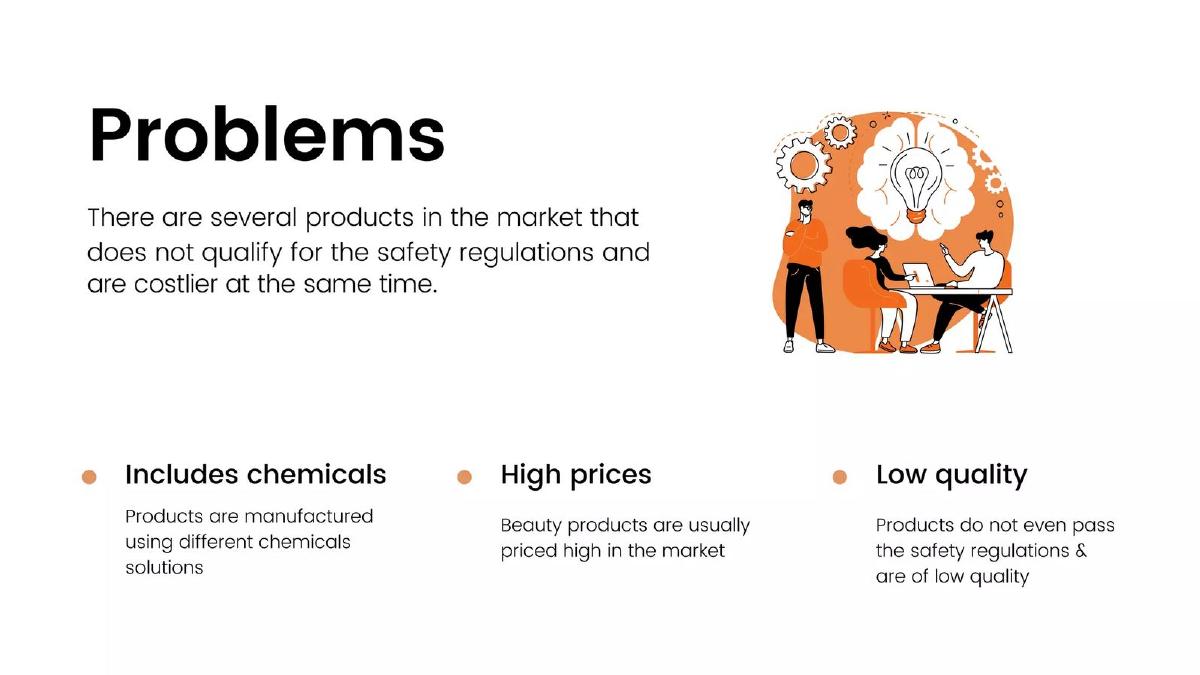
Beauty products. A sentence and three headings with one line each.
Beautyfyn deck, slide 2. Exact stored slide matched to this analysis.
Our analysis: Weak on purpose: three claims about the whole market with no customer, no product named and no number.
Evidence and limitation: No figures.
What a founder can adapt: Say which products, which regulations, and what shoppers pay.
Supporting analysis
What the deck claims: "Problems." "There are several products in the market that does not qualify for the safety regulations and are costlier at the same time." "Includes chemicals: Products are manufactured using different chemicals solutions." "High prices: Beauty products are usually priced high in the market." "Low quality: Products do not even pass the safety regulations & are of low quality."
Presentation choice: Kept as a contrast; compare Three Ships, which makes the same ingredient and price points with sources.
When it does not fit: "Products use chemicals"; all products do.
Whether each slide names who struggles, what goes wrong, and gives evidence.
Example
Who
What goes wrong
Evidence
Three Ships
Yes (US women)
Yes (labels, price)
Yes (sourced)
BeautyNow
Yes (both sides)
Yes
No
Blended
Yes (three personas)
Yes
No
Bauz
Partly
Yes (clogged blades)
No
Belezen
Partly (Brazil)
Yes (can't reach a salon)
Partly (maps)
BeautyDate
Yes (salon owners)
Partly (labels)
No
Nature Alchemy
Partly
Partly (two problems)
No
Beautyfyn
No
No
No
Key Takeaways
Name the shopper or salon and the moment: reading a label, booking a slot, rinsing a razor.
Back the problem with a sourced number; beauty claims are easy to doubt.
"Chemicals" is not a problem until you say which, and what they do.
For booking products, show both sides: the customer who can't book and the salon with empty slots.
Personas work when each has a different, specific frustration.
Build your beauty problem slide
One person, one moment, one sourced number.
Who. Which shopper, stylist or salon owner?
Moment. When does it go wrong: at the shelf, reading a label, booking, mid-routine?
Evidence. One figure with a source.
Today. What do they do instead, and why does it fail?
Copyable framework: [Person] [moment] and [what goes wrong]. [Figure] ([source]). Today they [workaround], which [why it fails].
Illustrative example 1 — written by us
Before: Beauty products contain harmful chemicals and are overpriced.
After: Women with eczema read an average of 6 labels before buying a moisturiser, and 1 in 3 still react to it; the dermatologist-recommended brands cost $45 a jar. (Source: our survey of 500 shoppers.)
What improved: Our illustrative rewrite; the figures are invented for the example. It names the shopper, the moment, the failure and the cost.
What this guide adds
This is the library's first guide on beauty startups. It covers products (Three Ships, Nature Alchemy, Beautyfyn), grooming hardware (Bauz), shopping (Blended) and salon services (BeautyNow, Belezen, BeautyDate).
Beauty decks split into two problems: what's in the product and whether the shopper can trust it, and how hard it is to book or reach a service.
Three things a beauty problem slide proves
Who: US women checking labels (Three Ships), travellers looking for a spa (BeautyNow), three shoppers by name (Blended), salon owners in Brazil (BeautyDate).
What goes wrong: "Can't find an appointment at the time needed" (BeautyNow), blades that "accumulate hair and dead skin" (Bauz).
"Contains chemicals". Name the ingredient and the effect, or drop it.
Market-wide claims. "Beauty is overpriced" needs a product and a price.
Two problems on one slide. Keep the customer's problem; supply stories go elsewhere.
Label lists. Five challenge labels with no numbers read as filler.
Watermarked stock images. They undermine the slide's credibility.
Diagnostic checklist
It names a specific shopper or business.
It describes the moment it goes wrong.
It gives one sourced number.
It says what they do today.
It has one problem, not two.
Frequently asked questions
How we chose these examples
Corpus: published pitch deck teardowns on StartupFundraising.com. Founder-uploaded private decks are excluded.
Selection (2026-09-25): we searched slides 2–5 for problem slides mentioning beauty, cosmetics, skincare, makeup, hair, salons or nails. Nine stored images were inspected. Glamour Cosmetic India slide 5 was left out as a close repeat of Beautyfyn's points; the AI Beauty Bot decks are product features, not problems. Bauz's solution slide (slide 4) is in the consumer solution guide; its problem slide is used here. Nature Alchemy is marked partial; Beautyfyn is kept as a weaker contrast.
Overlap check: none of these eight slides appears in another guide.
Review: all eight stored slide images were inspected on 2026-09-25 and matched to company, deck and slide number (editorial model review). No person has yet completed an editorial review of this page.
Claims are as shown on the slides; we have not verified them. We make no claim that any slide caused a fundraising outcome.