Beautyfyn is an early-stage skincare company positioning itself in the 'pure nature' segment. The deck reveals a company with modest initial traction, reporting 2000 customers served and a Monthly Recurring Revenue (MRR) of 1400 USD. While the deck identifies a massive Total Available Market of $380 billion, its own internal metrics show a slow monthly growth rate of just 2%. The fundraising ask is set at 1 Cr (approximately $120,000 USD), intended to fuel a go-to-market strategy built on digital marketing and influencer collaborations. However, the deck suffers from significant data gaps, in…
Key takeaways
- The company reports serving 2000 customers to date with a current MRR of 1400 USD (Slide 3).
- Monthly growth is currently stagnant at a rate of 2% (Slide 3).
- The Total Available Market is cited at $380 billion, with a targeted market share of 750M (Slide 4).
- The fundraising ask is 1 Cr, presented as an 'Investment opportunity' (Slide 8).
- The team consists of two primary members: Sanjay Kumar Ojha (Founder & CEO) and Shivali (COO) (Slide 7).
- Competitive advantages are listed as lower cost, better quality, and 'great packaging,' though no product photos are shown (Slide 6).
- The go-to-market strategy relies on four pillars: Digital Marketing, Influencer Partnerships, Offline Promotions, and Referrals (Slide 5).
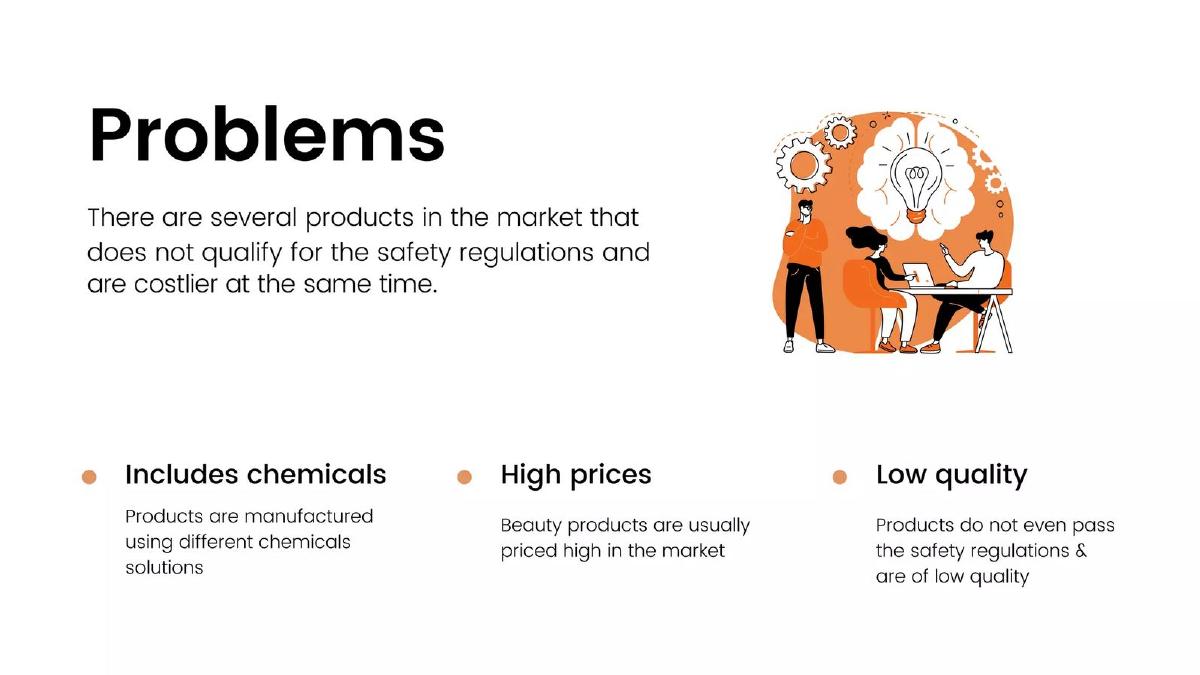
- The deck lacks a dedicated 'Problem' slide, moving directly from the title to 'Solutions' (Slide 2).
Slide-by-Slide Analysis
Slide 1: Title Slide
The cover slide features the brand name BEAUTYFYN in a serif typeface, accompanied by a circular logo containing the initials 'BF'. The tagline 'PURE NATURE' is repeated twice. The background uses a muted terracotta color block flanked by lifestyle photography of botanical elements and dropper bottles. While it establishes a 'natural' aesthetic, it lacks a clear one-sentence value proposition or a specific location/date for the pitch.
Slide 2: Solutions
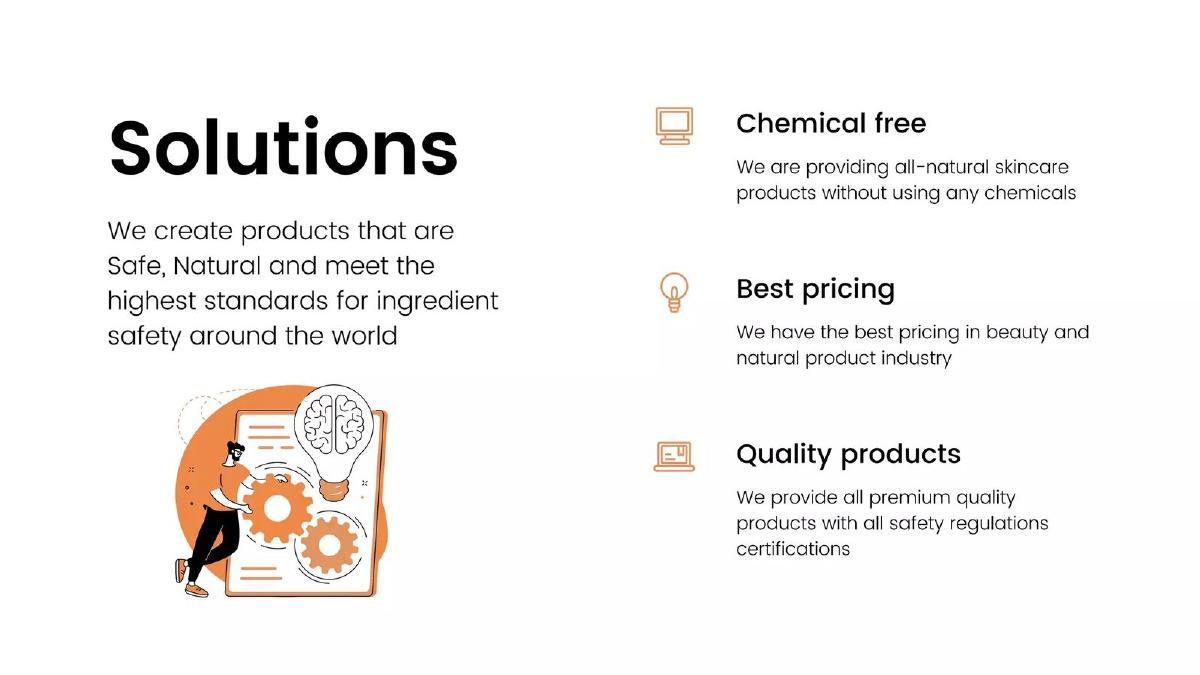
Unusually, the deck skips a dedicated 'Problem' slide and moves straight to 'Solutions'. It claims to create products that are 'Safe, Natural and meet the highest standards for ingredient safety around the world.' The slide lists three pillars: Chemical free , Best pricing , and Quality products . The text mentions 'all safety regulations certifications' but does not name specific ones (such as FDA, GMP, or ISO). The use of generic vector art of a person with gears and a lightbulb feels disconnected from the beauty industry.
Slide 3: Traction
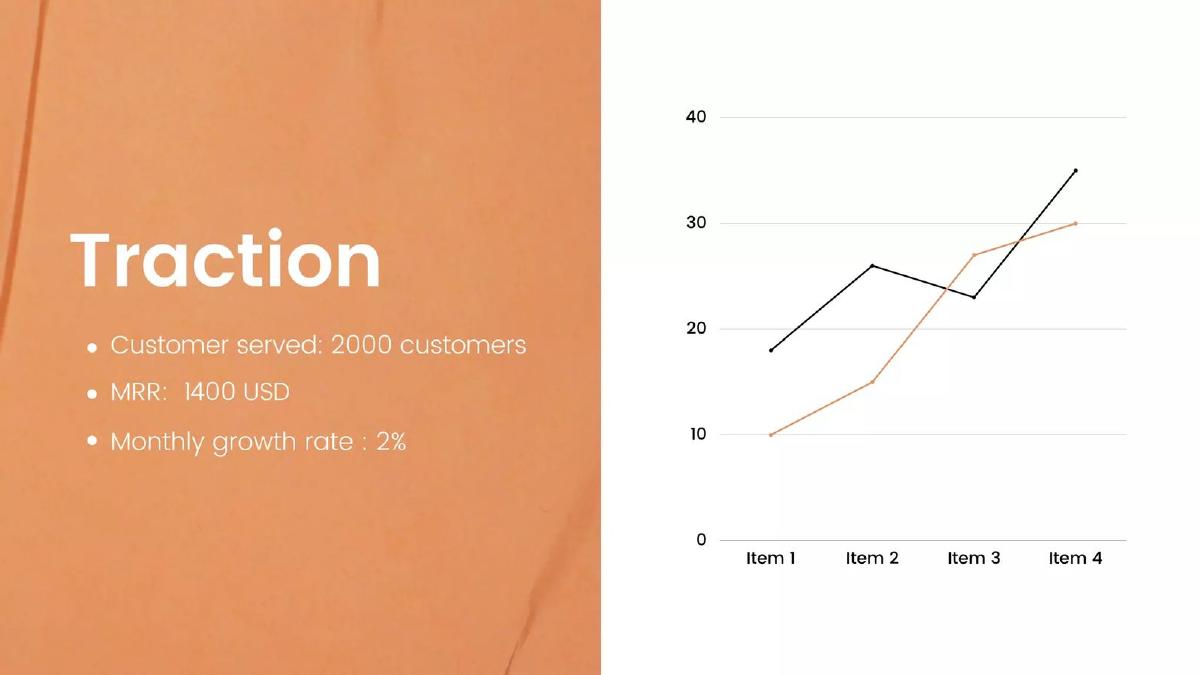
This slide provides the most critical data points in the deck. It lists:
Customer served: 2000 customers · MRR: 1400 USD · Monthly growth rate: 2%
The right side of the slide features a line graph with two data series. However, the axes are not labeled, and the 'Items' on the X-axis (Item 1 through Item 4) provide no chronological context. A 2% growth rate is notably low for a startup at this revenue level, suggesting a struggle with scale or customer acquisition efficiency.
Slide 4: Market Size
Beautyfyn uses a standard TAM/SAM/SOM layout. They value the Total Available Market at $380 billion and the Serviceable Available Market at $75 billion . Their specific Market Share target (SOM) is 750M . The slide does not cite sources for these figures, nor does it specify if these are global or regional (e.g., India-specific) numbers. The jump from a $1,400 MRR to a $750 million target represents a massive execution gap that the rest of the deck must address.
Slide 5: Go-To-Market Strategy
The strategy is presented as a list of four channels: Digital Marketing , Partnering with Influencers , Offline Promotions , and Referrals . This is a standard playbook for D2C (Direct-to-Consumer) brands. However, there is no detail on which platforms will be prioritized (Instagram vs. TikTok vs. Amazon) or how the 2% growth rate will be accelerated through these specific channels.
Slide 6: Competitive Advantages
Lower cost: Claiming to be 'way more affordable' than competitors. · Better Quality: Reiterating the safety and natural standards from the solution slide. · Great Packaging: Described as 'eye-catching' and something that 'exictes' (sic) customers.
The lack of a competitor matrix or specific price-point comparisons makes these claims difficult to verify. Furthermore, claiming 'Great Packaging' without showing a photo of the packaging is a missed opportunity.
Slide 7: The Team
The team slide introduces Sanjay Kumar Ojha (Founder & CEO) and Shivali (COO). The slide uses circular headshots framed by laurel wreaths. There are no bios, LinkedIn links, or mentions of previous experience in the beauty, retail, or manufacturing sectors. In early-stage fundraising, the 'founder-market fit' is often as important as the product, and this slide leaves that question unanswered.
Slide 8: Financials (The Ask)
The final slide in this set is titled 'Financials' but functions as the 'Ask' slide. It features a large orange circle with the text 1 Cr and the label 'Investment opportunity.' In Indian financial terms, 1 Crore is 10,000,000 INR. The slide does not provide a breakdown of how this capital will be allocated (e.g., % to marketing, % to R&D, % to inventory) or the runway it will provide.
What Beautyfyn Does Well
The deck is visually consistent. The color palette of terracotta and cream aligns well with the 'natural' and 'pure' branding they are aiming for. The traction slide is refreshingly honest; many early-stage founders attempt to hide low growth rates or small MRR figures, but Beautyfyn puts them front and center. This transparency can sometimes build trust with investors, provided the founder has a clear plan to improve those numbers.
The market size slide correctly identifies that the beauty industry is a multi-billion dollar opportunity. By breaking it down into TAM, SAM, and SOM, they show an understanding of standard venture capital frameworks, even if the specific numbers lack citations.
What is Missing from the Deck
The most glaring omission is the Product . In a D2C beauty pitch, investors expect to see the hero products, the ingredients, and the 'unboxing' experience. Without photos, the brand feels theoretical rather than tangible. There is also no mention of Unit Economics . For a brand with 2000 customers, investors will want to know the Customer Acquisition Cost (CAC), Lifetime Value (LTV), and Gross Margins. A 2% growth rate suggests that either the CAC is too high or the retention is too low, but the deck provides no data to explain this.
Additionally, there is no Problem slide. Why does the world need another natural skincare brand? Is the current market too expensive? Are 'natural' brands actually full of hidden chemicals? Without defining the pain point, the 'Solution' feels like a commodity. Finally, the Team slide lacks the professional pedigree necessary to convince investors that this specific duo can capture a $750M market share.
Founder's Guide: What to Copy and What to Avoid
Copy the simplicity: The deck is not cluttered. Each slide has a single focus, which makes it easy to digest during a quick first pass. The use of clear headings and bullet points is a good practice for ensuring readability.
Avoid the 'Ghost Product' trap: If you are selling a physical good, show it. High-quality product photography is non-negotiable in a beauty pitch. Using generic illustrations (like the ones on Slides 2 and 5) makes the startup look like a template rather than a real business.
Avoid vague competitive advantages: Claims like 'Better Quality' and 'Lower Cost' are made by almost every startup. To stand out, you must be specific. Instead of 'Lower Cost,' say '30% cheaper than Brand X.' Instead of 'Better Quality,' mention a specific patented ingredient or a clinical study result. Specificity creates credibility.
Improve the 'Ask': Simply stating '1 Cr' is insufficient. A professional pitch deck should include a 'Use of Funds' chart. Investors want to see that you have thought through the operational requirements of the next 18 months, not just picked a round number out of the air.
Frequently asked questions
- What is Beautyfyn's current revenue?
- According to Slide 3, Beautyfyn has a Monthly Recurring Revenue (MRR) of 1400 USD. This suggests the company is in a very early post-revenue stage, likely testing product-market fit with a small initial customer base.
- How much capital is Beautyfyn seeking?
- Slide 8 indicates an investment opportunity of 1 Cr. In the context of the Indian startup ecosystem where this terminology is common, 1 Crore equals 10 million Rupees, which is approximately $120,000 USD at current exchange rates.
- What is the company's growth trajectory?
- Slide 3 reports a monthly growth rate of 2%. For an early-stage startup seeking external capital, this is a relatively low figure, as investors typically look for double-digit month-over-month growth in the pre-seed or seed stages.
- Does the deck show the actual products?
- No. Despite claiming 'Great Packaging' as a competitive advantage on Slide 6, the provided slides contain no photographs of the actual skincare products, bottles, or labels, relying instead on generic illustrations.
- Who leads the company?
- The leadership team shown on Slide 7 consists of Sanjay Kumar Ojha, serving as Founder & CEO, and Shivali, serving as COO. The deck does not provide professional backgrounds or prior industry experience for either individual.