InfluxData’s Series E deck is a masterclass in category validation. By the time a company reaches a Series E, the 'if' of the product is settled; the 'how big' is the remaining question. InfluxData answers this by positioning time series data as the fastest-growing database category, citing a 1st place ranking on DB-Engines (Slide 5). With 750,000 active instances and 85,000 cloud signups, the deck leans on massive social proof and market tailwinds like the $31B IoT analytics market. While it lacks a traditional team slide or detailed financial projections, it compensates with an exhaustive l…
Key takeaways
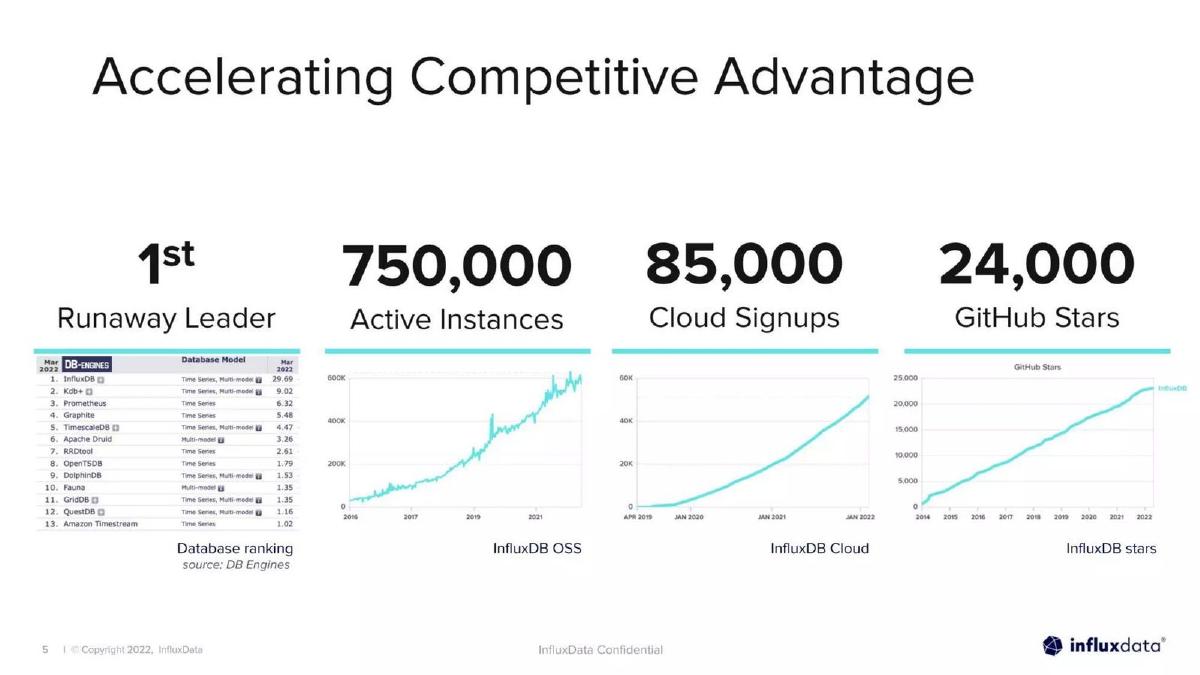
- InfluxData claims the #1 spot in time series database rankings, significantly ahead of competitors like Kdb+ and Prometheus (Slide 5).
- The company has built a massive top-of-funnel with 750,000 active open-source instances and 24,000 GitHub stars (Slide 5).
- The Total Addressable Market (TAM) for Time Series is estimated at $53B, driven by IoT, cloud infrastructure, and real-time analytics (Slide 15).
- The business model follows a proven path from Open Source to Enterprise Software to Cloud Service, mirroring MongoDB and Confluent (Slide 7).
- Market tailwinds are strong, with data creation growing at a 26% CAGR and IoT analytics expected to reach $31B by 2025 (Slides 12, 13).
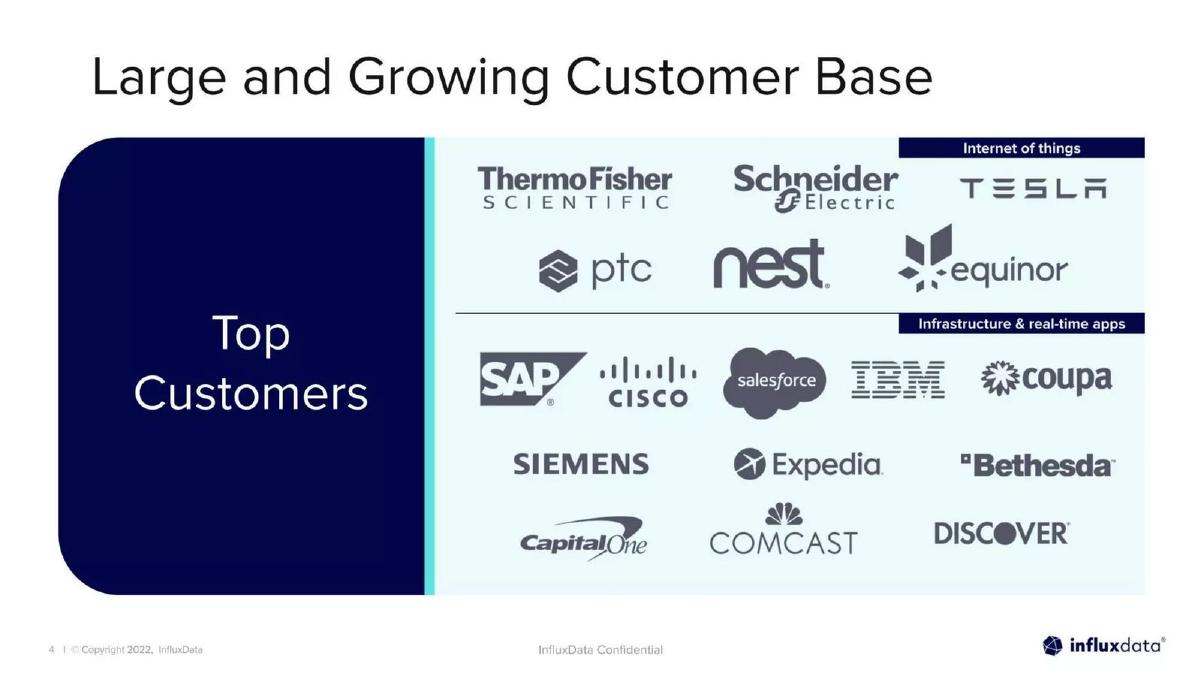
- The customer list is exceptionally high-quality, featuring major brands like Tesla, Nest, SAP, and Capital One (Slide 4).
- The deck emphasizes technical superiority, claiming 'unlimited' time series cardinality and millions of data points per second (Slide 18).
- There is a notable absence of a team slide, detailed financial history, or a specific 'ask' for the Series E round within these slides.
The Series E Narrative: From Category Creation to Category Dominance
InfluxData’s 2023 Series E deck is less about introducing a product and more about proving a market. At the Series E stage, investors are looking for evidence of a 'winner-take-all' trajectory. InfluxData provides this by leaning heavily on third-party validation and massive adoption metrics. The deck is structured to show that time series data is a distinct, massive, and rapidly growing category, and that InfluxData is its undisputed leader.
Slides 1-2: The Hook and the Executive Summary
Slide 1 is a clean title slide introducing InfluxDB as the 'time series data platform for IoT, analytics, and cloud applications.' The imagery of a stopwatch reinforces the 'time' element of their niche. Slide 2 , titled 'Painting the Picture,' serves as a three-point executive summary: a popular open-source product, an impressive TAM, and a successful evolution to a cloud-native platform. This sets the stage for the rest of the presentation, telling the investor exactly what they should believe by the end of the deck.
Slides 3-4: Social Proof and Enterprise Validation
Slide 3 uses high-impact brand imagery (Tesla, Nest, Disney+, Rappi) to show the real-world applications of their technology. This is immediately followed by Slide 4 , which provides a 'Large and Growing Customer Base.' The logos are segmented into 'Internet of Things' (Tesla, Nest, Schneider Electric) and 'Infrastructure & real-time apps' (SAP, Cisco, Salesforce, IBM). This slide is crucial for a Series E; it proves that the technology is mission-critical for the world's largest enterprises, moving beyond just 'hobbyist' open-source use.
Slide 5: The 'Runaway Leader' Metric
This is arguably the most important slide in the deck. It presents four key metrics that demonstrate market dominance: 1st place in database rankings (citing DB-Engines), 750,000 active instances of InfluxDB OSS, 85,000 cloud signups , and 24,000 GitHub stars . The inclusion of the DB-Engines table is a power move; it shows InfluxDB with a score of 29.69, while the next closest competitor, Kdb+, sits at 9.02. This 3x lead over the nearest rival is the definition of a 'runaway leader.'
Slides 6-7: Category Definition and Business Model
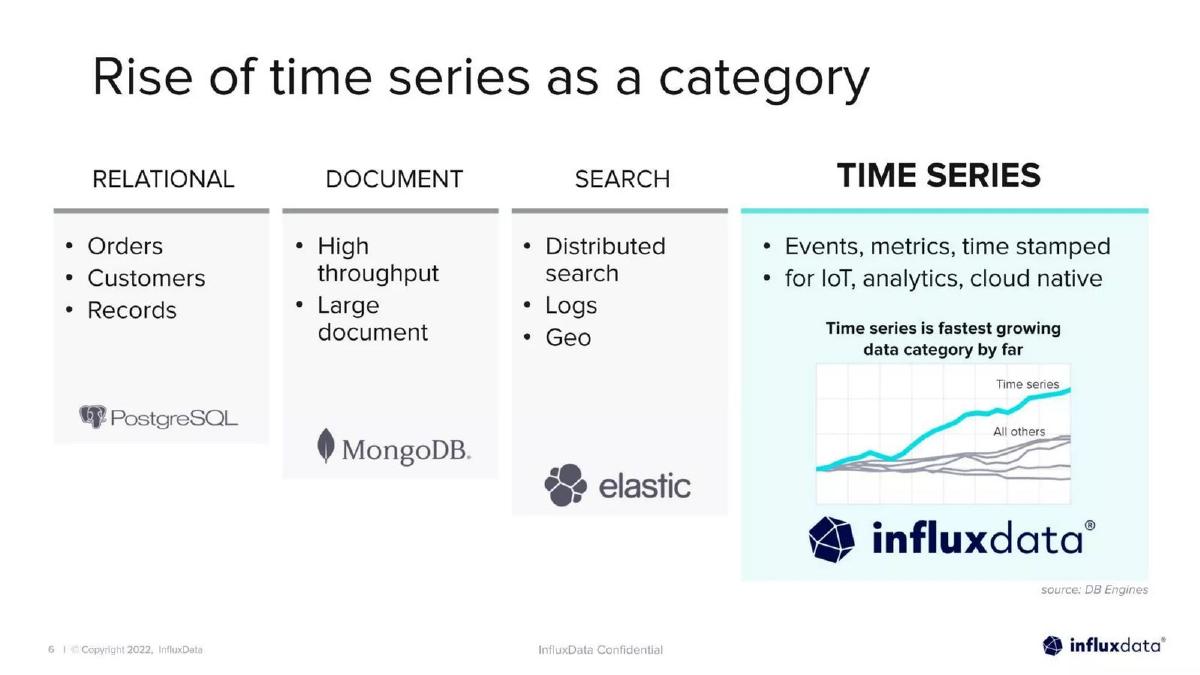
Slide 6 explains why Time Series is a separate category from Relational (PostgreSQL), Document (MongoDB), and Search (Elastic). It includes a small chart showing Time Series as the 'fastest growing data category by far.' Slide 7 , 'Following a well understood path,' is a strategic masterstroke. It compares InfluxData's trajectory to MongoDB, Confluent, and Elastic. By aligning themselves with these multi-billion dollar public companies, InfluxData makes their business model (Open Source -> Software -> Service) feel inevitable and de-risked.
Slides 8-11: The Rise of Time Series
This section focuses on the 'Why Now?' Slide 8 and Slide 9 argue that most data is best understood through time and that applications are being built in both 'Physical' (IoT) and 'Virtual' (Software) worlds. Slide 10 provides a dense grid of 'Mission critical use cases,' spanning Fintech (Capital One), Crypto (Solana), Gaming (Bethesda), and Sustainability (Tesla). Slide 11 returns to the DB-Engines data, showing a popularity chart from March 2020 to March 2022 where the 'Time Series' line climbs aggressively while other categories remain relatively flat.
Slides 12-15: The $53 Billion Opportunity
The deck moves into the 'How Big?' phase. Slide 12 cites research from 451 Research, IDC, and Goldman Sachs to project a $31 billion IoT analytics market by 2025 . Slide 13 looks at the broader data platform market, projecting it to reach $164 billion by 2025 with a 26% CAGR. Slide 14 highlights that InfluxData is playing in the fastest-growing segments, specifically Real-Time Analytics (197% growth) and IoT Analytics (129% growth). Finally, Slide 15 synthesizes this into a $53b Time Series TAM , broken down by IoT (45%), Cloud apps (25%), and Real-time analytics (10%).
Slides 16-18: Product and Performance
The final section addresses the product's technical moat. Slide 16 emphasizes 'One InfluxDB,' a common API across Cloud (consumption-based), Enterprise (subscription-based), and Open Source (community-based). Slide 17 summarizes the product into three pillars: API/Toolset, High Performance Engine, and Community. Slide 18 provides the technical 'wow' factor: 'Unlimited' time series cardinality and 'Millions' of data points per second . For a technical investor, these are the specs that justify the category leadership claimed earlier.
What Works in This Deck
The use of comparative anchoring is excellent. By placing themselves alongside MongoDB and Confluent, they bypass the need to explain their business model from scratch. The third-party validation (DB-Engines, IDC, Goldman Sachs) is relentless, making their claims of market leadership feel objective rather than promotional. The segmentation of customers also works well, showing that they aren't just an 'IoT database' but a horizontal platform used across Fintech, Gaming, and SaaS.
What Is Missing
As a Series E deck, this is remarkably light on financials . There are no mentions of ARR, Net Revenue Retention (NRR), or gross margins. While these were certainly in the data room, their absence in the main deck suggests this version was designed for high-level storytelling rather than a deep-dive audit. There is also no team slide , which is unusual, though at this stage, the company's 750,000 instances are a stronger testament to the team's ability than a list of resumes. Finally, there is no 'Ask' slide —no mention of how much they are raising or what the use of proceeds will be.
Founder Takeaway: Copy the 'Well Understood Path'
Founders building in the developer tools or infrastructure space should study Slide 7. If you are following a proven business model (like Open Core), don't try to reinvent the wheel in your pitch. Explicitly state that you are following the 'MongoDB path' or the 'Snowflake path.' It provides investors with a mental framework for your eventual exit and makes your growth projections feel grounded in historical precedent.
Frequently asked questions
- What is the primary value proposition of InfluxData?
- InfluxData positions itself as the leading platform for time series data, specifically optimized for IoT, analytics, and cloud applications. As shown on Slide 17, they focus on three pillars: a powerful API and toolset, a high-performance engine for real-time workloads, and a massive community of open-source developers.
- How does InfluxData monetize its open-source popularity?
- The company follows a 'well-understood path' (Slide 7) used by other successful data companies. They start with the open-source InfluxDB to gain developer adoption, move to InfluxDB Enterprise for on-premise subscription revenue, and finally offer InfluxDB Cloud as a consumption-based SaaS product.
- Who are InfluxData's main competitors according to the deck?
- Slide 5 lists the DB-Engines rankings, showing InfluxDB at #1. Competitors listed include Kdb+, Prometheus, Graphite, TimescaleDB, and Amazon Timestream. The deck highlights that InfluxDB's ranking score (29.69) is more than triple its nearest competitor, Kdb+ (9.02).
- What market trends are driving InfluxData's growth?
- The deck identifies three primary drivers: the explosion of IoT devices (reaching 12.2 billion by 2025, Slide 12), the general growth of data platforms to a $164B market (Slide 13), and the specific rise of time series as the fastest-growing database category (Slide 11).
- What is missing from the InfluxData Series E deck?
- The deck is missing several standard components: a team slide, a specific funding 'ask,' detailed unit economics (CAC/LTV), and a roadmap. This is common in late-stage decks where the brand is well-known and these details are often handled in a separate data room or supplemental documents.