Inductly, a mobile-first employee onboarding platform, raised $100,000 in 2017 with a remarkably brief 9-slide deck. The presentation relies heavily on full-bleed imagery and minimal text, aiming to communicate a 'simple' solution for HR managers. By focusing on the friction of manual onboarding—illustrated through icons of spreadsheets and paper manuals—the deck positions itself as a modern alternative for frontline workers, specifically referencing the Australian retail giant Woolworths as a contextual example. However, the deck is notably missing critical investor information: there is no…
Key takeaways
- The deck uses a single figure of $320 Billion on slide 2 to represent the market opportunity without further breakdown.
- Slide 3 features the Woolworths logo, suggesting a target customer profile or a specific use case in the retail industry.
- The 'Problem' is visualized on slide 4 using icons for XLS files, paper stacks, and manual training sessions.
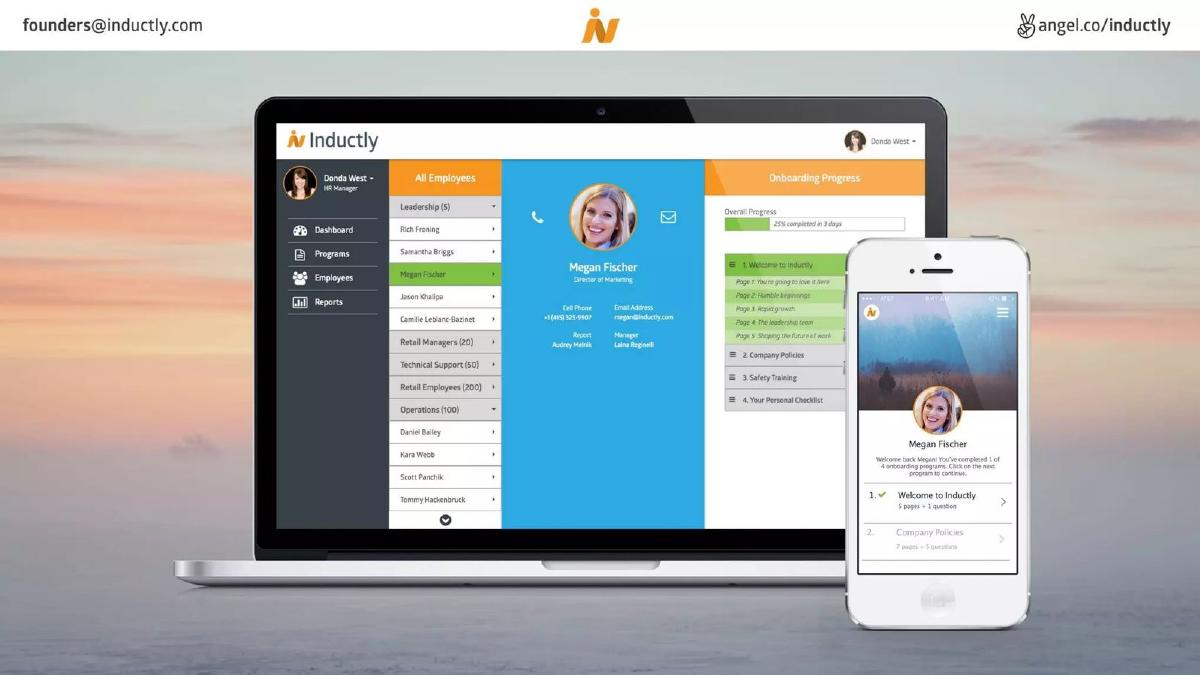
- Slide 6 provides the most detail, showing both an HR manager dashboard and a mobile employee interface.
- The team slide (slide 8) lists three members with experience at SAP, Tyco, and Dreamit Ventures.
- The deck contains no financial projections, revenue data, or customer traction metrics.
- There is no 'Ask' slide detailing how much capital is being raised or how it will be deployed.
- The company tagline, 'Simple employee onboarding,' is established on the title slide and maintained throughout.
Introduction: The 9-Slide Seed Deck
Inductly’s 2017 pitch deck is an exercise in extreme brevity. At only nine slides, it bypasses many of the traditional components of a venture presentation—such as competition, go-to-market strategy, and financial forecasts—to focus almost entirely on the product experience and the high-level problem. According to catalogue facts, this deck was used to secure $100,000 in seed funding. In the context of 2017, this was a modest raise, which may explain why the deck feels more like a proof-of-concept teaser than a late-stage pitch.
Slides 1-2: The Hook and the Macro Opportunity
Slide 1 is a standard title slide. It features the Inductly logo—a stylized 'i' and 'n' in orange—and the tagline 'Simple employee onboarding.' The contact email and AngelList URL are present in the corners, which is a practical addition for a deck intended for digital circulation.
Slide 2 attempts to establish the market scale. It features a high-resolution stock photo of professionals in a meeting room with a large orange overlay reading "$320 Billion." There is no text explaining what this number represents. In fundraising, a number without a label is often a red flag; while it suggests a massive opportunity, it fails to differentiate between the total cost of labor, the HR tech market, or the specific cost of onboarding inefficiency.
Slides 3-4: The Industry Context and the Problem
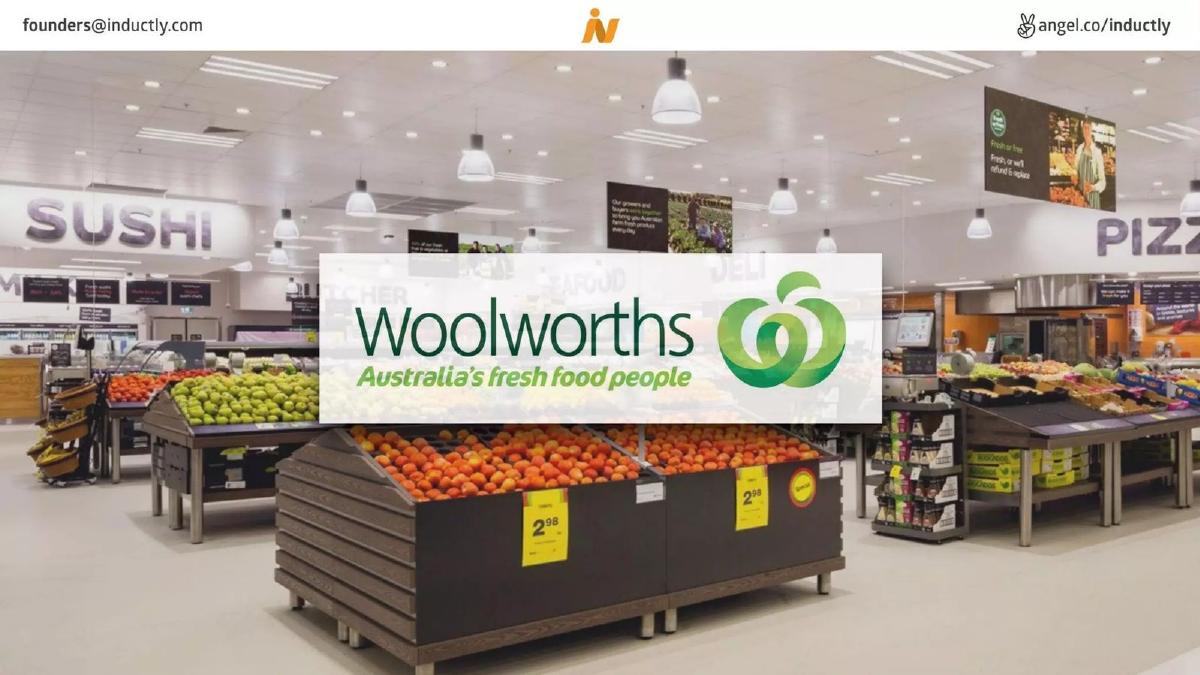
Slide 3 is perhaps the most specific slide in the deck, featuring the logo of Woolworths , a major Australian supermarket chain. The use of a specific corporate identity suggests either a pilot program, a target customer profile, or a case study. By placing a retail giant at the front of the deck, Inductly signals that its solution is built for high-volume, frontline workforces rather than just office-based corporate roles.
Slide 4 visualizes the 'Problem.' Instead of bullet points, the founders use five icons inside an orange box: an XLS file, a stack of papers, a person at a whiteboard, a play button (video), and a manual. This slide effectively communicates that current onboarding is fragmented across spreadsheets, physical documents, and classroom sessions. It sets the stage for a consolidated digital alternative.
Slides 5-6: The Solution and Product Interface
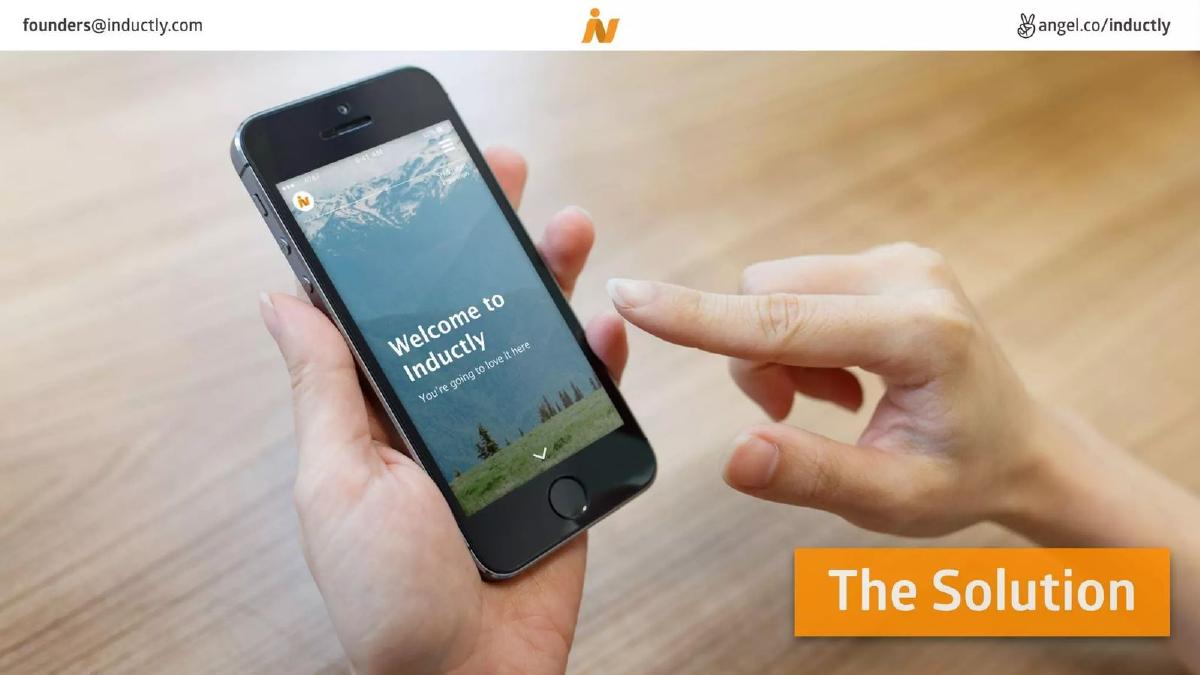
Slide 5 introduces 'The Solution' with a photo of a user holding a smartphone. The screen shows a 'Welcome to Inductly' message with the subtext, 'You’re going to love it here.' This emphasizes the 'simple and intuitive' nature mentioned in the company's self-description.
Slide 6 is the most substantive slide for an investor. It provides a side-by-side view of the HR Manager dashboard and the Employee mobile app . The dashboard shows 'Megan Fischer' as a new hire with a progress bar indicating she is '25% completed in 3 days.' The mobile view shows a checklist including 'Company Policies,' 'Safety Training,' and 'Your Personal Checklist.' This slide proves the product exists and demonstrates the dual-sided nature of the platform (admin vs. end-user).
Slides 7-9: Vision, Team, and Contact
Slide 7 is a 'vision' slide with the text "Shaping the future of work" over a photo of the New York City skyline. While aesthetically pleasing, it adds little technical or strategic value to the pitch.
Slide 8 introduces the team. Walter Haas (CTO & Co-Founder) , Jonathan Lai (CEO & Co-Founder) , and Wesley Ross (Head of Product) are pictured. Below them are logos for SAP , Tyco , and Dreamit Ventures . This implies a pedigree of enterprise software experience and suggests the company may have gone through the Dreamit accelerator. However, the slide does not specify their roles at these previous companies or their years of experience.
Slide 9 is a simple closing slide with the website, email, and AngelList link. There is no 'Ask' here. The deck ends without telling the investor how much money is needed or what the milestones for the next 18 months look like.
What Works
Visual Clarity: The deck is not cluttered. By using large icons and high-quality screenshots, the founders make the product's value proposition (moving from paper to mobile) immediately obvious. · Focus on Frontline: The inclusion of the Woolworths logo and the mention of 'Safety Training' on the product slide suggests a focus on the 'deskless worker' market, which is a distinct and underserved segment of HR tech. · Dual-Interface Demonstration: Showing both the manager's tracking dashboard and the employee's onboarding flow on Slide 6 answers the 'how it works' question effectively in a single glance.
What is Missing
The Business Model: There is zero mention of how Inductly generates revenue. Is it a SaaS model? Per seat? Per induction? This is a critical gap for any seed-stage investment. · Traction and Metrics: Beyond the Woolworths logo, there are no numbers regarding active users, number of inductions completed, or customer growth rates. · Competitive Landscape: The HR tech space is crowded with giants like Workday and smaller players like BambooHR. The deck fails to explain why Inductly’s 'simple' approach is defensible against incumbents. · The Ask: A pitch deck is a request for capital. By omitting the amount raised and the intended use of funds, the deck feels like a product demo rather than a business proposal. · Unit Economics: There is no data on Customer Acquisition Cost (CAC) or Lifetime Value (LTV), which are standard requirements for evaluating the scalability of a SaaS platform.
What a Founder Should Copy
The 'Problem' Visualization: Using icons to represent the 'old way' (Slide 4) is much more effective than a list of grievances. It allows the investor to visualize the clutter of the current process. · Clean UI/UX Presentation: Slide 6 is a great template for showing a platform. It shows the 'command center' for the buyer (HR) and the 'experience' for the user (Employee) simultaneously. · Consistent Branding: The orange and grey color palette is used consistently across all slides, creating a professional and cohesive brand identity despite the deck's short length.
Conclusion
Inductly’s deck is a 'teaser' deck. It is designed to get a first meeting by showing a slick product and a massive (if vague) market opportunity. While it succeeded in raising $100,000, a modern founder seeking a larger seed round would need to supplement this visual narrative with a robust slide on unit economics, a detailed go-to-market strategy, and a clear explanation of the $320 billion market figure. The deck proves that a clear product vision can open doors, but the lack of business fundamentals makes it a risky template for founders aiming for significant institutional capital.
Frequently asked questions
- What is the primary problem Inductly is trying to solve?
- Based on slide 4, Inductly targets the inefficiency of traditional onboarding methods. It uses icons representing spreadsheets (XLS), physical paperwork, and manual classroom-style training to illustrate the 'old way' of managing new hires. The solution, shown on slides 5 and 6, is a mobile-first application that digitizes these processes for both the employee and the HR manager.
- Who are the founders and what is their background?
- Slide 8 introduces the leadership team: Walter Haas (CTO & Co-Founder), Jonathan Lai (CEO & Co-Founder), and Wesley Ross (Head of Product). The slide includes logos for SAP, Tyco, and Dreamit Ventures, implying that the team has professional experience or accelerator backing from these specific organizations.
- Does the deck explain how Inductly makes money?
- No. The 9-slide deck completely omits a business model or pricing slide. There is no information regarding subscription tiers, per-employee fees, or implementation costs. This is a significant omission for a seed-stage deck, leaving investors to guess at the revenue strategy.
- What market size does Inductly claim to address?
- Slide 2 displays a large orange box with the text '$320 Billion.' The deck does not provide a source for this number, nor does it define whether this represents the Total Addressable Market (TAM) for HR software, the cost of employee turnover, or the specific onboarding niche. It is a 'vanity metric' used to establish scale without providing context.
- How does the product actually work for an HR manager?
- Slide 6 shows a desktop dashboard for an HR Manager named 'Donda West.' The interface includes a sidebar with sections for 'Dashboard,' 'Programs,' 'Employees,' and 'Reports.' It displays a list of employees categorized by department (e.g., Retail Managers, Technical Support) and tracks 'Onboarding Progress' as a percentage.