The WorkGenius pitch deck is a classic example of a 2015-era 'gig economy' play. At a time when Uber, Postmates, and GrubHub were scaling rapidly, WorkGenius identified a specific pain point: workers had to juggle multiple apps to earn a living wage. The deck uses a clean, mobile-first design to illustrate a three-step solution: set an earnings goal, connect existing gig apps, and claim work from a unified calendar. While it lacks deep financial modeling or a clear 'ask' slide, it effectively uses macro trends—citing a projected 37 million independent workers by 2020—to justify the market nee…
Key takeaways
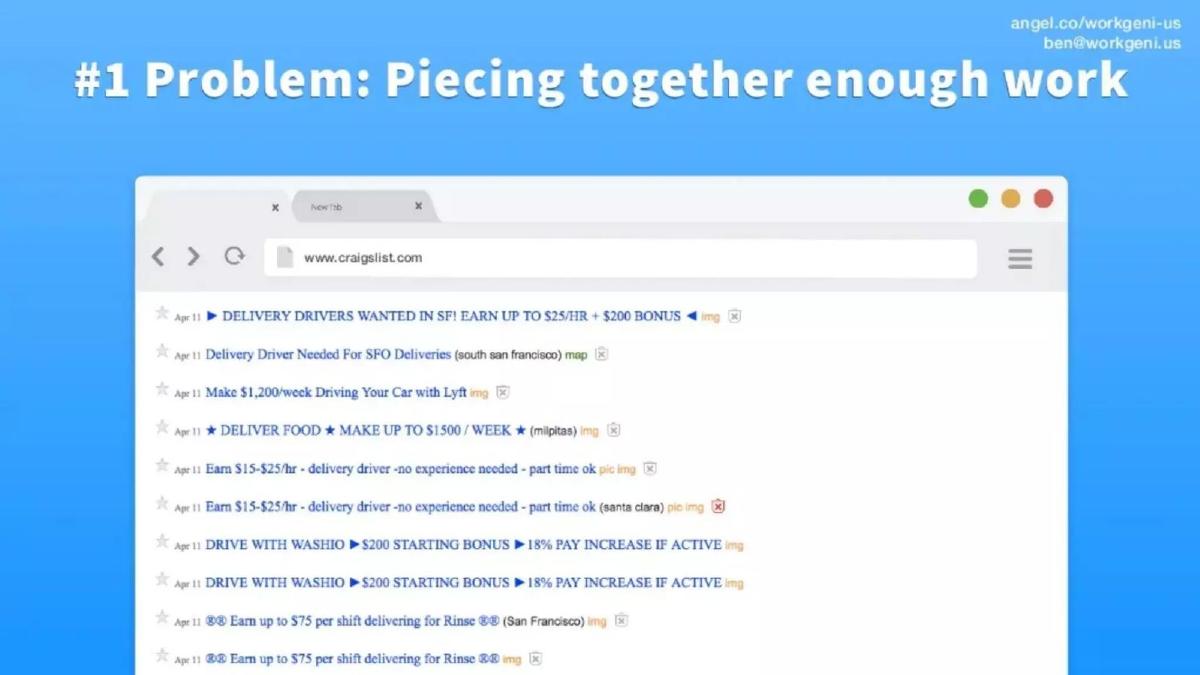
- The deck identifies 'piecing together enough work' as the primary problem for gig workers on slide 5.
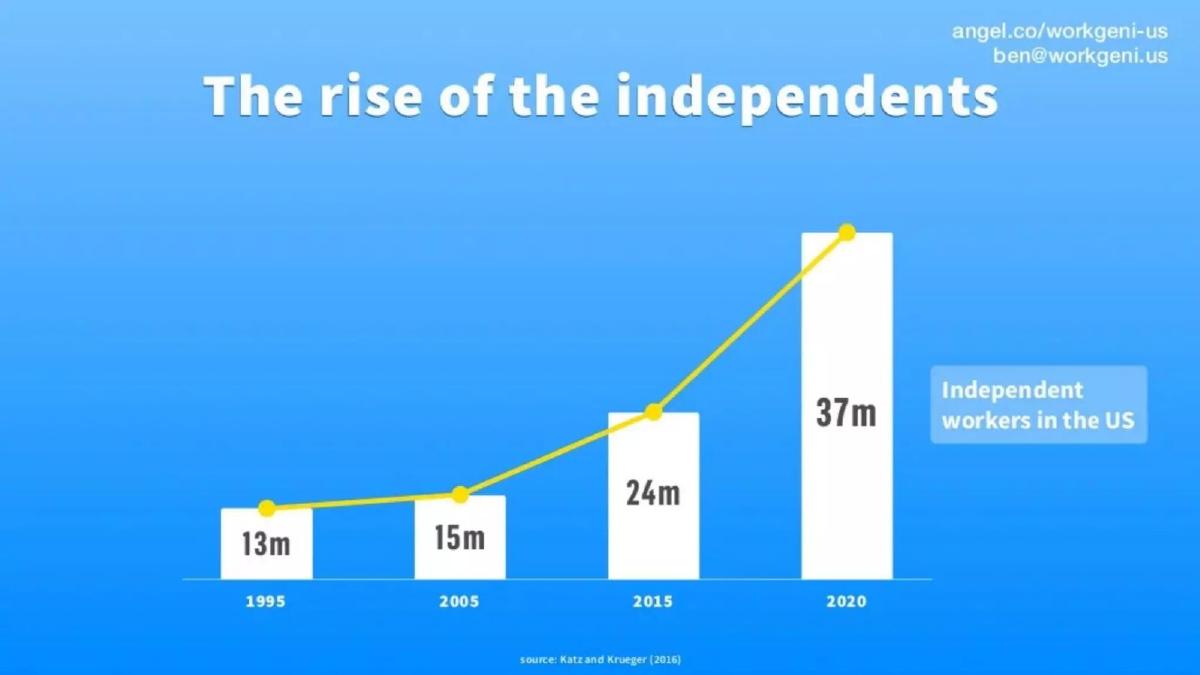
- Market size is justified by a growth chart showing independent workers increasing from 13m in 1995 to a projected 37m in 2020 on slide 3.
- The product demo is simplified into a three-step process: Set up, On-board, and Claim Work across slides 7-9.
- Early traction is demonstrated through a 'Private Beta in San Francisco' with over 2,200 hours worked on slide 10.
- The platform's value proposition is built on integrating existing services like Luxe, GrubHub, and Munchery, shown on slide 8.
- The team slide (slide 11) lists six members but omits specific titles or backgrounds, relying on logos like Vungle and Shyp for credibility.
- The deck lacks a formal 'Ask' slide, failing to specify the amount of capital being raised or the intended use of funds.
- Unit economics and a clear revenue model are entirely absent from the 13-slide presentation.
The Hook: A Hub for the New Economy
The WorkGenius pitch deck, dating back to 2015, captures a specific moment in the evolution of the gig economy. At this time, the 'Uber for X' craze was at its peak, leading to a fragmented landscape where workers had to manage five different apps just to stay busy. WorkGenius positioned itself not as another service provider, but as the 'Hub for Independent Workers' (Slide 1). This teardown examines how they used simplicity and macro-trends to secure their initial $125,000 in funding.
Slides 1-3: The Macro Opportunity
Slide 1: Title The deck opens with a minimalist blue gradient and a lightbulb icon. The tagline is clear: 'Hub for Independent Workers.' It includes contact information and an AngelList link, which was standard practice for the era.
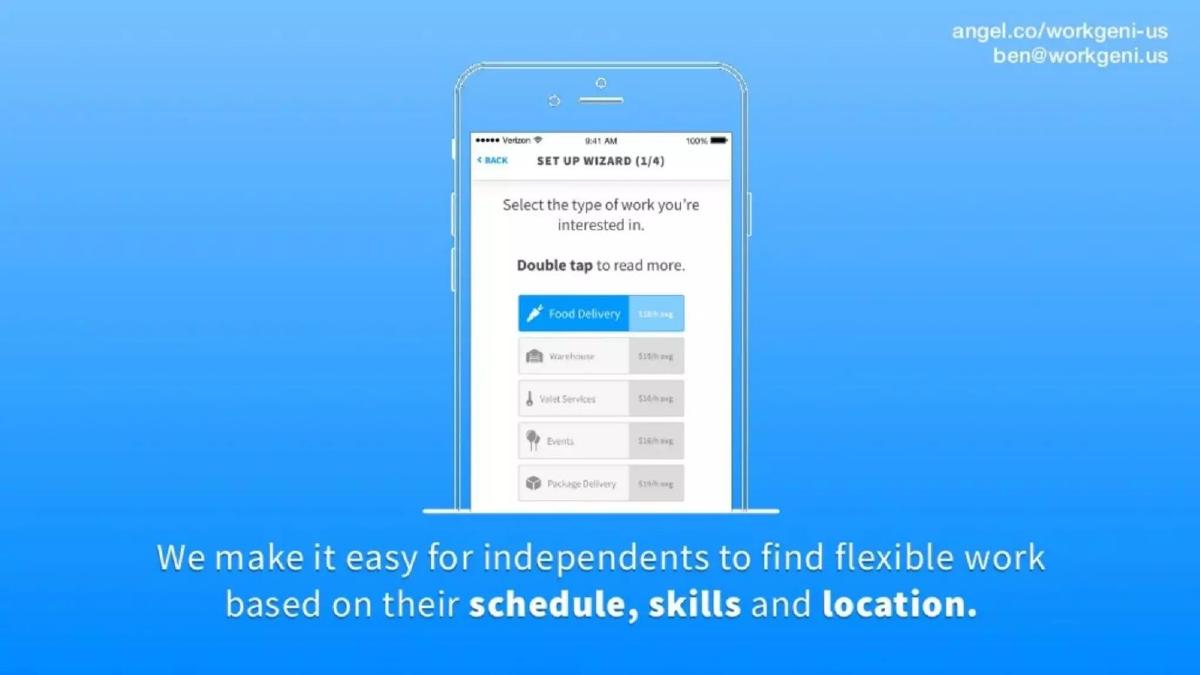
Slide 2: The Value Prop Immediately, the deck defines its mission: 'We make it easy for independents to find flexible work based on their schedule, skills and location.' The slide features a mobile mockup showing a 'Set Up Wizard' where users can select work types like Food Delivery ($18/h avg), Warehouse ($15/h avg), and Valet Services ($16/h avg). This establishes that the platform is an aggregator of existing gig roles.
Slide 3: Market Size Titled 'The rise of the independents,' this slide uses a bar chart to show the growth of the US independent workforce. It cites Katz and Krueger (2016) and shows a jump from 24 million workers in 2015 to a projected 37 million in 2020. This is a classic 'large and growing market' slide designed to convince investors of the venture-scale potential.
Slides 4-6: Defining the Pain Point
Slide 4: The User Motivation WorkGenius identifies the primary driver for this workforce as 'Control over schedule.' By showing a photo of a worker looking at two phones, it subtly hints at the complexity of the current workflow without needing much text.
Slide 5: The Problem This is the 'villain' of the story. The deck identifies the '#1 Problem' as 'Piecing together enough work.' It shows a screenshot of Craigslist with a list of delivery driver ads from various companies (Lyft, Washio, Rinse). The visual chaos of the Craigslist UI serves as a perfect foil for the clean WorkGenius UI shown later.
Slide 6: The Solution Statement A simple transition slide: 'We make it easy to find enough work.' It acts as a bridge between the problem and the product walkthrough.
Slides 7-9: The Product Walkthrough
Slide 7: Step 1 - Set Up The product demo begins with goal-setting. A mobile mockup asks, 'What is your daily earnings goal?' and shows a slider set to $100. This is a clever psychological hook; it shifts the focus from 'finding a job' to 'hitting a financial target.'
Slide 8: Step 2 - On-board This slide shows the integration layer. Users are prompted to 'Connect Your Apps.' Logos for Luxe, GrubHub, and Munchery are visible with toggle switches. This slide is crucial because it explains the 'how'—WorkGenius acts as a middleware layer for the gig economy.
Slide 9: Step 3 - Claim Work The final step of the workflow is a unified calendar. It shows a schedule for 'Wednesday, Jan 5th' with an 'Est. Earnings' of $153. The user has shifts from Luxe (7:00 AM - 10:30 AM), Deliv (2:00 PM - 4:00 PM), and Munchery (5:30 PM - 8:30 PM). This is the 'aha' moment of the deck, showing the fragmented problem from Slide 5 solved in a single view.
Slides 10-13: Traction, Team, and Vision
Slide 10: Traction The deck highlights a 'Private Beta in San Francisco' with '2200+ hours worked.' It also lists partners like Farm Hill, Deliv, Munchery, Bento, and Clutter. For a pre-seed round, 2,200 hours is a respectable proof of concept, showing that workers are actually using the tool to book shifts.
Slide 11: Team The team slide features six individuals: Aaron Sholin (Live Ops), AJ Shewki (Marketing), Bjorn Wanbo (Product), Ben Bear (CEO), Shashank Bharadwaj (Engineering), and TJ Mimbs (Worker Ops). Below the photos are logos for Vungle, Shyp, and Rinse. While it doesn't detail their specific roles at those companies, the logos provide 'social proof' by association.
Slide 12: Vision The vision slide moves beyond just scheduling. It shows a 'Profile' screen with a 'Reliability' score of 94% and a section for 'Anthem Blue Cross' insurance. This suggests WorkGenius intended to become a full-stack HR platform for the 1099 workforce, including benefits and portable reputations.
Slide 13: Closing The final slide features an 'Evolution of Man' graphic ending with a modern gig worker. It repeats the contact email (ben@workgeni.us) and the AngelList URL. Notably, there is no mention of how much money they are looking for or what the terms of the round are.
What Works in This Deck
The Problem-Solution Gap: The contrast between the 'messy' Craigslist slide (Slide 5) and the 'clean' Claim Work slide (Slide 9) is highly effective. It visually demonstrates the value of the product without requiring a long technical explanation.
Goal-Oriented Design: By starting the user journey with an 'earnings goal' rather than a 'job search,' WorkGenius tapped into the primary motivation of hourly workers. This framing makes the product feel like a financial tool rather than just another job board.
Macro-Trend Alignment: Using a 20-year growth chart (Slide 3) helps contextualize the startup as part of a larger economic shift. It makes the investment feel like a bet on the future of work rather than just a bet on a specific app.
What Is Missing
The Business Model: There is zero mention of how WorkGenius makes money. Do they take a cut from the partners? Do they charge the workers a subscription? Do they sell data? Investors generally want to see at least a hypothesis for monetization, even at the pre-seed stage.
The Ask: A pitch deck is a fundraising tool, yet this deck fails to state how much capital is being sought. Without an 'Ask' slide, the deck feels more like a product presentation than a business proposal.
Competitive Landscape: In 2015, several companies were attempting to solve the 'portable benefits' and 'unified gig worker' problem. The deck doesn't explain why WorkGenius's approach is superior to competitors or how they plan to defend their position once the major platforms (like Uber) inevitably try to lock workers into their own ecosystems.
What a Founder Should Copy
The Three-Step Demo: Founders should emulate the way WorkGenius distilled a complex technical integration into three simple, logical steps (Slides 7, 8, and 9). It makes the product feel inevitable and easy to use.
Visual Consistency: The deck uses a consistent color palette and clean typography throughout. This level of polish suggests a high attention to detail, which can subconsciously build trust with investors regarding the quality of the actual product.
Focus on the User: Instead of focusing on the 'features' of the backend, the deck focuses entirely on the 'experience' of the worker. By showing the worker's schedule and earnings, they make the benefits of the platform tangible and immediate.
Final Thoughts
The WorkGenius deck is a masterclass in simplicity. It identifies a massive, messy problem and presents a clean, intuitive solution. While it leaves many business questions unanswered—specifically regarding revenue and competition—it provides enough of a 'vision' of the future of work to justify a $125,000 pre-seed check. For founders at the earliest stages, this deck proves that a clear narrative and a few strong traction metrics can be more powerful than a 40-page financial model.
Frequently asked questions
- What was the primary problem WorkGenius aimed to solve?
- According to slide 5, the '#1 Problem' was 'Piecing together enough work.' The deck illustrates this by showing a cluttered Craigslist search results page. Independent workers were struggling to fill their schedules and reach their income goals because opportunities were fragmented across dozens of different on-demand apps and job boards.
- How did WorkGenius demonstrate market demand?
- WorkGenius used a macro-trend approach on slide 3, titled 'The rise of the independents.' Citing Katz and Krueger (2016), they showed a steady climb in the number of independent workers in the US, growing from 13 million in 1995 to 24 million in 2015, with a projection of 37 million by 2020. This framed the startup as a solution for a rapidly expanding demographic.
- What were the core features of the WorkGenius app?
- The product is presented as a three-step workflow. First, the user sets a daily earnings goal (e.g., $100) on slide 7. Second, they connect their existing gig economy accounts like Luxe, GrubHub, and Munchery on slide 8. Finally, slide 9 shows a unified calendar where workers can 'Claim Work' from different providers to fill their day and meet their earnings target.
- What traction did the company have at the time of the pitch?
- Slide 10 highlights a 'Private Beta in San Francisco.' The company reported '2200+ hours worked' through the platform. It also listed several 'partners' including Farm Hill, Deliv, Munchery, Bento, and Clutter, suggesting they had already established the necessary API or referral relationships to aggregate work opportunities.
- What is missing from the WorkGenius pitch deck?
- The deck is missing several critical components for a late-stage round but typical for a 2015 pre-seed. There is no 'Ask' slide (amount raised, valuation, or runway), no business model or monetization strategy, and no detailed competitor analysis. Furthermore, while it lists a team of six, it provides no professional biographies or specific track records for the founders.