WoowUp, a CRM and predictive marketing platform, utilized a minimalist 9-slide deck to raise $350,000 in 2012. The deck is notable for its heavy emphasis on the Brazilian market opportunity, citing a $600 billion retail and consumer market. Rather than spending time on complex technical explanations, the founders leaned into their early traction: $12,000 MRR, 90% margins, and a 22% month-over-month growth rate. The team slide highlights significant pedigree, including a founder with a previous exit to Globant. While the deck lacks a formal 'Ask' slide or detailed competitor analysis, its focu…
Key takeaways
- The company achieved a 19% increase in sales for their case study client, Bienestar, as shown on slide 2.
- WoowUp identifies a $600 billion retail and consumer market in Brazil, with $10.2 billion specifically in 2015 e-commerce sales projections on slide 5.
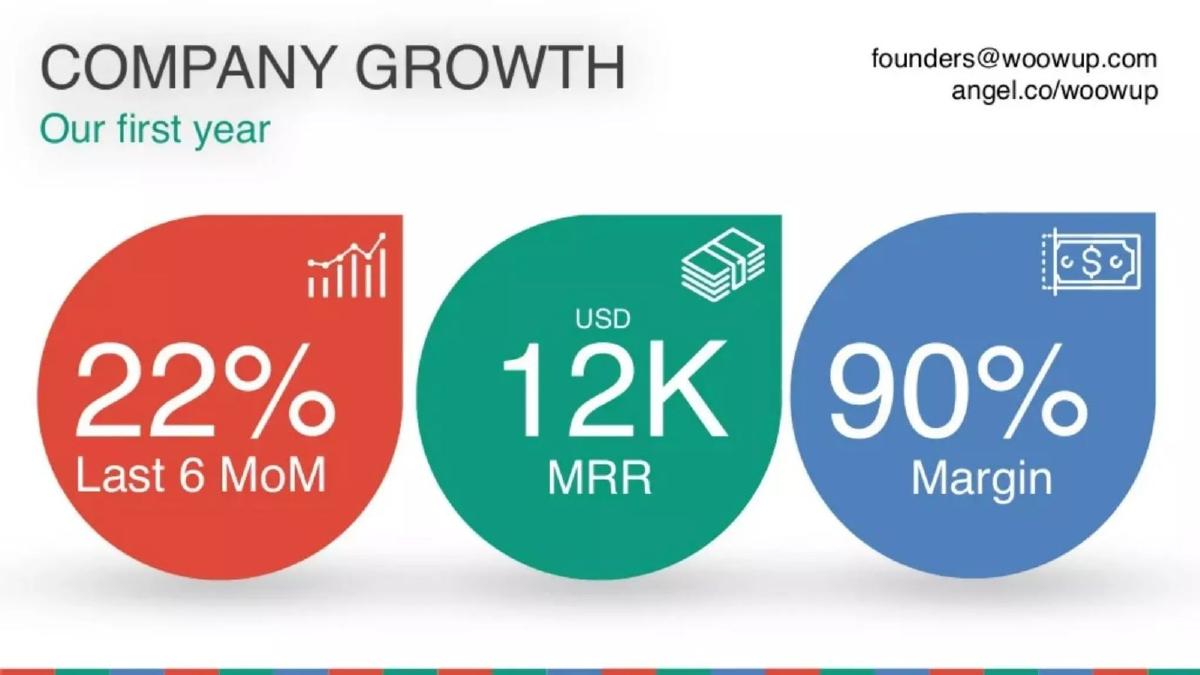
- Financial traction at the time of the deck included $12,000 USD in Monthly Recurring Revenue (MRR) on slide 6.
- The business model boasts a 90% margin and 22% month-over-month growth over the last six months, according to slide 6.
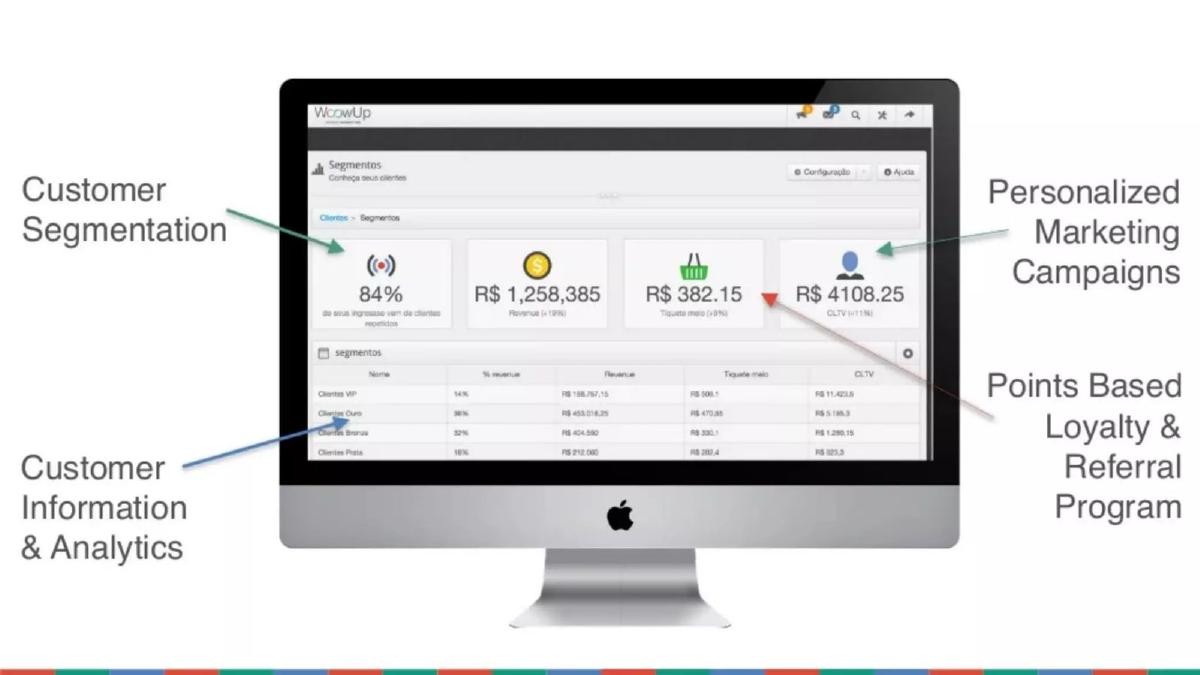
- The product interface includes modules for customer segmentation, personalized marketing, and points-based loyalty programs, as detailed on slide 3.
- Founder Enrique Novomisky brings significant credibility with a previous exit to Globant (NYSE: GLOB), noted on slide 8.
- The deck claims a 100% success rate or conversion for 'Pilots' on slide 7, though it does not specify the number of pilots conducted.
- The deck concludes on slide 9 with a goal of reaching break-even and doubling revenue, but omits a specific dollar amount for the funding ask.
The WoowUp Pitch Deck: A Minimalist Approach to Pre-Seed Fundraising
In 2012, WoowUp raised $350,000 for its CRM and predictive marketing platform. At a time when pitch decks were often bloated with 20+ slides of market theory, WoowUp took the opposite approach. Their 9-slide deck is a study in efficiency, focusing almost exclusively on three things: the size of the Brazilian market, the strength of their early traction, and the technical pedigree of the founding team. By stripping away the fluff, they presented a lean, high-margin business that was already proving its value in the real world.
Slides 1-3: The Hook and the Product
Slide 1: Title Slide The deck opens with a clean logo and a very specific subtitle: "CUSTOMER RETENTION FOR BRAZIL." This is a strategic choice. Instead of claiming to be a global CRM leader, they stake a claim on a specific, high-growth geography. This immediately tells an investor which 'bucket' this startup belongs in.
Slide 2: Customer Retention Case Study Rather than starting with a problem slide, WoowUp leads with results. They feature a case study for a brand called 'Bienestar,' claiming a "19% Increase in sales." Using a real-world outcome as the second slide is a powerful way to validate the product before even explaining how it works. It shifts the conversation from 'what if' to 'it works.'
Slide 3: Product Interface The product slide uses a single screenshot of a dashboard on an iMac. Four callouts explain the core functionality: Customer Segmentation, Customer Information & Analytics, Personalized Marketing Campaigns, and a Points Based Loyalty & Referral Program. The dashboard itself shows figures in Brazilian Real (R$), reinforcing the geographic focus. Notable metrics on the screen include a CLTV (Customer Lifetime Value) of R$ 4108.25 and a repeat customer rate of 84%.
Slides 4-5: The Market Opportunity
Slide 4: MarTech Growth This slide acts as a bridge between the product and the market size. It notes "Exponential growth in USA" with a "10X" multiplier. The implication is clear: the MarTech explosion seen in the US is about to happen in South America, and WoowUp is positioned to catch that wave.
Slide 5: The Brazilian Market This is the 'Big Number' slide. It uses a graphic of Brazil overlaid with the national flag and cites two massive figures: a "$10.2B Sales 2015 e-Commerce" projection and a "$600B Retail and consumer market." By showing the total retail market alongside the e-commerce segment, they demonstrate both the current opportunity and the massive headroom for growth as retail moves online.
Slides 6-7: Traction and Validation
Slide 6: Company Growth This is arguably the most important slide in the deck. It breaks down the performance of their first year into three simple circles:
22% Last 6 MoM (Month-over-Month growth) · $12K USD MRR (Monthly Recurring Revenue) · 90% Margin
For a pre-seed company, $12,000 in MRR with 90% margins is an incredibly strong signal. It proves the software is scalable and that the founders have a handle on unit economics.
Slide 7: Pilots This slide is the briefest in the deck, featuring a large "100%" next to a cash icon. While it lacks context (i.e., 100% of what?), the placement suggests that 100% of their pilot programs converted into paying customers. This reinforces the 'it works' narrative established on slide 2.
Slides 8-9: The Team and the Future
Slide 8: Our Team The team slide focuses on two founders. Martin Biegun is highlighted for his MBA and experience at Genesys and Microsoft. Enrique Novomisky is the technical powerhouse, noted as a Software Engineer with a "Previous exit, acquired by Globant (NYSE: GLOB)." Having a founder who has already successfully exited to a major public company like Globant significantly de-risks the investment for early-stage backers.
Slide 9: The Goal The final slide does not ask for a specific dollar amount. Instead, it lists two milestones: "Break Even" and "2X Revenue." It includes the founders' email and an AngelList link. While the lack of a specific 'Ask' is unusual, the focus on reaching break-even suggests a capital-efficient mindset that appeals to many angel investors.
What Works in the WoowUp Deck
Extreme Focus on Traction: By slide 6, the investor knows exactly how much money the company makes, how fast it is growing, and how profitable it is. Many founders hide these numbers in the appendix; WoowUp puts them front and center.
Geographic Specialization: By branding themselves as the solution "for Brazil," they make themselves the logical choice for investors looking for exposure to the Latin American market. It turns a potential weakness (limited geographic reach) into a competitive moat.
Founder Pedigree: Mentioning the NYSE-listed acquisition of the CTO's previous company is a major credibility booster. It proves the team can build and sell technology at scale.
What is Missing from the WoowUp Deck
The Problem Slide: The deck never explicitly states what is wrong with current CRM solutions in Brazil. While the results imply a solution, a clear problem statement helps investors understand the 'pain' they are solving.
Competitive Analysis: There is no mention of competitors like Salesforce, HubSpot, or local Brazilian players. Investors need to know why WoowUp will win against established giants.
The Ask: The deck ends without telling the investor how much money is needed or how it will be spent. This forces a follow-up conversation, which can be a tactic, but usually, a 'Use of Funds' slide is expected to show strategic planning.
What a Founder Should Copy
The 90% Rule: If you have high margins, shout them from the rooftops. Slide 6 is a perfect example of how to display unit economics simply and effectively.
Result-First Logic: Leading with a case study (Slide 2) is much more persuasive than leading with a list of features. Show the value you've created for a real customer before you explain the code behind it.
Clean Visuals: The deck uses a consistent color palette (red, green, blue) and very little text. This ensures that the investor stays focused on the key numbers rather than getting lost in paragraphs of jargon.
Conclusion WoowUp's deck is a reminder that you don't need 20 slides to raise six figures. If your team is strong and your traction is undeniable, brevity is your friend. They identified a massive market, proved they could capture a slice of it profitably, and showed they had the team to execute. For a pre-seed round, that is often all an investor needs to see.
Frequently asked questions
- What is the primary value proposition of WoowUp?
- WoowUp positions itself as a customer retention and predictive marketing tool specifically tailored for the Brazilian market. According to the product slide, it combines customer segmentation, analytics, and a points-based loyalty and referral program to help retail stores personalize communications and drive repeat purchases.
- How does the deck justify the market opportunity in Brazil?
- Slide 5 uses large-scale macroeconomic figures to validate the opportunity. It cites a $600 billion total retail and consumer market and a $10.2 billion e-commerce market for 2015. By framing the company as 'Customer Retention for Brazil,' they signal a localized focus that global competitors might overlook.
- What are the key financial metrics shared in the deck?
- The deck is very transparent about its early-stage performance. Slide 6 highlights $12,000 in MRR, a 90% profit margin, and a 22% month-over-month growth rate. These figures suggest a highly efficient, scalable software model that was already generating meaningful revenue before the pre-seed round.
- Who are the founders and what is their background?
- The team consists of Martin Biegun, who holds an MBA and has experience with Genesys and Microsoft, and Enrique Novomisky, a software engineer. Novomisky is highlighted for having a previous exit to Globant, a company listed on the NYSE, which provides significant investor confidence.
- What is missing from this pitch deck?
- The deck is missing several standard elements: a formal 'Problem' slide, a 'Competitor' matrix, a detailed 'Use of Funds' breakdown, and a specific 'Ask' (the amount of money they are raising). It relies almost entirely on traction and team pedigree to carry the narrative.