WorkClout's 2018 Seed deck is a lean, 10-slide presentation that successfully raised $2.5 million by leaning heavily on founder-market fit and a clear gap in the industrial software market. The company identified that while 44% of manufacturers spend $24B on software, 56% of SMBs remain underserved or rely on manual processes like paper and fax. The deck excels by contrasting legacy software—which costs an average of $250k with a 2-year implementation—against WorkClout’s 4-week implementation and 20% throughput increase. While the deck lacks a formal 'Ask' slide and detailed unit economics, i…
Key takeaways
- The deck highlights a massive market inefficiency where 56% of manufacturers do not currently use software (Slide 7).
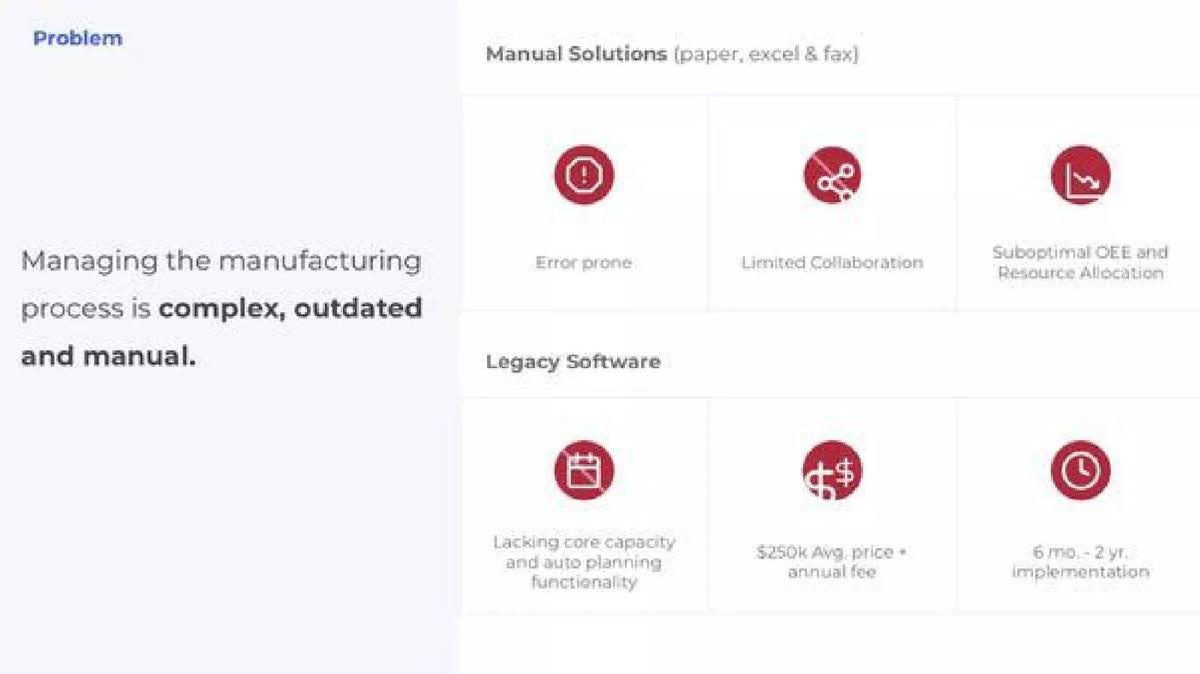
- Legacy software is framed as a barrier due to a $250k average price and a 6-month to 2-year implementation timeline (Slide 3).
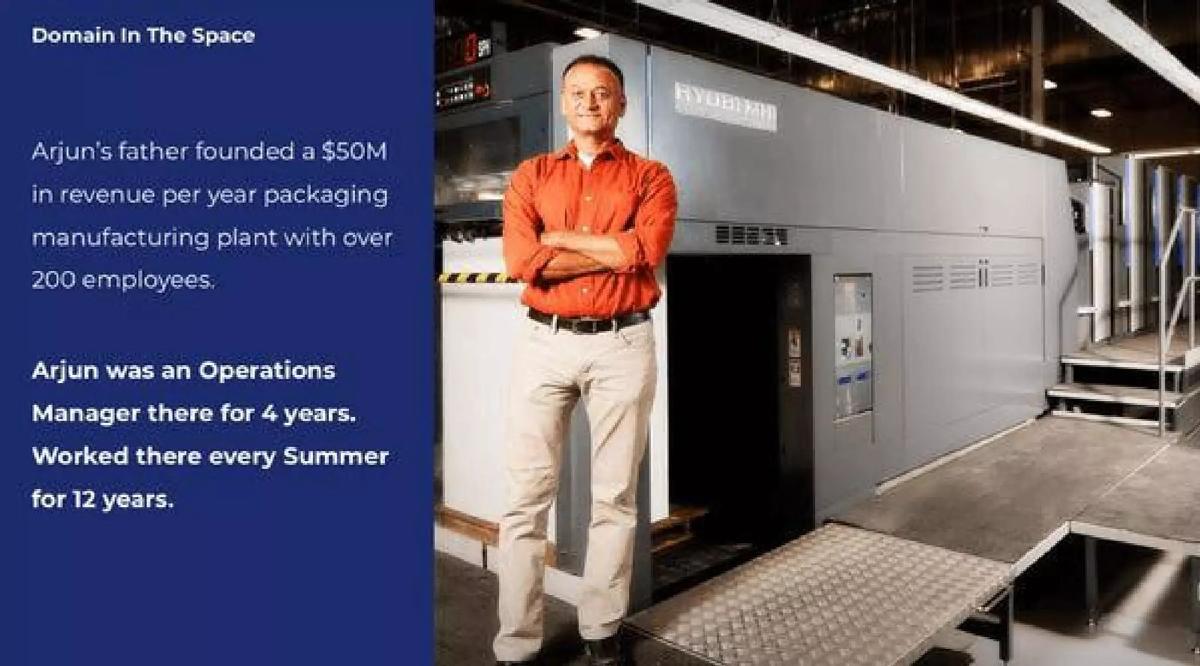
- Founder Arjun Patel establishes immediate credibility by citing 12 years of experience at his father's $50M revenue manufacturing plant (Slide 2).
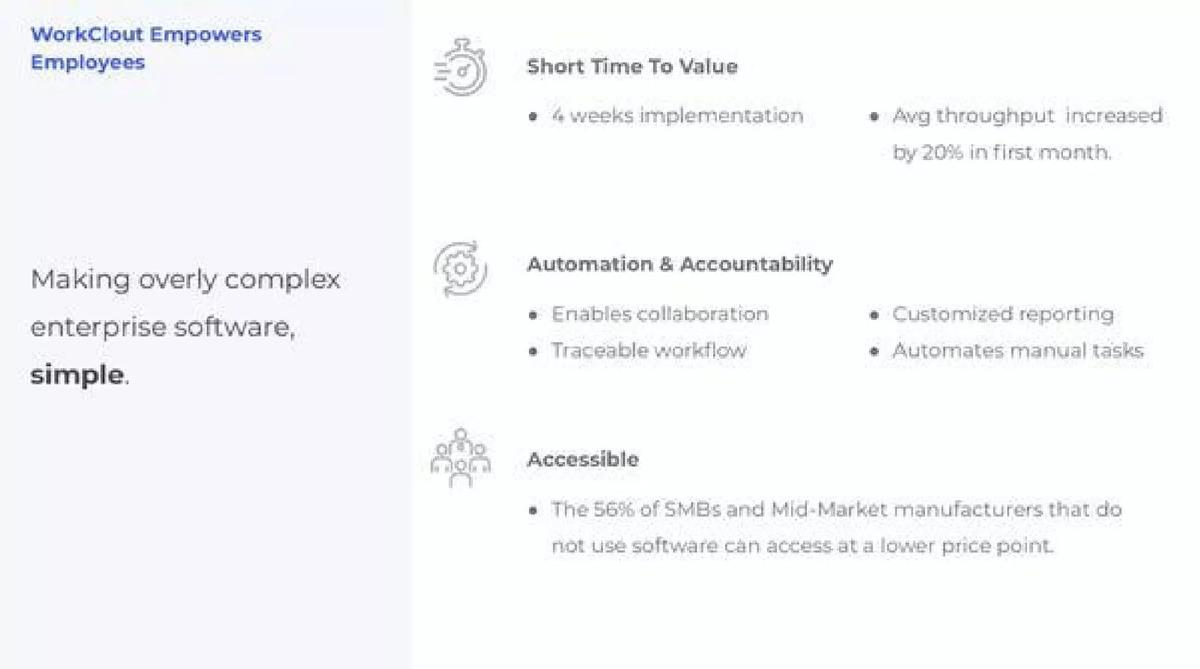
- The product claims a significant ROI, stating that average throughput increased by 20% in the first month of use (Slide 5).
- WorkClout targets the 'deskless' workforce, which represents 80% of the global workforce across multiple industries (Slide 8).
- The team slide showcases high-tier pedigree with past experience at Tesla, Disney, and Y Combinator (Slide 9).
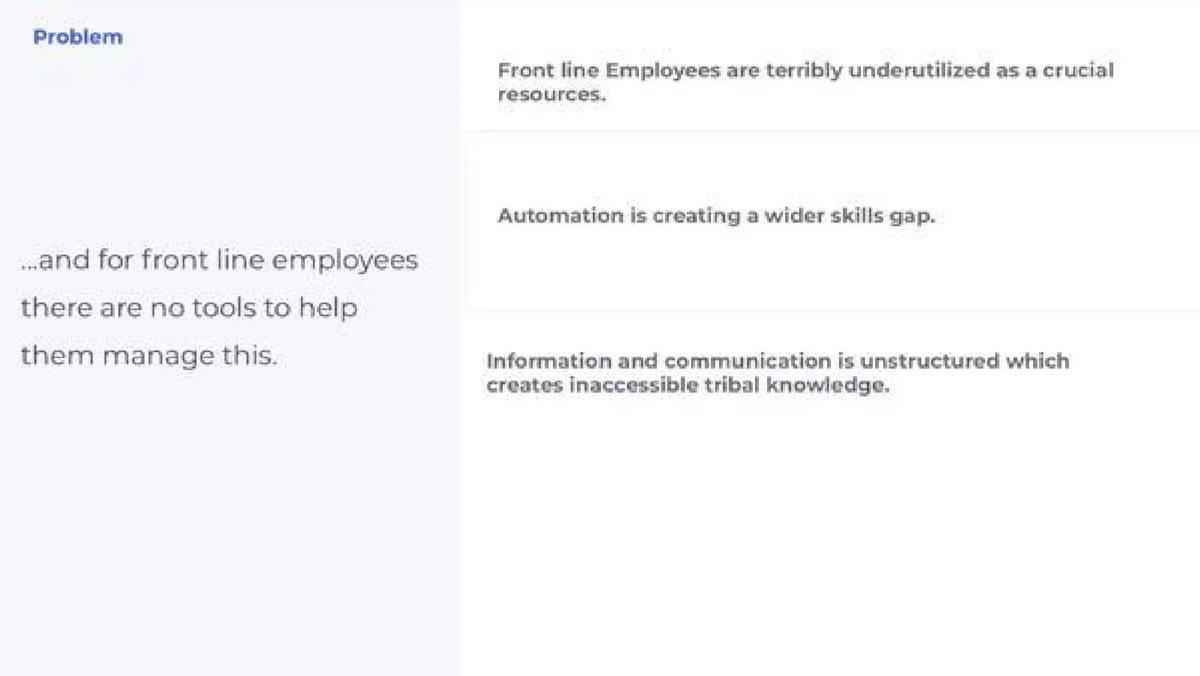
- The deck identifies 'tribal knowledge' as a core problem, where unstructured communication makes information inaccessible (Slide 4).
- Market sizing is specific, noting 354,000 manufacturers in the US and 998,000 worldwide (Slide 7).
Introduction: The Lean Seed Deck
WorkClout’s 2018 Seed deck is a study in brevity. At only 10 slides, it follows a classic narrative arc: establish founder credibility, identify a massive but underserved market, and present a solution that is faster and cheaper than the status quo. While many modern decks suffer from over-design, WorkClout uses a clean, high-contrast layout that prioritizes legibility and data points. The company, which eventually raised $2.5 million, focused its pitch on the 'deskless worker'—a demographic often ignored by traditional SaaS but vital to the global economy.
Slide 1: Title and Vision
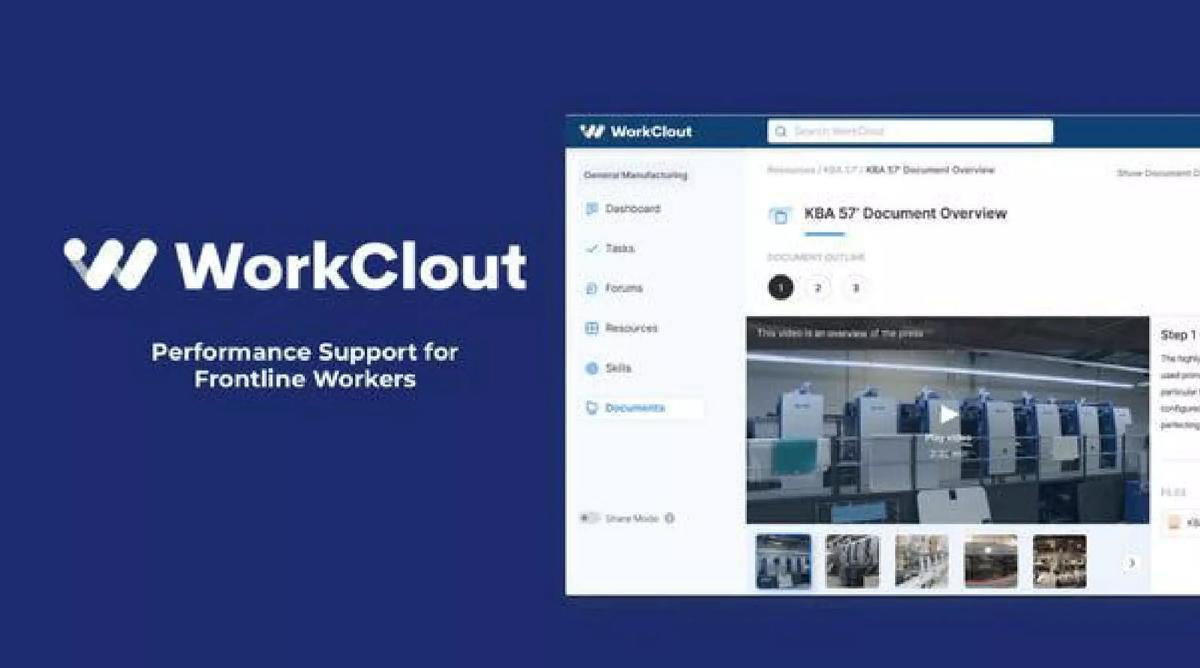
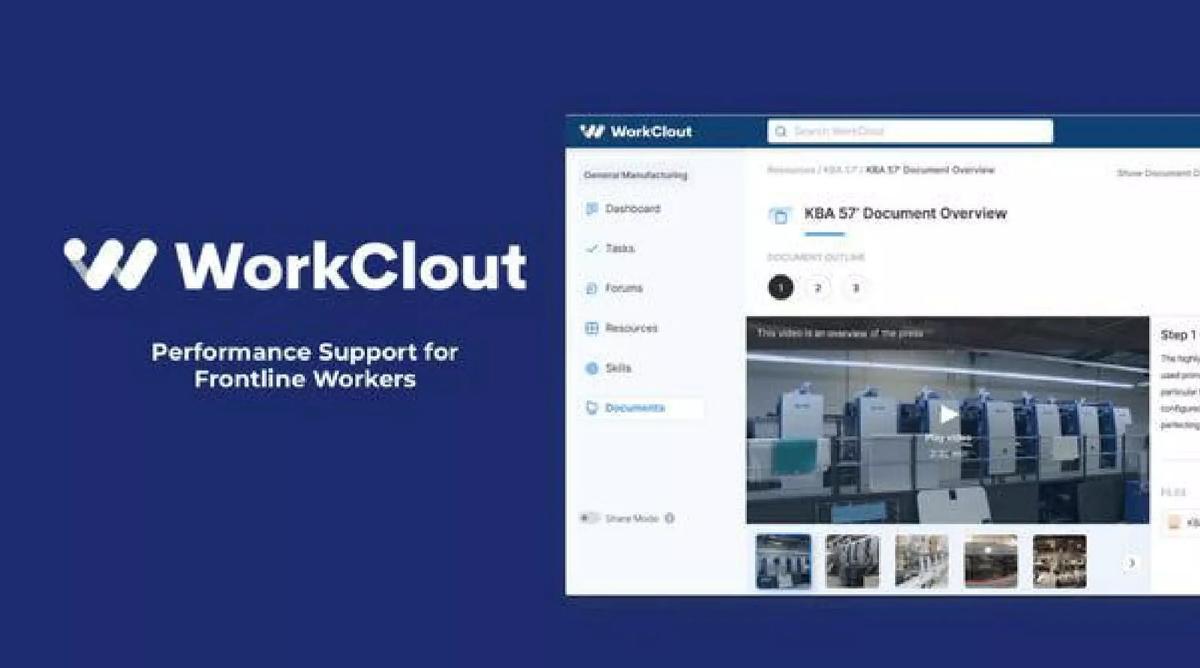
The cover slide introduces WorkClout with the tagline: Performance Support for Frontline Workers . The visual includes a screenshot of the software interface, showing a 'Document Overview' for a KBA 57 machine. This immediately grounds the product in a real-world manufacturing context. By using the term 'Performance Support' rather than 'ERP' or 'Management Software,' the company signals a focus on the worker rather than just the administrator.
Slide 2: The 'Domain In The Space' Slide
This is perhaps the most important slide in the deck. Instead of starting with a global problem, WorkClout starts with Founder-Market Fit . It states that CEO Arjun Patel’s father founded a $50M revenue packaging plant with over 200 employees. Arjun worked there every summer for 12 years and served as an Operations Manager for 4 years. This slide preempts the question: 'Why you?' It proves the founders aren't just software engineers looking for a problem; they have lived the problem for over a decade.
Slide 3 & 4: The Two-Part Problem
Slide 3 breaks down the 'complex, outdated and manual' nature of manufacturing. It categorizes the competition into two buckets: Manual Solutions (paper, excel & fax) which are error-prone and have limited collaboration, and Legacy Software . The critique of legacy software is specific: a $250k average price plus annual fees and a 6-month to 2-year implementation cycle. Slide 4 shifts the focus to the human element, noting that frontline employees are underutilized and that automation is creating a 'skills gap.' It identifies 'tribal knowledge'—unstructured, inaccessible information—as a major operational risk.
Slide 5: The Solution and Early Traction
Slide 5 presents the WorkClout value proposition: Making overly complex enterprise software, simple. It lists three key pillars: Short Time To Value, Automation & Accountability, and Accessibility. Crucially, it includes a metric: Avg throughput increased by 20% in first month. It also claims a 4-week implementation time, which directly counters the 2-year implementation pain point mentioned on Slide 3. The slide also notes that 56% of SMBs do not use software, positioning WorkClout as the entry point for digital transformation.
Slide 6: Product Interface
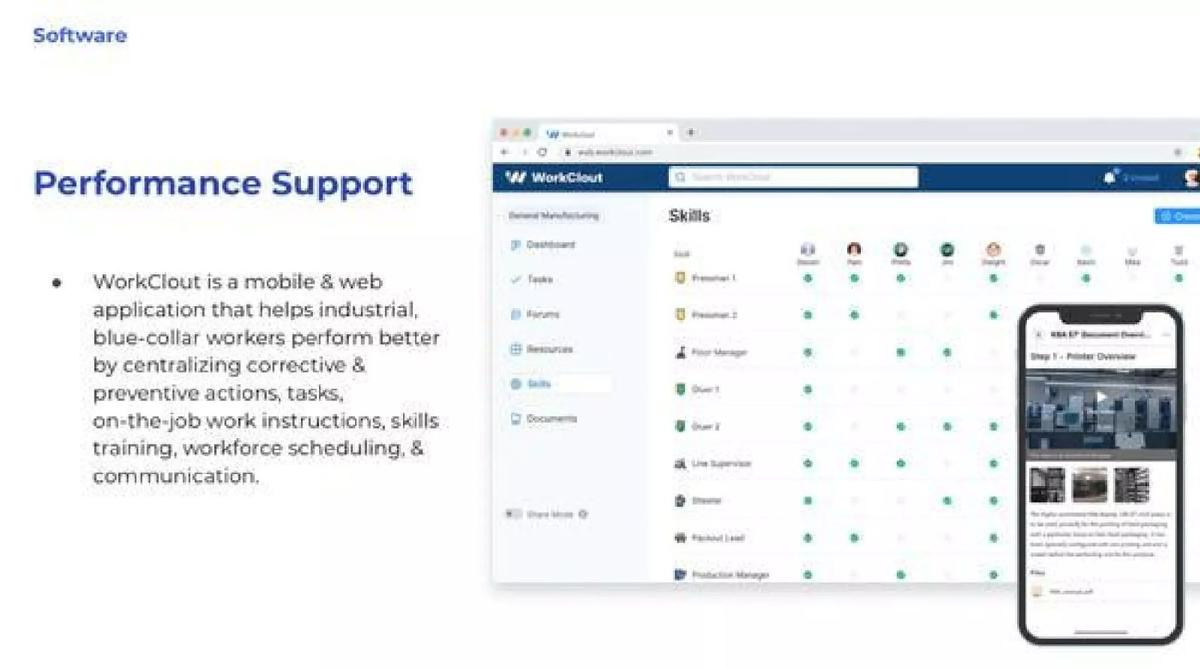
The 'Software' slide provides a high-level overview of features. It describes WorkClout as a mobile and web application that centralizes corrective and preventive actions, tasks, work instructions, and workforce scheduling. The visual shows a 'Skills' matrix, which allows managers to see at a glance which workers are qualified for specific tasks. This reinforces the 'Performance Support' angle mentioned on the title slide.
Slide 7 & 8: Market Opportunity
Slide 7 provides the 'hard' market data. It notes there are 354,000 manufacturers in the US and nearly 1 million worldwide. It quantifies the market size for SMBs at $1,140,276,480 and Mid-Market/Large at $9,900,572,880 . Slide 8 expands the vision, stating that 80% of the global workforce (2.7 billion people) is deskless. This suggests that while WorkClout is starting in manufacturing, the underlying technology could apply to Agriculture, Healthcare, Retail, and Construction.
Slide 9: The Team
The team slide highlights three co-founders: Arjun Patel (CEO), Bryan Trang (CPO), and Richard Girges (CTO). The pedigree is strong, with logos from Tesla, Disney, Genentech, Steelhouse, and Y Combinator . Richard Girges is noted for having 14+ years of software engineering experience, including a VP of Engineering role. This balances Arjun’s domain expertise with high-level technical execution capability.
Slide 10: Contact
The deck ends with a simple contact slide for Arjun Patel, including an email and phone number. There is no 'Ask' slide, no mention of the $2.5M target, and no breakdown of how the funds will be used. While this information was likely delivered in person, its absence from the deck makes it feel slightly incomplete as a standalone fundraising document.
What Works in the WorkClout Deck
The strongest element of this deck is the contrast between the status quo and the solution . By specifically naming the cost ($250k) and time (2 years) of legacy software, WorkClout makes its '4-week implementation' and 'lower price point' feel like a radical improvement. The deck also does an excellent job of humanizing the problem. It doesn't just talk about 'efficiency'; it talks about 'tribal knowledge' and the 'skills gap,' which are visceral pain points for factory owners.
The Founder-Market Fit slide is also a standout. In the Seed stage, investors are betting on the team's ability to navigate a specific niche. Showing a photo of the founder in a factory and citing 12 years of experience is much more persuasive than a list of degrees.
What is Missing from the WorkClout Deck
The most glaring omission is the Business Model . The deck mentions a 'lower price point' but never specifies what that price is. Is it a per-seat SaaS model? A per-factory flat fee? Investors need to know how the company plans to capture a portion of that $11B market.
Additionally, there is no Competitive Landscape slide. While they mention 'Legacy Software,' they don't address other modern startups that might be targeting the same deskless worker niche. Finally, the lack of a Financial Ask and Roadmap is a missed opportunity to show the founders' strategic thinking regarding how they will scale from the current product to the 2.7 billion deskless workers mentioned on Slide 8.
What a Founder Should Copy
Founders should emulate the specific metric-driven problem/solution slides . Don't just say your software is 'faster'; say it takes 4 weeks instead of 2 years. Don't just say it 'improves efficiency'; say it increases throughput by 20%. These specific numbers stick in an investor's mind.
Another takeaway is the narrow focus . Even though Slide 8 hints at a massive global workforce, the rest of the deck stays laser-focused on manufacturing. This 'wedge' strategy—dominating one specific niche before expanding—is a classic successful startup trope that this deck executes well.
Frequently asked questions
- How much did WorkClout raise with this deck?
- According to the catalogue facts, WorkClout raised $2,500,000 in a Seed round in 2018. The deck itself does not state the amount being raised or the valuation, which is common for decks shared publicly after the round closes, though omitting the 'Ask' is generally discouraged during active fundraising.
- What is the primary value proposition of WorkClout?
- The primary value proposition is 'Performance Support for Frontline Workers.' As stated on Slide 5, the software aims to make complex enterprise software simple, offering a 4-week implementation time and a 20% increase in throughput within the first month, contrasting sharply with the long lead times of legacy systems.
- Who is the target customer for WorkClout?
- The deck specifically targets Small to Medium-sized Businesses (SMBs) and Mid-Market manufacturers. Slide 7 identifies a $1.14B market size for SMBs and a $9.9B market size for Mid-Market/Large manufacturers in the US, noting that 56% of these companies currently use no software at all.
- How does the deck demonstrate founder-market fit?
- Slide 2 is dedicated entirely to 'Domain In The Space,' highlighting that CEO Arjun Patel’s father founded a $50M packaging plant. Arjun worked there for 12 years, including 4 years as an Operations Manager. This personal history suggests a deep, firsthand understanding of the manual inefficiencies described later in the deck.
- What are the major omissions in this pitch deck?
- The deck is missing several standard components: a competition slide (beyond the general 'Legacy Software' category), a business model/pricing slide, a financial roadmap, and a specific 'Ask' slide detailing how the $2.5M would be spent. It relies almost entirely on the problem-solution narrative and team pedigree.