Womco’s 19-slide pitch deck presents a compelling case for the intersection of hormonal health and nutrition. Seeking a £500K investment, the company highlights that 85% of women suffer from hormonal imbalances. The deck effectively uses scientific grounding—citing 20 years of research—to support its personalized recipe and tracking app. While the initial business model is a £20.99/month freemium consumer play, the roadmap reveals a strategic shift toward B2B digital therapeutics by late 2024. The team is technically strong, featuring Ph.D. and MSc backgrounds in bioengineering. However, the…
Key takeaways
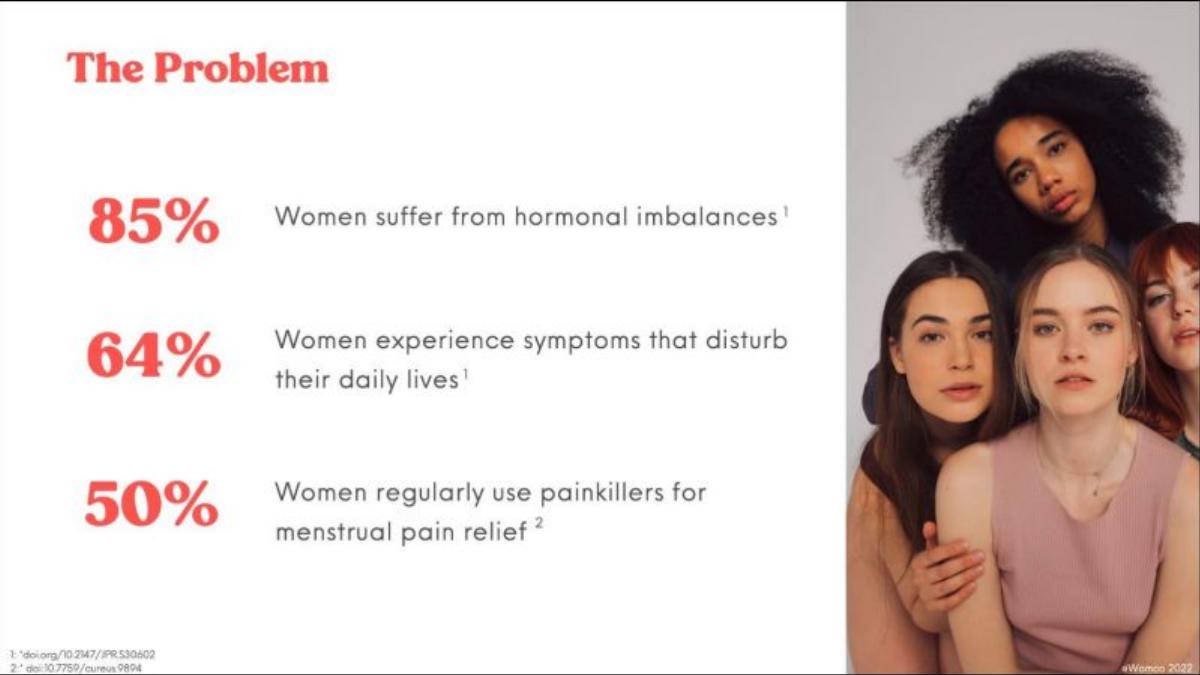
- The problem is quantified by stating 85% of women suffer from hormonal imbalances and 50% regularly use painkillers for menstrual relief (Slide 2).
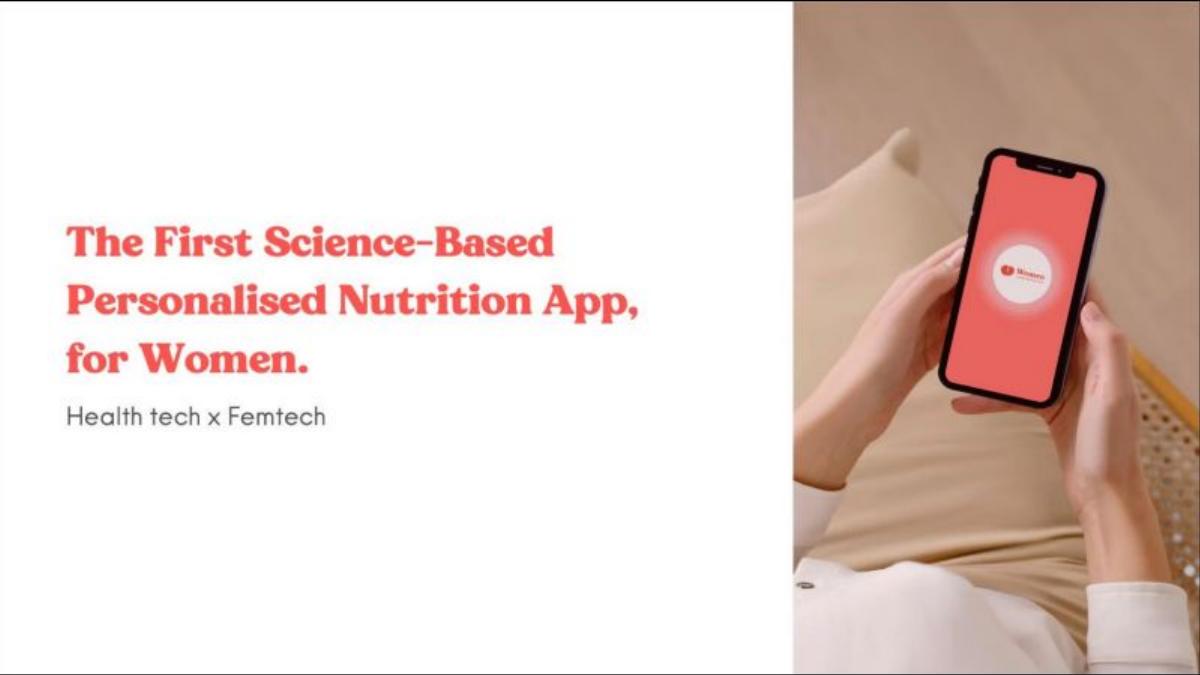
- Womco positions itself as the first science-based personalized nutrition app for women, bridging Health tech and Femtech (Slide 5).
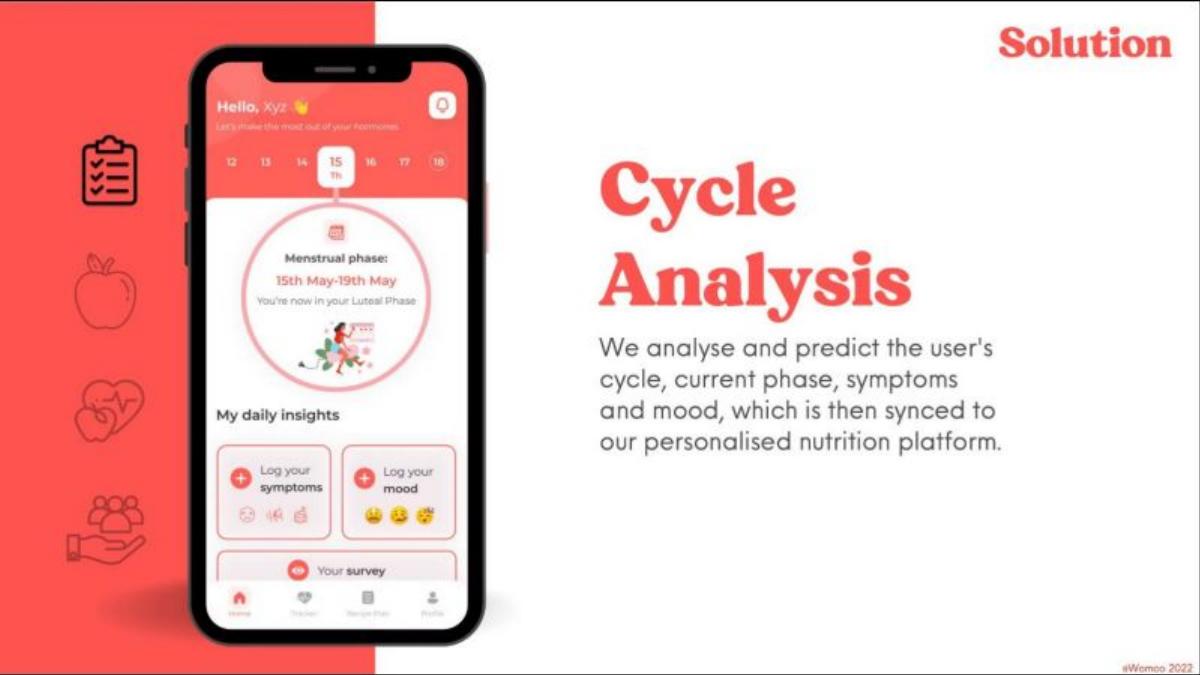
- The product features a cycle analysis tool that syncs symptoms and mood to a personalized nutrition platform (Slide 6).
- The revenue model is a freemium structure, with a premium tier priced at £20.99 per month including hormone testing and nutritionist consultations (Slide 11).
- The total addressable market (TAM) for UK Femtech is estimated at $10bn, with Womco targeting a $300M market share (Slide 13).
- The founding team includes a CTO with a Ph.D. in Bioengineering and a CEO with an MBA and MSc in Business Sustainability (Slide 15).
- User validation data shows that 82% of beta users expressed a willingness to buy a premium membership for hormone testing (Slide 18).
- The company is seeking £500K in funding and is EIS/SEIS approved (Slide 19).
The Hook: Addressing the Hormonal Imbalance Epidemic
Slides 1-3: Problem and Complexity
Womco opens with a clear, high-contrast title slide (Slide 1) featuring the tagline "female fitting food." This immediately establishes the niche: the intersection of diet and female biology. Slide 2, "The Problem," uses three heavy-hitting statistics to justify the company's existence: 85% of women suffer from hormonal imbalances, 64% experience symptoms that disturb daily life, and 50% regularly use painkillers for menstrual relief. These figures are cited to academic sources, providing immediate credibility.
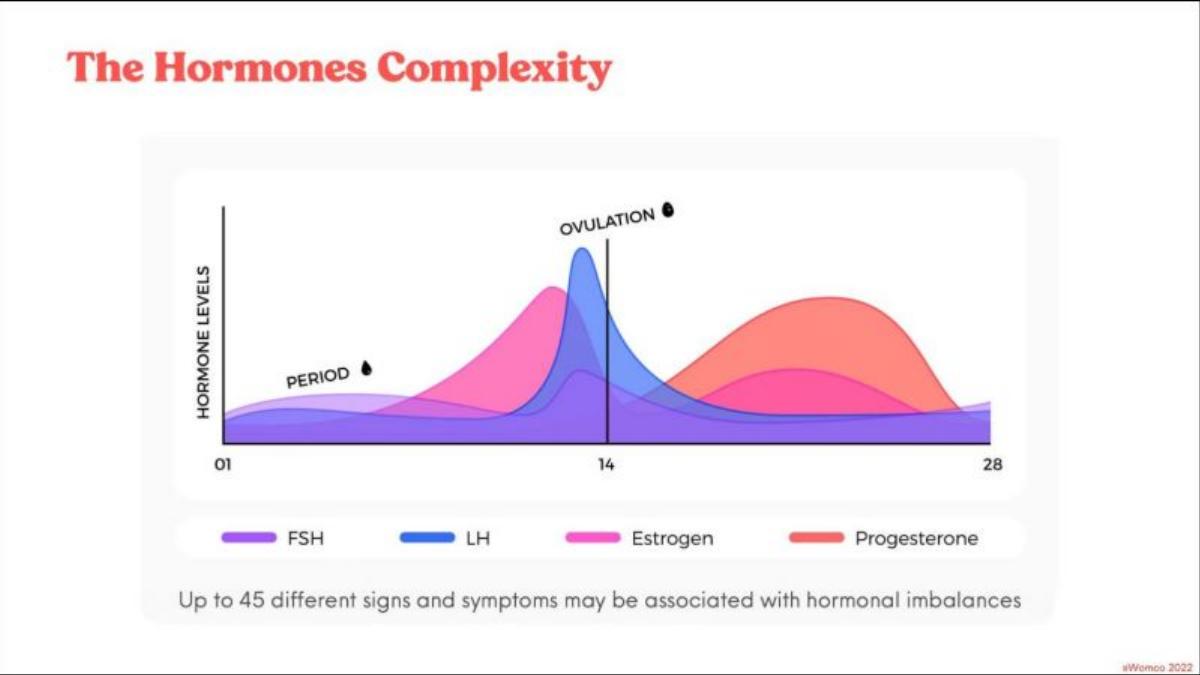
Slide 3, "The Hormones Complexity," uses a visualization of FSH, LH, Estrogen, and Progesterone levels across a 28-day cycle. This slide serves to educate the investor on why a generic nutrition app is insufficient for women. It notes that up to 45 different signs and symptoms are associated with these fluctuations, setting the stage for a personalized solution.
Slides 4-5: The Science and the Opportunity
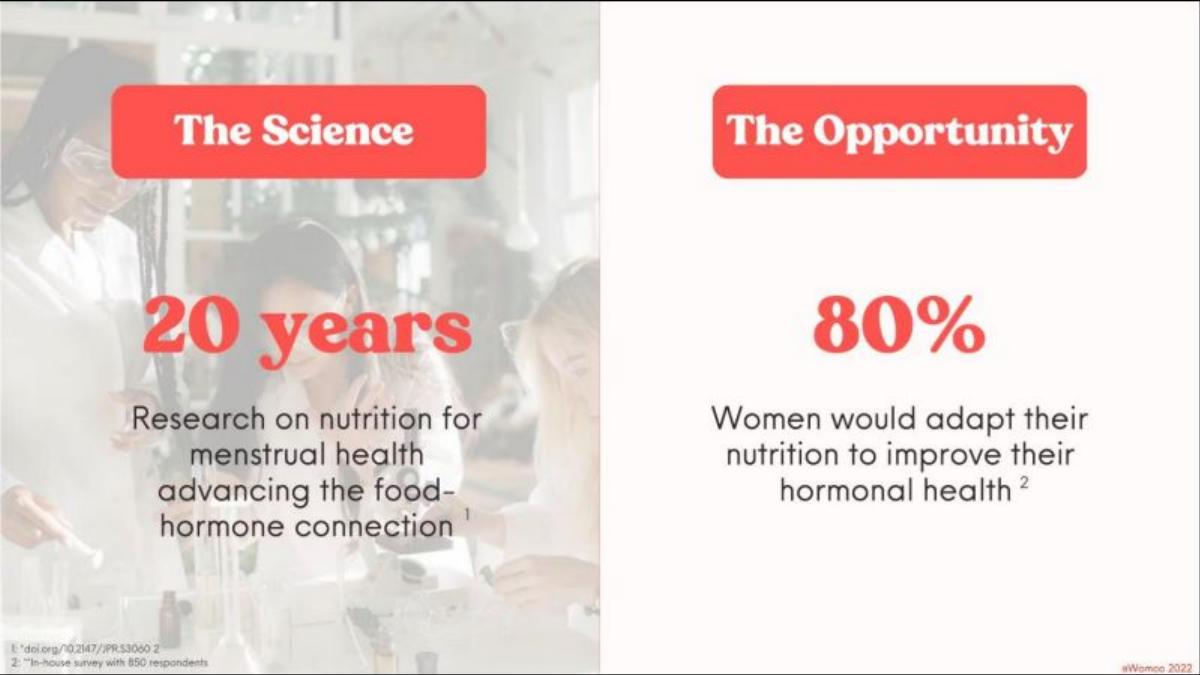
Slide 4 bridges the gap between the problem and the solution by citing "20 years of research on nutrition for menstrual health." It also includes a crucial piece of internal validation: 80% of women surveyed (850 respondents) would adapt their nutrition to improve hormonal health. This proves intent before the product is even fully detailed. Slide 5 then officially introduces Womco as "The First Science-Based Personalised Nutrition App, for Women," categorizing it as a hybrid of Health tech and Femtech.
The Product: A Data-Driven Nutrition Platform
Slides 6-10: Solution and Features
The solution is broken down into four distinct pillars. Slide 6 focuses on "Cycle Analysis," showing a UI mockup where users log symptoms and mood. The app predicts the user's current phase (e.g., Luteal Phase) and syncs this data to the nutrition engine. Slide 7 and 8 detail the "Personalised Nutrition" and "Science-Based Recipes." The deck emphasizes that recipes are "expert-crafted" and include nutritionist insights, such as how specific ingredients (like tofu for iron and calcium) support energy levels during specific cycle phases.
Slide 9 introduces "Continuous Tracking," which allows users to see their symptom history over time. This is a standard feature in many period trackers, but Womco differentiates it by linking it directly to nutritional interventions. Slide 10 is a transition slide that reinforces the "Solution" branding, though it adds little new information beyond visual consistency.
Slide 11: Business Model
Womco presents a classic freemium model. The "Standard" tier is free and includes 6 weekly recipes and basic tracking. The "Premium" tier is priced at £20.99 per month. This is a relatively high price point for a consumer health app, but Womco justifies it by including high-cost services: hormone testing and 1-to-1 nutritionist consultations. This suggests the company is positioning itself as a premium health service rather than just a utility app.
Market Dynamics and Competition
Slides 12-13: Market Size
The market opportunity is framed globally and then narrowed to the UK. Slide 12 notes the Global FemTech market was $50.6bn in 2022 with a 13% CAGR. It also highlights that women are 75% more likely to use digital health tools. Slide 13 provides a traditional TAM/SAM/SOM breakdown. They estimate the UK Femtech Market (TAM) at $10bn, the Hormonal Health Subsector (Target Market) at $2bn, and aim for a 15% market share, which they value at $300M. While the $10bn TAM for just the UK seems aggressive, the subsector focus is more realistic.
Slide 14: Competitive Landscape
The competition matrix (Slide 14) uses "Women's Health" and "Nutrition Personalisation" as its axes. Womco places itself in the top-right quadrant (high on both). Competitors like Flo and Clue are high on women's health but low on nutrition. HelloFresh and Noom are high on nutrition but low on specific female health focus. This is a standard but effective way to show a "white space" in the market.
The Team and Strategic Partners
Slide 15: Founders and Advisors
The team slide is a strong point for a pre-seed company. CTO Jacopo Gabrielli holds a Ph.D. in Bioengineering, and CPO Micol Hafez holds an MSc in Bioengineering. CEO Annabel de Gheldere brings the business side with an MBA. The presence of two bioengineers suggests the "science-based" claim is backed by internal expertise. The advisor section includes the CMO of Lumen and several certified nutritionists, further bolstering their medical/nutritional authority.
Slide 16: Partnerships
Slide 16 uses a Venn diagram to show partnerships across Suppliers (Waitrose, Tesco, Sainsbury's), Community (Equinox, Third Space), and Platform (Natural Cycles, Flo). It is unclear if these are active, signed partnerships or "target" partners, as the slide doesn't specify. If these are active integrations, it represents a significant moat.
Traction and Future Roadmap
Slides 17-19: Go-to-Market and The Ask
Slide 17 provides a timeline from June 2022 to June 2023. Key milestones include winning the Initiator VC Accelerator and launching a private beta in December 2022. Slide 18, "User Validation," provides the most important traction metrics: 250+ private beta users, an 80% recommendation rate (4 out of 5 users), and 82% expressing a willingness to pay for the premium tier. These are strong early signals of product-market fit.
The final slide (Slide 19) outlines the future. The roadmap is ambitious: launching hormone tests in Sept 2023, expanding to pregnancy and menopause by Dec 2023, and transitioning to a B2B "Digital Therapeutic" by Sept 2024. The slide concludes with the ask: £500K in investment, noting they are EIS/SEIS approved.
What Womco Does Well
Scientific Authority: By leading with bioengineering founders and citing 20 years of research, Womco avoids the "wellness fluff" that often plagues the nutrition app space. They frame hormonal health as a biological data problem, which appeals to sophisticated investors.
Clear Differentiation: The competitive matrix clearly identifies why existing giants (Flo, Noom) aren't solving this specific problem. The focus on the "food-hormone connection" is a unique and defensible niche.
High-Value Monetization: Instead of relying on $4.99/month subscriptions, Womco goes for a high-ticket £20.99/month model by bundling physical goods (hormone tests) and professional services (consultations). This significantly increases the potential LTV (Lifetime Value) of a user.
What is Missing from the Womco Deck
Unit Economics: There is no mention of Customer Acquisition Cost (CAC) or the margins on the £20.99 premium tier. Given that this tier includes hormone tests and 1-to-1 consultations, the COGS (Cost of Goods Sold) will be high. Investors need to know if this model can scale profitably.
B2B Strategy Details: The roadmap mentions a shift to B2B Digital Therapeutics by 2024, but the deck provides zero information on how they will sell to enterprises or insurance providers. Since the catalogue facts list them as a B2B company, the lack of a B2B sales strategy slide is a notable omission.
Partnership Clarity: Slide 16 lists major retailers like Waitrose and Tesco. Without labels like "In Discussion" or "Signed Agreement," these logos can be misleading. Clarifying the nature of these relationships is essential for due diligence.
What Other Founders Should Copy
The Problem-Complexity-Science Sequence: Womco does an excellent job of explaining why the problem is hard before showing the solution. Founders in complex regulated spaces should follow this flow: quantify the pain, explain the biological/technical complexity, and then present the science-backed solution.
Validation of Intent: Even without massive revenue, Womco proved that 82% of their beta users would pay for a specific feature (hormone testing). Surveying your beta users on their willingness to pay for specific tiers is a powerful way to de-risk the business model for early-stage investors.
Advisor Alignment: Their advisors aren't just random names; they are specifically chosen to fill gaps. Having the CMO of a successful metabolic health company (Lumen) and GTM experts for menopause/pregnancy shows they are thinking about the next three steps of their roadmap.
Frequently asked questions
- What is Womco's primary value proposition?
- Womco provides personalized nutrition plans specifically designed to manage female hormonal health. By analyzing a user's menstrual cycle, symptoms, and mood, the app generates expert-crafted recipes and nutritional insights intended to reduce the 45 different symptoms associated with hormonal imbalances.
- How does Womco plan to make money?
- The company uses a freemium model. The 'Standard' version offers 6 weekly recipes and basic tracking for free. The 'Premium' tier costs £20.99 per month and includes hormone testing, 1-to-1 nutritionist consultations, and full access to all app features.
- What is the background of the founding team?
- The team is led by CEO Annabel de Gheldere (MBA/MSc), CTO Jacopo Gabrielli (Ph.D. in Bioengineering), and CPO Micol Hafez (MSc in Bioengineering and food influencer). This combination provides a mix of technical scientific expertise and business sustainability knowledge.
- Who are Womco's main competitors according to the deck?
- Womco identifies competitors across two axes: Women's Health and Nutrition Personalization. Key competitors listed include Flo, Clue, and Hormona on the health side, and Noom, HelloFresh, and ZOE (implied by the 'Nutrition Personalization' axis) on the food side.
- What are the funding requirements and status?
- Womco is seeking £500K in investment. The deck notes that they are EIS/SEIS approved, which offers tax incentives for UK investors. According to the catalogue facts, they previously raised $11.5K from Initiator VC.