Wise’s 2020 Series A deck is a clinical example of how to pitch a 'platform-as-a-service' model in the fintech space. Rather than fighting for individual small business customers, Wise focuses on the 'Modern Business Ecosystem'—the platforms where these businesses already live. By offering a 50% revenue share to partners and promising a two-week implementation timeline, Wise positions itself as a friction-free infrastructure layer. The deck is notably light on traditional competitive analysis but heavy on unit economics, projecting $600 ARR per business and showcasing a $0 CAC acquisition str…
Key takeaways
- Wise targets the 'Bring Your Own Bank' (BYOB) friction point in digital ecosystems (Slide 6).
- The company claims a $0 CAC through a B2B2B model, acquiring high-intent businesses via partners like Shopify and Fundera (Slide 10).
- Partners are incentivized with a 50% revenue share on acceptance, banking, and card spend (Slide 16).
- Unit economics are clearly defined at approximately $600 ARR per business, split between deposits and interchange (Slide 15).
- The platform enables partners to launch branded business banking services in just two weeks (Slide 11).
- Traction as of October 2020 included 10,000+ business applications and over $10M moved (Slide 17).
- The leadership team features executives with deep partnership experience at T-Mobile, Google, AMEX, and VISA (Slide 20).
- Wise offers a 1% APY interest rate to small businesses as a primary incentive to switch (Slide 13).
The Thesis: Banking for the Digital Ecosystem
Slides 1-5: The Problem and Thesis
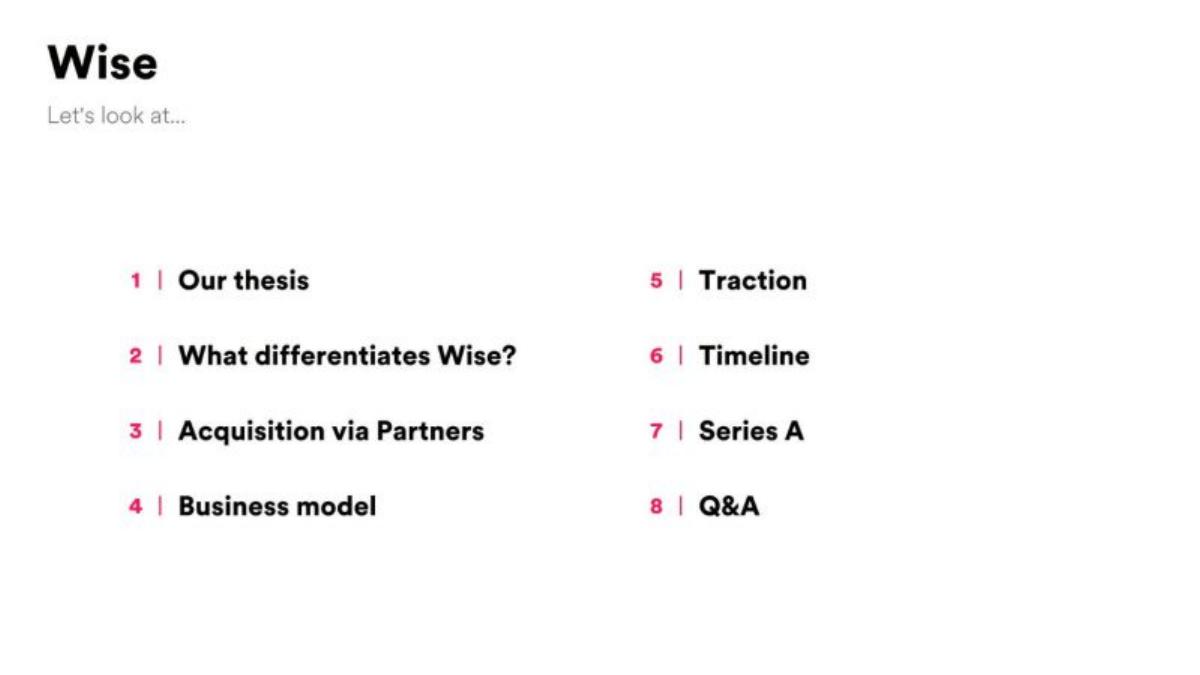
Wise opens the deck with a clear, bold title: Embedded Business Banking . The subtitle, "Supercharging modern business ecosystems by embedding business banking," immediately identifies their target customer: not the small business itself, but the platforms that serve them (Slide 1). The table of contents (Slide 2) sets a professional tone, outlining a standard but comprehensive flow from thesis to traction.
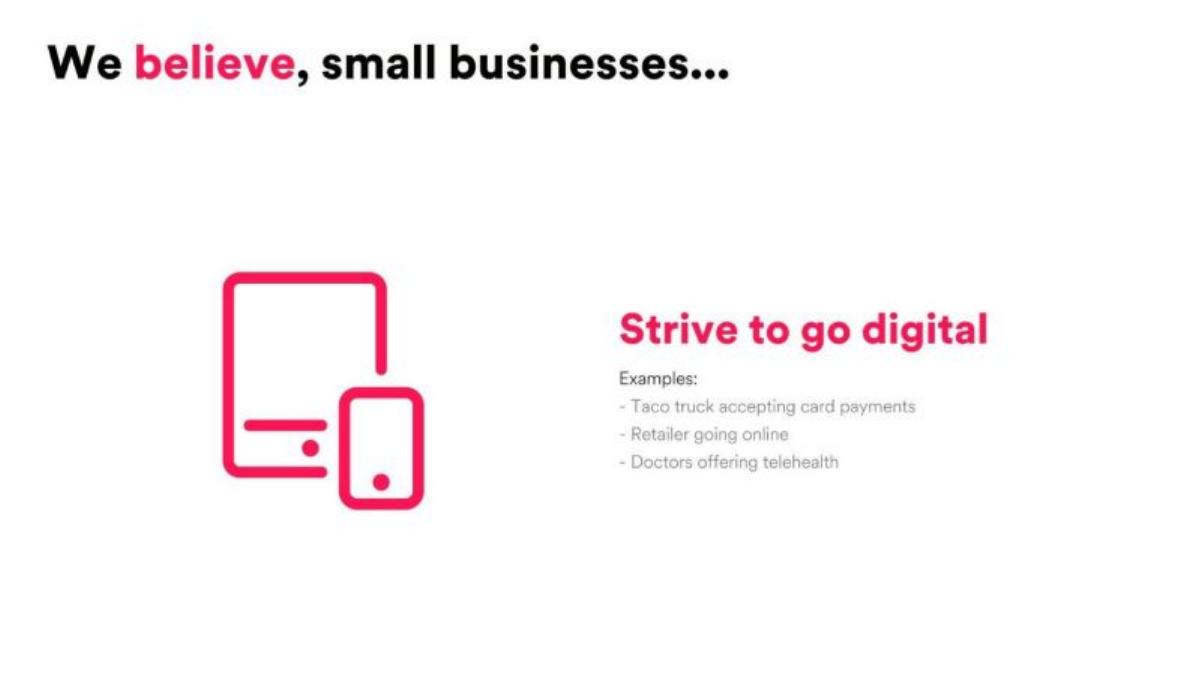
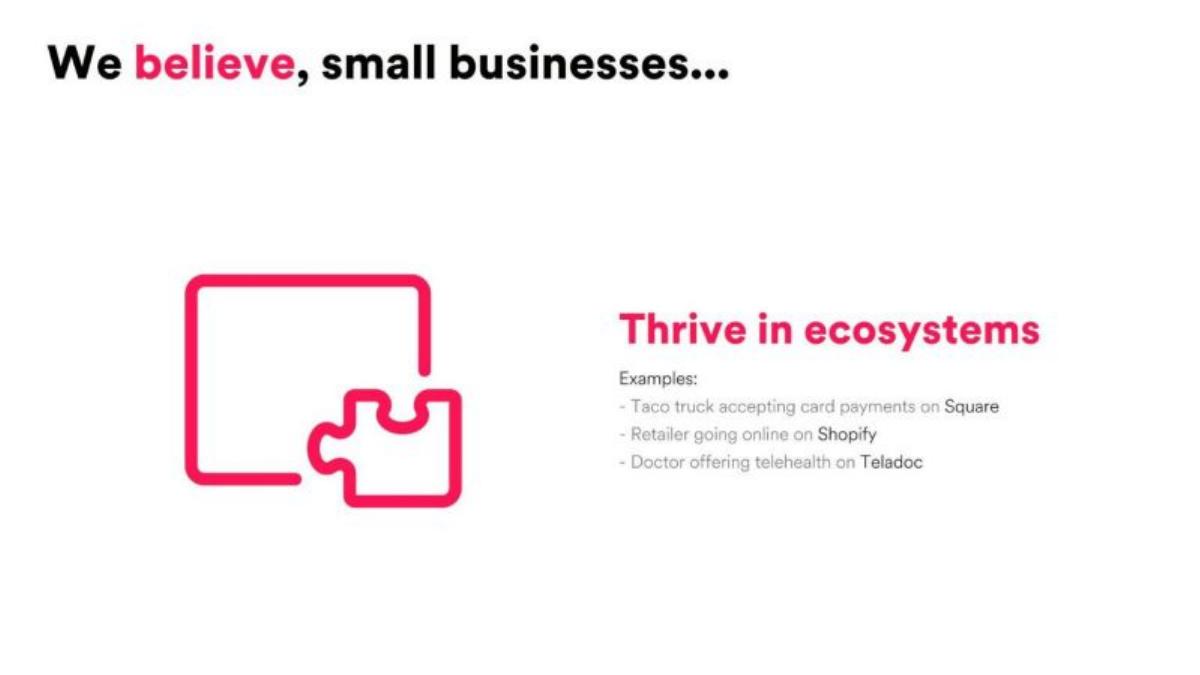
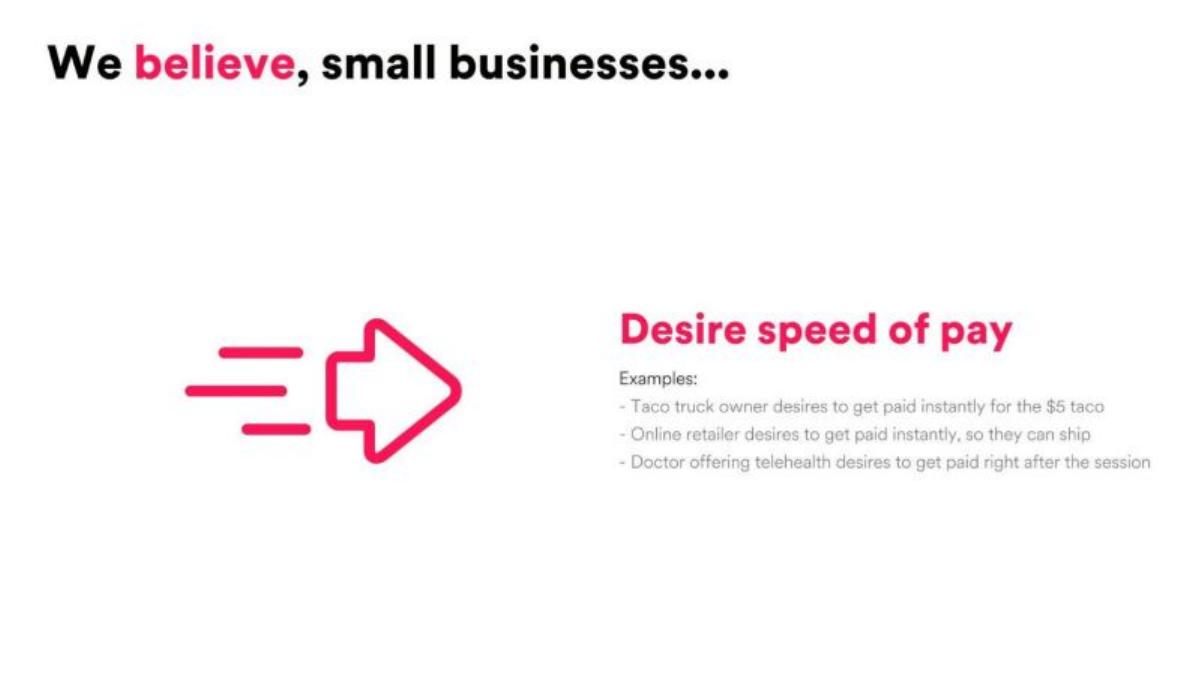
Slides 3, 4, and 5 establish the 'We Believe' framework. They argue that small businesses are going digital (taco trucks accepting cards), thriving in ecosystems (Shopify, Square), and desiring speed of pay. By using recognizable names like Teladoc and Shopify, Wise anchors its abstract service in real-world utility. The core argument is that while the business has gone 24/7 digital, the banking infrastructure supporting them has not.
Slides 6-8: The Friction Point
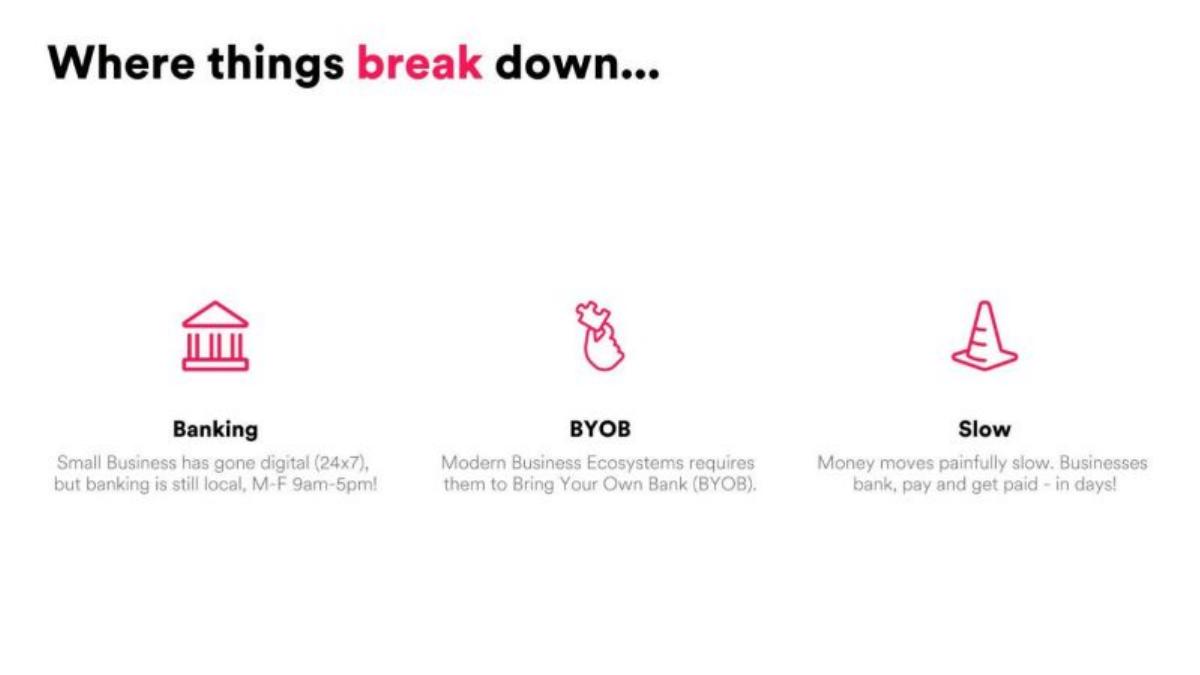
Slide 6 identifies where things "break down." They cite three specific pain points: Banking (local 9-5 hours vs. 24/7 digital needs), BYOB (the requirement for businesses to 'Bring Your Own Bank' to a platform), and Slow (money moving in days, not seconds). Slide 7 presents the Wise fix: a digital, embedded, and instant solution. Slide 8 serves as a transition, repeating the mission statement to reinforce the 'Embedded' nature of the product.
Slides 9-11: Product Differentiation and Distribution
Slide 9 lists the specific features that differentiate Wise. These include bank account origination in 90 seconds, built-in fraud/risk/compliance, and customer acquisition via partner channels. This is the first mention of their unique distribution strategy. Slide 10 is perhaps the most important slide in the deck, illustrating the B2B2B model . It shows the flow from the FDIC-insured bank through the Wise platform to partners (Affiliates like Fundera, App Stores like Shopify, and Co-brands like Invoice2go) and finally to the end business. The footer of this slide makes a bold claim: B2B2B = $0 CAC . For a Series A investor, the promise of acquiring high-intent users at zero cost is a massive signal.
Slide 11 emphasizes speed to market, promising that partners can "Launch Banking in 2 weeks." This addresses the primary objection a platform might have: the complexity of financial integration.
Slides 12-14: The Value Exchange
Wise uses Slides 12 and 13 to explain why this is a "win-win-win." For the partner (Slide 12), it adds revenue and stickiness. For the small business (Slide 13), it offers convenience and a 1% APY interest rate—a competitive figure in the 2020 interest rate environment. Slide 14 visualizes the 3-week implementation timeline, moving from due diligence to launch, further de-risking the partnership for the viewer.
Slides 15-17: Unit Economics and Traction
Slide 15 gets into the granular math. Wise projects ~$600 ARR per business , derived from $20/month in deposit revenue (~100 bps) and $30/month in interchange (~100 bps). Slide 16 clarifies the revenue share: Wise gives 50% of this back to the partner, resulting in ~$50/month in additional revenue per business for the platform. This transparency in unit economics is a hallmark of a strong Series A deck.
Slide 17 presents the hard numbers as of October 1, 2020: 10K+ business applications and $10M+ money moved . These figures provide the proof of concept needed to back up the earlier claims of a $0 CAC model.
Slides 18-22: Pipeline, Team, and History
Slide 18 shows the growth potential with a partner pipeline: 2 live, 3 in pilot, and 31+ in the pipeline . Slide 19 highlights their infrastructure partners, including BBVA, VISA, Plaid, and Stripe, which lends institutional credibility to their tech stack. Slide 20 introduces the team, focusing heavily on their past experience with "mega partnership deals" at companies like Google and AMEX. Slide 21 provides a timeline of the company since its founding in February 2019, showing a rapid progression from Pre-Seed to Series A in less than two years. The deck concludes with a Q&A slide (Slide 22).
What Wise Does Well
The Wise deck is exceptionally focused on distribution . Most fintech decks spend too much time on the 'what' (the features of the bank account) and not enough on the 'how' (how they will get users). By centering the entire narrative around the B2B2B model and $0 CAC, Wise addresses the biggest risk in fintech: the high cost of customer acquisition. The clear breakdown of unit economics and the 50/50 revenue share makes the business model feel inevitable rather than speculative.
What is Missing
The deck is noticeably missing a Competitive Landscape slide. While they mention the 'BYOB' problem, they do not explicitly name or compare themselves to other BaaS (Banking-as-a-Service) providers like Unit, Treasury Prime, or Bond, which were active during this period. Additionally, there is no 'The Ask' slide. While the catalogue listing mentions a $12M raise, the deck itself does not specify the amount being raised or the planned use of funds. Finally, there is very little detail on the regulatory framework ; while they mention being FDIC-insured via a bank partner, they don't detail the specific nature of their charter or ledgering agreements.
Founder Takeaways: What to Copy
Focus on Distribution: If you have a unique way to acquire customers (like the B2B2B model), make it the centerpiece of your deck. · Quantify the Partner Value: Wise doesn't just say partners make money; they estimate exactly how much ($50/month per business). This makes the pitch to partners (and investors) much more tangible. · Use 'We Believe' Statements: Starting with a thesis helps align the investor with your worldview before you show them the product. · Highlight Infrastructure: If you are building on top of giants (Stripe, AWS, VISA), show those logos. It proves you aren't reinventing the wheel where you don't need to.
Frequently asked questions
- What is the core value proposition for Wise's partners?
- According to slide 12, Wise offers partners four main benefits: a branded banking experience with custom cards, the ability for their users to get paid instantly, a new revenue stream through a 50% rev-share, and increased product stickiness. The deck emphasizes that partners can launch these services in just two weeks, removing the technical and regulatory hurdles of building a bank from scratch.
- How does Wise make money according to the deck?
- Slide 15 breaks down the revenue drivers into two main categories: Deposits and Interchange. They estimate earning ~100 bps on each. This results in an estimated $600 ARR per business, composed of $20/month from deposits and $30/month from interchange. Slide 16 notes that they share 50% of this revenue with the platform partner.
- What was Wise's traction at the time of the Series A?
- Slide 17 and 18 provide specific traction metrics as of October 1, 2020. The company had over 10,000 business applications and had moved more than $10M through the platform. In terms of partnerships, they had 2 partners live, 3 in pilot, and a pipeline of over 31 potential partners.
- Who are the key people behind Wise in this deck?
- Slide 20 introduces the two primary leaders: Arjun Thyagarajan (CEO/Product), who previously handled partnership deals with T-Mobile and Google, and Raghav Lal (President/Ops), who implemented co-branded card partnerships at AMEX and VISA. The slide also notes a global team of 50 people headquartered in San Mateo, CA.
- What technical infrastructure does Wise rely on?
- Slide 19, titled 'Built with the best in class,' lists five major infrastructure partners: BBVA for banking services, VISA for card issuing, Plaid for account linking, Stripe for payments, and AWS for cloud hosting. This highlights that Wise acts as an orchestration layer on top of established financial primitives.