Wisecar addresses the legal and safety risks associated with 'grey fleets,' where employees use personal vehicles for business purposes. The deck highlights that 57% of 'at work' mileage is covered by employee-owned vehicles, yet employers lack visibility into vehicle maintenance and driver eligibility. Wisecar proposes a centralized digital platform to store service records, registration, and insurance, utilizing blockchain for immutable data security. While the deck provides a clear problem statement and a tiered pricing model, it lacks a specific dollar amount for the funding ask and detai…
Key takeaways
- The problem centers on the 'grey fleet,' noting that over 40% of companies use this to minimize fleet costs, yet 57% of work mileage lacks employer oversight (Slide 3).
- Legal risk is quantified by citing Section 19 of the Work Health & Safety Acts and a recent $4M compensation case involving a personal vehicle accident (Slide 4).
- The solution is a centralized platform for logbooks, expense tracking, insurance evidence, service records, and registration (Slide 5).
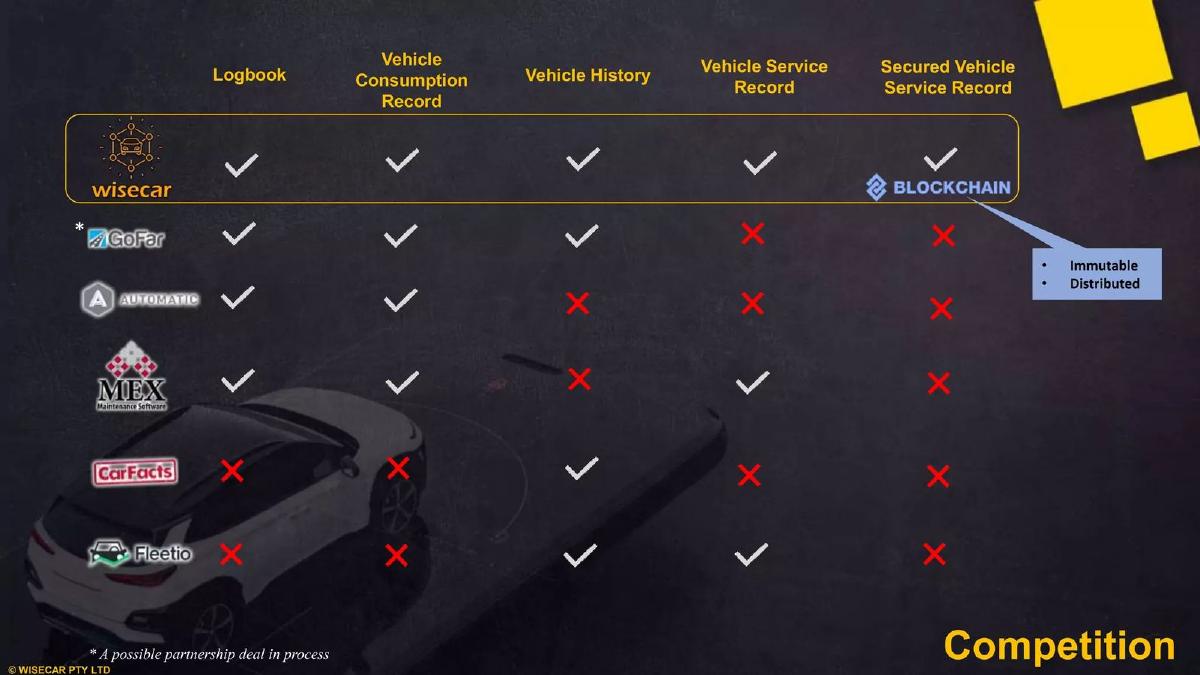
- Wisecar claims a competitive advantage by using blockchain for 'Secured Vehicle Service Records,' which they describe as immutable and distributed (Slide 11).
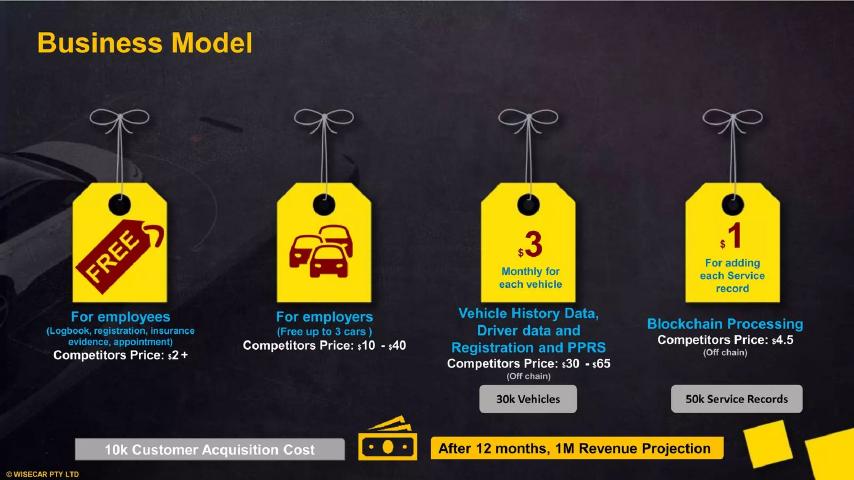
- The business model includes a free tier for employees and small employers, with a $3 monthly fee per vehicle for history and registration data (Slide 9).
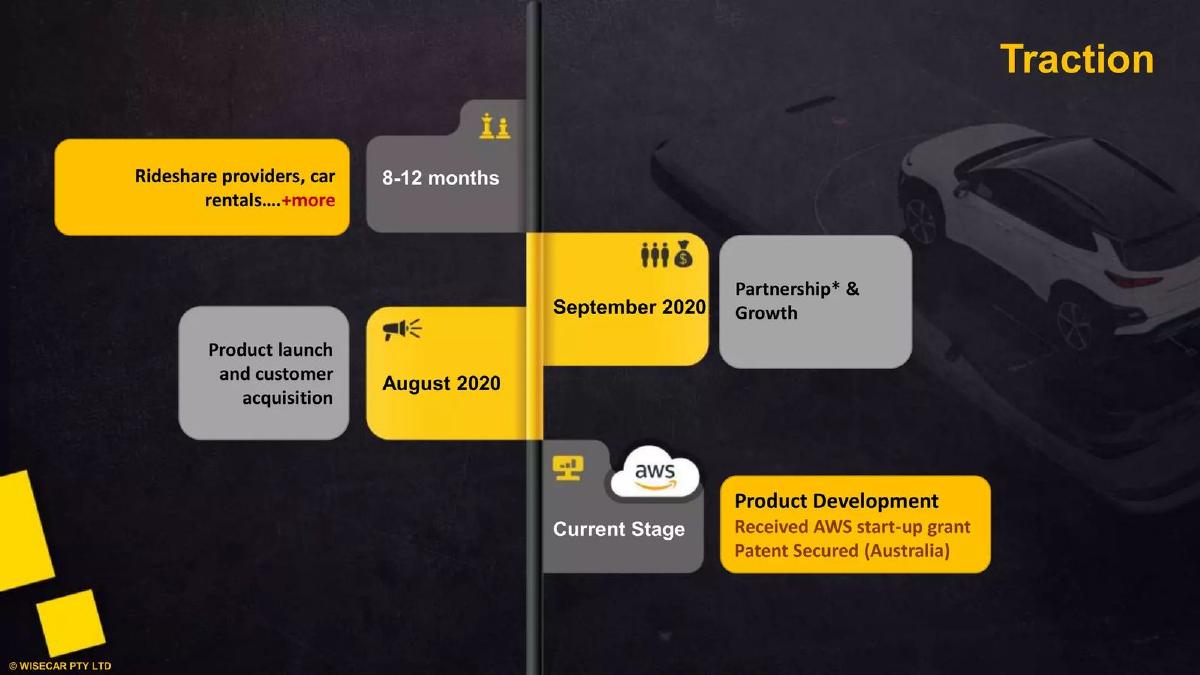
- Early traction includes securing an Australian patent, receiving an AWS start-up grant, and having two corporate MOUs in process (Slides 8 and 12).
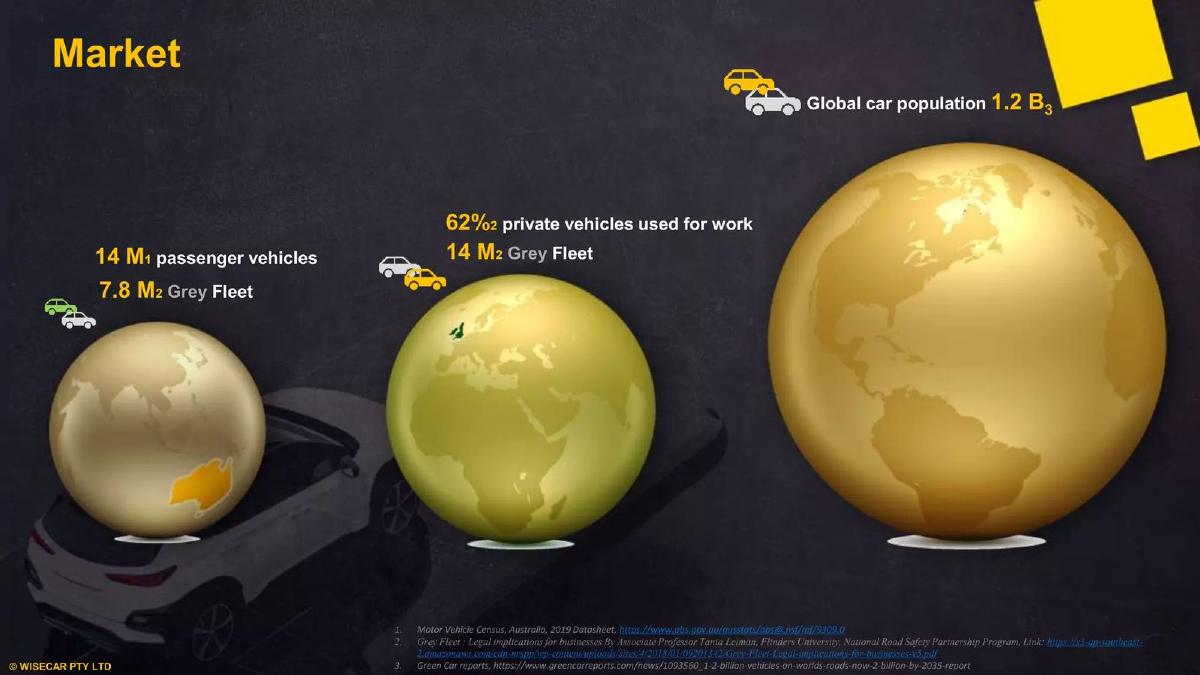
- The market size is framed globally at 1.2 billion cars, with a specific Australian focus on 7.8 million grey fleet vehicles (Slide 10).
- The 'Ask' slide is non-specific, requesting 'initial funding,' 'incubation,' and 'publicity' without defining a target investment amount or valuation (Slide 14).
Executive Summary
Wisecar is an Australian-based startup targeting the niche but high-risk 'grey fleet' management sector. Their pitch deck, published in 2020, outlines a platform designed to bridge the compliance gap between employers and employees who use their own cars for work. By digitizing vehicle records and securing them via blockchain, Wisecar aims to mitigate legal risks for corporations while providing a streamlined expense and maintenance tool for drivers. The deck is structured to move from a high-stakes legal problem to a technical solution, though it leaves several financial questions unanswered.
Slide 1: Title Slide
The cover slide introduces the brand identity with a logo featuring a car inside a hexagonal network, hinting at the blockchain/connectivity aspect. The tagline 'manage your car wisely' is present, along with contact information including a .com.au domain, an Australian phone number, and a Facebook handle. The visual focuses on a smartphone displaying a vehicle, establishing the mobile-first nature of the product.
Slides 2-4: The Problem and Legal Stakes
Slide 2 defines the scope of vehicle compliance, categorizing personal cars used for ridesharing (Uber, Lyft), car sharing (Zipcar), and the 'Grey Fleet' (workers using own cars). Slide 3 provides the core thesis: over 40% of companies use grey fleets to save money, yet 57% of work mileage is covered by these vehicles without employer visibility into maintenance or driver eligibility. Slide 4, titled 'Grey fleet is a ticking time bomb,' uses a word cloud dominated by 'Violation,' 'Danger,' and 'Law.' It cites Section 19 of the Work Health & Safety Acts, reminding employers they are responsible for the safety of any vehicle used for work. A specific case study of a $4M compensation payout serves as the 'fear factor' to drive urgency for the solution.
Slides 5-7: The Solution and Product Interface
Slide 5 introduces the solution: a single platform to digitize logbooks, service records, registration, insurance, and expenses. Slide 6 shows a simple mobile sign-in screen, while Slide 7 displays a desktop dashboard for fleet managers. The dashboard mockup includes driver status (license expiry), vehicle status (last service and registration), and a table for claims and invoices. This slide effectively demonstrates how the 'lack of visibility' mentioned earlier is solved through a centralized UI.
Slide 8: Traction and Roadmap
The traction slide uses a vertical timeline. At the 'Current Stage,' the company has secured an Australian patent and received an AWS start-up grant. The roadmap is aggressive, projecting a product launch in August 2020 and a partnership/growth phase starting in September 2020. It also mentions future expansion into rideshare providers and car rentals within 8-12 months.
Slide 9: Business Model and Revenue Projections
Wisecar presents a clear, albeit ambitious, pricing strategy. The service is free for employees and for employers with up to 3 cars. They plan to charge $3 monthly per vehicle for data access and $1 for adding service records. The slide includes a '10k Customer Acquisition Cost' (though it is unclear if this is total or per segment) and projects $1M in revenue after 12 months based on 30k vehicles and 50k service records. They benchmark their pricing against competitors, claiming their $3 fee is significantly lower than the $30-$65 charged by others for 'off-chain' records.
Slide 10: Market Size
The market slide uses three globes to represent scale. It identifies the global car population at 1.2 billion. More specifically, it highlights the Australian market: 14 million passenger vehicles, of which 7.8 million are considered grey fleet. They further refine this by stating 62% of private vehicles are used for work, totaling 14 million 'Grey Fleet' instances (this figure seems to conflict slightly with the 7.8M figure on the same slide, perhaps referring to different regions or definitions).
Slide 11: Competitive Landscape
A feature-comparison matrix pits Wisecar against GoFar, Automatic, MEX, CarFacts, and Fleetio. Wisecar claims to be the only provider offering a 'Secured Vehicle Service Record' via blockchain. The slide highlights that while others offer logbooks and consumption records, they lack the 'Immutable' and 'Distributed' nature of blockchain-backed data. A footnote mentions a 'possible partnership deal in process' with GoFar.
Slide 12: Go-to-Market Strategy
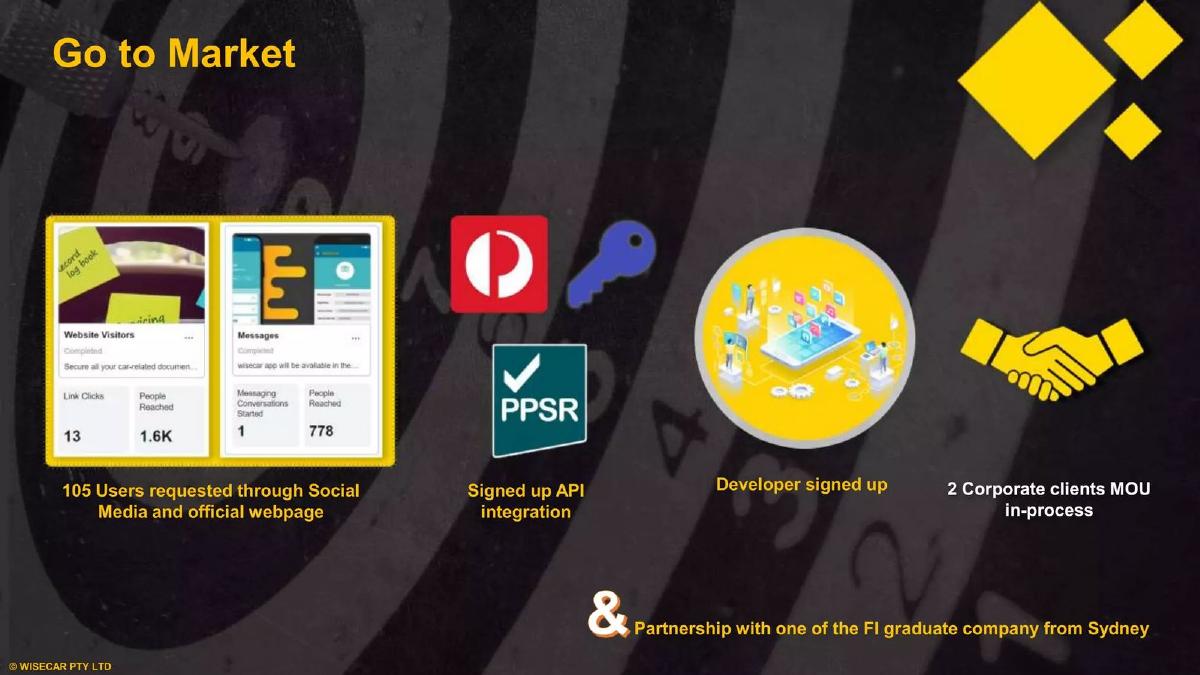
The GTM slide lists several early wins: 105 user requests via social media, signed-up API integrations with PPSR and Australia Post, a developer signed up, and two corporate MOUs in process. They also mention a partnership with a 'FI graduate company from Sydney,' likely referring to the Founder Institute.
Slide 13: The Squad (Team)
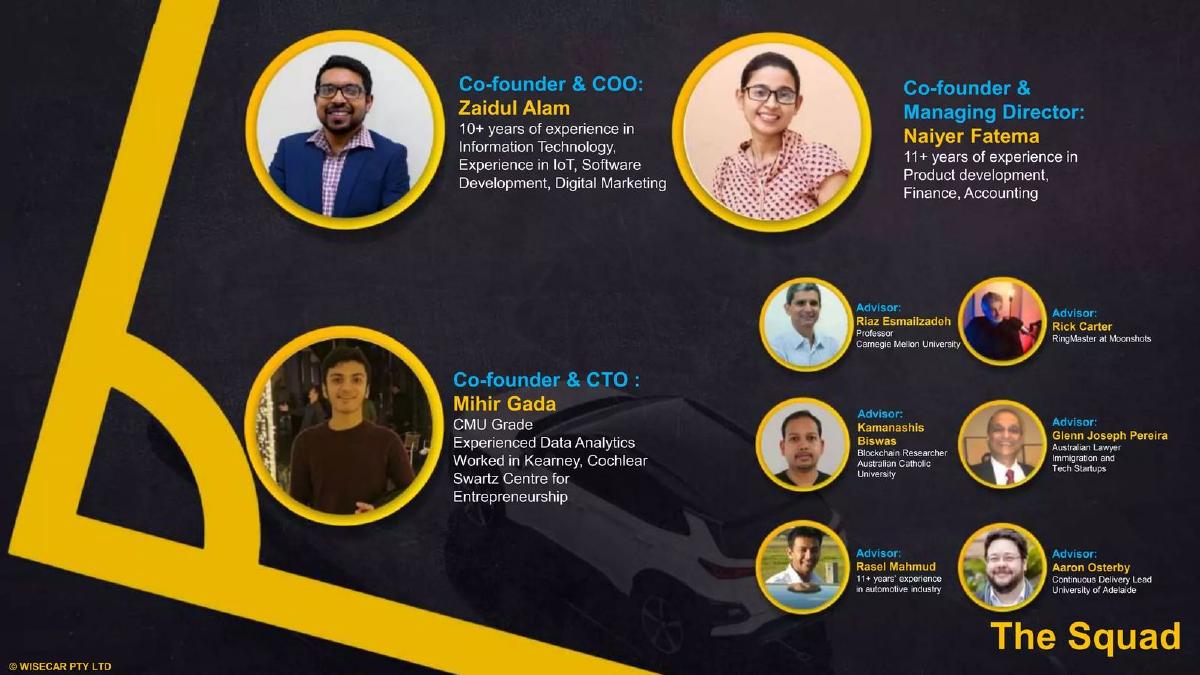
The team consists of three co-founders: Zaidul Alam (COO, 10+ years IT), Naiyer Fatema (Managing Director, 11+ years Product/Finance), and Mihir Gada (CTO, CMU grad). The slide also lists six advisors, providing a mix of academic, legal, and automotive industry expertise. The presence of a 'Blockchain Researcher' and an 'Australian Lawyer' aligns well with the company's technical and regulatory focus.
Slides 14-15: The Ask and Closing
Slide 14 is the 'Ask.' It is notably vague, requesting 'Initial funding,' 'Initial support and incubation,' and 'Publicity.' It does not state a dollar amount, a valuation, or a specific use of funds beyond 'development of our product.' Slide 15 is a standard Q&A closing slide with contact details.
What Works Well
Clear Problem Definition: The deck does an excellent job of defining the 'Grey Fleet' and the specific legal liabilities associated with it. Citing actual safety acts and multi-million dollar court cases creates a compelling 'why now' for corporate buyers. · Visualizing the Gap: Slide 7 effectively shows exactly what the employer sees, which directly addresses the 'lack of visibility' problem identified in the beginning. · Niche Positioning: By focusing on the grey fleet rather than general fleet management, Wisecar carves out a specific territory where their blockchain-backed 'immutability' argument carries more weight for compliance audits.
What is Missing
Specific Funding Ask: The 'Ask' slide is the weakest part of the deck. Investors need to know how much capital is being raised and what the specific milestones are for that capital. 'Initial funding' is too broad for a professional pitch. · Unit Economics: While the pricing is listed, there is no mention of the cost to serve or the Lifetime Value (LTV) of a customer. The '10k Customer Acquisition Cost' is mentioned on Slide 9 but lacks context—is that the total budget or the cost to acquire one corporate client? · Blockchain Justification: While blockchain is mentioned as a differentiator, the deck doesn't fully explain why a standard encrypted database wouldn't suffice for these records, other than using the buzzwords 'immutable' and 'distributed.'
Founder Takeaways
Use Fear and Logic: Wisecar’s use of legal statutes and high-value lawsuits is a powerful way to sell B2B compliance software. It moves the product from a 'nice-to-have' to a 'risk-mitigation necessity.' · Benchmark Your Pricing: Slide 9 is a great example of showing how your pricing compares to the status quo. By showing that they are 10x cheaper than 'off-chain' competitors, they make the barrier to entry for a new customer very low. · Be Specific with the Ask: If you are raising money, put a number on the slide. Even a range (e.g., 'Raising $500k - $750k') is better than a generic request for 'initial funding.'
Frequently asked questions
- What exactly is a 'grey fleet' and why does Wisecar focus on it?
- A grey fleet refers to personal vehicles used by employees for work purposes. Wisecar focuses on this because, as Slide 3 notes, 57% of work mileage occurs in these vehicles, but employers have zero visibility into their compliance. This creates massive legal liability under safety acts, as shown on Slide 4, where an employer could be held responsible for accidents involving poorly maintained personal vehicles.
- How does Wisecar plan to make money?
- The revenue model is tiered. According to Slide 9, it is free for employees and employers with up to 3 cars. Revenue is generated by charging $3 per month per vehicle for history and registration data, $1 for adding service records, and a blockchain processing fee. They project $1M in revenue after 12 months, targeting 30,000 vehicles and 50,000 service records.
- What is the role of blockchain in this automotive platform?
- Wisecar uses blockchain to differentiate itself from competitors like GoFar and Fleetio. Slide 11 specifies that blockchain is used for 'Secured Vehicle Service Records.' The primary benefits cited are that the records are 'Immutable' and 'Distributed,' preventing the tampering of maintenance history which is a common issue in vehicle resale and compliance auditing.
- What stage was the company at when this deck was produced?
- The company was in the pre-launch/development phase. Slide 8 indicates the 'Current Stage' involved product development, an AWS grant, and a secured Australian patent. The roadmap scheduled a product launch for August 2020, followed by a partnership and growth phase in September 2020.
- Who is behind Wisecar?
- The leadership team, shown on Slide 13, includes Co-founder/COO Zaidul Alam (10+ years in IT), Co-founder/Managing Director Naiyer Fatema (11+ years in product and finance), and Co-founder/CTO Mihir Gada (CMU graduate with data analytics experience). They are supported by six advisors with backgrounds in blockchain research, law, and the automotive industry.