Wire’s Series C deck is a concise, high-level overview that leans heavily on the company’s technical pedigree and the macro shift toward remote work. By positioning itself as the 'most secure collaboration platform,' Wire targets a specific $9B 'security-first' subset of the broader $26.2B collaboration market. The deck emphasizes a 'Privacy-by-Design' architecture that eliminates 'Man In the Middle' vulnerabilities, specifically noting that even Wire cannot access encryption keys. While the deck lacks specific financial performance data or a detailed team breakdown, it successfully communica…
Key takeaways
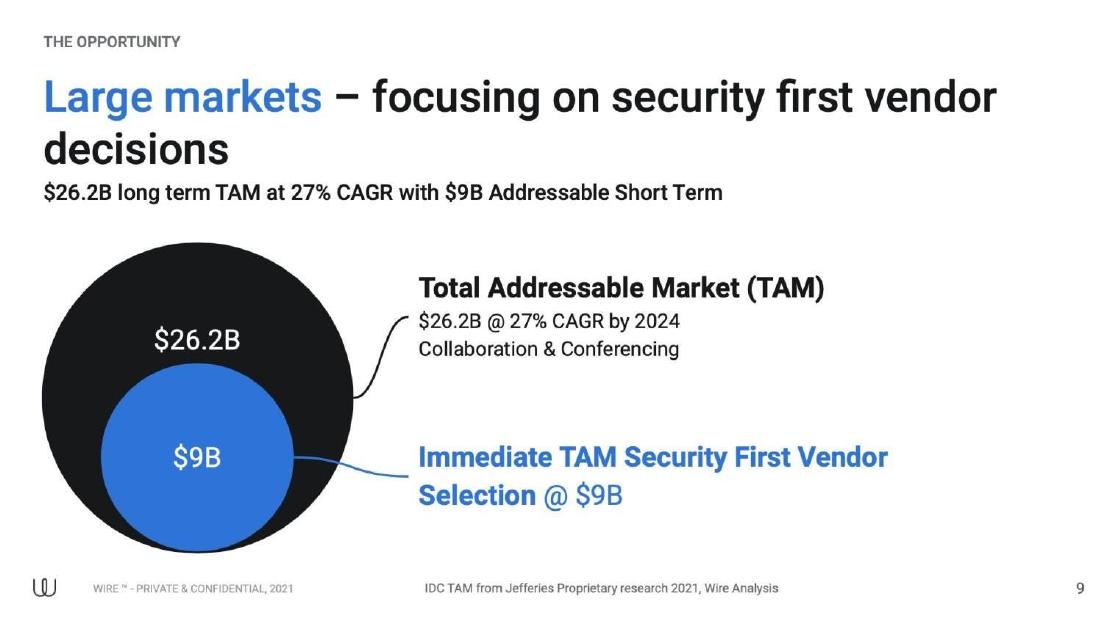
- The deck identifies a $26.2B Total Addressable Market for collaboration and conferencing, growing at a 27% CAGR (Slide 9).
- Wire specifically targets a $9B 'Immediate TAM' comprised of security-first vendor selections (Slide 9).
- The platform claims to eliminate 'Man In the Middle' vulnerabilities by ensuring the administrator cannot access encryption keys (Slide 7).
- Wire positions its architecture as 'Post Quantum Resistant,' claiming communications are secure against future quantum computing threats (Slide 7).
- The management team is credited with scaling organizations to over $150M in revenues with multiple IPOs and M&As (Slide 2).
- The deck cites 18 billion BYOD (Bring Your Own Device) units outside firewalls as a primary driver for the growing cybersecurity problem (Slide 5).
- Wire emphasizes its recognition by industry analysts Gartner, IDC, and Forrester as a leading solution (Slide 2).
- The product suite includes messaging, conferencing, and file sharing available on any device with 'Always on E2EE' (Slide 6, Slide 7).
Introduction: The Sovereign Security Play
Wire, a Berlin-based cybersecurity firm, raised $24M in 2024 for its Series C round. The company positions itself as the most secure collaboration platform in the world, targeting a niche that mainstream tools like Slack or Microsoft Teams often struggle to satisfy: governments and high-security enterprises. This teardown looks at the 6 slides provided, which serve as a high-level strategic overview of their market positioning and technical architecture.
Slide 1: Title and Visual Identity
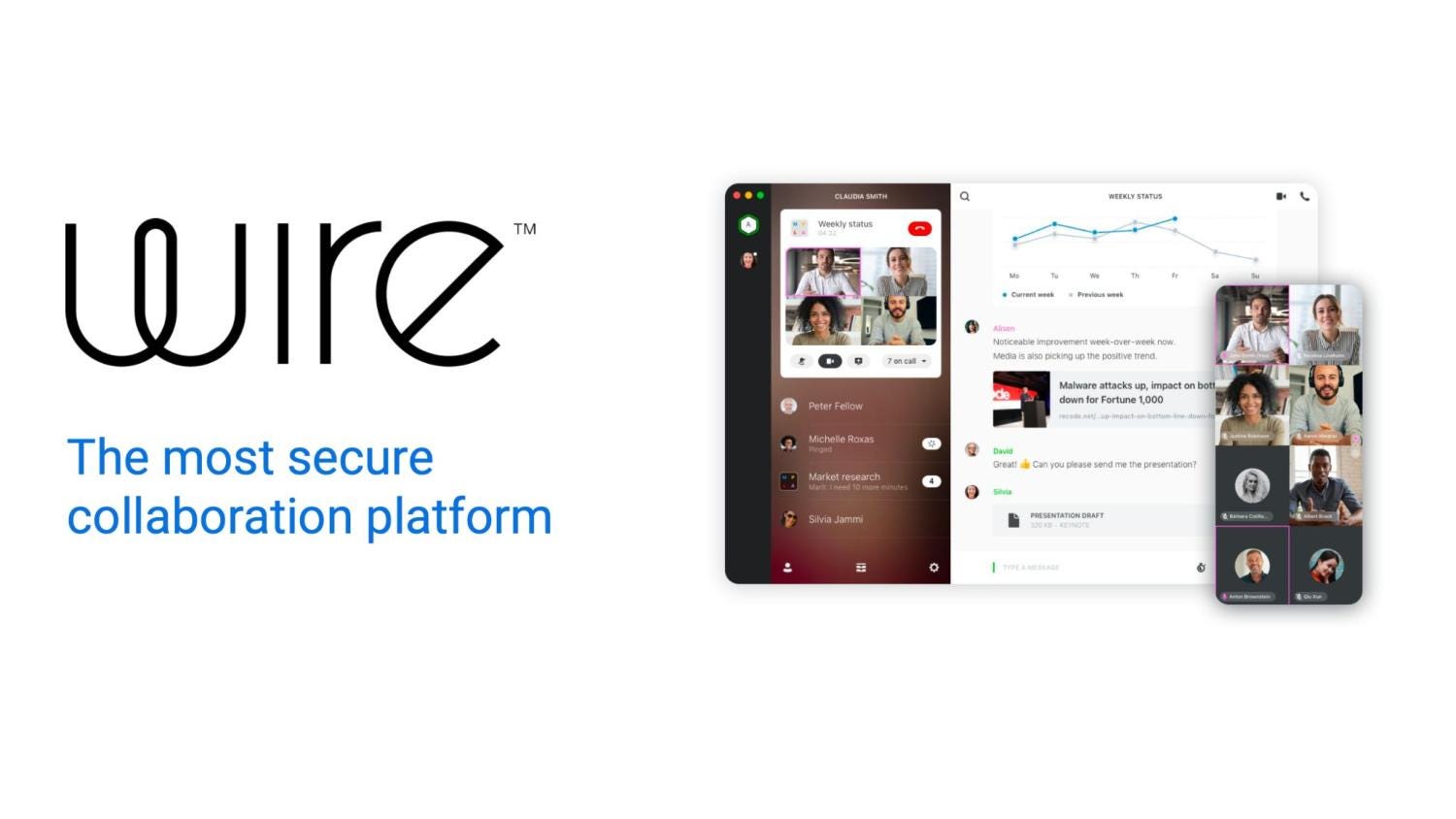
The deck opens with a clean, minimalist title slide. It features the Wire logo and the tagline: "The most secure collaboration platform." To the right, a mockup shows the interface across desktop and mobile devices. The visual evidence suggests a product that is already mature, featuring video conferencing, file sharing, and chat interfaces. By showing the UI immediately, Wire attempts to dispel the notion that 'secure' means 'clunky' or 'difficult to use.'
Slide 2: The Spotlight Summary
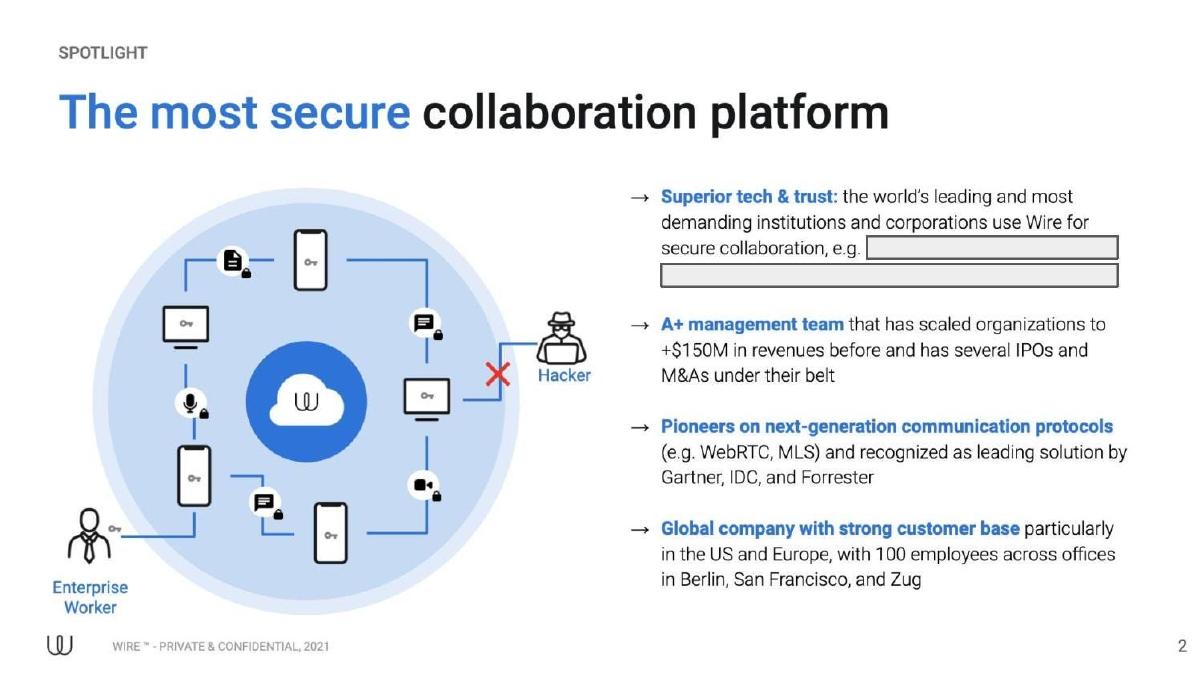
Slide 2 acts as an executive summary, titled "Spotlight." It repeats the core value proposition and provides four key pillars of the business:
Superior tech & trust: Claims that the world’s leading and most demanding institutions use Wire. While specific names are redacted in the provided image, the intent is clear: social proof via high-stakes clients. · A+ management team: Mentions a team that has scaled organizations to +$150M in revenues and has several IPOs and M&As. This is a crucial signal for a Series C round, reassuring investors that the leadership has 'been there, done that.' · Pioneers on next-generation protocols: Cites WebRTC and MLS (Messaging Layer Security) and mentions recognition by Gartner, IDC, and Forrester . · Global company: Notes 100 employees across Berlin, San Francisco, and Zug, establishing their footprint in key regulatory and tech hubs.
The slide also includes a diagram showing an 'Enterprise Worker' protected by a cloud-based encryption layer that blocks a 'Hacker.' It is a simplified representation of their 'Zero Trust' approach.
Slide 5: The Problem - Future of Work Risks
Slide 5 (numbered as such in the footer) frames the problem through the lens of the World Economic Forum (WEF) and EY research. It argues that the cybersecurity problem is being 'inflated by the future of work.' Key data points include:
Cybersecurity is a top 3 global problem according to the WEF. · There are 18B BYOD (Bring Your Own Device) units outside traditional firewalls. · 65% of people agree hybrid work is here to stay (EY 2021 survey). · 9 out of 10 employees want flexibility in where and when they work.
The logic here is that as employees move outside the office, the traditional 'perimeter' security model fails, creating a massive opening for Wire’s device-to-device encryption model.
Slide 6: The Product Suite
This slide details the specific capabilities of "Wire for enterprises & governments." It describes the offering as "Complex security wrapped in simple and intuitive design." The product is broken down into four categories, all described as a "Full collaboration suite available on any device":
The slide also features badges from Capterra (Shortlist 2021) and G2 (Leader Winter 2021) , providing third-party validation of the user experience and market leadership.
Slide 7: Security First Architecture
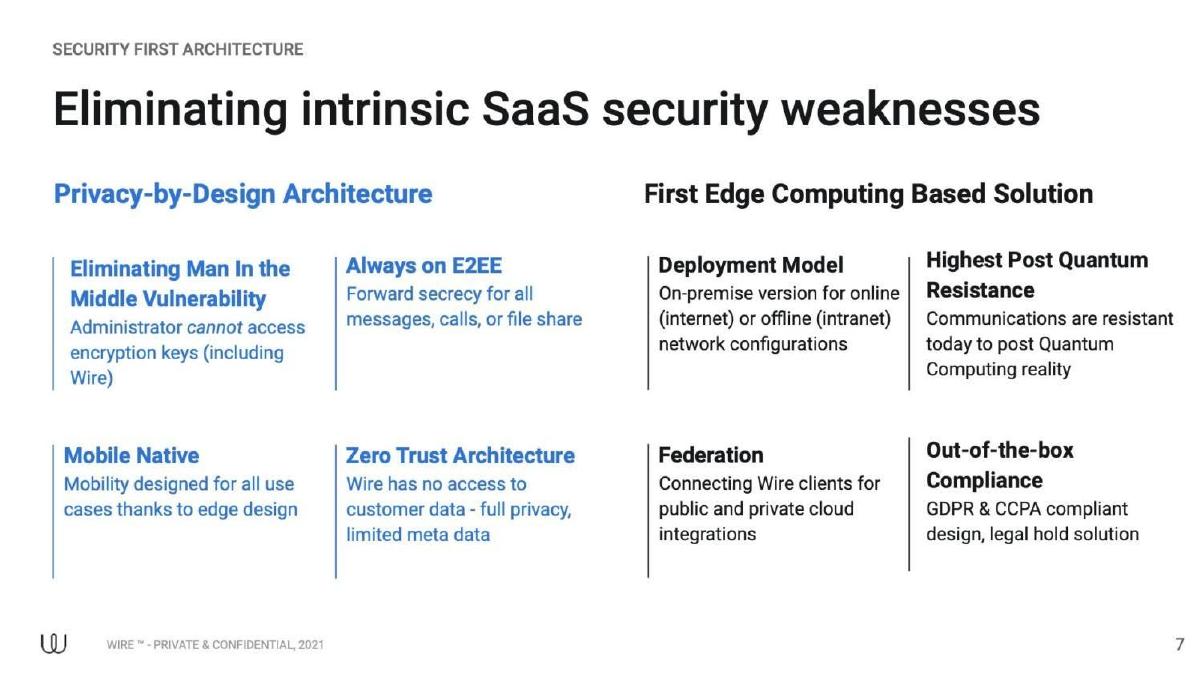
This is the technical 'meat' of the deck. Wire outlines how it is "Eliminating intrinsic SaaS security weaknesses." The architecture is divided into two main philosophies:
Eliminating Man In the Middle: The administrator cannot access encryption keys, including Wire itself. · Always on E2EE: Forward secrecy for all messages, calls, and file shares. · Mobile Native: Designed for edge-based security. · Zero Trust Architecture: Wire has no access to customer data, ensuring full privacy with limited metadata.
Deployment Model: Offers on-premise versions for both online and offline (intranet) environments. · Highest Post Quantum Resistance: Claims the platform is resistant to future quantum computing threats. · Federation: Allows connecting clients across different cloud environments. · Out-of-the-box Compliance: GDPR & CCPA compliant with legal hold solutions.
Slide 9: The Opportunity (TAM)
The final slide in this set addresses the market size. It uses a nested circle diagram to show the Total Addressable Market (TAM) :
$26.2B: The total market for Collaboration & Conferencing by 2024, growing at a 27% CAGR . · $9B: The "Immediate TAM" for Security First Vendor Selection .
By carving out the $9B segment, Wire is telling investors they don't need to beat Microsoft Teams in the general market to be a massive company; they only need to win the segment where security is the non-negotiable priority. The data is attributed to IDC TAM from Jefferies Proprietary research 2021 .
What Works in This Deck
1. Clear Segmentation: Wire does not claim to be a 'Slack killer' for every small business. By identifying the $9B 'Security First' market, they demonstrate a sophisticated understanding of their ideal customer profile (ICP)—governments and regulated industries.
2. Technical Specificity: In a Series C deck, investors expect more than just 'we are secure.' Wire delivers by mentioning specific protocols (MLS), architectural choices (Zero Trust, Edge-based), and future-proofing (Post Quantum Resistance). This builds credibility with technical due diligence teams.
3. Third-Party Validation: The inclusion of Gartner, IDC, Forrester, G2, and Capterra logos provides a 'safety net' for investors. It shows that the product has been vetted by analysts and users alike.
What is Omitted
1. Financial Performance: There are no slides showing Annual Recurring Revenue (ARR), growth rates, or net revenue retention. While these might be in a separate data room, their absence in the main narrative makes it hard to judge the business's current momentum.
2. Unit Economics: There is no mention of Customer Acquisition Cost (CAC) or Lifetime Value (LTV). For a Series C company, these metrics are usually central to the pitch to prove the scalability of the sales engine.
3. Detailed Team Slide: While Slide 2 mentions the management team's past successes, there is no slide introducing the actual individuals leading the company. Investors at this stage usually want to see the specific pedigree of the C-suite.
4. The 'Ask': The deck does not explicitly state how much they are raising or how the funds will be allocated (e.g., R&D vs. Sales expansion). According to publisher reports, the round was $24M, but that information is not on these slides.
Lessons for Founders
1. Use 'Immediate TAM' to prove focus: If you are entering a crowded market (like collaboration), don't just show a massive, generic TAM. Show the specific sub-segment that must buy your product because of a unique requirement (like security or compliance).
2. Lead with 'Future of Work' context: Wire successfully ties its product to a massive shift in human behavior (remote/hybrid work). If your startup benefits from a macro trend, make sure to quantify that trend with reputable sources like the WEF or EY.
3. Address the 'Trust' factor early: In cybersecurity, trust is the product. Wire’s emphasis on 'Privacy-by-Design'—specifically the fact that they cannot access user keys—is a powerful way to build that trust through architecture rather than just promises.
Frequently asked questions
- What is Wire's primary competitive advantage according to the deck?
- Wire’s primary advantage is its 'Security First Architecture.' Unlike standard SaaS tools, Wire utilizes a Privacy-by-Design approach where the administrator (and Wire itself) has no access to customer data or encryption keys. It also highlights 'Post Quantum Resistance,' preparing for future computing threats that could break current encryption standards.
- How does Wire define its target market?
- Wire segments the market into two tiers: a broad $26.2B collaboration market and a specific $9B 'Security First' market. They focus on 'demanding institutions and corporations' that require sovereign control over their communications, such as government agencies and highly regulated enterprises.
- What macro trends does the deck use to justify the need for Wire?
- The deck points to the 'Future of Work,' noting that work is no longer confined to an office. It cites an EY survey stating 9 out of 10 employees want flexibility and highlights the risk of 18 billion BYOD devices operating outside traditional corporate firewalls.
- Does the deck provide specific financial metrics?
- No. The provided slides do not include Revenue, ARR, Churn, or CAC. It mentions the management team has scaled previous organizations to $150M+ in revenue, but it omits Wire’s specific financial performance, which is common in high-level teaser decks or late-stage sovereign-focused raises.
- What deployment models does Wire support?
- Wire offers a flexible deployment model, including an on-premise version for online (internet) or offline (intranet) network configurations. It also supports federation, allowing for the connection of clients across public and private cloud integrations.