Willa’s Series A deck is exceptionally lean, consisting of only nine slides that prioritize narrative and market momentum over dense financial modeling. The deck centers on a singular, acute pain point: the administrative burden and cash flow issues faced by creators. By positioning themselves as the financial backbone for the 'future of work,' Willa uses aggressive market projections—predicting a $4+ trillion GDP contribution from freelancers by 2030—to justify their scale. The deck relies heavily on the founders' previous successes at companies like Spotify and King to build investor confid…
Key takeaways
- The deck explicitly states a fundraising goal of $10-15M for their Series A on slide 2.
- Willa claims to have reached the #5 position among finance apps in the U.S. within days of launch (slide 2).
- The company targets a massive market shift, projecting that 1 in 2 workers will be freelancers by 2030 (slide 3).
- The core product value proposition is 'Instant payment' with 'No paperwork' and 'Zero stress' (slide 5).
- Willa projects reaching $4.5 billion in revenue from 1 million freelancers by 2026 (slide 6).
- The founders highlight a '10+ year relationship' with thousands of influencers as their unfair market advantage (slide 7).
- The team includes early Spotify members who helped grow that user base 10x (slide 7).
- The deck omits standard sections such as a detailed competitive landscape, cap table, and specific use of funds breakdown.
The Narrative-First Approach to Fintech
Willa’s pitch deck is a departure from the data-heavy presentations typical of the fintech sector. With only nine slides, the company leans heavily on the 'Creator Economy' trend of 2021. The deck is designed to sell a vision of a transformed workforce where the primary friction point—getting paid—is solved by a single app. It prioritizes speed, simplicity, and founder pedigree over granular financial disclosures.
Slide 1: Title and Brand Identity
The cover slide features the Willa logo with the tagline 'Setting Creators Free.' The background image shows a group of young, diverse creators around a vintage truck, immediately signaling that this is a lifestyle-aligned financial product rather than a legacy banking tool. A small testimonial in the corner reads: 'It’s like magic money,' emphasizing the emotional relief the product provides.
Slide 2: The tl;dr (Executive Summary)
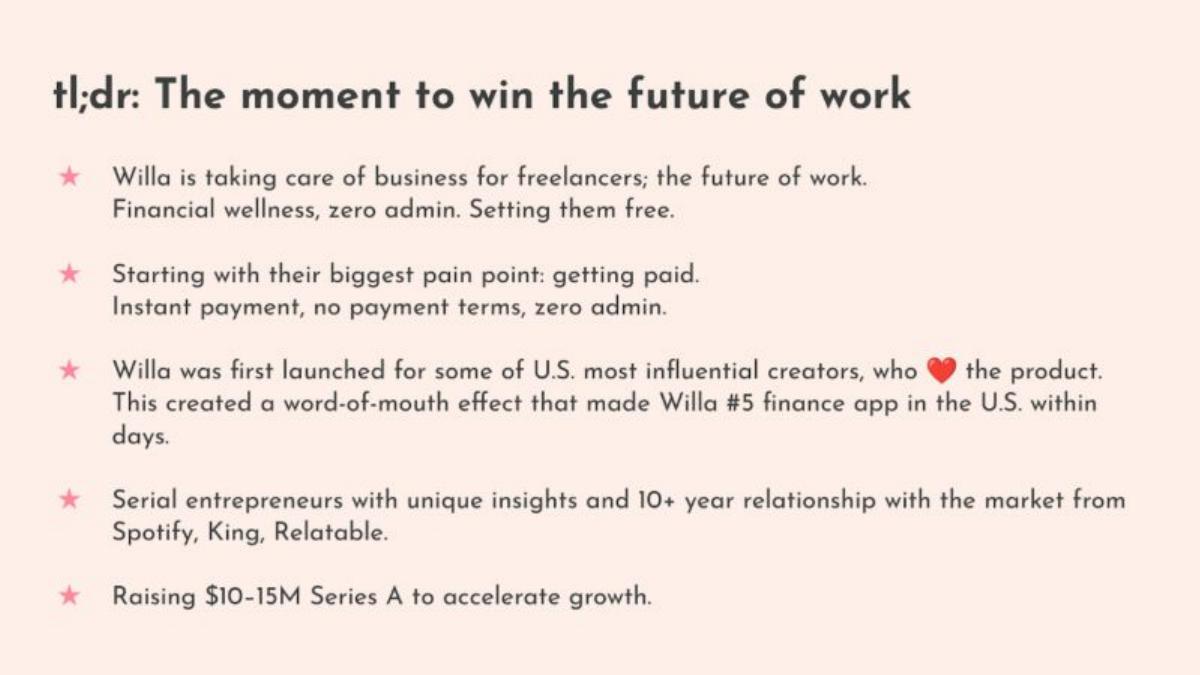
Willa uses a 'tl;dr' slide to front-load their most impressive claims. They define their mission as providing 'Financial wellness' and 'zero admin' for freelancers. Key highlights include their launch success, where they claim to have become the '#5 finance app in the U.S. within days.' Crucially, this slide contains the 'Ask,' stating they are raising a '$10-15M Series A to accelerate growth.' It also mentions the founders' backgrounds at Spotify, King, and Relatable.
Slide 3: The Future of Work Projection
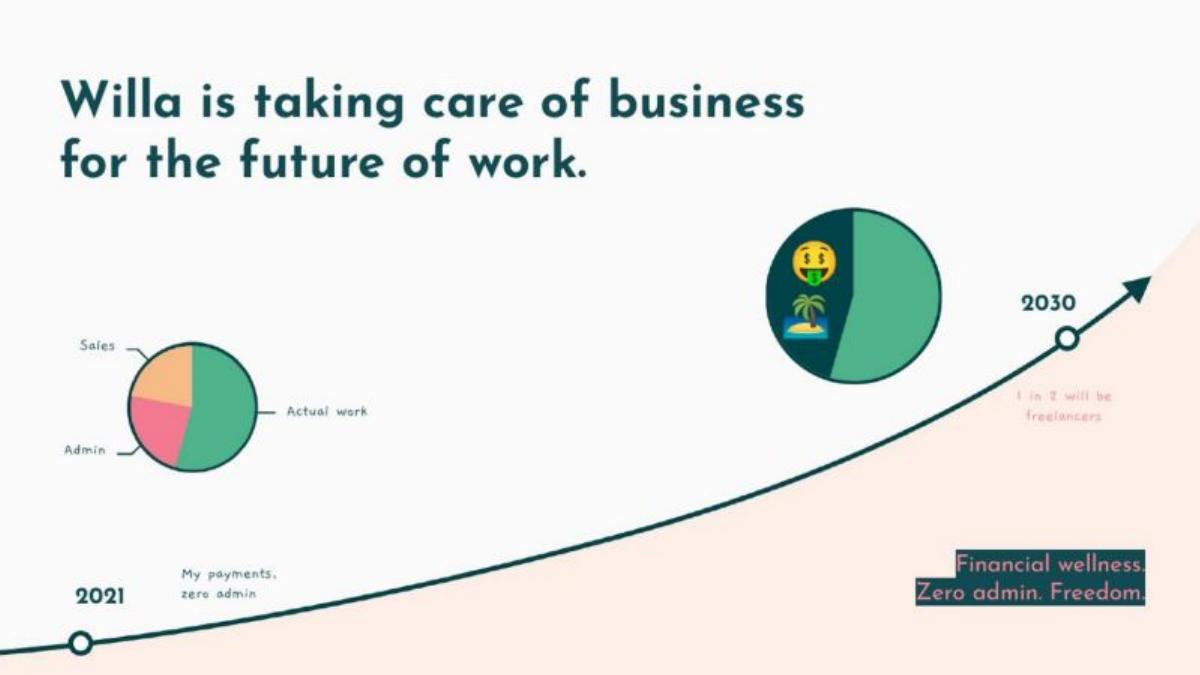
This slide uses a growth curve to visualize the shift in the labor market. It contrasts the 2021 state, where a pie chart shows 'Actual work' being crowded out by 'Admin' and 'Sales,' with a 2030 projection. The slide claims that by 2030, '1 in 2 will be freelancers.' The goal stated here is to move the user toward 'Financial wellness. Zero admin. Freedom.'
Slide 4: The Problem Statement
The problem is distilled into two short sentences: 'All creators fear admin' and 'Millions have cash flow issues.' The simplicity of this slide is intentional; it assumes the investor is already aware of the 'gig economy' struggles and doesn't spend time on secondary problems. The imagery continues to focus on the creator persona—a woman on a basketball court—reinforcing the target demographic.
Slide 5: The Solution (Willa Smart Invoice)
This is the primary product slide. It introduces 'Willa Smart Invoice Technology.' The value proposition is listed as 'Instant payment. No paperwork. Zero stress.' A mockup of the iPhone app shows a clean interface with a '$2940.00' balance and a prominent 'Request Money' button. There is also a visual of a branded Visa debit card. A testimonial at the bottom claims the app made it possible for a user to 'buy my 1st house,' linking the fintech tool to major life milestones.
Slide 6: Market Size and Revenue Goals
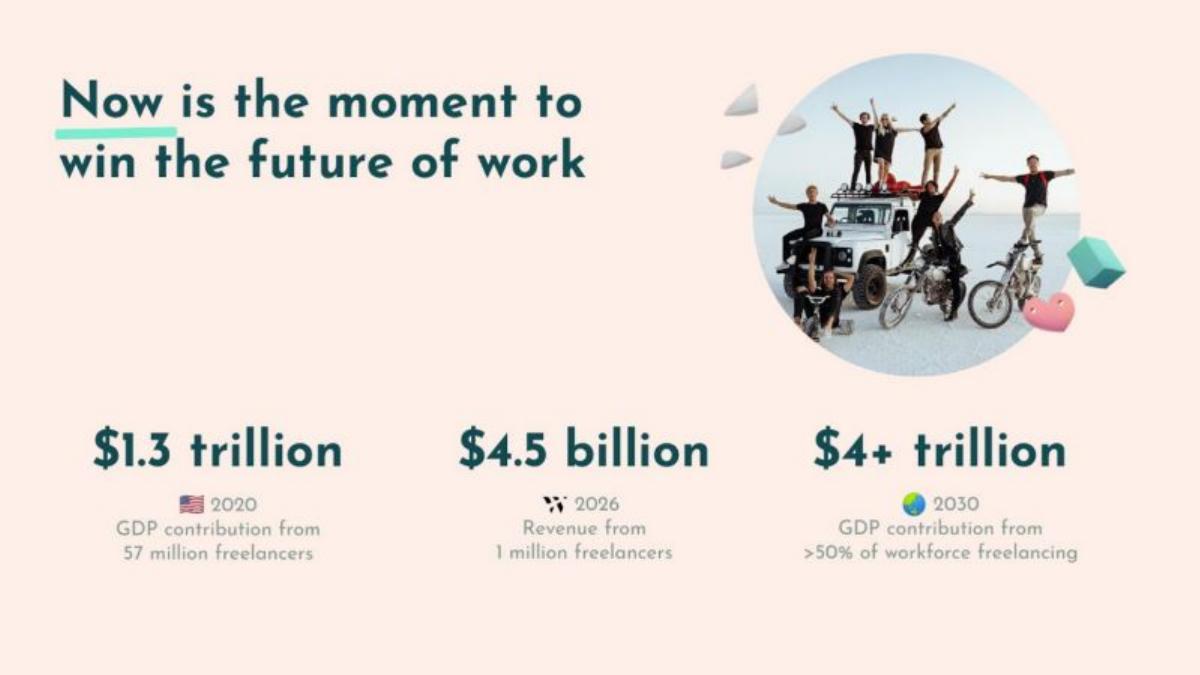
Willa presents three massive figures to define their opportunity:
$1.3 trillion: 2020 GDP contribution from 57 million US freelancers. · $4.5 billion: Willa’s projected revenue from 1 million freelancers by 2026. · $4+ trillion: 2030 GDP contribution from a workforce that is >50% freelance.
This slide attempts to bridge the gap between a niche creator tool and a multi-billion dollar revenue company.
Slide 7: Founder/Market Fit
The team slide focuses on 'Obsessed product builders' and 'Serial founders.' It highlights a '10+ year relationship to thousands of influencers' as an 'unfair market advantage.' Logos for King, Relatable, and Spotify are displayed prominently. A specific note mentions that team members were 'Early Spotify team members' who 'grew user base 10x,' which serves as a proxy for their ability to scale Willa.
Slide 8: Closing Call to Action
The penultimate slide is a simple 'Let’s go' with an illustration of a hot air balloon. It contains no contact information or specific next steps, functioning more as a thematic transition than a data slide.
Slide 9: External Resource
The final slide is a promotional graphic for bestpitchdeck.com and does not contain company-specific information for Willa.
What Works in the Willa Deck
Clarity of Purpose: The deck never wavers from its core message: freelancers hate admin and need money fast. By repeating 'zero admin' and 'instant payment' across multiple slides, the founders ensure the investor remembers the specific problem they are solving.
Social Proof and Pedigree: For an early-stage Series A, the team is often more important than the current revenue. By highlighting their history with Spotify and King, the founders position themselves as experts in 'consumer-grade hits.' The claim of being a top 5 finance app shortly after launch provides the necessary 'traction' signal to back up the pedigree.
Visual Storytelling: The deck uses high-quality photography and a consistent color palette that feels more like a consumer brand than a financial institution. This supports their 'Future of Work' narrative—that work is becoming more creative and less corporate.
What is Missing from the Willa Deck
Unit Economics: There is no mention of how Willa actually makes money on a per-transaction basis. Do they charge a percentage of the invoice? A monthly subscription? A fee for the 'instant' aspect? This is a significant omission for a fintech Series A deck.
Competitive Landscape: The deck operates as if Willa is the only solution in the market. It ignores established players like PayPal or Stripe, as well as other freelancer-specific tools like HoneyBook or FreshBooks. Investors typically want to see how a startup differentiates itself from incumbents.
Use of Funds: While the deck asks for $10-15M, it doesn't explain how that capital will be deployed. There is no breakdown for engineering, marketing, or regulatory compliance—the latter being a major cost center for any fintech company handling payments.
What Other Founders Should Copy
The 'tl;dr' Slide: Placing a summary slide at the beginning (Slide 2) is an excellent tactic. It allows an investor to get the 'gist' of the deal in 30 seconds. If the summary is compelling, they will pay closer attention to the subsequent slides.
Aggressive Market Framing: Willa doesn't just say they are an invoicing app; they say they are 'winning the future of work.' Framing a product within a massive, inevitable macroeconomic shift (the rise of freelancing) makes the investment feel like a bet on a global trend rather than just a single software tool.
Minimalist Design: The lack of clutter makes the deck highly readable. Each slide has one job. Founders should avoid the temptation to cram every metric onto every page; Willa proves that a clean, narrative-driven approach can be enough to secure interest.
Frequently asked questions
- How much did Willa raise with this deck?
- While the deck on slide 2 states they were seeking a $10-15M Series A, the catalogue facts from the listing indicate they raised $3M. This discrepancy often occurs when a deck is used for a specific tranche or if the round terms changed during the fundraising process.
- What is Willa's primary business model according to the slides?
- The deck focuses on a 'Smart Invoice' technology that provides instant payments to creators. Slide 5 emphasizes 'Every client. Every time,' suggesting they sit between the freelancer and the corporate payer to eliminate payment terms and cash flow delays.
- Who is the target audience for Willa?
- The deck specifically identifies 'creators' and 'freelancers' as the primary users. Slide 4 notes that 'millions have cash flow issues,' and slide 7 mentions the founders' direct access to 'thousands of influencers' as a key growth lever.
- What market data does Willa use to justify its valuation?
- On slide 6, Willa cites that 57 million freelancers contributed $1.3 trillion to the US GDP in 2020. They project this will grow to over 50% of the workforce and a $4+ trillion GDP contribution by 2030.
- Does the deck show any actual product features?
- Slide 5 shows a mobile app interface featuring a 'Willa Balance' of $2,940.00 and a 'Request Money' button. It also displays a physical or virtual Visa debit card, indicating a full-stack financial services approach.