WiKey's pitch deck introduces a wireless storage device positioned as a 'Tiny Cloud Computer' to solve security and convenience issues associated with traditional USB drives. The deck relies heavily on consumer sentiment data, claiming 80% of users don't feel safe with current options (Slide 2). The business model is a straightforward hardware play, with price points ranging from $149 for 32GB to $249 for 128GB (Slide 8). While the deck showcases a functional user interface (Slide 9) and a clear competitive matrix (Slide 11), it lacks specific financial projections, manufacturing timelines, a…
Key takeaways
- The product is positioned as a wireless alternative to USB drives, accessible via a web browser without specialized software (Slide 7).
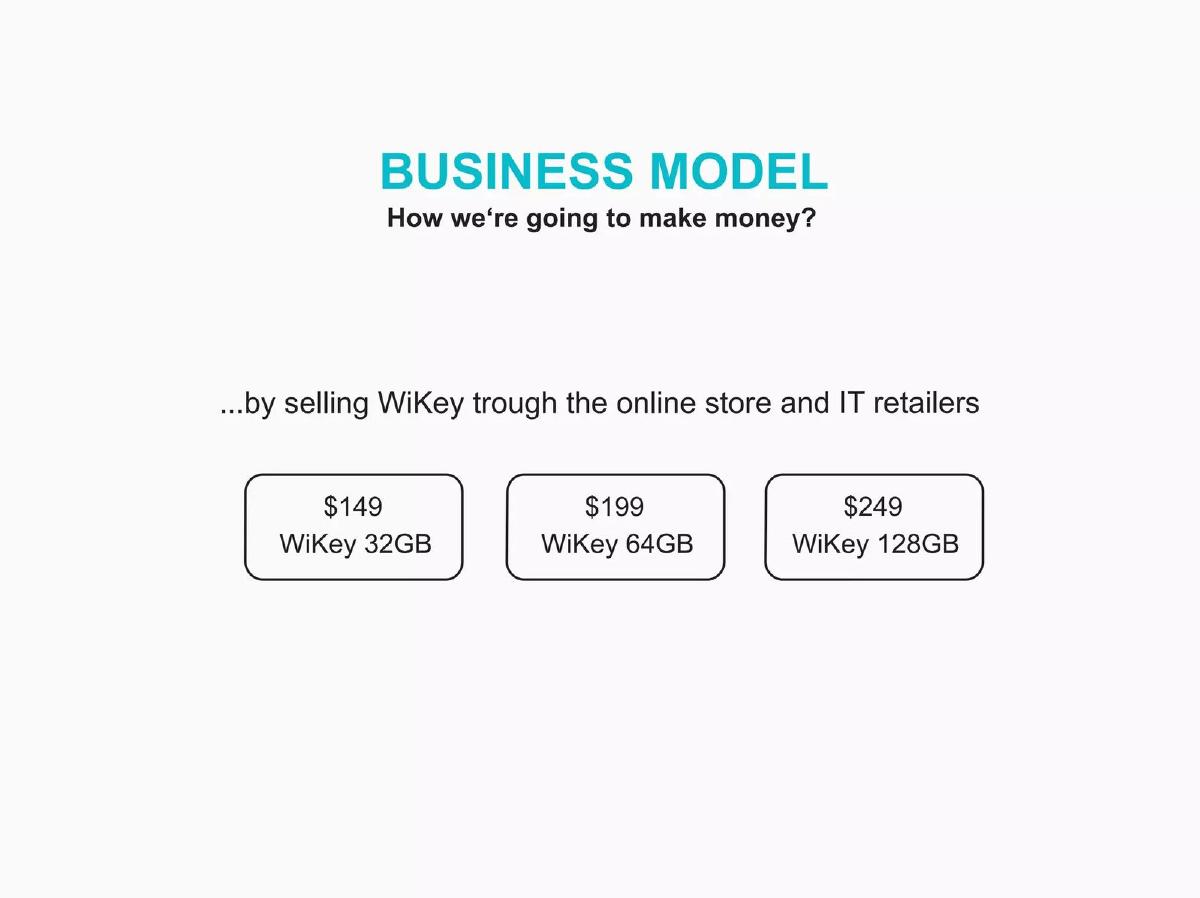
- Pricing is tiered based on storage capacity: $149 (32GB), $199 (64GB), and $249 (128GB) (Slide 8).
- Market size data is dated, citing 63 million USB drives sold in Q2 2012 as the primary growth indicator (Slide 12).
- The deck identifies a security gap, claiming 80% of users feel unsafe with current storage methods (Slide 2).
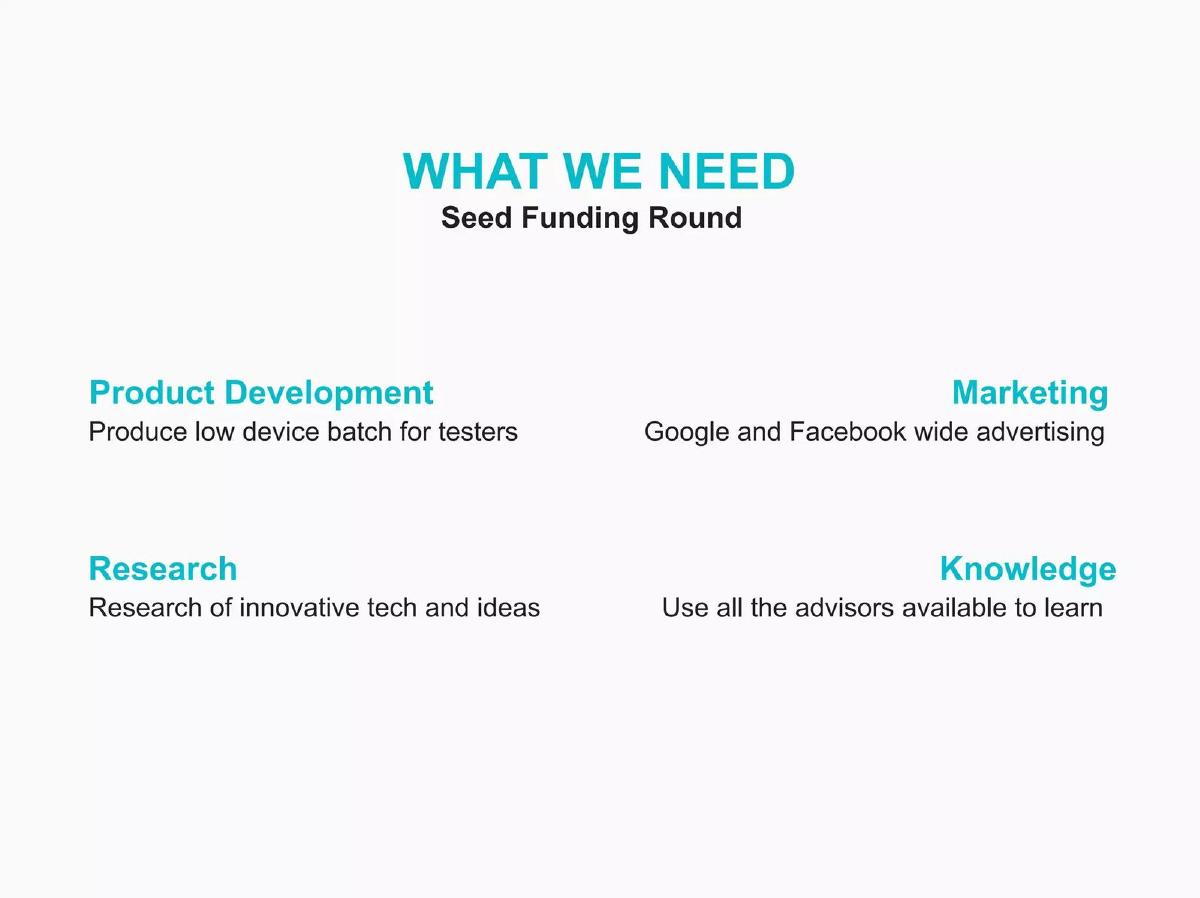
- The 'What We Need' slide specifies a Seed Funding Round but fails to state the actual capital requirement (Slide 10).
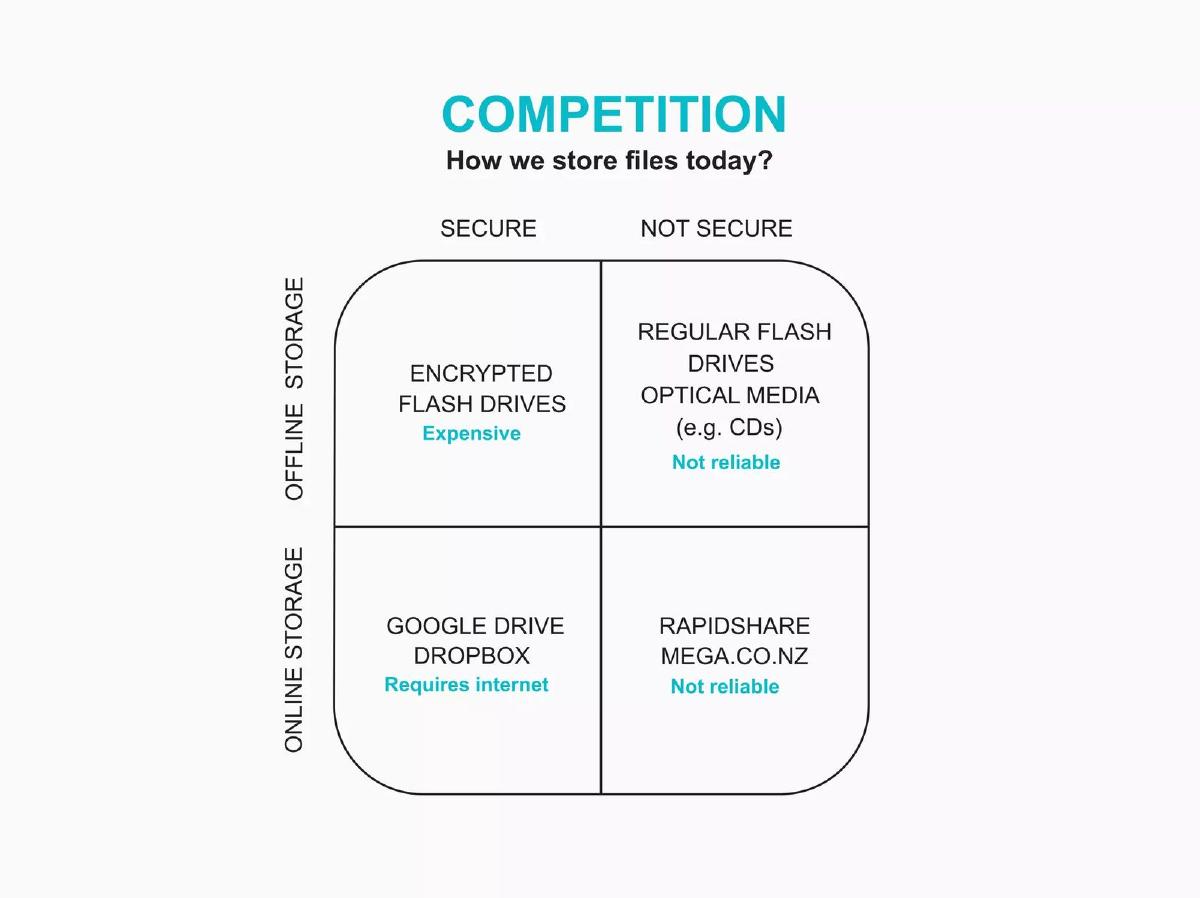
- The competitive landscape is mapped across two axes: Online vs. Offline storage and Secure vs. Not Secure (Slide 11).
- The team consists of a Founder, a Hardware Solutions lead, and a Digital Artist/Designer (Slide 13).
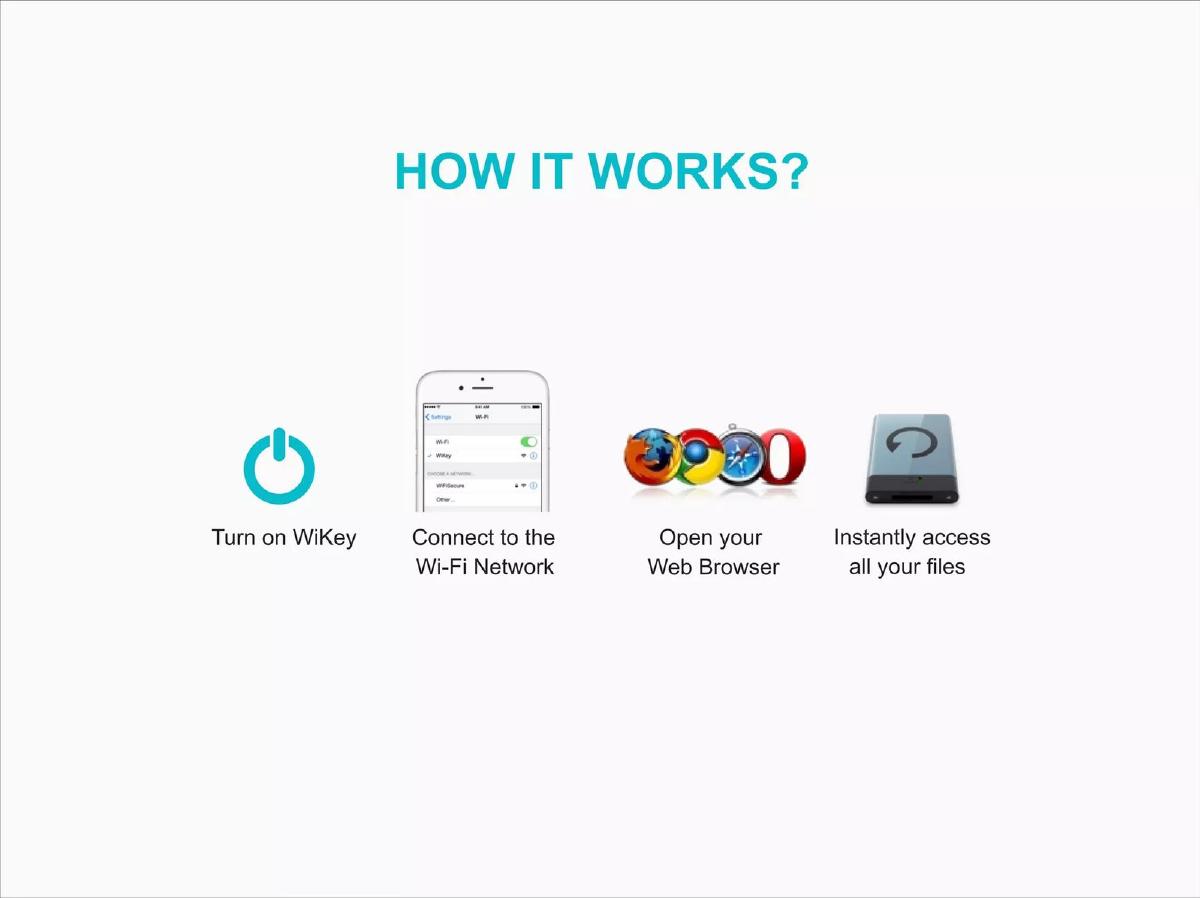
- The product requires a four-step user process: turn on, connect to Wi-Fi, open browser, and access files (Slide 7).
Slide-by-Slide Analysis
Slide 1: Title Slide
The deck opens with the WiKey logo, featuring a Wi-Fi symbol integrated with a keyhole. The tagline is "THE COOLEST WAY TO BOOST STORAGE." It is a clean, minimalist start that establishes the brand identity immediately but provides no information about the company's stage or location.
Slides 2-4: The Problem Statement
WiKey uses three slides to establish the problem, each featuring a single pie chart. Slide 2 claims 80% of people "Don't feel safe" with current storage. Slide 3 states 40% "Hate sharing an USB drive," and Slide 4 notes that 25% "Buy a new one each year." While these statistics point to consumer dissatisfaction, the deck does not cite the source of this data, which weakens the argument for professional investors.
Slide 5: The Solution
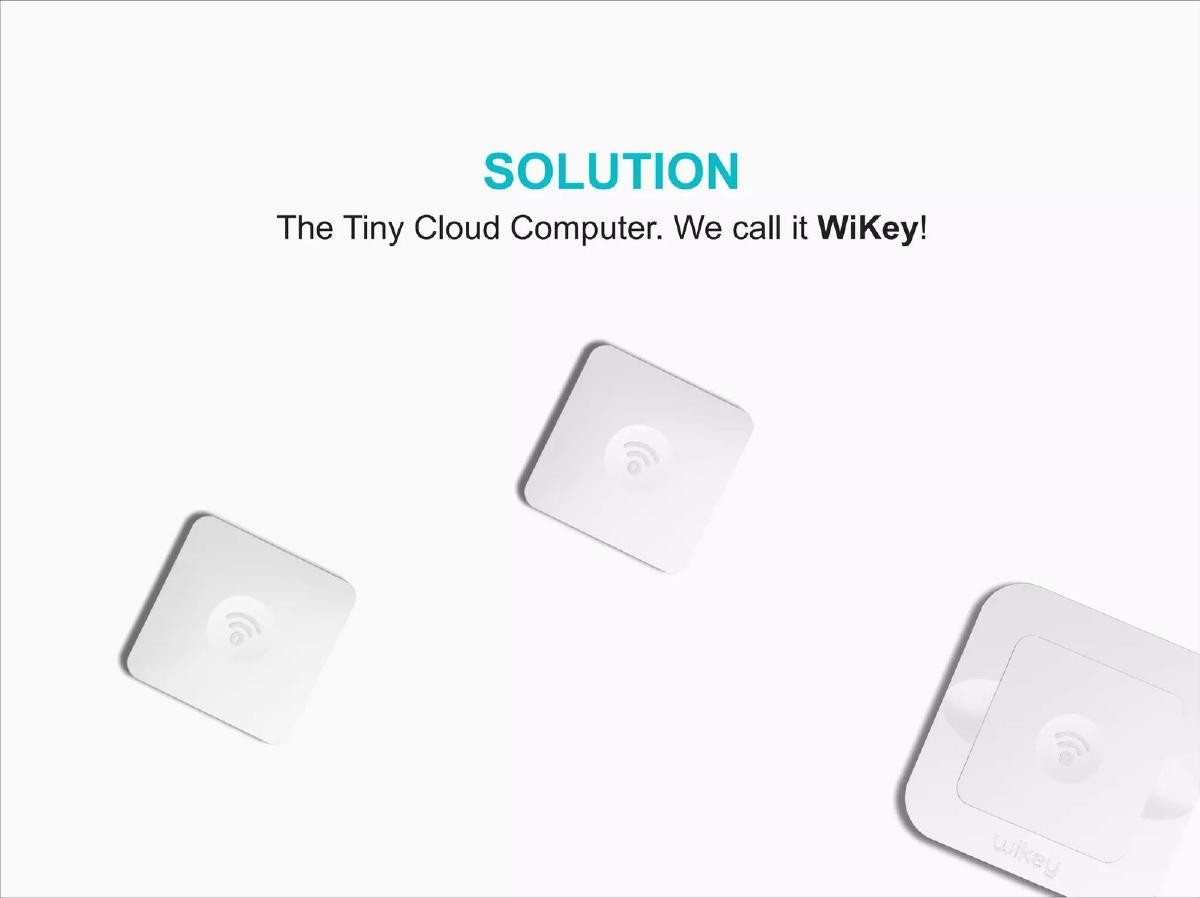
The solution is introduced as "The Tiny Cloud Computer. We call it WiKey!" The slide shows three renders of a small, white, square device with a Wi-Fi logo on top. This is the first time the hardware is visualized, moving the narrative from abstract problems to a physical product.
Slide 6: The Product Render
This slide provides a closer look at the device, labeled "Render (Device)." It shows a slim profile with metallic-looking sides. The simplicity of the design is emphasized, though there are no callouts for ports, buttons, or battery indicators.
Slide 7: How It Works
This is a critical functional slide. It outlines a four-step process: 1. Turn on WiKey, 2. Connect to the Wi-Fi Network, 3. Open your Web Browser, 4. Instantly access all your files. By using the browser as the interface, WiKey avoids the friction of app store downloads or OS-specific drivers. The slide uses icons for popular browsers (Firefox, Chrome, Safari, Opera) to illustrate cross-platform compatibility.
Slide 8: Business Model
WiKey presents a clear, tiered pricing strategy. They plan to sell "trough [sic] the online store and IT retailers." The price points are:
$149 for WiKey 32GB · $199 for WiKey 64GB · $249 for WiKey 128GB
The slide lacks information on manufacturing costs, expected margins, or customer acquisition costs (CAC).
Slide 9: User Interface
Labeled "WHAT WE HAVE," this slide shows a screenshot of the file management software running on a MacBook Air. The UI appears to be a web-based file explorer with categories for Music, Photos, and Videos, as well as integrations for Dropbox, Google Drive, OneDrive, and Box. This suggests the device acts as a hub for both local and cloud-based storage.
Slide 10: The Ask
Under the heading "WHAT WE NEED," the company lists four areas for their "Seed Funding Round" :
Product Development: Produce low device batch for testers. · Marketing: Google and Facebook wide advertising. · Research: Research of innovative tech and ideas. · Knowledge: Use all the advisors available to learn.
Crucially, the slide omits the dollar amount they are seeking to raise.
Slide 11: Competition
The competition is presented in a standard 2x2 matrix. WiKey places itself in the Secure/Offline Storage quadrant (though the device is wireless, it is technically 'offline' relative to the public internet). They contrast themselves against:
Encrypted Flash Drives: Labeled as "Expensive." · Regular Flash Drives/CDs: Labeled as "Not reliable." · Google Drive/Dropbox: Labeled as "Requires internet." · Rapidshare/Mega.co.nz: Labeled as "Not reliable."
Slide 12: Market Size
This slide is the most dated part of the deck. It cites research by Santa Clara Consulting Groups showing 59,000,000+ USB drives sold in 2012 Q1 and 63,000,000+ ($1.2 billion USD) sold in 2012 Q2 . The 6% growth rate is highlighted. Using decade-old data is a significant red flag for current investors.
Slide 13: The Team
The team consists of three individuals: Adel Miljković (Founder), Indir Okanović (Hardware Solutions), and Haris Veljačić (Digital Artist and Designer). The slide includes a testimonial from Mate Rimac , who states, "WiKey has all the right ingredients to launch itself into the pockets of millions of users." This endorsement is a strong signal, given Rimac's success in the hardware/EV space.
Slide 14: Closing Slide
The deck ends with "You just saw innovation! Help us make it happen!" and the company logo. It lacks contact information, which is a standard requirement for a pitch deck.
What Works
Clear Product Utility: The "How It Works" slide (Slide 7) is excellent. It demystifies a technical product by showing a simple four-step consumer journey. The decision to use a web browser as the interface is a strong selling point for ease of use. Visual Consistency: The deck is clean, uses a consistent color palette, and doesn't clutter slides with excessive text. High-Profile Validation: The quote from Mate Rimac (Slide 13) provides a level of technical and entrepreneurial validation that is often missing from early-stage hardware pitches.
What is Missing
The Financial Ask: You cannot have a "What We Need" slide (Slide 10) without a specific number. Investors need to know if the founders are looking for $50k or $5M to determine if the opportunity fits their mandate. Modern Market Data: Using data from 2012 (Slide 12) suggests the founders have not updated their research in years. In the fast-moving storage market, 2012 data is irrelevant to a modern fundraise. Unit Economics: For a hardware company, the most important metrics are the cost to build (COGS) and the margin. While the MSRP is listed, there is no indication of whether the $149 price point is profitable. Traction and Roadmap: There is no mention of how many prototypes exist, whether there is a waitlist, or what the specific timeline is for the "tester batch" mentioned on Slide 10.
Founder Takeaways
1. Always cite your data: The problem slides (2-4) make bold claims about consumer sentiment. Without a source (e.g., "Survey of 1,000 frequent travelers, 2023"), these are just opinions. 2. Update your market research: If your deck is more than six months old, refresh your market size numbers. Using 2012 data in a pitch is an immediate disqualifier for most VCs. 3. Be specific with the 'Ask': Don't just say you need money for "Marketing" and "Research." State the amount, the equity offered (if applicable), and the specific milestones that capital will buy you (e.g., "Raising $500k to manufacture 2,000 units and achieve $300k in pre-orders"). 4. Leverage your UI: Slide 9 is a strong asset. Showing that the software already exists and integrates with major cloud providers proves that this is more than just a 'dumb' storage drive.
Frequently asked questions
- What is the primary problem WiKey aims to solve?
- WiKey targets three main pain points identified in slides 2, 3, and 4: a lack of perceived safety in current storage (80%), a dislike for physical USB sharing (40%), and the frequency of replacement (25% buy a new drive annually). It aims to provide a secure, wireless, and permanent storage solution that avoids the physical limitations of traditional flash drives.
- How does the WiKey device actually function for the end user?
- According to Slide 7, the device operates as a local wireless node. A user turns the device on, connects their computer or phone to the WiKey Wi-Fi network, and opens a standard web browser to access the file management interface. This eliminates the need for physical ports or proprietary desktop software to transfer files.
- What is the revenue model for WiKey?
- WiKey follows a traditional hardware sales model. Slide 8 outlines three SKUs: a 32GB model for $149, a 64GB model for $199, and a 128GB model for $249. The deck mentions distribution through an internal online store and third-party IT retailers, though it does not list specific retail partners or margins.
- Who is behind the company and what is their expertise?
- The team (Slide 13) includes Adel Miljković (Founder), Indir Okanović (Hardware Solutions), and Haris Veljačić (Digital Artist and Designer). The deck also features a supportive quote from Mate Rimac, founder of Rimac Automobili, which suggests the project has some level of high-profile mentorship or validation in the hardware space.
- What are the major omissions in this pitch deck?
- The deck lacks several critical components for a professional fundraise: it does not state the amount of money being raised (Slide 10), it provides no financial projections or unit economics (COGS vs. MSRP), and the market data is significantly outdated (Slide 12). Additionally, there is no roadmap showing when the 'low device batch for testers' will be completed.