Chattermill’s Series B deck is a highly professional, metric-dense presentation that successfully positions the company as a unifying layer in a fragmented Customer Experience (CX) market. By highlighting a $60k+ landing ACV and a roster of blue-chip clients including Amazon, Uber, and Zappos, the deck establishes immediate enterprise credibility. The narrative focuses on the transition from a point solution to a 'Unified Customer Intelligence' platform, backed by a case study showing a 62% upgrade rate after year one. While the deck lacks a traditional team slide or a specific breakdown of t…
Key takeaways
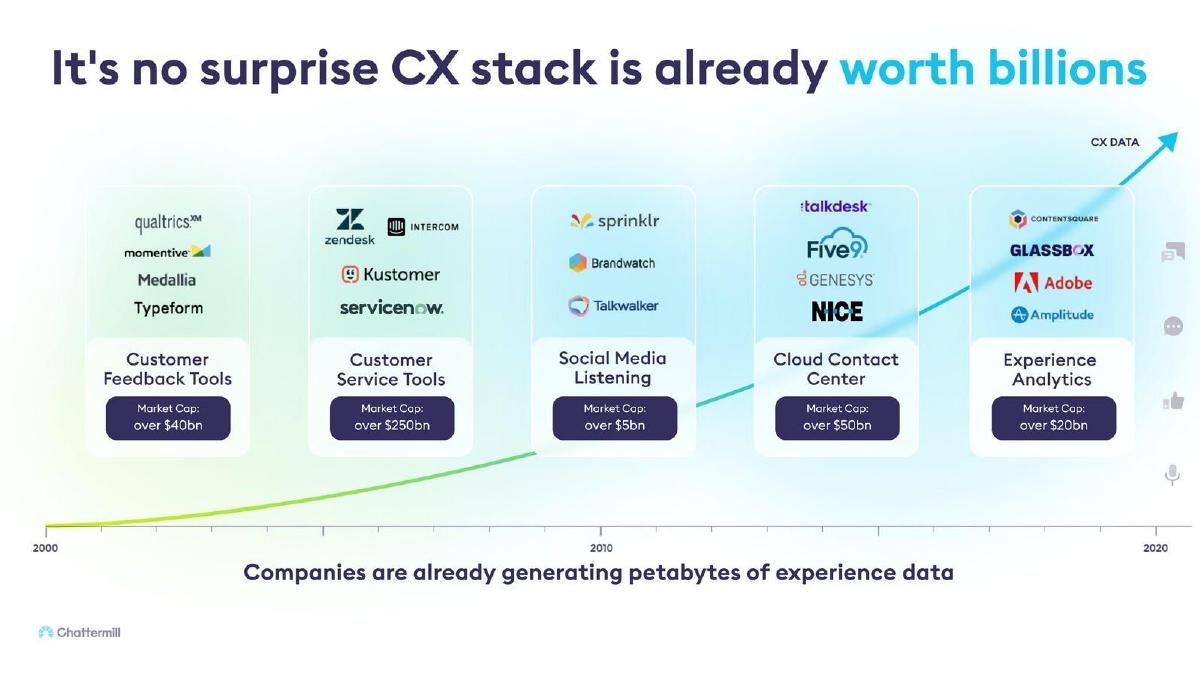
- The deck identifies five distinct CX market segments with a combined market cap exceeding $365 billion (Slide 4).
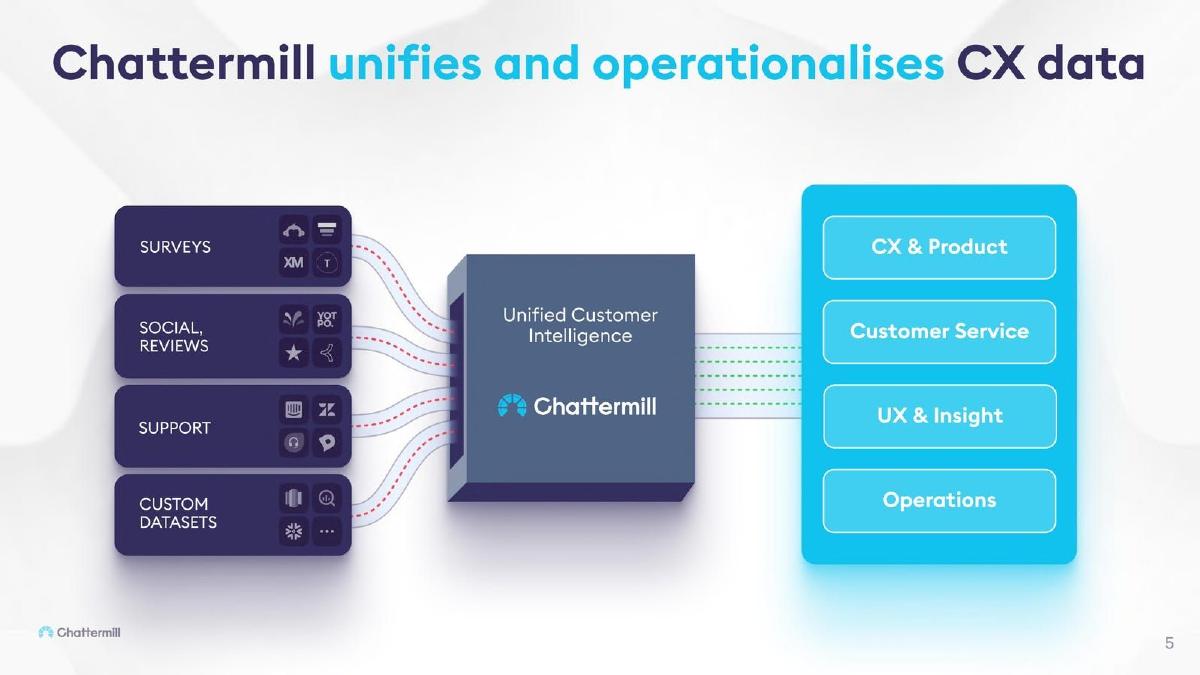
- Chattermill positions itself as a 'Unified Customer Intelligence' hub that integrates surveys, social reviews, and support data (Slide 5).
- The company reports a significant $60k+ Landing ACV across a base of 90 customers (Slide 9).
- Enterprise social proof is central to the pitch, featuring logos like Amazon, Uber, H&M, and Virgin (Slide 9).
- A detailed case study for a sporting goods retailer demonstrates a $400k+ two-year deal with a 62% upgrade after the first year (Slide 11).
- The platform helped a retailer increase its NPS from 66 to 73 through data-driven staffing adjustments (Slide 11).
- Product expansion is cited as a primary growth lever, with the first addition boosting ACV by 65% in a single year (Slide 13).
- The deck omits a dedicated team slide and a specific 'Ask' slide detailing the breakdown of the $26M raise.
Chattermill Series B: The Unified Intelligence Play
Chattermill’s Series B deck is a clinical example of how to present a B2B SaaS company that has found its stride in the enterprise market. Reported by Business Insider as a $26M raise in 2024, the deck focuses less on the 'visionary' aspects of AI and more on the practical, operational benefits of unifying customer data. The narrative is built around the 'Experience Economy' and the massive fragmentation of tools currently used to measure it.
Slide 1-3: Branding and Positioning
The opening slides are minimalist, focusing on the company logo and the tagline 'Powering the Experience Economy.' By the third slide, the contact information for Mikhail (presumably Mikhail Dubov, the CEO) is provided. There is no immediate 'hook' or problem statement on these title slides, which is typical for a deck intended to be presented rather than just read as a standalone document.
Slide 4: The Market Landscape and Opportunity
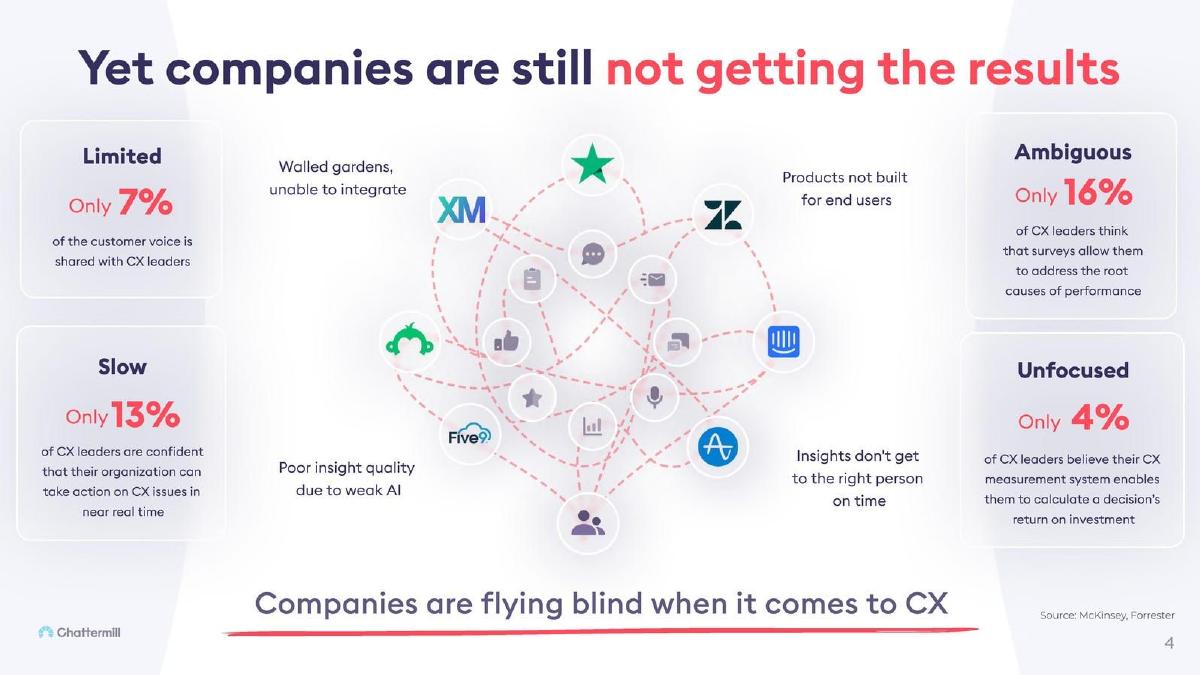
Slide 4 is one of the most effective slides in the deck. It categorizes the CX (Customer Experience) stack into five distinct buckets: Customer Feedback Tools, Customer Service Tools, Social Media Listening, Cloud Contact Centers, and Experience Analytics. By listing the market caps of incumbents in these spaces—ranging from $5bn to over $250bn—Chattermill establishes the scale of the ecosystem they inhabit. The slide notes that 'Companies are already generating petabytes of experience data,' setting the stage for a solution that can manage this volume.
Slide 5: The Solution Architecture
This slide introduces the 'Unified Customer Intelligence' engine. It uses a clear diagram to show how Chattermill acts as a central hub. On the left, input sources are listed: Surveys (Qualtrics, Typeform), Social/Reviews (Trustpilot, Yotpo), Support (Zendesk, Intercom), and Custom Datasets. These feed into the Chattermill box, which then outputs actionable insights to four key internal teams: CX & Product, Customer Service, UX & Insight, and Operations. This slide successfully moves Chattermill from being 'another tool' to being 'the tool that connects all tools.'
Slide 7: Product and UX Showcase
Slide 7 focuses on the interface. It highlights four pillars: a 'CX Data Lake,' 'AI purpose built for CX,' 'Powerful team collaboration workflows,' and a 'Strong emphasis on ease of use.' The screenshots show a clean UI with sentiment analysis (e.g., 'Green bean,' 'Small portion') and Slack integrations. The inclusion of a bar chart showing 'Price/Value for Money' vs. 'Quality' suggests the platform provides deep-dive competitive or thematic analysis beyond simple keyword tracking.
Slide 9: Traction and Social Proof
This is the 'credibility' slide. It features a 4x4 grid of high-tier logos, including Virgin, Tesco, Uber, Amazon, H&M, and Zappos. Beneath the logos, two critical metrics are highlighted: '90 customers' and '$60k+ Landing ACV.' For a Series B, a $60k landing ACV is a strong indicator of enterprise viability, suggesting that even their 'small' deals are significant and that they are not chasing low-margin SMBs.
Slide 11: The Deep-Dive Case Study
Chattermill uses Slide 11 to prove ROI through a specific Sporting Goods Retailer case study. The metrics are impressive: a '$400k+ 2 year deal' and a '62% Upgrade after year 1.' The slide explains the 'Insight' (Staff availability is a key driver of CX issues), the 'Solution' (Dynamically deploy staff to low-sentiment stores), and the 'Result' (NPS increased from 66 to 73). This provides a concrete example of how their 'Unified Intelligence' translates into bottom-line business decisions.
Slide 13: The Expansion Roadmap
The final content slide, Slide 13, addresses future growth. It shows a timeline of product expansion. In 2020, the 'Core' product handled Reviews and Surveys. The '20XX' (current/near future) columns show the addition of 'Conversations' (Chats/Emails) and finally 'Unified Customer Intelligence' (Voice, Social, Experience Analytics). The key takeaway here is the statement: 'Our first Product addition has already boosted ACV by 65% this year.' This tells investors that the company has a proven 'land and expand' motion.
What Chattermill Does Exceptionally Well
The deck excels at segmenting the market . By breaking down the CX stack into five categories with specific market caps, they make the 'Unified Intelligence' category feel like an inevitable and lucrative evolution of the market. They don't just say the market is big; they show exactly where the money currently sits and how they sit above it.
The use of social proof is also top-tier. Many startups list logos, but Chattermill combines those logos with a high Landing ACV and a specific case study that details a 62% upgrade rate. This combination proves that not only do big companies buy the software, but they also find it valuable enough to spend significantly more money on it within twelve months.
What is Missing from the Chattermill Deck
The most glaring omission is the Team Slide . In a Series B round, investors are betting heavily on the ability of the leadership team to scale the organization. While the CEO's email is present, there is no mention of the engineering talent, the sales leadership, or the background of the founders. This information was likely handled in a separate document or during the verbal pitch, but its absence in the primary deck is notable.
There is also no Financial Projections slide. While the deck mentions ACV and upgrade percentages, it does not show a path to $100M ARR or provide historical revenue growth rates (e.g., YoY growth). Furthermore, the Competition slide is missing. While Slide 4 lists other tools, it positions them as partners/integrations rather than competitors. A sophisticated investor would want to know how Chattermill differentiates itself from the 'Experience Analytics' bucket specifically.
Lessons for Founders
Quantify the 'Unification' Value: If your product is a middleware or an aggregator, don't just say you 'integrate.' Show the inputs (Slide 5) and the specific business outcomes (Slide 11) that result from that integration. · Lead with ACV: If you have moved into the enterprise space, make your Average Contract Value a headline metric. It immediately changes the conversation from 'user growth' to 'revenue quality.' · Use the 'Land and Expand' Narrative: Investors love to see that you can grow within your existing base. Chattermill’s Slide 13, showing a 65% ACV boost from a single product addition, is a powerful way to demonstrate future revenue potential without relying solely on new customer acquisition. · Market Mapping: When entering a crowded space, map the existing categories and their market caps (Slide 4). This helps investors place your company in a broader context and understand the potential exit size.
Frequently asked questions
- What is Chattermill's core value proposition according to the deck?
- Chattermill positions itself as the unifying layer for fragmented customer experience data. According to Slide 5, it pulls data from surveys, social media, reviews, and support tickets into a 'Unified Customer Intelligence' engine. This allows various departments—including Product, Customer Service, UX, and Operations—to act on a single source of truth rather than siloed data points.
- How does Chattermill demonstrate its enterprise readiness?
- The deck relies heavily on high-value social proof and contract metrics. Slide 9 displays 16 major enterprise logos, including global giants like Amazon and Uber. Furthermore, the mention of a $60k+ landing ACV and a case study featuring a $400k+ multi-year deal (Slide 11) signals to investors that the company has successfully moved past the SMB market into high-value enterprise sales.
- What specific metrics are used to prove the product's ROI?
- In a case study on Slide 11, Chattermill shows a direct correlation between its insights and business outcomes. By identifying that 'Staff Availability' was a key driver of negative sentiment, the client was able to redeploy staff, resulting in an Net Promoter Score (NPS) increase from 66 to 73. The slide also notes a 62% upgrade rate, proving the client saw enough value to increase their investment.
- What is the primary growth driver mentioned in the Series B deck?
- The deck emphasizes 'Product Expansion' as the key to moving upmarket. Slide 13 illustrates a roadmap where adding 'Conversations' (chats and emails) and 'Unified Intelligence' (voice and social) to the core product has already boosted ACV by 65%. This strategy suggests that growth will come from both new customer acquisition and significant expansion within the existing 90-customer base.
- What essential pitch deck elements are missing from this presentation?
- This deck is notably missing a Team slide, which is unusual for a Series B raise where leadership experience is critical. It also lacks a clear 'Ask' slide or 'Use of Funds' breakdown. While we know from external reports that they raised $26M, the deck itself does not specify the amount sought or how the capital will be allocated across hiring, R&D, or sales expansion.