Moving Upmarket on a Pitch Deck: Define the Segment, Show
'Moving upmarket' is a common plan and a vague one. Four real decks show how to say which customers you mean, what proves larger buyers will pay.
Moving Upmarket on a Pitch Deck: Say Which Customers, Show the Proof, Name What Changes
Many companies start with small customers because they buy quickly, and then plan to sell to larger ones because they pay more and stay longer. 'Moving upmarket' is how founders describe that shift, and it appears in decks at every stage from seed to growth. Investors take the phrase seriously because the move changes almost everything: product, pricing, sales team, sales cycle, support and cash needs. They also discount it, because it is easy to announce and hard to do. This guide looks at four real decks that describe a move upmarket and shows what makes the claim credible: a definition of the segment, evidence that larger customers already pay more, a list of what the company changes to serve them, and a plan for the customers it already has.
TL;DR
Define the segment you are moving from and to (by employee count, revenue or contract size), show evidence that larger customers already buy and pay more, name what you will change to win them (product, pricing, sales hires, partners, acquisitions), and say what happens to your current customers. airSlate, in an overview slide, lists the changes behind its move 'up-market to SME' between 2017 and 2019: an acquisition, inside sales and partner teams, and a new product; but its own figures, '$17 mil ARR and 165K customers' in 2016 and '$51M ARR and 443K customers' in 2019, work out to about $103 and $115 of ARR per customer, a rise of roughly 12%, so the slide shows growth more clearly than a move to bigger customers. Chattermill ties the move to product: 'Our first Product addition has already boosted ACV by 65% this year', the only measured result of the four. Airbase, in a Series B memo, defines its segment, 'mid-market (50-1000 employees)', and says it will keep that focus while investing further upmarket, but gives no evidence yet. Katana says 'Initial traction from workshops selling on Shopify ... and now moving upmarket towards SME' with no figure, so the reader learns the direction and nothing else.
Four documents that describe a move upmarket
Each page is read at full size. Quotes are exact.
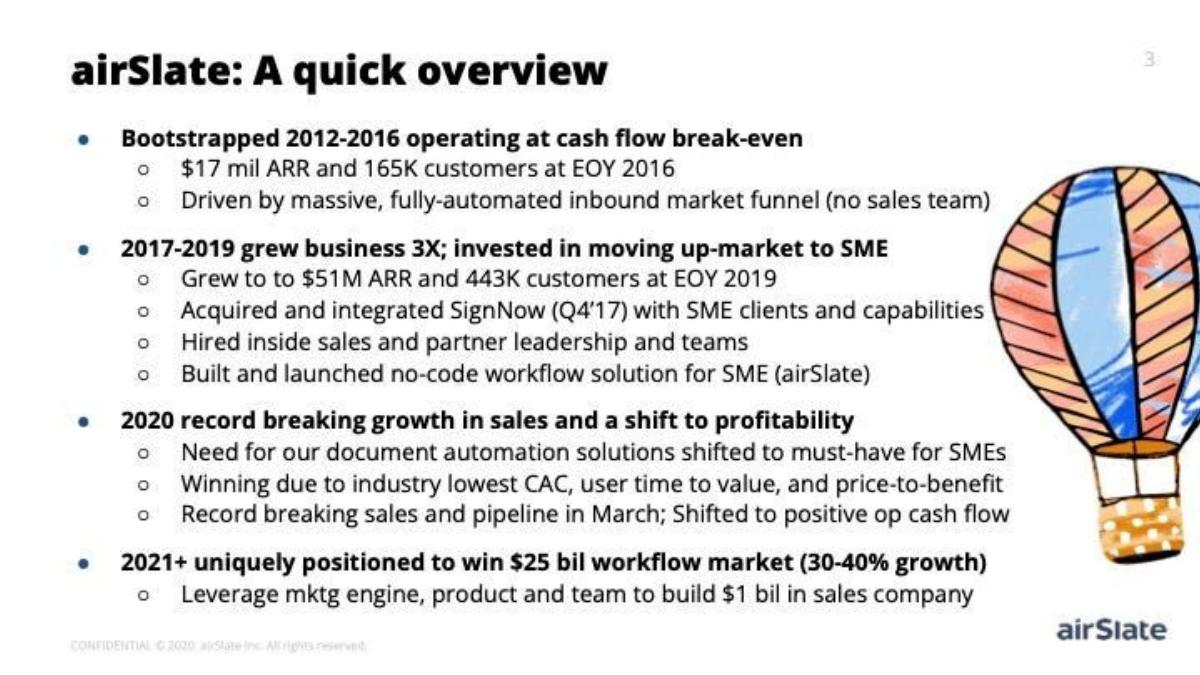
airSlate go to market slide — slide 2
Document workflow software. Company overview slide.
airSlate deck, slide 2. Exact stored slide matched to this analysis.
Our analysis: Clear actions; the figures show growth more than larger customers.
Evidence and limitation: Changes listed; ARR per customer about $103 → $115 (our calculation), roughly +12%.
What a founder can adapt: Add ACV and share of new ARR by segment.
Supporting analysis
What the deck claims: "2017-2019 grew business 3X; invested in moving up-market to SME"; "$17 mil ARR and 165K customers at EOY 2016"; "$51M ARR and 443K customers at EOY 2019"; SignNow acquisition, inside sales and partner teams, SME product.
Presentation choice: Shows how to list what a move upmarket involved.
When it does not fit: Totals that don't show the shift you describe.
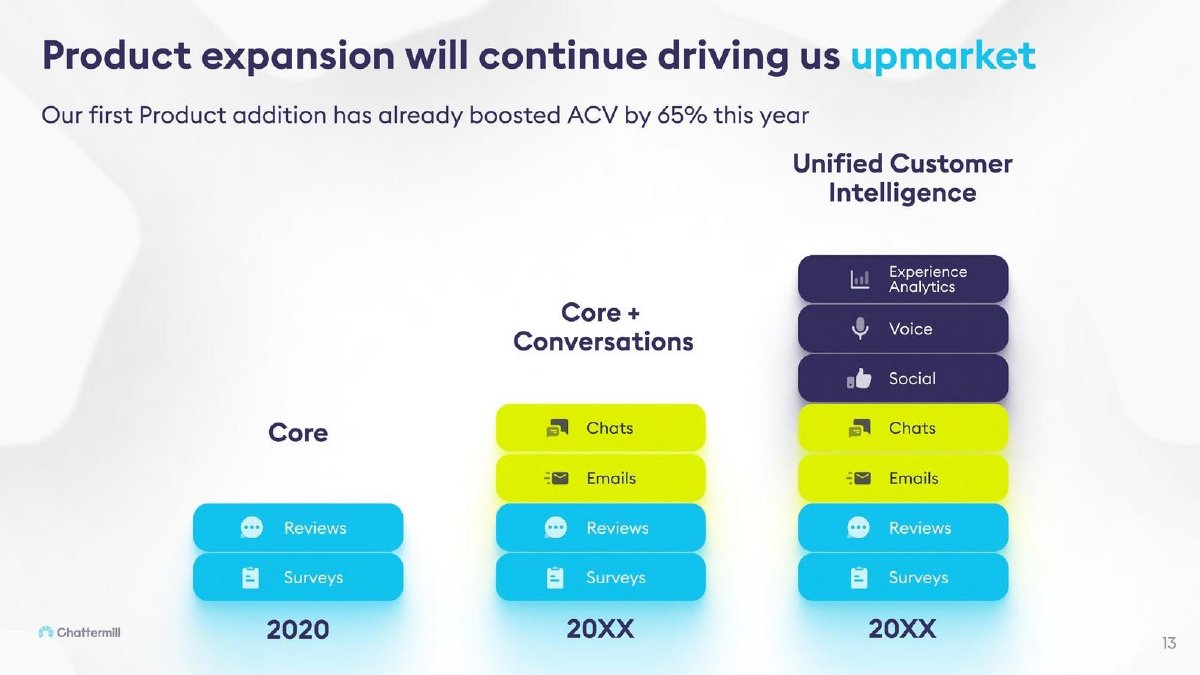
Chattermill deck, slide 13. Exact stored slide matched to this analysis.
Our analysis: Links product breadth to contract size.
Evidence and limitation: One measured ACV change; no base, no split between upsell and new larger customers.
What a founder can adapt: Give the ACV before and after, and the new-logo share by size.
Supporting analysis
What the deck claims: "Product expansion will continue driving us upmarket"; "Our first Product addition has already boosted ACV by 65% this year"; stages Core (2020), Core + Conversations (20XX), Unified Customer Intelligence (20XX).
Presentation choice: The only measured result of the four.
When it does not fit: A percentage with no starting figure.
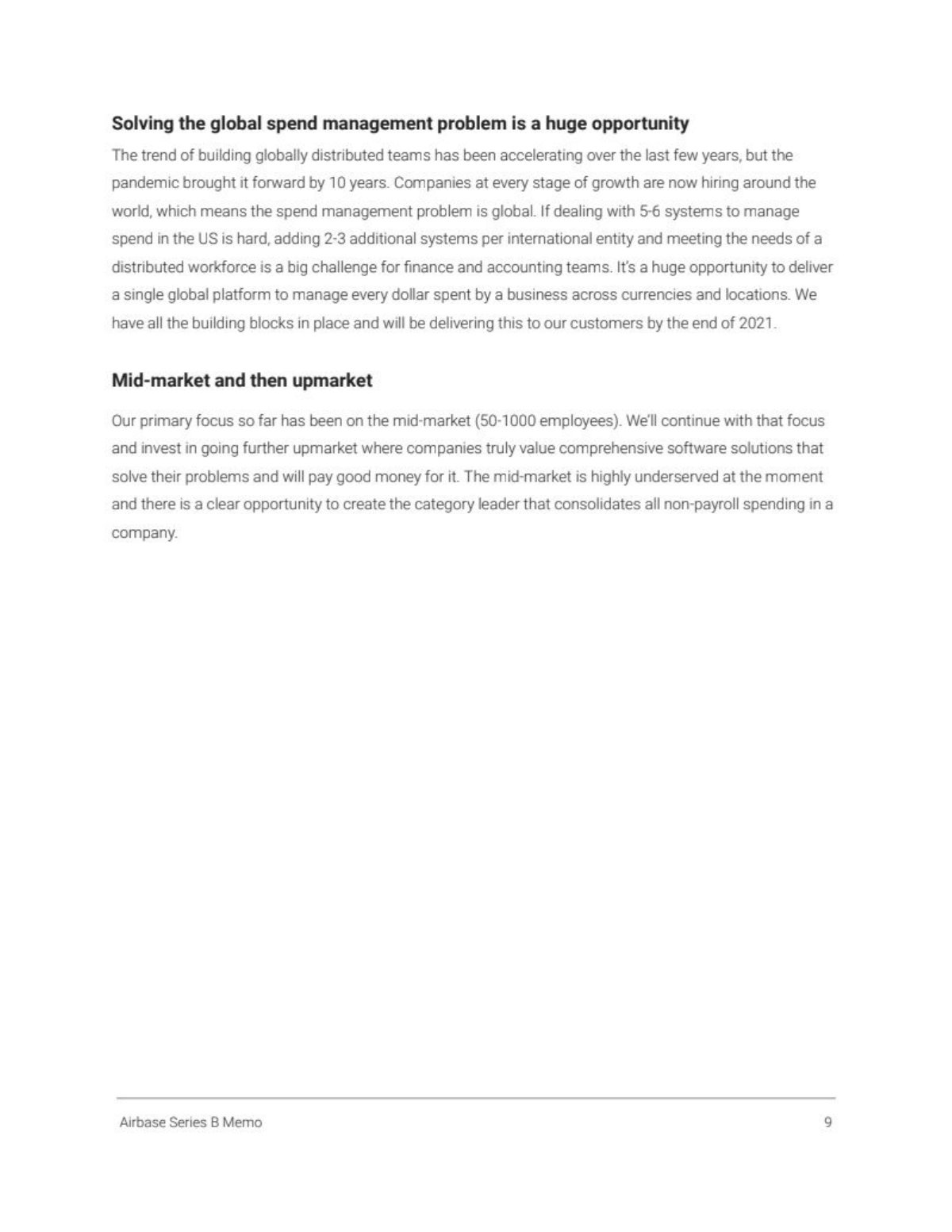
Spend management. Written Series B memo, not a slide.
Airbase deck, slide 9. Exact stored slide matched to this analysis.
Our analysis: A clear statement of plan, not yet a result.
Evidence and limitation: Segment defined in numbers; current focus kept; no evidence or trigger for the next segment.
What a founder can adapt: Add larger customers already won and when the investment starts.
Supporting analysis
What the deck claims: "Our primary focus so far has been on the mid-market (50-1000 employees). We'll continue with that focus and invest in going further upmarket..."
Presentation choice: Shows how to define a segment in one line.
When it does not fit: 'Will pay good money' without a price.
Define the segments in numbers: employees, revenue or contract size.
Show that larger customers already pay more: ACV by segment.
Name what changes: product, pricing, sales team, partners.
Check your own figures: revenue per customer should rise.
Say what happens to existing small customers.
Tie the move to the round: which hires and features it funds.
Prepare your move upmarket
Answer these before writing the slide.
Segments. Where do you sell today and where next, in numbers?
Proof. How many larger customers do you have, at what ACV?
Changes. What product, pricing and team changes does the move need?
Base. What happens to your current small customers?
Copyable framework: "Today: [segment], ACV $[x]. Next: [segment]; [n] already at ACV $[y]; [changes] funded by this round."
Illustrative example 1 — written by us
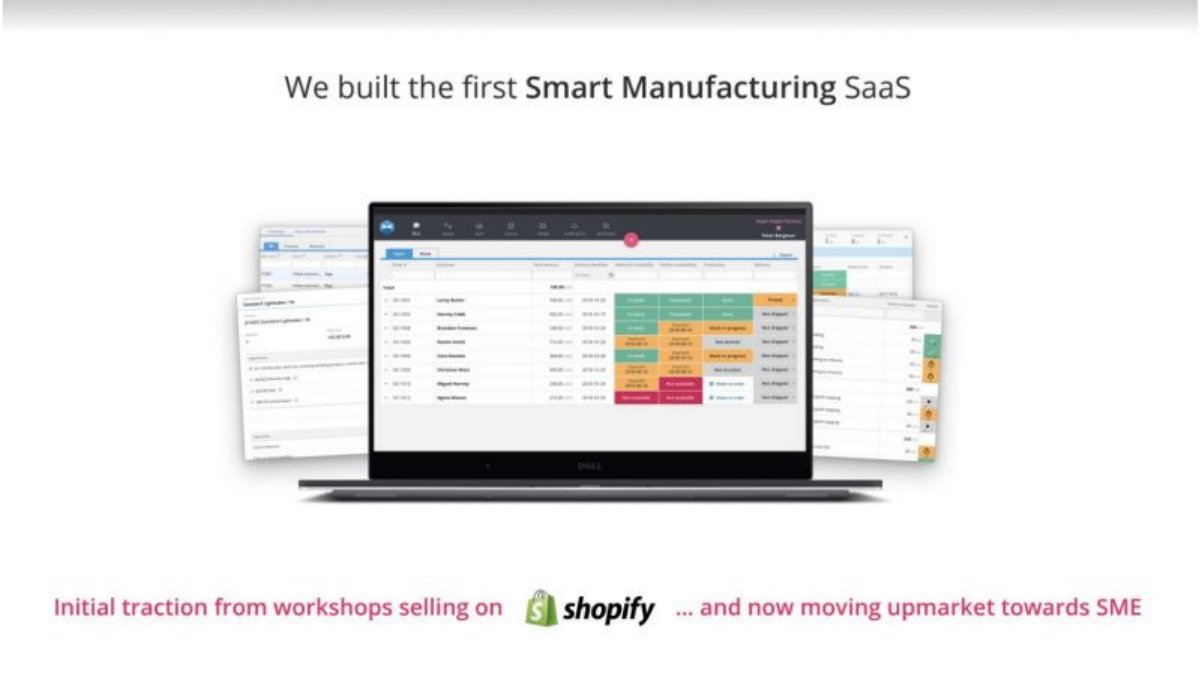
Before: "Initial traction from workshops selling on Shopify ... and now moving upmarket towards SME"
After: "Started with Shopify workshops (ACV $[x]); now [n] SMEs with [range] employees at ACV $[y]."
What improved: Our illustrative rewrite of Katana's line. Bracketed details are not stated on the slide.
The question this guide answers
This guide answers one founder question: how should I present a plan to sell to larger customers so that investors believe it is under way and not just intended?
Our deal-size guide covers how to report ACV and average order value: what is averaged, over whom, and for what period. Our SaaS go-to-market guide includes a plan that moves from self-serve to enterprise over time and notes that it lacks triggers. Our land-and-expand draft covers growing revenue within an account. None takes the move between customer segments as its subject: how to define the segments, what evidence shows the larger segment buys, what the company must change, and how its current numbers should support the claim.
How we chose and read the examples
We searched extracted text across the library for 'upmarket', 'up-market' and related phrases. Most matches used the word about markets in general (coffee moving upmarket, banks retreating up-market) or listed 'move upmarket' as a single word on a funds slide. We kept four documents where a company describes its own move: an overview slide with figures before and after, a product slide with a measured ACV change, a written memo page that defines the segment, and a product slide with a one-line claim. We set aside a Series A ask slide that lists 'Move upmarket for higher ACVs' because its targets are redacted.
Airbase's page is from a written Series B memo, not a slide; we include it because it shows how to define a segment in one sentence. Each page was rendered from the source document and read at full size. airSlate's per-customer figures are our calculation from its own numbers. All four companies were private when these documents were made. We did not check any figure against outside sources.
Why investors probe the claim
It changes the company. Larger customers want security reviews, integrations, admin controls, contracts and named support. Serving them may need a sales team the company doesn't have yet. An investor wants to see that the founder knows the list.
It changes the numbers. Bigger deals take longer to close and cost more to win. CAC, sales cycle and cash burn all rise before revenue per customer does. A forecast that keeps today's CAC and cycle while moving upmarket is likely to be wrong.
It can be a sign of trouble. Some companies announce a move upmarket because small customers churn or the small-customer market is smaller than hoped. That can be the right decision, but investors will ask whether the move is driven by pull from larger buyers or push from problems below.
It is easy to say. 'Moving upmarket' has no number in it. Without a definition and a measure, the reader cannot tell whether the move has started.
Changes listed, figures that don't yet show the move: airSlate
airSlate, a document workflow company, opens with 'airSlate: A quick overview', four phases with bullets. 'Bootstrapped 2012-2016 operating at cash flow break-even': '$17 mil ARR and 165K customers at EOY 2016', 'Driven by massive, fully-automated inbound market funnel (no sales team)'. '2017-2019 grew business 3X; invested in moving up-market to SME': 'Grew to to $51M ARR and 443K customers at EOY 2019', 'Acquired and integrated SignNow (Q4'17) with SME clients and capabilities', 'Hired inside sales and partner leadership and teams', 'Built and launched no-code workflow solution for SME (airSlate)'. Two further phases cover 2020 growth and a 2021+ market goal.
The strength of this slide is the list of changes. It names three things the company did to move upmarket: bought a company that already had SME customers, hired the sales and partner teams that larger customers need, and built a product for them. That is the kind of concrete answer investors look for when they ask what the move involved.
The figures tell a less clear story. $17M over 165,000 customers is about $103 of ARR per customer; $51M over 443,000 is about $115, a rise of roughly 12% over three years. ARR tripled, but most of it came from more customers, not larger ones. That may be fine: the SME segment may be a small part of the base, or the acquisition may have added many small accounts. But the slide doesn't split revenue by segment, so the reader can't see the move in the numbers. A single added line would close the gap: 'SME share of new ARR: [a]% in 2017 → [b]% in 2019; SME ACV $[x] vs $[y] for self-serve.'
A measured result tied to product: Chattermill
Chattermill, a customer feedback analytics company, has a slide headed 'Product expansion will continue driving us upmarket', with the subtitle 'Our first Product addition has already boosted ACV by 65% this year'. Below, three stacks of product blocks grow from left to right. 'Core' (2020): Reviews, Surveys. 'Core + Conversations' (20XX): adds Chats and Emails. 'Unified Customer Intelligence' (20XX): adds Social, Voice and Experience Analytics.
This is the only one of the four with a measured result. It links one change (a product addition) to one outcome (ACV up 65%) in one period ('this year'). It also gives a plausible mechanism: larger customers buy broader products, so each added module raises the contract size. The stacking design makes the plan easy to follow.
The gaps are in what the 65% means. It doesn't say whether ACV rose because existing customers bought the new product, or because the new product attracted larger new customers, or what the starting ACV was. Upselling the existing base and winning bigger logos are both good, but only the second is moving upmarket. The future stages are labelled '20XX' in our copy, so there is no timing. A stronger version: 'ACV up 65% this year ($[a] → $[b]); new customers with [n]+ employees now [x]% of bookings.'
A defined segment, with the move still ahead: Airbase
Airbase, a spend management company, wrote its Series B pitch as a memo. Page 9 has a section headed 'Mid-market and then upmarket': 'Our primary focus so far has been on the mid-market (50-1000 employees). We'll continue with that focus and invest in going further upmarket where companies truly value comprehensive software solutions that solve their problems and will pay good money for it. The mid-market is highly underserved at the moment and there is a clear opportunity to create the category leader that consolidates all non-payroll spending in a company.'
Two things here are worth copying. The segment is defined in numbers, '50-1000 employees', so a reader knows exactly where the company sells today. And the plan keeps the current focus while adding the next segment, which answers the question of what happens to existing customers: they stay the priority.
What's missing is evidence and a trigger. The page gives no figure showing that larger companies already buy, no definition of 'upmarket' (1,000+ employees? a revenue threshold?), and no condition for when the investment begins. 'Will pay good money' is a belief, not a result. In a deck, one line could carry all of it: 'Today: 50–1,000 employees, ACV $[x]. Next: 1,000+, [n] customers already, ACV $[y]; enterprise team from [quarter].'
Direction only: Katana
Katana, a manufacturing software company, has a slide headed 'We built the first Smart Manufacturing SaaS' with product screenshots on a laptop. A line at the bottom reads 'Initial traction from workshops selling on [Shopify logo] ... and now moving upmarket towards SME'.
The line does useful work in a small space. It says who the first customers were (small workshops selling through Shopify), which explains the company's starting channel, and it names the next segment (SME). For an investor reading quickly, that sets the direction of the business.
It has nothing to weigh. There is no definition of SME, no number of SME customers, no change in deal size, and nothing on what the company is doing to win them. As written, 'now moving upmarket' could mean one SME customer or a new sales team. If the move has started, a figure belongs here: '[n] SME customers ([x]+ employees), ACV $[y] vs $[z] for workshops.'
What to put on the slide
The segments. Define where you are and where you are going, in numbers: 'today 10–200 employees; next 200–2,000'. Use the measure your buyers recognise: employees, revenue, locations or contract size.
The proof. Show larger customers already buying: count, ACV and share of new bookings by segment. Even two or three larger customers at a higher price are evidence. Chattermill's measured ACV change is the model.
The changes. List what you have done or will do: product features, pricing tiers, security or compliance work, sales and success hires, partners, acquisitions. airSlate's list is the model.
The check. Make sure your own numbers support the claim. If revenue per customer is flat, say why (segment mix, acquisition) or show the segment split.
The current base. Say whether small customers stay a focus, move to self-serve, or are phased out. Airbase's 'continue with that focus' answers this in five words.
The cost. Say how the move affects sales cycle, CAC and the hiring plan, and link it to the use of funds.
Where the move goes in the deck
On the go-to-market slide when it is the main change in how you will sell. On the traction slide when larger customers are already part of the evidence, shown by segment. In the use-of-funds and hiring plan when the round pays for it, with the same segment definitions.
Keep it consistent. If the go-to-market slide says 'moving upmarket' and the forecast shows today's average deal size for five years, the reader will see the gap.
These four documents show how founders have described a move upmarket. They can't show whether the moves succeeded, what larger customers actually paid, how the sales cycle or CAC changed, or what happened to the smaller customers. airSlate's per-customer figures are our calculation from its slide and don't reflect any segment split the company may have had. Chattermill's 65% is stated without a base.
Treat them as patterns. airSlate lists concrete changes but its figures don't yet show bigger customers. Chattermill links a product change to a measured ACV rise. Airbase defines its segment and its priority but gives no evidence. Katana names a direction and nothing more.
Common mistakes
Undefined segment. 'SME' or 'enterprise' with no size range.
No proof. A move announced with no larger customers shown.
Numbers that disagree. Flat revenue per customer beside a claim of bigger customers.
No changes named. Nothing on product, pricing or sales hires.
Same CAC in the forecast. Larger deals assumed at today's cost and cycle.
Diagnostic checklist
Current and target segments defined in numbers.
Larger customers shown: count, ACV, share of bookings.
Product, pricing and team changes listed.
Own figures checked against the claim.
Plan for current customers stated.
Sales cycle, CAC and hiring linked to the move.
Frequently asked questions
Can I claim a move upmarket before I have larger customers?
Yes, as a plan. Label it as a plan, define the segment, and say what will trigger the investment, such as a number of larger customers or a feature shipped.
Is upselling existing customers the same as moving upmarket?
No. Upselling raises revenue per account; moving upmarket means winning larger customers. Both raise ACV, so say which one drove yours.
How we chose these examples
Corpus: published pitch deck teardowns on StartupFundraising.com. Founder-uploaded private decks are excluded.
Selection (2026-10-01): we searched extracted text for 'upmarket' and 'up-market', set aside uses about markets in general and a slide with redacted targets, and kept four private-company documents each describing their own move differently.
Review: the four pages were rendered from the source documents on 2026-10-01 and read in full at full size against company, document and page number (editorial model review, with AI assistance in drafting; not human-reviewed). airSlate's ARR per customer was calculated from its stated figures. No figure was checked against outside sources.