airSlate secured $51.5M in 2022 for its Series C round, following a period of massive revenue expansion and strategic acquisitions. The 8-slide deck is notably light on traditional 'problem' slides, opting instead to lead with a veteran team and a dense historical overview of their path from a bootstrapped startup to a $73M ARR powerhouse. The core of the pitch rests on their ability to bundle e-signature, PDF editing, and no-code automation into a single 'Business Cloud' that undercuts legacy competitors like DocuSign and UiPath on price. By showcasing a clear 3-year sales plan targeting $25…
Key takeaways
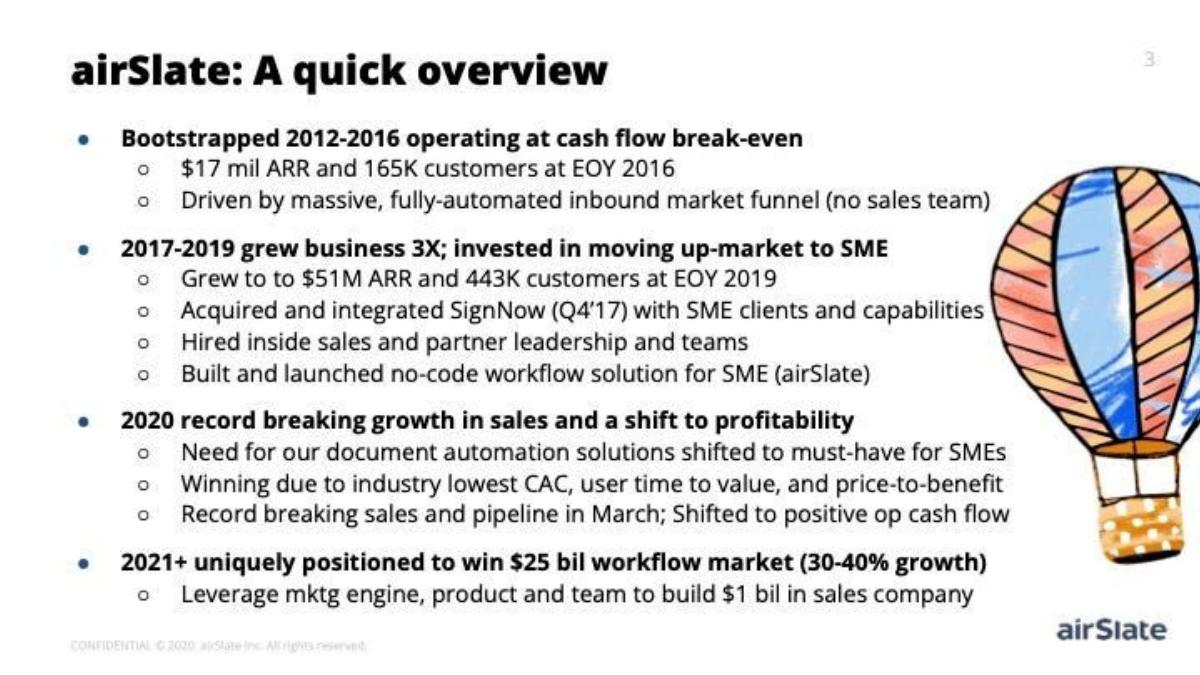
- The company reached $17M in ARR and 165K customers by 2016 while remaining bootstrapped and operating at cash flow break-even (Slide 3).
- A strategic acquisition of SignNow in Q4 2017 allowed the company to expand its capabilities into the SME market (Slide 3).
- Revenue growth is exceptionally consistent, reaching $73M ARR by August 2020 with a 50%+ year-over-year growth rate (Slide 5).
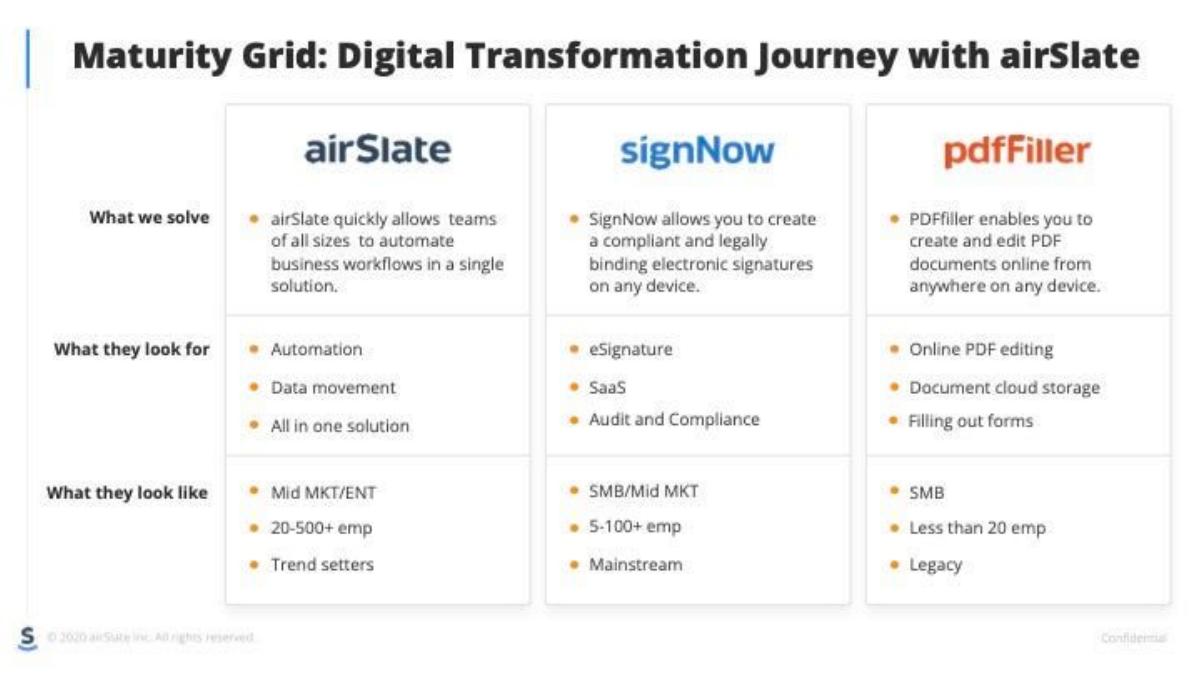
- The product strategy relies on a 'Maturity Grid' that transitions customers from simple PDF editing (pdfFiller) to e-signatures (signNow) and finally full automation (airSlate) (Slide 4).
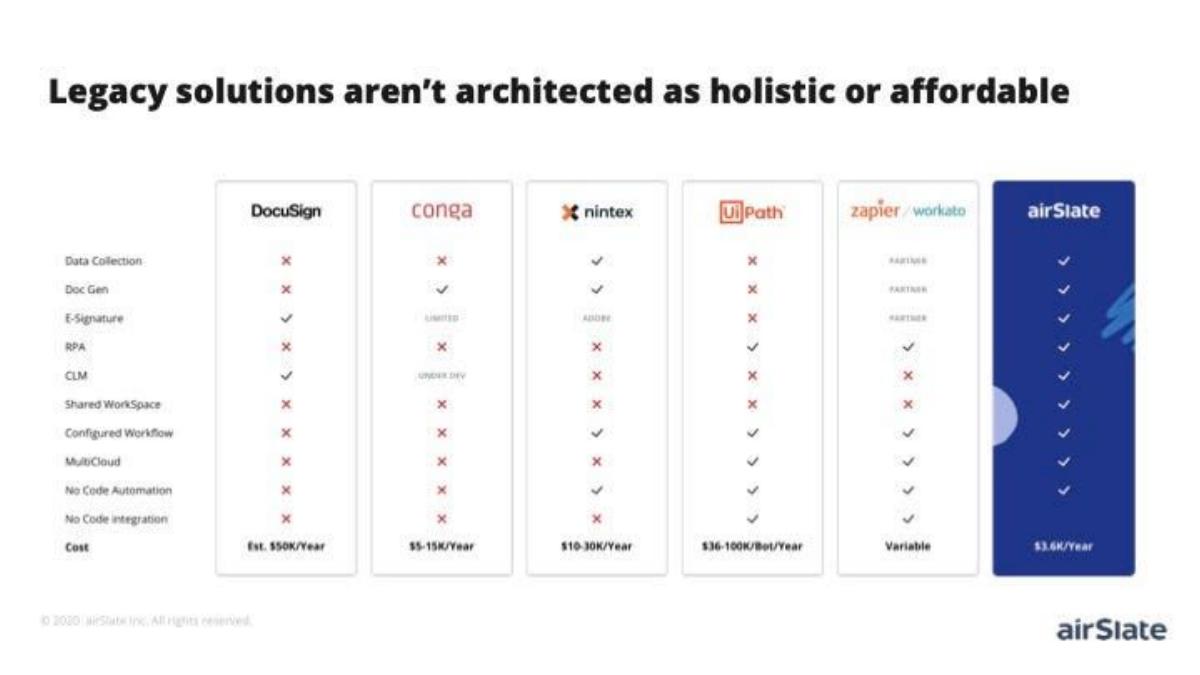
- airSlate positions itself as a price disruptor, offering a holistic solution for $3.6K/year compared to DocuSign's estimated $50K/year (Slide 7).
- The 3-year sales plan projects a massive jump in SME revenue, growing from $4M in 2019 to a projected $56M by 2022 (Slide 6).
- The deck highlights a 'no sales team' origin, citing a fully-automated inbound market funnel as the primary driver for early growth (Slide 3).
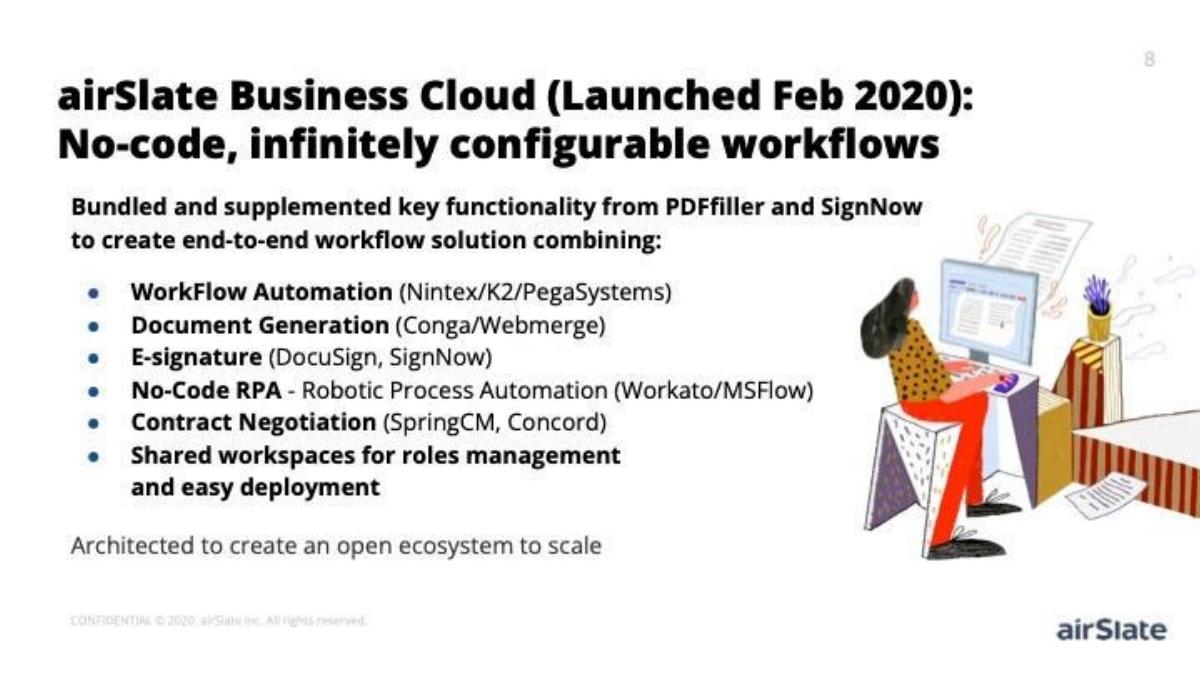
- The 'Business Cloud' launched in Feb 2020 serves as a catch-all for workflow, document generation, RPA, and contract negotiation (Slide 8).
The Series C Shift: From Product to Platform
The airSlate Series C deck is a masterclass in narrative efficiency. By the time a company reaches a $51.5M raise, the 'problem' is usually well-understood by the market. Instead of wasting slides on why digital transformation matters, airSlate uses its 8-slide presentation to prove one thing: they have built a scalable, profitable revenue engine that can displace every major incumbent in the document workflow space. The deck focuses heavily on the transition from a self-service tool for small businesses to a comprehensive 'Business Cloud' for mid-market and enterprise clients.
Slide 1: Vision and Branding
The title slide is minimalist, featuring the airSlate logo and the tagline "Automation is the future of Business." The imagery depicts two individuals interacting with a digital interface that is outputting documents, reinforcing the company's focus on document-centric processes. A small footer note indicates the deck is confidential and dated 2020, which aligns with the internal metrics shown later in the presentation.
Slide 2: The Veteran Leadership Team
Unusually for a growth-stage deck, airSlate places the team slide second. This signals that the strength of their leadership is a primary selling point. The slide features 10 executives, led by founders Borya Shakhnovich (CEO) and Vadim Yasinovsky (CPO) . The deck specifically highlights 'veteran' status, noting key hires from competitors: CMO Shawn Herring (previously PandaDoc) and VP of Sales Brian Lawrence (previously HelloSign). This suggests a deliberate strategy of poaching talent from the very companies they intend to disrupt.
Slide 3: The Historical Growth Narrative
Slide 3, titled "airSlate: A quick overview," provides a dense timeline of the company's evolution. It breaks the history into four distinct phases:
2012-2016: The bootstrapped era. They reached $17 mil ARR and 165K customers with no sales team, relying on an automated inbound funnel. · 2017-2019: The expansion era. They grew 3X to $51M ARR and 443K customers, acquired SignNow, and built the no-code airSlate solution. · 2020: The pivot to profitability. The slide notes a shift to positive op cash flow and record-breaking sales in March 2020. · 2021+: The future. They position themselves to win a $25 bil workflow market with a goal to build a $1 bil sales company.
Slide 4: The Maturity Grid
This slide explains the product hierarchy. It categorizes their three main brands— airSlate, signNow, and pdfFiller —based on what they solve and who the target customer is. pdfFiller is the entry point for SMBs (less than 20 employees) looking for legacy PDF editing. signNow targets the mid-market (5-100 employees) for e-signatures. airSlate is the premium offering for mid-market and enterprise (20-500+ employees) seeking full automation and data movement. This 'maturity journey' shows investors how airSlate captures a customer early and upsells them as their needs become more complex.
Slide 5: The Traction Curve
Slide 5 is a pure data play. It shows a bar chart of ARR from January 2017 to August 2020. The headline states: "$73M ARR at end of August, growing 50%+ YoY." The chart distinguishes between 'Self-Service' revenue (the dark blue base) and 'SME' revenue (the light blue top). While self-service remains the bulk of the revenue, the SME segment shows visible growth starting in 2019, validating the company's move up-market.
Slide 6: The 3-Year Sales Plan
This slide provides the forward-looking financial model. It projects EOY ARR to reach $252 million by 2022 . The most critical data point here is the projected growth of the SME segment, which is expected to rise from $4.05M in 2019 to $56.14M in 2022 . This 14x growth in the SME segment is the core justification for the Series C capital, as it requires more intensive sales and marketing investment than the self-service model.
Slide 7: Competitive Displacement
Slide 7 is a classic 'check-mark' comparison table, but with a focus on cost. It compares airSlate against DocuSign, Conga, Nintex, UiPath, and Zapier/Workato . airSlate claims to be the only solution that offers all 10 listed features (Data Collection, Doc Gen, E-Signature, RPA, CLM, etc.). The 'Cost' row is the most aggressive, listing airSlate at $3.6K/Year , while estimating DocuSign at $50K/Year and UiPath at $36-100K/Bot/Year. This positions airSlate as the 'value' alternative that doesn't sacrifice functionality.
Slide 8: The Business Cloud Launch
The final slide details the airSlate Business Cloud , launched in February 2020. It describes the product as a 'no-code, infinitely configurable' workflow solution that bundles functionality from their other brands. It explicitly lists the categories they are disrupting: Workflow Automation (Nintex), Document Generation (Conga), E-signature (DocuSign), and RPA (Workato). The slide emphasizes an 'open ecosystem to scale,' suggesting that while they bundle these tools, they also allow for integration.
What Works in This Deck
The 'Bootstrapped to $17M' Story: Leading with the fact that they reached $17M ARR without a sales team is an incredible signal of product-market fit and marketing efficiency. It tells investors that the core engine is incredibly healthy and that adding capital is just 'pouring gasoline on the fire.'
Clear Product Segmentation: The Maturity Grid on Slide 4 is excellent. It prevents the three brands from appearing fragmented and instead shows a logical progression for customer acquisition and retention. It turns a potential weakness (brand confusion) into a strength (a multi-entry-point funnel).
Aggressive Pricing Comparison: By including estimated annual costs for competitors, airSlate makes a compelling case for why they can win in a crowded market. They aren't just 'better'; they are significantly cheaper, which is a powerful lever during economic downturns or for mid-market companies with limited budgets.
What Is Missing
The 'Ask' Slide: The deck completely omits a slide detailing how much they are raising and how they plan to spend the funds. While this information is often shared in a separate document or verbal conversation, its absence here makes the deck feel more like a corporate overview than a specific fundraising pitch.
Unit Economics: Despite the strong ARR growth, there is no mention of LTV (Lifetime Value), CAC (Customer Acquisition Cost), or Net Revenue Retention (NRR). For a Series C round, investors typically want to see these efficiency metrics to ensure the growth is sustainable.
Market Size (TAM) Detail: While Slide 3 mentions a '$25 bil workflow market,' there is no slide dedicated to breaking down the Total Addressable Market. Investors at this stage usually want to see a bottom-up calculation of how the company reaches its billion-dollar valuation goal.
Founder Takeaways
Show, Don't Just Tell, Your History: airSlate’s Slide 3 is a great example of how to summarize years of work into a single narrative. If you have a unique origin story (like being bootstrapped to significant revenue), make it a pillar of your pitch.
Use a Maturity Grid: If your company has multiple products or tiers, use a grid to show how they relate to different customer segments. This helps investors understand your 'land and expand' strategy.
Position Against the Giants: Don't be afraid to name your competitors and put your price next to theirs. If you are disrupting a market on cost and consolidation, make that the centerpiece of your competitive slide.
Frequently asked questions
- How did airSlate reach its first $17M in ARR?
- According to Slide 3, the company was bootstrapped from 2012 to 2016. They reached $17M in ARR and 165K customers by operating at cash flow break-even, driven entirely by a 'massive, fully-automated inbound market funnel' without the use of a traditional sales team.
- What is airSlate's competitive pricing strategy?
- Slide 7 shows that airSlate positions itself as the most affordable holistic solution in the market. They list their cost at $3.6K/year, which significantly undercuts competitors like DocuSign (est. $50K/year), Nintex ($10-30K/year), and UiPath ($36-100K/bot/year).
- What products make up the airSlate ecosystem?
- Slide 4 identifies three core brands: pdfFiller for SMBs (PDF editing), signNow for SMB/Mid-Market (e-signatures), and airSlate for Mid-Market/Enterprise (full business workflow automation). Slide 8 notes that the airSlate Business Cloud, launched in 2020, bundles all these functionalities into one no-code solution.
- What are the projected revenue targets in the deck?
- Slide 6 outlines a 3-year sales plan. It shows EOY ARR growing from $51M in 2019 to $82M in 2020, $143M in 2021, and finally $252M in 2022. The plan highlights a significant shift toward SME revenue, which is projected to reach $56.1M by the end of 2022.
- Who leads the airSlate executive team?
- Slide 2 features a 10-person leadership team led by CEO/Founder Borya Shakhnovich and CPO/Founder Vadim Yasinovsky. The team includes veterans from industry competitors, such as CMO Shawn Herring (formerly PandaDoc) and VP of Sales Brian Lawrence (formerly HelloSign).