Aircall’s Series C deck, dated March 2020, is a masterclass in positioning a legacy technology—the phone call—within a modern SaaS ecosystem. The company argues that while email, chat, and docs have been redefined by players like Slack and Dropbox, voice remained stagnant until Aircall. The core of their thesis is 'integration-first' growth, where connecting to CRMs like Salesforce and HubSpot drives massive stickiness. The data supports this, showing a 135% net retention rate for their 2019 cohort by month 11. By targeting an $80Bn market dominated by $70Bn in on-premise legacy systems, Airc…
Key takeaways
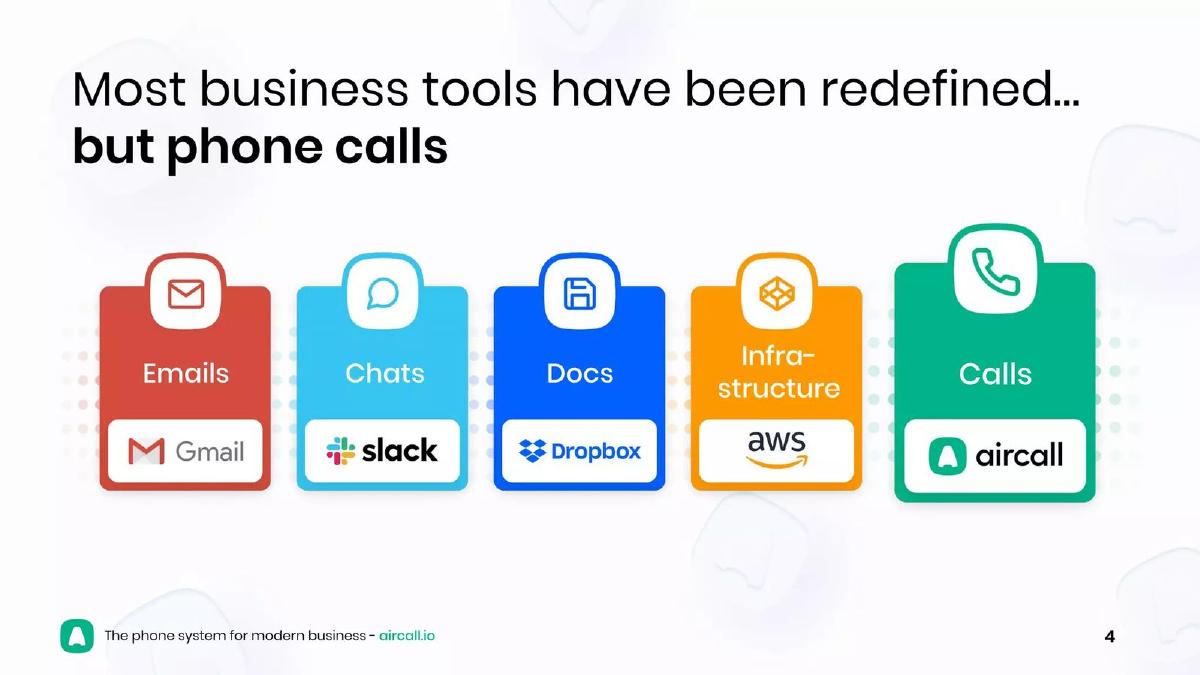
- The deck positions Aircall as the final piece of the modern business tool stack alongside Gmail, Slack, and Dropbox (Slide 4).
- Product value is defined by 'Caller Insights,' which pull context from external data sources like Salesforce and HubSpot during active calls (Slide 7).
- Aircall's platform strategy relies on a hub-and-spoke model connecting to communication apps, CRMs, helpdesks, and BI tools (Slide 10).
- The company claims a 'virtuous flywheel' where integrations drive acquisition, and experience apps drive retention and expansion (Slide 13).
- Gross retention is reported at 87%, while net retention reaches a significant 135% (Slide 16).
- Cohort analysis shows that the 2019 cohort outperformed 2017 and 2018 in both gross and net retention metrics by month 11 (Slide 16).
- The total addressable market is valued at $80Bn, with $70Bn currently held by on-premise legacy systems (Slide 19).
- The cloud-based portion of the market is $10Bn and growing at 20-25% YoY (Slide 19).
Introduction and Market Context
Slide 4: The Redefinition of Business Tools
Aircall opens its narrative by contextualizing its product within the broader SaaS revolution. Slide 4 uses a simple visual comparison to show that while most business categories have been disrupted—Emails by Gmail, Chats by Slack, Docs by Dropbox, and Infrastructure by AWS—the 'Calls' category remained stagnant. Aircall positions itself as the definitive modern successor in the voice space. This is a classic 'why now' and 'why us' slide, framing the company not just as a utility, but as a peer to the most successful cloud platforms in history.
Product Value and Integration Strategy
Slide 7: Why Customers Come to Us
On Slide 7, the company moves from high-level positioning to specific product utility. The core value proposition is defined as 'Caller insights bringing context to each call from other softwares and data sources.' The slide features a mobile UI mockup showing an incoming call from 'Margot Chen' at 'Acme Inc.' Crucially, the UI displays direct links to 'Salesforce Contact page' and 'Hubspot contact details.' By showing the owner of the account (Benjamin Davis) and the email address directly in the call interface, Aircall demonstrates how it saves time and improves customer interactions. This slide effectively argues that Aircall is a layer of intelligence, not just a dialer.
Slide 10: The Voice Platform Ecosystem
Slide 10 reinforces the 'platform' narrative. It features a hub-and-spoke diagram with Aircall at the center, surrounded by categories of integrations: Communication apps (Slack, G Suite), Business-specific CRMs (Shopify, Clio, Neon), General CRMs (Salesforce, HubSpot, Zoho), Helpdesks (Zendesk, Intercom), and Data & BI tools (Amazon Redshift, Segment). There is also a mention of 'API links to own back-end.' This slide is intended to show the breadth of the ecosystem, suggesting that no matter what stack a business uses, Aircall can integrate with it. This is a key defense against churn; the more tools Aircall connects to, the harder it is for a customer to switch to a competitor.
Business Model and Growth Flywheel
Slide 13: The Virtuous Flywheel
Slide 13 explains the mechanics of their growth. The 'virtuous flywheel' starts with CRM/HD integrations acting as new customer acquisition channels. As more customers join, they bring a broader set of use cases, which attracts more 'experience apps' to the platform. These apps create better adoption mechanisms and a more 'defensible and attractive ecosystem,' which leads to 'increased stickiness' and expansion. This slide is critical for a Series C pitch because it explains how the company will scale efficiently without just relying on linear sales hiring.
Slide 16: Retention and Expansion Metrics
Slide 16 provides the 'proof in the pudding' with hard data. The company reports an 87% Gross Retention rate and a 135% Net Retention rate. The cohort charts (2017, 2018, and 2019) show a clear trend: each successive year’s cohort is performing better than the last. The 2019 cohort (yellow line) shows significantly higher net retention by month 11 compared to the 2017 cohort (blue line). A 135% net retention rate is elite for the SMB/Mid-market space, indicating that Aircall has a very strong 'land and expand' motion. A small footnote clarifies that Gross Retention is computed between months 3-11 and then annualized, excluding 'micro-customers,' which is a standard way to remove noise from very small, high-churn accounts.
Market Opportunity and Future Outlook
Slide 19: The $80Bn Market Opportunity
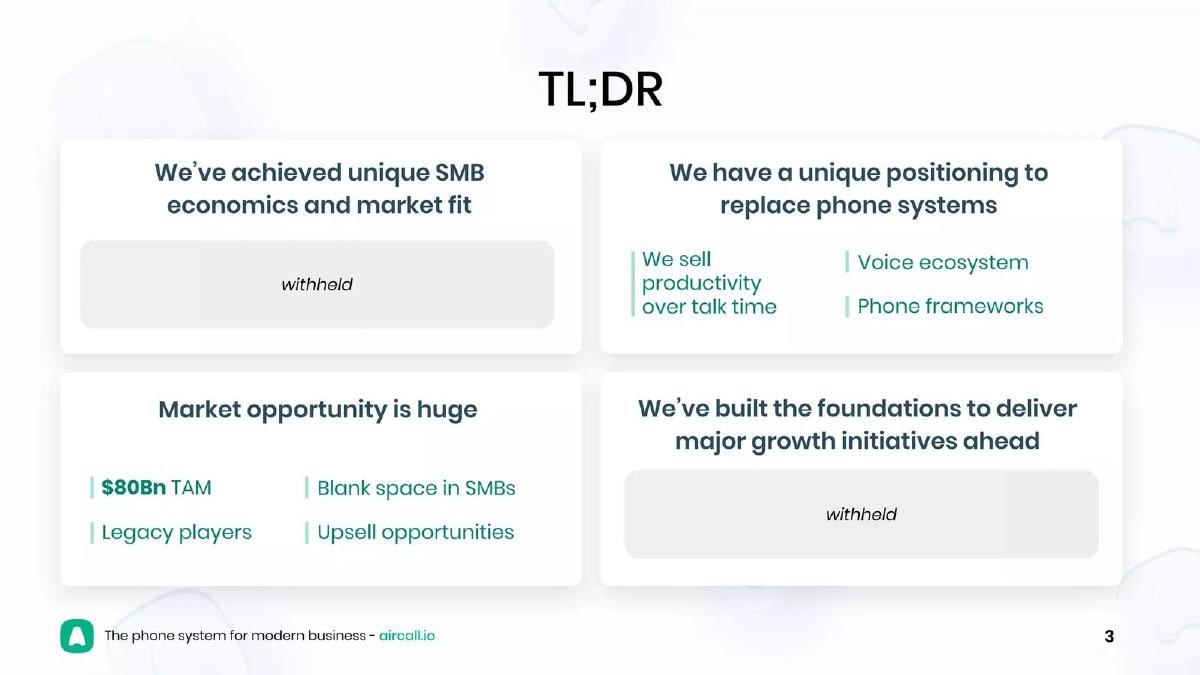
Slide 19 breaks down the Total Addressable Market (TAM). Aircall identifies an $80Bn total opportunity, but the nuance is in the segments. They note that $70Bn is still tied up in 'On-prem legacy' systems, while only $10Bn is currently 'Cloud-based.' However, the cloud segment is growing at 20-25% YoY. The slide also maps out their expansion strategy: moving from 'Support & Sales' teams to 'All teams' (cross-sell) and moving from 'SMBs' to 'Mid Mkt/Enterprise' (up-sell). The 1,000-employee mark is cited as the threshold for their enterprise ambitions.
Slide 22: Redacted Initiatives
Slide 22 is a placeholder, stating '6 slides outlining our key initiatives (can’t be shared, sorry :)).' While this is common in public versions of decks to protect competitive secrets, it indicates that the full Series C deck went into significant detail regarding the product roadmap and operational scaling for the 2020-2022 period. For the purposes of this teardown, we can only note that these initiatives were considered a major portion of the pitch (25% of the total 24 slides).
What Works in This Deck
Ecosystem Positioning: By comparing themselves to Slack and Dropbox, they immediately elevate the perceived value of a 'phone system' to a 'mission-critical SaaS platform.' · Data-Driven Validation: The cohort analysis on Slide 16 is exceptionally clear. It doesn't just show one number; it shows that the business is getting better at retaining and expanding customers every year. · Visual Clarity: The deck uses a consistent, clean brand identity. The integration map (Slide 10) and the flywheel (Slide 13) turn complex business strategies into easily digestible visuals. · Clear Up-sell Path: Slide 19 clearly defines how they grow beyond their initial niche. Investors want to see that a company isn't just stuck in the SMB segment, and the '1,000 employees' line provides a concrete target for enterprise expansion.
What Is Missing
Team Slide: This version of the deck omits the founders and key leadership. For a Series C, investors want to see a 'war cabinet' capable of taking the company to an IPO. · Unit Economics (CAC/LTV): While retention is covered, there is no mention of the cost to acquire these customers or the payback period. · Competition: There is no slide addressing competitors like RingCentral, Talkdesk, or 8x8. In a crowded market, explaining why Aircall wins against specific incumbents is vital. · The Ask: The deck does not state how much capital is being raised or how it will be allocated across departments (e.g., 40% R&D, 40% S&M).
What a Founder Should Copy
The 'Integration-First' Narrative: If your product connects to other tools, don't just list them as features. Frame them as the core of your retention and acquisition strategy, as seen on Slide 13. · Cohort Benchmarking: Don't just show your current retention. Show how your 2023 cohort is better than your 2022 cohort. This proves that your product-market fit is deepening and your onboarding is improving. · Market Segmentation: Use a slide like Slide 19 to show the 'Big Prize' (Legacy) vs. the 'Current Reality' (Cloud). It helps investors understand the tailwinds supporting your growth. · Contextual UI Mockups: Instead of showing a generic dashboard, show a specific use case that solves a pain point, like the 'Caller Insights' on Slide 7.
Frequently asked questions
- What is Aircall's primary competitive advantage according to the deck?
- Aircall's primary advantage is its 'integration-first' business model. Rather than being a standalone phone system, it acts as a voice platform that connects to all other business tools, such as Shopify, Zendesk, and Slack. This connectivity creates 'Caller Insights' that provide immediate context to agents, making the tool more valuable and harder to rip out than a standard VoIP provider.
- How does Aircall justify its retention metrics?
- The deck uses cohort data from 2017, 2018, and 2019 to show improving performance. While gross retention sits at 87%, the net retention of 135% is the standout figure. This indicates that existing customers are expanding their usage significantly over time, likely through adding more seats or integrating more deeply into their tech stack, which offsets the 13% gross churn.
- What is the specific market opportunity Aircall is targeting?
- Aircall targets an $80Bn total market. The strategy is to capture the $70Bn currently spent on 'on-prem legacy' systems as they migrate to the cloud. They also highlight a $10Bn existing cloud-based market that is growing at 20-25% annually. Their growth strategy involves cross-selling from sales/support teams to all teams within a company and up-selling from SMBs to larger enterprises.
- What information is missing from this version of the deck?
- This specific version of the deck is missing the team slide, the specific financial 'ask' (valuation and amount raised), and six slides regarding 'key initiatives' for 2020-2022, which were redacted for confidentiality. It also lacks a detailed slide on unit economics like CAC (Customer Acquisition Cost) or LTV (Lifetime Value) ratios beyond the retention percentages.
- How does Aircall use the 'flywheel' concept in their pitch?
- The flywheel (Slide 13) illustrates how integrations serve as acquisition channels. As more customers join, they demand more 'experience apps' to fill specific use cases. This leads to a more defensible ecosystem and better adoption mechanisms, which ultimately increases 'stickiness' and drives expansion through those same apps, restarting the cycle of acquisition.