The AirBnD pitch deck is a concise 10-slide presentation focusing on the transition from traditional hotels to local hosting. The deck defines a clear problem—price and cultural disconnection—and proposes a web platform solution that allows users to save money, make money, and share culture. Key highlights include market validation through 630,000 CouchSurfing users and 17,000 Craigslist listings, a simple 10% commission business model, and a market adoption strategy leveraging major events like Oktoberfest and Mardi Gras. While the deck lacks a team slide and a specific financial ask, it eff…
Key takeaways
- The deck identifies a three-pronged problem: price concerns, cultural disconnection in hotels, and the lack of an easy booking method for local rooms (Slide 2).
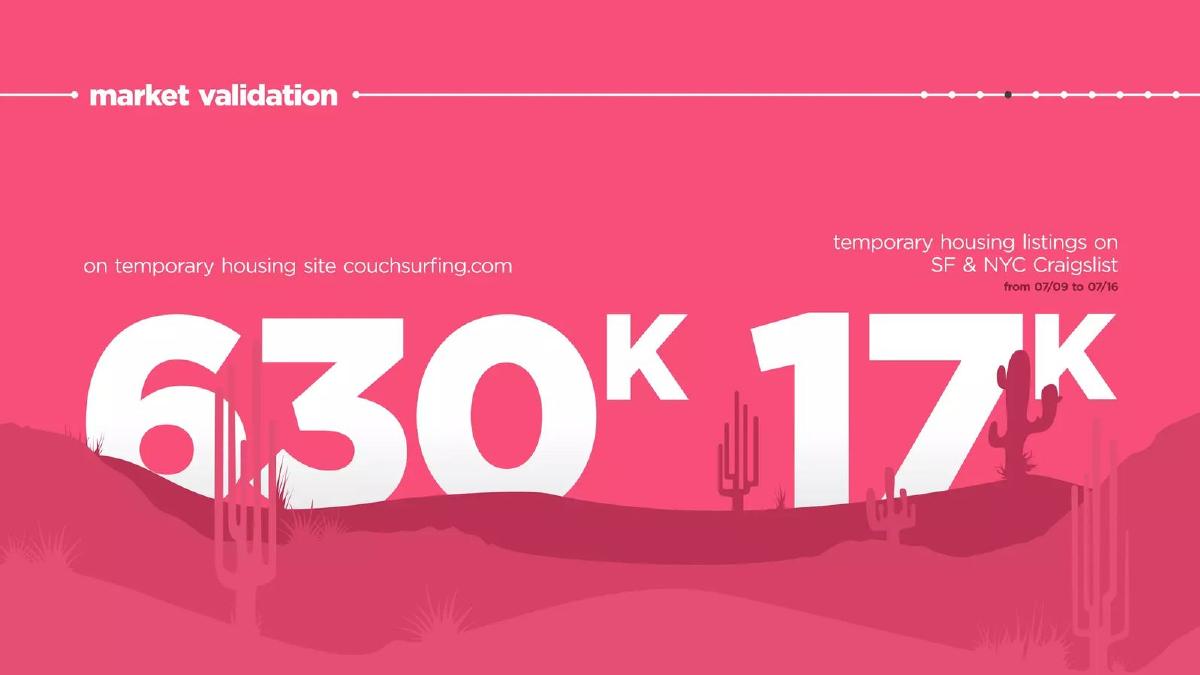
- Market validation is built on existing user behavior, citing 630,000 users on CouchSurfing and 17,000 temporary housing listings on Craigslist (Slide 4).
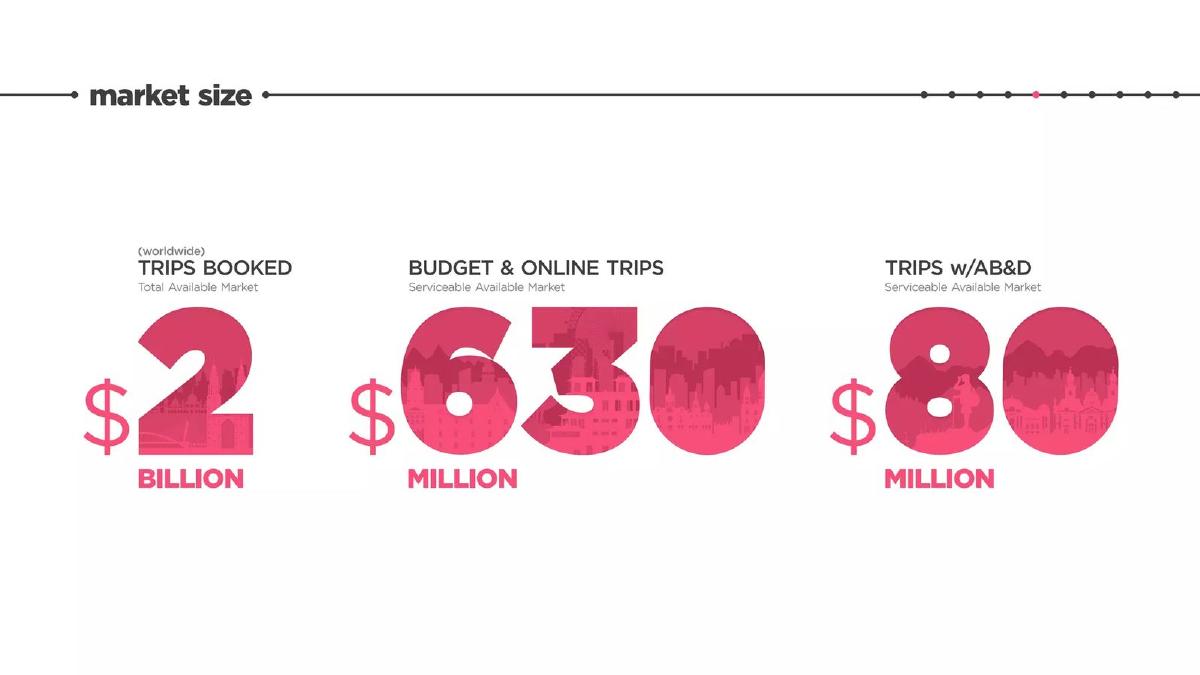
- The Total Available Market is defined as 2 billion trips booked worldwide, with a serviceable market of 80 million trips for the company (Slide 5).
- The business model is a flat 10% commission on each transaction, projecting an average fee of $20 based on a $70/night rate for 3 nights (Slide 7).
- Revenue projections for the 2008-2011 period are estimated at $200 million (Slide 7).
- Market adoption relies on a 'dual posting feature' with Craigslist and targeting high-demand events like Oktoberfest and the Eurocup (Slide 8).
- The competitive landscape is visualized using a 2x2 matrix, positioning the company as the leader in 'Affordable' and 'Online Transaction' categories (Slide 9).
- Competitive advantages include being '1st to market' for transaction-based temporary housing and offering a '3 clicks' booking process (Slide 10).
AirBnD Pitch Deck Analysis
This 10-slide deck represents an early-stage pitch for AirBnD, focusing on the disruption of the traditional hotel industry through a peer-to-peer web platform. The presentation is characterized by its minimalist design, high-contrast pink and white color scheme, and a heavy reliance on market validation from existing platforms. It attempts to bridge the gap between free social hosting and expensive professional hotels.
Slide 1: Title and Tagline
The cover slide introduces the brand with the logo and the tagline "welcome home, anywhere." The primary header, "Book rooms with locals, rather than hotels," immediately establishes the company's core value proposition as a direct alternative to the hospitality status quo. The visual design uses a cloud motif, suggesting travel and ease.
Slide 2: The Problem
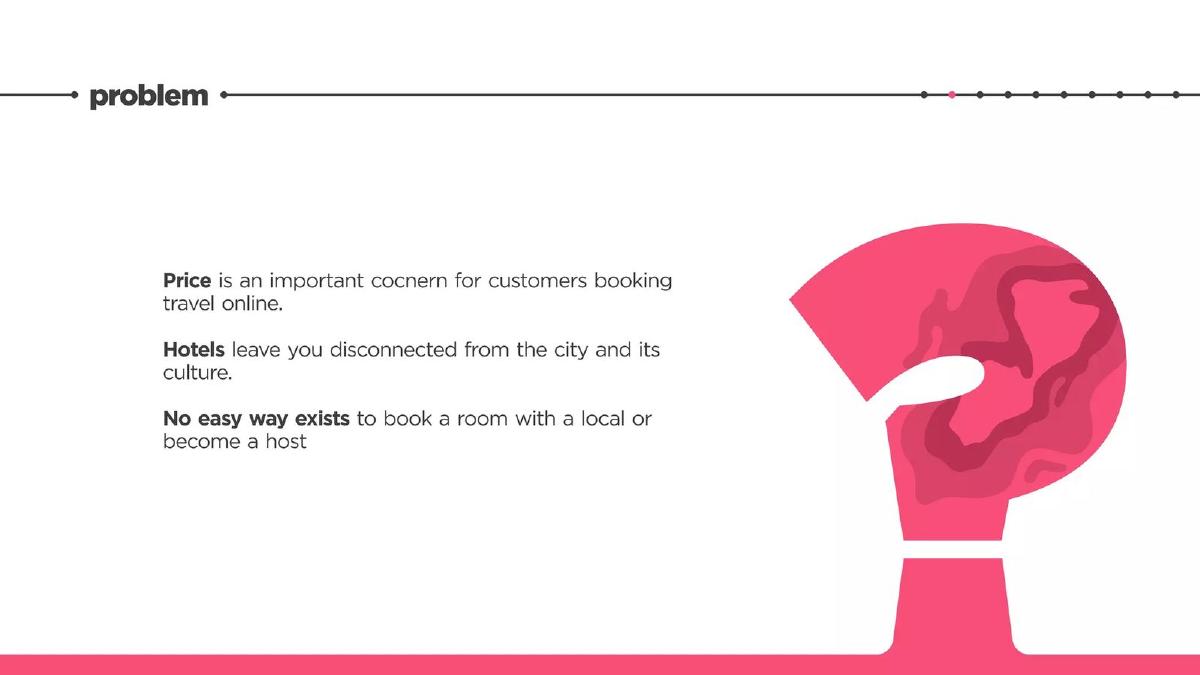
The problem is defined by three bullet points: price is a concern for online travelers, hotels create a cultural disconnect, and there is no existing "easy way" to book with a local or become a host. Notably, the slide contains a typo ("cocnern"), which is a rare oversight in such a high-profile deck. The slide sets up the need for a middle ground between formal hotels and informal arrangements.
Slide 3: The Solution
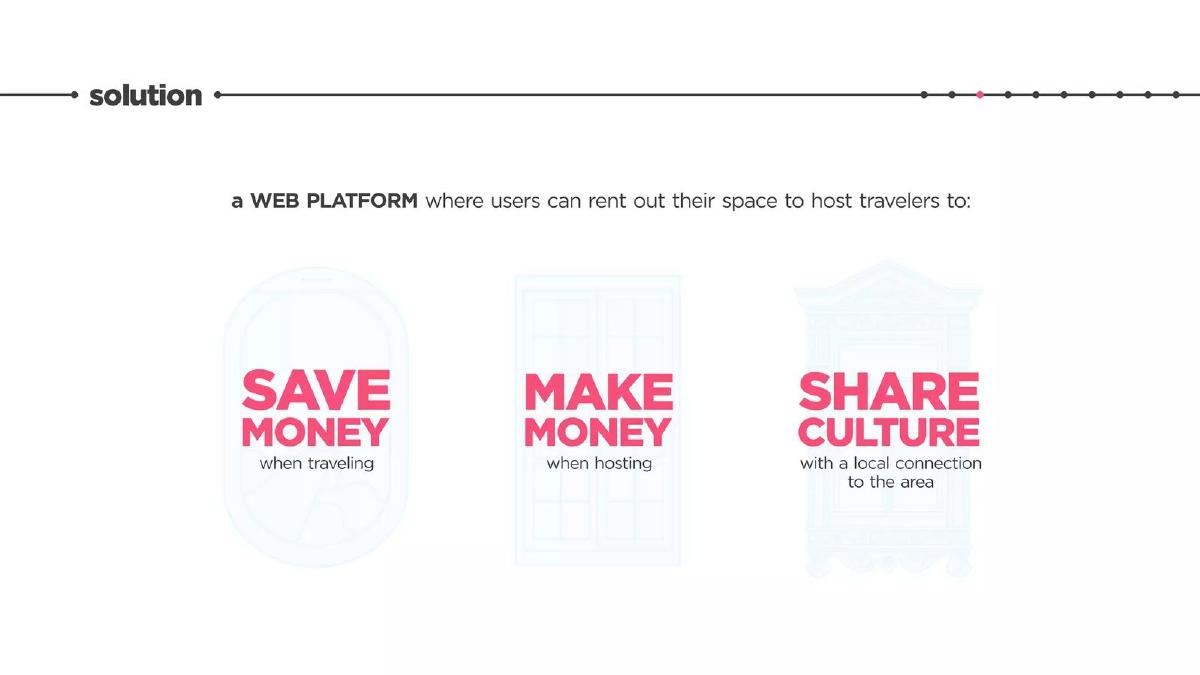
The solution is described as a "WEB PLATFORM" where users can rent out space. The slide uses three large icons to highlight the benefits: "SAVE MONEY" for travelers, "MAKE MONEY" for hosts, and "SHARE CULTURE" for the local connection. This addresses both sides of the marketplace (supply and demand) simultaneously.
Slide 4: Market Validation
This is one of the strongest slides in the deck. Rather than speculating on future demand, the founders point to existing behavior. They cite 630,000 users on couchsurfing.com and 17,000 temporary housing listings on SF & NYC Craigslist during a one-week period in July (07/09 to 07/16). This proves that the desire to stay in non-hotel environments already exists at scale.
Slide 5: Market Size
The market size is presented in three stages. The Total Available Market (TAM) is listed as 2 billion trips booked worldwide. The Serviceable Available Market (SAM) is narrowed to 630 million "BUDGET & ONLINE TRIPS." Finally, the company identifies a target of 80 million "TRIPS w/AB&D," representing their specific serviceable market share.
Slide 6: Product
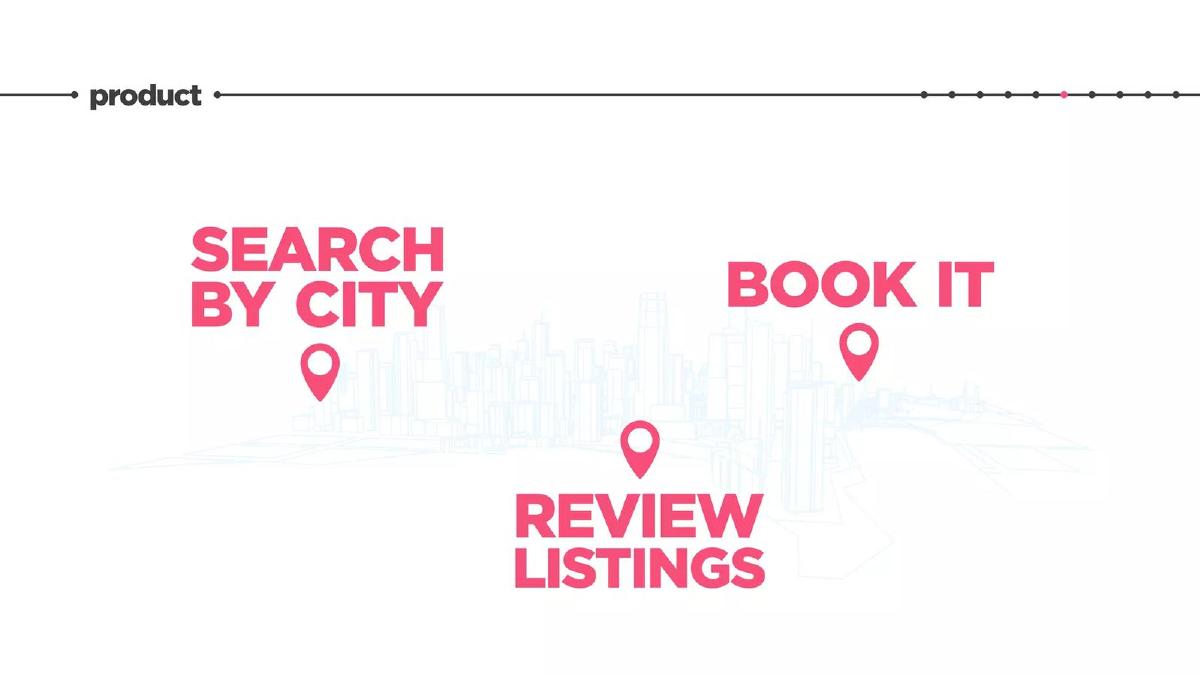
The product slide is minimalist, showing a city skyline with three location pins: "SEARCH BY CITY," "REVIEW LISTINGS," and "BOOK IT." It emphasizes a simplified user journey, though it lacks actual screenshots of the interface, which is common in early-stage decks to avoid dating the software design.
Slide 7: Business Model
The business model is straightforward: a 10% commission on each transaction. The slide breaks down the math: 10.6 million trips (share of market) multiplied by an average fee of $20 (based on $70/night for 3 nights) equals an estimated revenue of $200 million for the period of 2008-2011. This provides investors with a clear unit economic story.
Slide 8: Market Adoption
The go-to-market strategy relies on three pillars. First, targeting specific high-traffic events like Oktoberfest, CEBIT, Summerfest, Eurocup, and Mardi Gras. Second, establishing partnerships with "cheap/alternative travel" sites like GoLoco, Kayak, and Orbitz. Third, a Craigslist "dual posting feature" to capture users where they are already listing rooms.
Slide 9: Competition
The competition is mapped on a 2x2 matrix with axes for Price (Affordable vs. Expensive) and Transaction Type (Offline vs. Online). AirBnD positions itself in the top-right quadrant as the only "Affordable" and "Online Transaction" option. Competitors like Craigslist and CouchSurfing are labeled as offline transactions, while Hotels.com and VRBO are labeled as expensive.
Slide 10: Competitive Advantages
The final slide lists six advantages: being first to market for transaction-based sites, providing a host incentive (money), allowing hosts to list once instead of daily, ease of use (search by price/date), host profiles for trust, and a memorable brand. It mentions a plan to launch at the "historic DNC" (Democratic National Convention) to gain mindshare.
What Works in This Deck
The deck is a masterclass in brevity. It avoids the "wall of text" trap that many founders fall into, using large typography and clear icons to convey one major point per slide. The use of Craigslist and CouchSurfing as market validation (Slide 4) is particularly effective because it demonstrates that the founders aren't creating a new behavior, but rather optimizing an existing, messy one. The business model (Slide 7) is also exceptionally clear; an investor can understand the revenue potential in less than five seconds.
What is Missing
From a modern fundraising perspective, the omissions are significant. There is no Team Slide , which is usually considered the most important slide for a seed-stage company. Investors want to know why these specific founders are the right ones to build this platform. There is also no Ask Slide ; the deck ends without stating how much money they are raising or what the milestones for that capital will be. Finally, there is no Traction Slide showing their actual current numbers, only projections and market validation from other sites.
What a Founder Should Copy
The 2x2 Matrix: Slide 9 is a perfect example of how to define a niche. By choosing the right axes (Affordability and Online Transaction), the founders make their company look like the only logical choice in a crowded market. · The "List Once" Value Prop: In Slide 10, identifying a specific pain point (posting daily on Craigslist) and offering a technical solution (list once) is a great way to show how you will steal users from a dominant incumbent. · Event-Based Marketing: Targeting specific dates like Oktoberfest (Slide 8) is a smart, low-cost way to solve the "cold start" problem of a marketplace by focusing supply and demand in one location at one time.
Frequently asked questions
- What is the primary value proposition offered in the deck?
- The deck centers on a web platform that enables three core benefits: saving money for travelers, making money for hosts, and sharing culture through local connections. It positions itself as a superior alternative to hotels, which the founders claim leave travelers disconnected from a city's actual culture.
- How does the company plan to acquire users from competitors?
- The strategy involves a 'dual posting feature' for Craigslist, allowing hosts to list once on AirBnD rather than daily on Craigslist. They also plan to siphon users from CouchSurfing by offering a financial incentive (making money) that the free couch-sharing site does not provide.
- What are the specific market size figures used in the presentation?
- The deck breaks the market into three tiers: a Total Available Market (TAM) of 2 billion trips worldwide, a Serviceable Available Market (SAM) of 630 million budget/online trips, and a target share of 80 million trips specifically for the platform.
- How is the revenue model structured?
- The model is purely transactional. The company takes a 10% commission on each booking. Based on an assumed average stay of 3 nights at $70 per night, they calculate an average fee of $20 per booking to reach their $200 million revenue goal.
- What major omissions are present in this 10-slide deck?
- The deck is missing several standard venture components: there is no Team slide to establish founder credibility, no Financials slide showing burn rate or historical growth, and no 'The Ask' slide detailing how much capital is being raised or how it will be spent.