Airbase’s Series B memo, dated April 2021, represents a departure from the traditional visual pitch deck, opting instead for a 12-page document that emphasizes first-principles thinking. The company positions itself as a 'workflow-driven software product first and a fintech company second,' a strategic choice to differentiate from competitors who offer free tools to capture interchange revenue. By targeting the mid-market (50-1000 employees) and focusing on the 'lifecycle of spending,' Airbase argues that the deep software layer is where the long-term value resides. The memo highlights a clea…
Key takeaways
- Airbase explicitly defines its target market as the mid-market, specifically companies with 50 to 1,000 employees (Slide 9).
- The company positions itself as software-first, viewing payments as a 'utility' and 'enabler' rather than the primary value proposition (Slide 5).
- A core strategic differentiator is the use of subscription fees, contrasting with competitors who rely solely on interchange revenue (Slide 7).
- The memo identifies three critical steps for finance teams: spend control, vendor payment, and automated categorization into the general ledger (Slide 3).
- Airbase names specific competitors, categorizing them into legacy players (Bill.com, Expensify) and emerging players (Brex, Divvy, Ramp, Teampay) (Slide 7).
- The product roadmap includes expansion into adjacent opportunities such as Budgeting and planning, Contract Lifecycle Management, and SaaS management (Slide 11).
- The document lacks a specific 'Ask' slide or detailed financial tables in the provided pages, focusing instead on the 'thesis' and 'strategy' (Slide 7).
- Airbase claims that nine out of ten prospects they engage with are currently using siloed point solutions or corporate cards (Slide 7).
The Narrative Shift: Analyzing the Airbase Series B Memo
The Airbase Series B memo, dated April 2021, is a masterclass in strategic positioning. Unlike seed or Series A decks that rely on flashy visuals to sell a dream, this document is designed to sell a thesis. It assumes the reader is sophisticated and understands the fintech landscape, specifically the 'spend management' wars of the early 2020s. By choosing a memo format, Airbase signals that their value proposition is intellectual and structural, not just a better user interface for a corporate card.
Slide 1: Title and Context
The cover page is minimalist, titled simply 'Airbase Memo' with the date 'April 2021'. This establishes a professional, document-first tone. It sets the expectation that this is a briefing for a partner meeting rather than a pitch for a general audience.
Slide 3: The Problem of Fragmentation
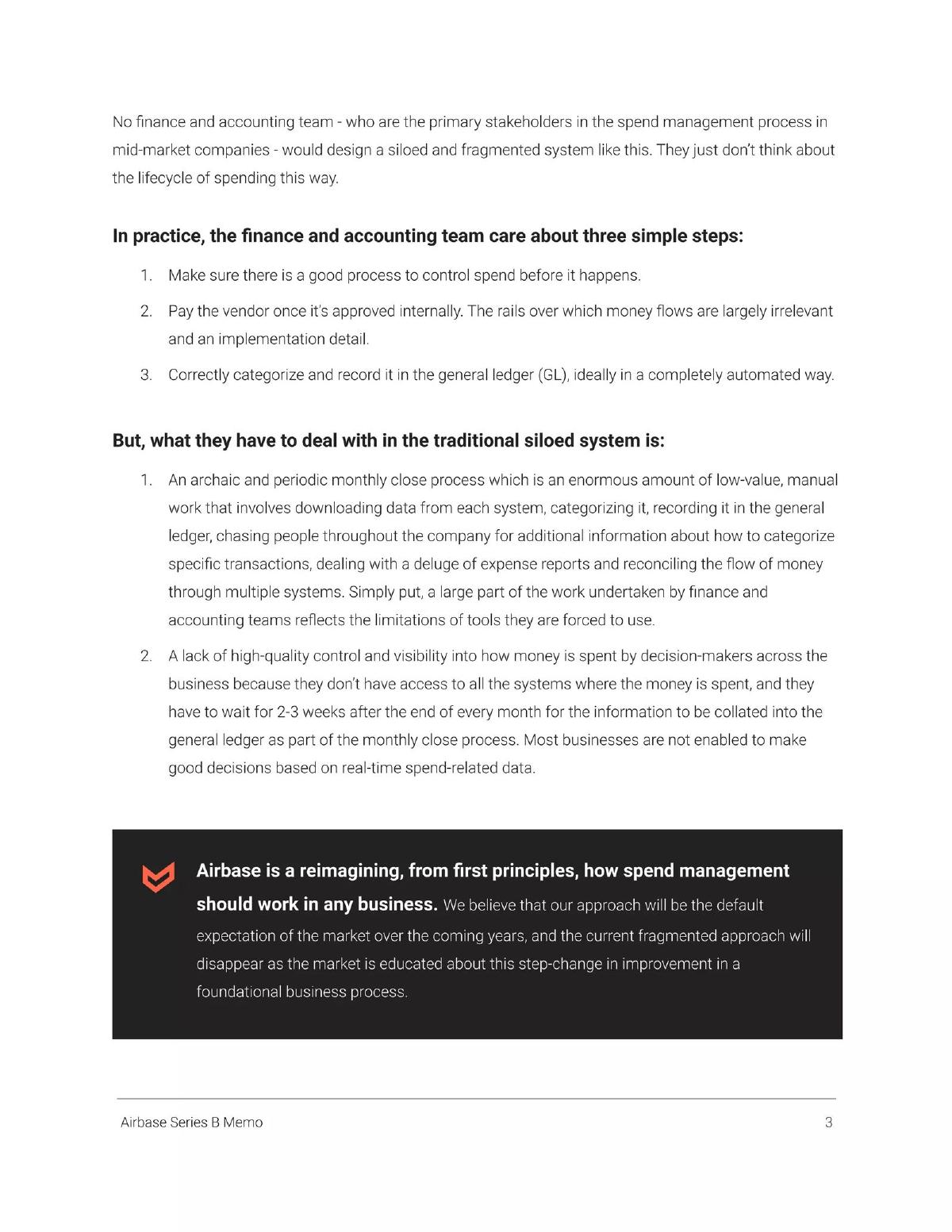
Slide 3 dives directly into the psychology of the target user: the finance and accounting team. It argues that no finance professional would intentionally design a 'siloed and fragmented system.' The slide breaks down the finance workflow into three steps: control, payment, and categorization. It then contrasts this with the 'traditional siloed system' which suffers from archaic monthly close processes and a lack of real-time visibility. The slide concludes with a bold mission statement: 'Airbase is a reimagining, from first principles, how spend management should work in any business.'
Slide 5: Product Principles and Workflow-First Philosophy
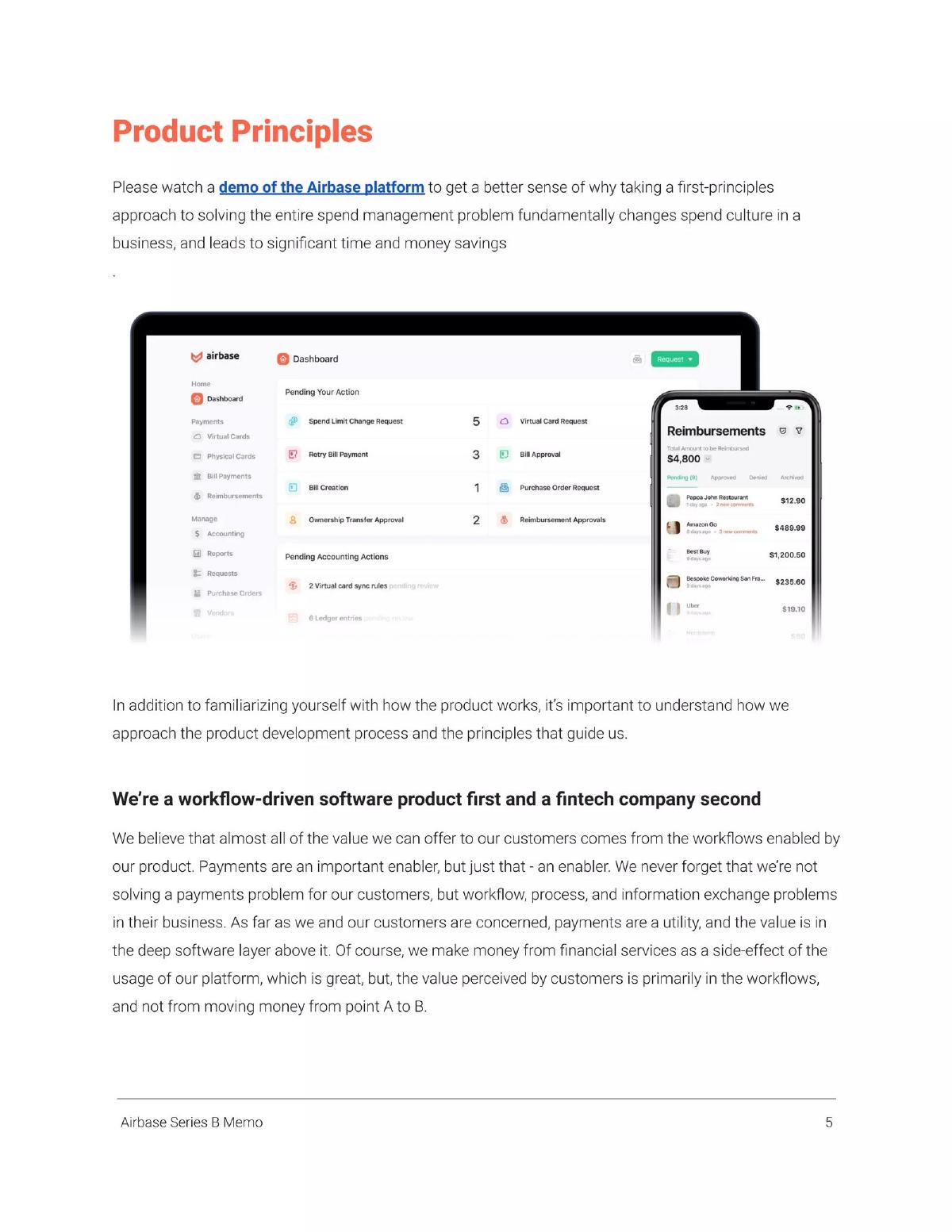
This slide features a rare visual—a mockup of the Airbase dashboard on a laptop and mobile device. However, the text is the primary driver. Airbase makes a definitive claim: 'We’re a workflow-driven software product first and a fintech company second.' This is a direct shot at the 'card-first' startups. They argue that payments are merely a 'utility' and an 'enabler,' while the true value is the 'deep software layer' that manages the process. They admit to making money from financial services as a 'side-effect,' but insist the customer perceives value in the workflow.
Slide 7: Competition and Strategy
Slide 7 is perhaps the most important slide for an investor. It categorizes competitors into 'Legacy players' (Bill.com, Expensify) and 'Emerging players' (Brex, Divvy, Ramp, Teampay). Airbase highlights their 'contrarian' approach: charging a subscription fee. They point out that over a billion dollars has been invested in the 'alternate approach' of giving software away for free to capture interchange. Airbase argues this forces a narrow, card-centric view, whereas their model allows them to own all 'non-payroll spend related workflows.'
Slide 9: Market Opportunity and Segment Focus
Slide 9 addresses the 'Global Spend Management' problem, noting that the pandemic accelerated the need for distributed team spend controls by '10 years.' Crucially, it defines their primary focus as the 'mid-market (50-1000 employees).' They describe this segment as underserved and willing to pay for comprehensive software. The slide also hints at a move 'upmarket' where complexity increases, further distancing them from small-business-focused card startups.
Slide 11: Future Expansion and Adjacencies
The final provided slide, 'How big can this get?', looks at the long-term roadmap. It identifies three 'adjacent opportunities': Budgeting and planning collaboration, Contract Lifecycle Management (CLM), and SaaS management. By framing these as 'natural extensions,' Airbase suggests that their platform is the 'strategic real estate' upon which all other corporate finance functions will eventually sit.
What Airbase Does Well
Clear Differentiation: In a crowded market, Airbase does not shy away from naming competitors. By categorizing Ramp and Brex as 'emerging players' with a flawed 'card-centric' model, they create a clear 'us vs. them' narrative that justifies their subscription-based pricing.
User-Centric Logic: The memo speaks the language of a CFO. It focuses on the 'monthly close,' 'general ledger,' and 'categorization'—the actual pain points of a finance department—rather than just the 'perks' or 'cashback' of a credit card.
Strategic Roadmap: Slide 11 provides a logical path to a much larger Total Addressable Market (TAM). By moving into CLM and SaaS management, they transition from a 'tool' to an 'operating system' for finance.
What is Missing from the Memo
Unit Economics and Metrics: While the memo mentions a 'X/Y split in favor of subscription revenue' on Slide 7, the actual figures are redacted or missing. There is no mention of CAC (Customer Acquisition Cost), LTV (Lifetime Value), or specific churn rates in the provided slides.
The Team: The provided slides do not include a team slide. For a Series B, investors want to see the scaling leadership team, not just the founders.
The Ask: There is no slide detailing how much capital is being raised or how it will be allocated. While this is common in a 'memo' format where the numbers are often discussed in a separate data room, its absence in the pitch document leaves the 'why now' for the funding slightly vague.
Lessons for Founders
Don't Fear the Memo: If your product is complex and your strategy is contrarian, a narrative memo can be more effective than a deck. It allows you to build a logical argument that a slide with three bullet points cannot sustain.
Own Your Pricing: Airbase turned their subscription fee—which could be seen as a disadvantage against 'free' competitors—into a strategic strength. They argued that paying for software ensures the software is the priority, not the transaction volume.
Define Your Segment: By explicitly stating they are for the 'mid-market (50-1000 employees),' Airbase avoids being compared to tools meant for freelancers or massive enterprises. Specificity in targeting makes your GTM (Go-To-Market) strategy much more believable to investors.
Focus on Workflow, Not Just Features: Airbase wins by promising to solve the 'lifecycle of spending.' Founders should look at the entire process their customer goes through, rather than just the moment of the transaction.
Frequently asked questions
- Why did Airbase use a memo instead of a traditional slide deck?
- Airbase likely chose a memo format to force investors to engage with their complex 'first-principles' logic. By using dense text, they can explain the nuances of why a software-first approach is superior to an interchange-only model. This format is common for Series B and beyond, where the business model's maturity allows for a deeper narrative rather than just high-level visual hooks.
- How does Airbase differentiate itself from Ramp and Brex?
- According to Slide 7, Airbase differentiates by charging a subscription fee for its software. They argue that competitors who give away software for free to earn interchange revenue are forced into a 'corporate card centric view.' Airbase believes the real value is in the workflow and the 'deep software layer,' allowing them to capture both subscription and financial services revenue.
- What is Airbase's specific target customer profile?
- Slide 9 explicitly states their focus is the mid-market, defined as companies with 50 to 1,000 employees. They argue this segment is 'highly underserved' and values comprehensive software solutions enough to pay for them. They also mention a plan to move 'further upmarket' where the complexity of spend management increases.
- What are the 'three simple steps' Airbase aims to solve for finance teams?
- Slide 3 outlines these as: 1. Controlling spend before it happens, 2. Paying the vendor regardless of the 'rails' used, and 3. Correctly categorizing and recording transactions in the general ledger (GL) in an automated way. Airbase argues that traditional systems are too siloed to handle this lifecycle effectively.
- What future product expansions does Airbase identify?
- Slide 11 lists three major adjacent opportunities: Budgeting and planning collaboration (integrating with tools like Excel or Anaplan), Contract Lifecycle Management (CLM) to handle the legal side of spend, and SaaS management to help businesses track recurring software expenses.