AiVA (AI From the Edge) positions itself as a bridge between physical CCTV infrastructure and intelligent data extraction. The deck emphasizes a technical architecture that utilizes edge 'Perception Devices' to process video locally before sending data to the cloud. A significant portion of the presentation is dedicated to validating the company through its status as a member of the NVIDIA Inception Program and a Microsoft Azure Partner. However, the deck functions more as a technical product overview than a fundraising document. It lacks a defined problem statement, market sizing (TAM/SAM/SO…
Key takeaways
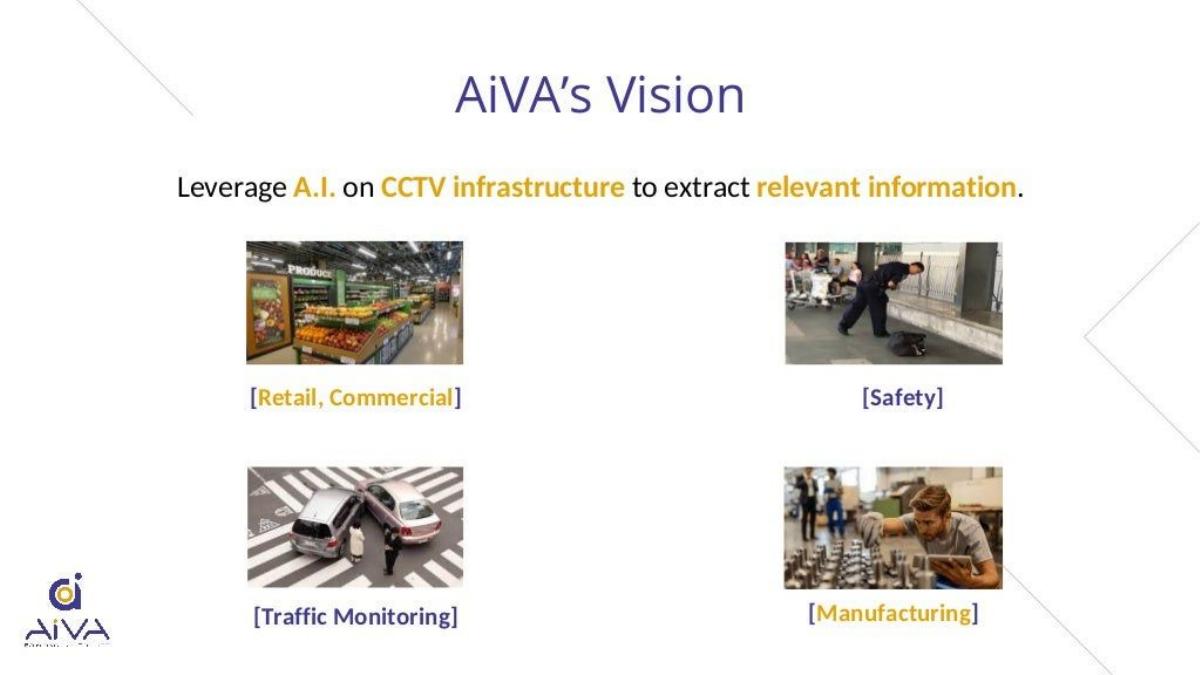
- The company's core mission is to leverage AI on CCTV infrastructure to extract relevant information across retail, safety, traffic, and manufacturing sectors (Slide 2).
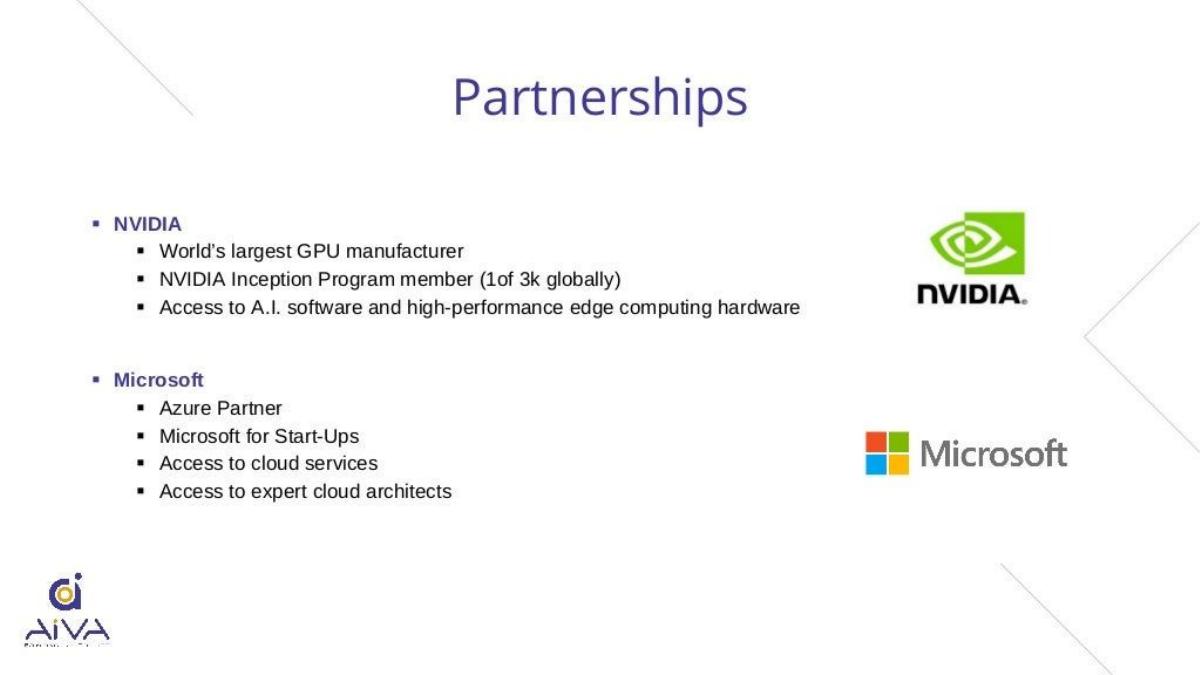
- AiVA relies heavily on its partnership with NVIDIA, specifically citing its membership in the NVIDIA Inception Program as one of only 3,000 members globally (Slide 3).
- The technical architecture utilizes a hybrid model where 'Perception Devices' handle edge processing to interface with cloud-based storage and visualization tools (Slide 4).
- The software stack is built on a suite of third-party tools including Confluent Cloud, Elasticsearch, Kibana, and various Azure IoT services (Slide 5).
- Four proprietary applications are named—Cradle, Conveyor, Flügelmann, and Caster—though their specific functions are not detailed (Slide 5).
- The deck identifies Alexandru Cocîndă as the Head of Development but does not list a CEO, CFO, or other founding members (Slide 6).
- There is no mention of current revenue, customer count, or specific case study results despite showing four target industries (Slide 2).
- The presentation completely omits a 'The Ask' slide, leaving the funding goal and use of proceeds unknown.
Executive Summary: The Technical Blueprint
The pitch deck for AI From the Edge (AiVA) is a concise, six-slide document that prioritizes technical architecture and ecosystem partnerships over business fundamentals. The company aims to transform standard CCTV cameras into intelligent data sources by deploying AI at the edge. While the vision is clear, the deck lacks the traditional narrative structure required for a successful fundraise, omitting market data, competitive positioning, and a clear financial request.
Slide 1: Title and Branding
The opening slide introduces the company as "AiVA" with the tagline "Bringing A.I. To Life." The branding is consistent with the "AI From the Edge" source listing. The visual theme uses a stylized human profile with a neural network overlay, signaling a focus on computer vision and artificial intelligence. There is no specific company description on this slide, relying entirely on the logo and tagline to set the stage.
Slide 2: AiVA’s Vision
This slide defines the company's core value proposition: "Leverage A.I. on CCTV infrastructure to extract relevant information." It lists four primary sectors for application: Retail, Commercial ; Safety ; Traffic Monitoring ; and Manufacturing . Each sector is accompanied by a stock photo representing a use case (e.g., a grocery aisle for retail, a car accident for traffic). This slide serves as the "Solution" slide but lacks a corresponding "Problem" slide to explain why current CCTV infrastructure is failing or what specific pain points these industries face.
Slide 3: Partnerships and Validation
AiVA leans heavily on two major tech giants for credibility. Under the NVIDIA heading, they claim to be an "NVIDIA Inception Program member (1 of 3k globally)," which grants them access to AI software and high-performance edge computing hardware. Under Microsoft , they are listed as an "Azure Partner" and a member of "Microsoft for Start-Ups," providing access to cloud services and expert architects. This slide is the strongest in the deck regarding technical feasibility, as it suggests the company is building on industry-standard stacks.
Slide 4: Technical Architecture (Edge Deployment)
This slide provides a diagram of the system's workflow. It shows a clear hierarchy: Store(s) contain Cameras , which feed into a Perception Device at the Edge . This edge device then communicates upward to the Cloud , which consists of three layers: Confluent Cloud , a Storage option , and a Visualization tool . This diagram is helpful for technical due diligence but does not explain the proprietary nature of the "Perception Device"—whether it is custom hardware or a software layer running on NVIDIA hardware.
Slide 5: The Tech Stack and Proprietary Apps
The deck lists four "Proprietary apps": Cradle , Conveyor (noted as part of the demo), Flügelmann , and Caster . No descriptions are provided for what these apps actually do. The rest of the slide is populated with logos for the third-party technologies they utilize: Confluent Cloud , Blob Storage , IoT Edge , IoT Central , Elasticsearch , and Kibana . This slide reinforces that the company is an integrator of existing powerful tools rather than a creator of a new underlying database or cloud infrastructure.
Slide 6: Team and Contact
The final slide in the provided set features Alexandru Cocîndă , identified as the Head of Development . It includes his email, LinkedIn profile, and the company website (www.aiva.vision). The absence of a CEO, founders, or a broader team is a significant red flag for investors, as it suggests a one-person operation or a very early-stage project that hasn't yet filled out its leadership ranks.
What Works in This Deck
Clarity of Architecture: Slide 4 does an excellent job of explaining the edge-to-cloud relationship. In the world of AI, bandwidth and latency are major hurdles; by showing that they process at the edge and only send "relevant information" to the cloud, they address a major technical concern for scalability.
Ecosystem Alignment: By highlighting NVIDIA and Microsoft, the company shows it isn't trying to reinvent the wheel. They are building within established ecosystems, which reduces the perceived risk of the underlying technology failing to work.
What is Missing from This Deck
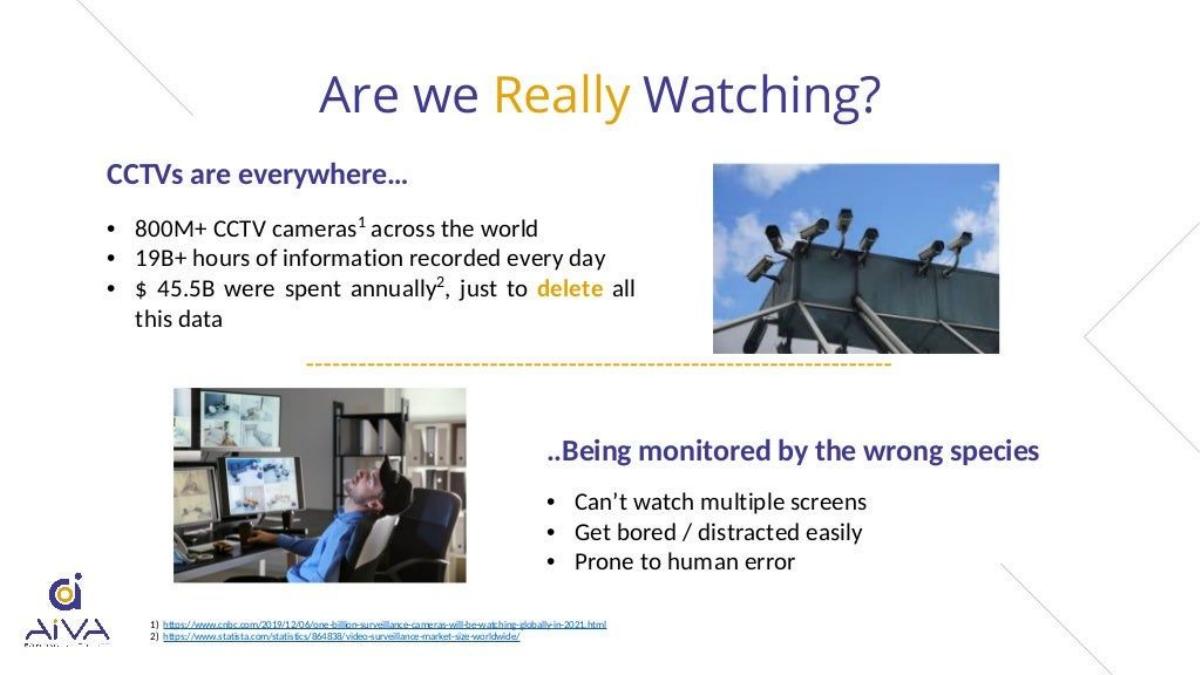
The Problem Statement: The deck never explains why we need AI on CCTV. Is it because human monitoring is too expensive? Is it because data is currently being lost? Without a problem, the solution feels like a "nice-to-have" rather than a "must-have."
Market Size and Opportunity: There are no figures regarding the number of CCTV cameras globally or the dollar value of the retail or manufacturing inefficiencies they aim to solve. Investors cannot calculate a potential return without these numbers.
Business Model: It is unclear how AiVA makes money. Do they sell the hardware (Perception Device)? Is it a SaaS subscription for the proprietary apps? Without a revenue model, this is a project, not a business.
Competitive Landscape: The computer vision space is crowded with giants and well-funded startups. AiVA does not mention a single competitor or explain why their "Proprietary apps" are superior to existing solutions.
The Ask: A pitch deck's primary purpose is to raise money. This deck does not state how much capital is being sought, what the valuation is, or what milestones the funding will help achieve.
Founder Recommendations
Define the Apps: The names "Flügelmann" and "Caster" are unique but meaningless without context. A founder should add a single sentence under each proprietary app explaining its function (e.g., "Caster: Real-time alert distribution system").
Humanize the Business: If Alexandru is the only team member, he should list advisors or previous experience that validates his ability to lead a company, not just a development team. If there are other founders, they must be included to show a balanced skill set (Sales, Operations, Finance).
Lead with the 'Why': Move the vision slide to the front, but reframe it as a solution to a massive, expensive problem. Quantify the cost of traffic accidents or retail shrinkage to create urgency.
Add a Roadmap: Since the deck mentions a "demo" for the Conveyor app, a slide showing the development timeline and future feature releases would help prove momentum.
Frequently asked questions
- What is the primary product offered by AI From the Edge?
- Based on Slide 4 and 5, the product appears to be a combination of edge hardware (Perception Devices) and a suite of proprietary apps (Cradle, Conveyor, Flügelmann, Caster) that process CCTV feeds. The system uses AI to extract data for industries like retail and manufacturing, then visualizes that data using cloud tools like Kibana and Elasticsearch.
- How does the company handle data processing?
- AiVA uses an 'edge-to-cloud' architecture. According to Slide 4, cameras feed into an on-site 'Perception Device.' This device processes the video locally (at the edge) and then sends the relevant data to the Confluent Cloud for storage and visualization. This approach typically reduces bandwidth costs compared to streaming raw video to the cloud.
- What evidence of market validation is provided?
- The deck relies on 'Partnerships' as its primary form of validation. Slide 3 highlights that they are a member of the NVIDIA Inception Program and a Microsoft Azure Partner. While these programs provide access to hardware and cloud architects, the deck does not list any paying customers or pilot programs to prove market demand.
- Who is leading the company according to the deck?
- The only team member identified is Alexandru Cocîndă, who holds the title of Head of Development (Slide 6). The deck is notably missing a slide for the executive leadership team, founders, or advisors, which is a significant omission for a standard venture capital pitch.
- What are the target use cases for this technology?
- Slide 2 identifies four specific verticals: Retail/Commercial (store monitoring), Safety (detecting abandoned objects or incidents), Traffic Monitoring (vehicle collisions), and Manufacturing (quality control or worker monitoring). However, the deck does not explain how the software differs for each of these distinct use cases.