Nanonets used this 23-slide deck to secure a $29 million funding round, positioning itself as a 'frictionless workflow automation platform.' The narrative moves strategically from a high-utility entry point—unstructured data extraction—to a broader vision of enabling '5 Person $1B Companies.' By showcasing specific procurement automation examples and a clear 'Land and Expand' strategy, Nanonets demonstrates how they capture immediate value while building long-term platform stickiness. The deck excels at defining its Ideal Customer Profile (ICP) across three distinct organizational roles, ensu…
Key takeaways
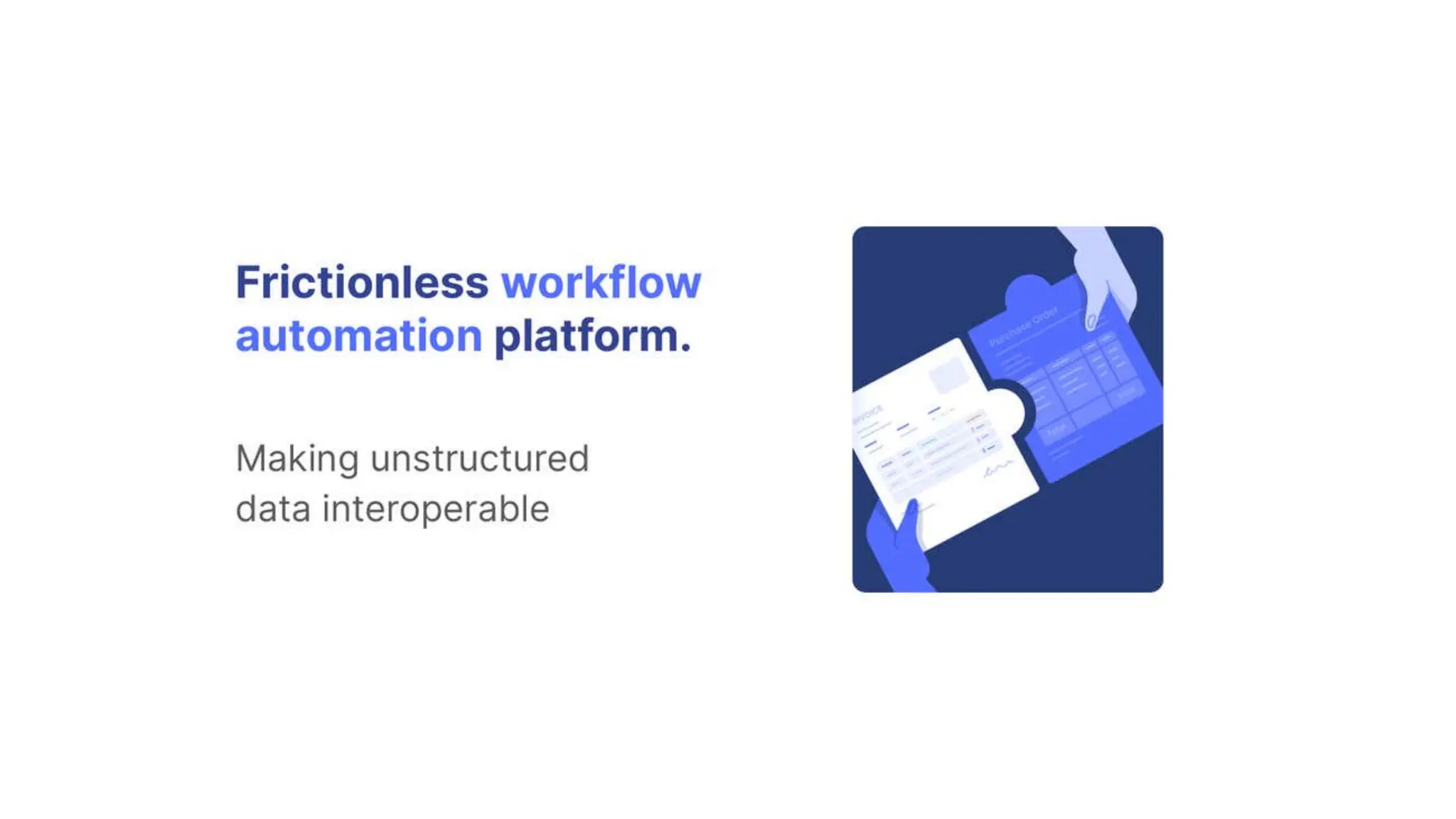
- The platform defines its core mission as making unstructured data interoperable to drive frictionless workflows (Slide 1).
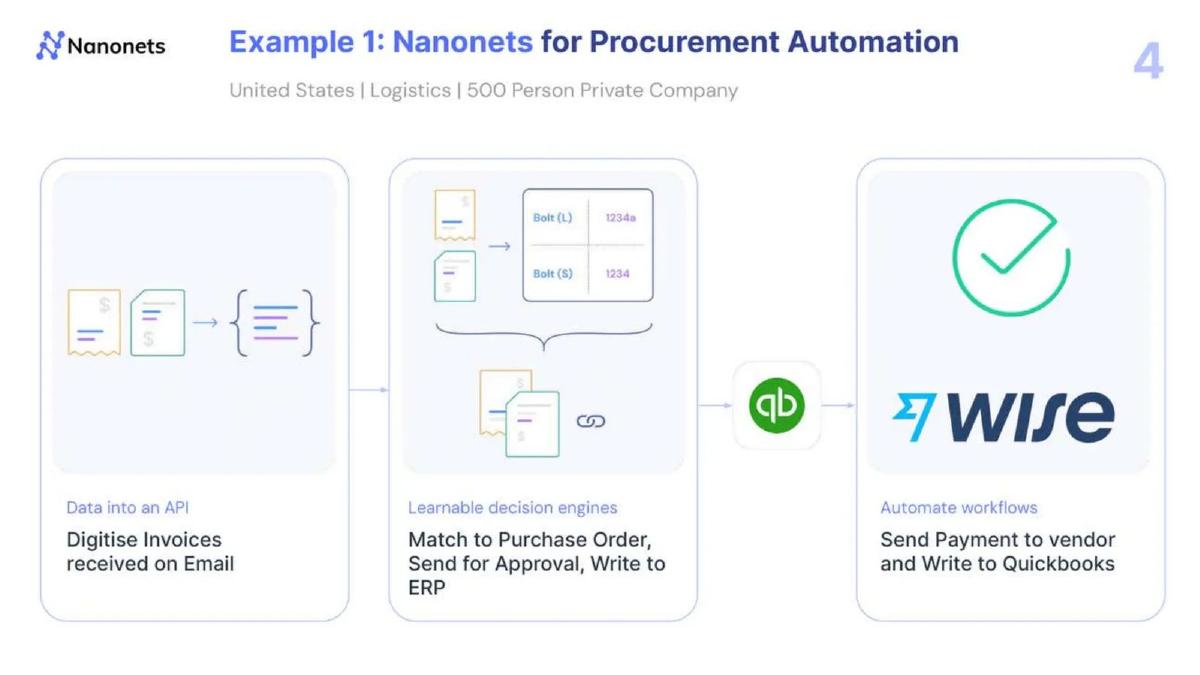
- Nanonets uses a specific procurement automation case study involving a 500-person logistics company to ground the technology in reality (Slide 4).
- The product allows users to generate complex workflows instantly using natural language prompts, integrating tools like Zendesk, QuickBooks, and Shopify (Slide 7).
- A clear 'Land and Expand' model shows the transition from per-extraction pricing to per-step workflow pricing (Slide 10).
- ARR projections show a consistent growth trajectory from January 2022 through a projected peak in January 2025 (Slide 13).
- The deck identifies three specific ICPs: IT/Procurement Managers, Finance/Ops Managers, and CXOs of 250-person companies (Slide 16).
- The 'Self Serve' capability is highlighted through a four-step UI flow: Import, Train, Postprocess, and Export (Slide 19).
- The long-term vision is centered on enabling '5 Person $1B Companies' through API integration and workflow orchestration (Slide 22).
Nanonets: The Infrastructure for the Lean Enterprise
Nanonets presents a compelling case for the future of work, where AI doesn't just assist humans but orchestrates the entire flow of data between disparate business systems. This teardown covers the 8 key slides provided from their 23-slide deck used to raise $29 million.
Slide 1: The Vision Statement
The deck opens with a clean, minimalist title slide. It defines Nanonets as a "Frictionless workflow automation platform" with the sub-headline "Making unstructured data interoperable." The graphic shows a puzzle piece connection between an invoice and a purchase order, immediately signaling that their primary use case is bridging the gap between physical/digital documents and structured business logic.
Slide 4: Practical Application in Procurement
Nanonets avoids the trap of being too abstract by providing a concrete example early on. Slide 4 details a use case for a "United States | Logistics | 500 Person Private Company." The workflow is broken into three clear stages:
Data into an API: Digitizing invoices received via email. · Learnable decision engines: Matching invoices to Purchase Orders and sending them to the ERP. · Automate workflows: Sending payments via Wise and writing the data to QuickBooks.
This slide is crucial because it proves the platform can handle the 'messy' middle of business operations where data usually gets stuck.
Slide 7: Natural Language Workflow Generation
Slide 7 introduces a powerful product feature: "Generate Workflows Instantly." It showcases a chat-like interface where a user provides a complex prompt: "For refund emails, create a Zendesk ticket. If The right side of the slide shows the "GENERATED WORKFLOW" with green checkmarks next to integrations like Zendesk, Nanonets AI, QuickBooks, FedEx, and Shopify. This demonstrates that Nanonets is moving toward a 'No-Code' or 'Natural Language' interface for complex DevOps and Ops tasks.
Slide 10: The Land and Expand Strategy
For investors, the business model is just as important as the tech. Slide 10, titled "Lands and Expand," outlines a clear path to increasing Net Revenue Retention (NRR). They "Land with Data Extraction" at a price point of "$0xx/Extraction." The expansion happens in three phases:
More Volume: Increasing the number of extractions. · More Data Types: Moving into different document categories at a yearly flat rate ( "$xk/year" ). · More Automation: Charging for the orchestration of the workflow itself ( "$0.0x/Step/Workflow" ).
This transition from a commodity service (OCR/Extraction) to a platform service (Orchestration) is a key indicator of long-term defensibility.
Slide 13: ARR Projections
Slide 13 provides a bar chart of "ARR Projections." The chart shows actual ARR from January 2022 through January 2024 (indicated by light blue bars) and projected ARR through January 2025 (dark blue bars). While the specific dollar amounts are omitted from the axis, the visual trend shows an accelerating growth curve, particularly in the projected period, suggesting they expect the 'Automation' phase of their expansion to drive significant revenue spikes.
Slide 16: Ideal Customer Profile (ICP)
Understanding who buys the product is vital for sales scalability. Slide 16 breaks the ICP into three personas:
IT + Procurement Manager: Motivated by "Becoming a hero within the org." · Finance / Ops Manager: Motivated by "Reduce frustration of managing process." · CXO of 250 Person Company: Motivated by wanting a "highly efficient organization."
By mapping actions, goals, and motivations for each, Nanonets shows they have a sophisticated go-to-market strategy that addresses both the bottom-up user and the top-down decision-maker.
Slide 19: The Self-Serve Product Loop
Slide 19 emphasizes "Unmatched Capability : Self Serve." It displays the user interface across four steps: Import, Train, Postprocess, and Export. The 'Import' screen shows logos for Dropbox, Amazon S3, and Google Drive. The 'Export' screen shows Sage, Salesforce, and Webhooks. This slide is intended to prove that the software is not a 'black box' requiring heavy professional services, but a tool that customers can configure themselves.
Slide 22: The Billion Dollar Vision
The final provided slide, "Vision - Enabling 5 Person $1B Companies," is the 'big dream' slide. It places a 5-person team at the center of a concentric circle of integrations including Salesforce, Slack, Zendesk, Asana, GitHub, and QuickBooks. The text reiterates the natural language prompts from earlier slides. This slide frames Nanonets not just as a tool, but as the essential operating system for a new breed of hyper-efficient, AI-driven enterprises.
What Makes This Deck Work
1. Specificity over Hype: Instead of just saying "AI is the future," Nanonets shows exactly how AI handles a refund email or a logistics invoice. The use of real company sizes (500-person logistics firm) makes the claims feel grounded.
2. Clear Monetization Path: The 'Land and Expand' slide is a masterclass in explaining SaaS economics. It shows how they capture a low-friction entry point and then move up the value chain.
3. Multi-Persona Targeting: By addressing the CXO, the Finance Manager, and the IT Manager on one slide, they demonstrate they understand the complex buying committee of mid-market and enterprise sales.
What is Missing from the Deck
1. Team Slide: The provided slides do not include a team overview. In a $29M round, the pedigree of the founders and the engineering team is usually a major selling point.
2. Competitive Landscape: There is no slide comparing Nanonets to incumbents like UiPath or other AI-native extraction tools. Investors would want to know why Nanonets wins against established RPA players.
3. Unit Economics: While ARR projections are present, the deck lacks data on Customer Acquisition Cost (CAC), LTV, or churn rates, which are critical for a growth-stage round.
4. The Ask: There is no slide detailing the specific amount being raised (though the source listing mentions $29M) or how that capital will be allocated across R&D, Sales, and Marketing.
Founder Takeaway
Founders should emulate Nanonets' ability to visualize the workflow. Many AI decks are too heavy on text and light on how the product actually interacts with the existing software stack. By showing the 'Import' and 'Export' logos and the step-by-step logic of a procurement task, Nanonets makes a complex technical product feel intuitive and highly valuable. Furthermore, the '5 Person $1B Company' vision is a perfect example of a 'hook'—a memorable, provocative statement that gives investors a simple way to describe the company's ultimate potential.
Frequently asked questions
- What is the primary value proposition of Nanonets according to the deck?
- Nanonets positions itself as a 'frictionless workflow automation platform' that specializes in making unstructured data interoperable. As shown on Slide 1 and Slide 4, this involves digitizing documents like invoices received via email, using learnable decision engines to match them to purchase orders, and automatically triggering actions in external software like QuickBooks and Wise.
- How does Nanonets plan to grow its revenue within existing accounts?
- The company employs a 'Land and Expand' strategy detailed on Slide 10. They 'Land' with basic data extraction priced per extraction. They then 'Expand' by increasing volume, adding more data types (priced per year), and finally moving into full automation where they charge per step or per workflow.
- Who are the target customers for this AI automation platform?
- Slide 16 identifies three distinct personas. The IT/Procurement Manager focuses on implementation and 'becoming a hero.' The Finance/Ops Manager aims to reduce manual overhead and frustration. The CXO of a mid-sized (250 person) company seeks a highly efficient organization with low staff counts.
- What technical integrations does the Nanonets platform support?
- The deck highlights a wide range of integrations across multiple slides. Slide 19 shows imports from Email, Dropbox, Amazon S3, and Google Drive, with exports to QuickBooks, Sage, Salesforce, and Webhooks. Slide 22 further includes Slack, GitHub, Asana, and Zendesk as part of their orchestration ecosystem.
- What is the '5 Person $1B Company' vision mentioned in the deck?
- This is the company's ultimate 'North Star' vision found on Slide 22. Nanonets aims to provide the infrastructure—API integration, data interoperability, and workflow orchestration—that allows a very small team to manage the operations and scale of a billion-dollar enterprise by automating the vast majority of manual business processes.