AgriNation is a conceptual platform designed to enable Community-Supported Agriculture (CSA) through IoT-driven monitoring and management. The 9-slide deck focuses heavily on the technical architecture and the user personas—specifically targeting aging farmers and busy urban professionals. By providing real-time alerts for irrigation, pest management, and soil health, AgriNation aims to lower the barrier to entry for collaborative farming. However, the deck functions more as a product proposal than a fundraising document. It completely omits a team slide, business model, market sizing (TAM/SA…
Key takeaways
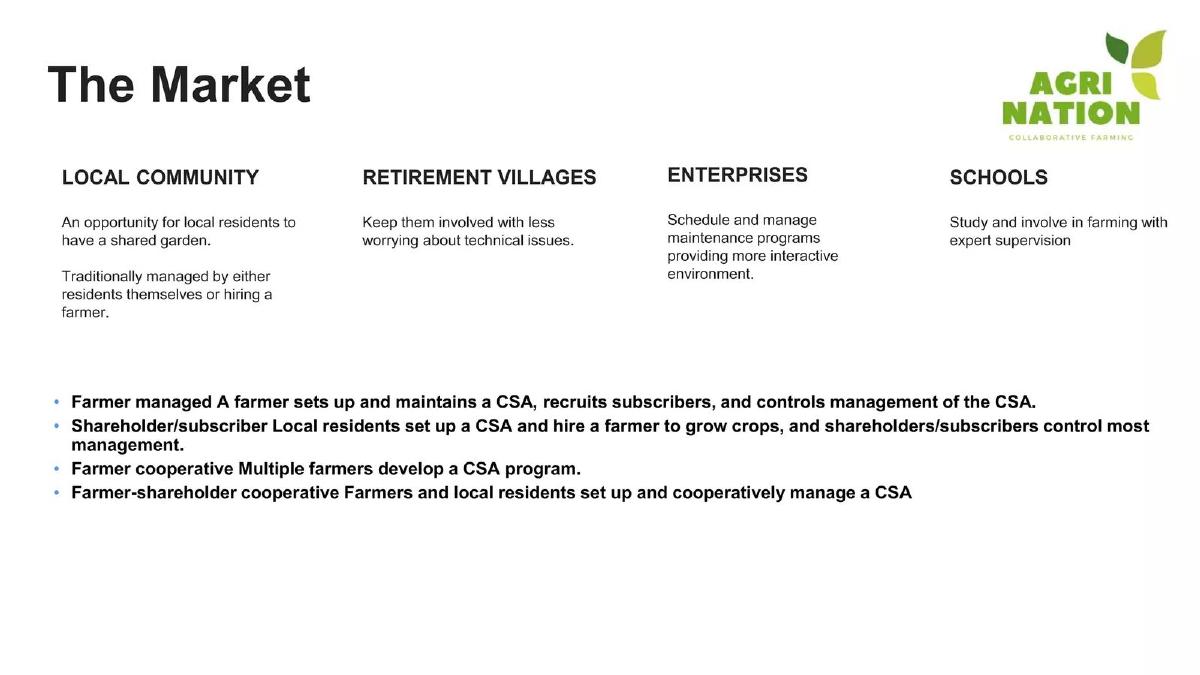
- The company defines four distinct market segments: Local Communities, Retirement Villages, Enterprises, and Schools (Slide 2).
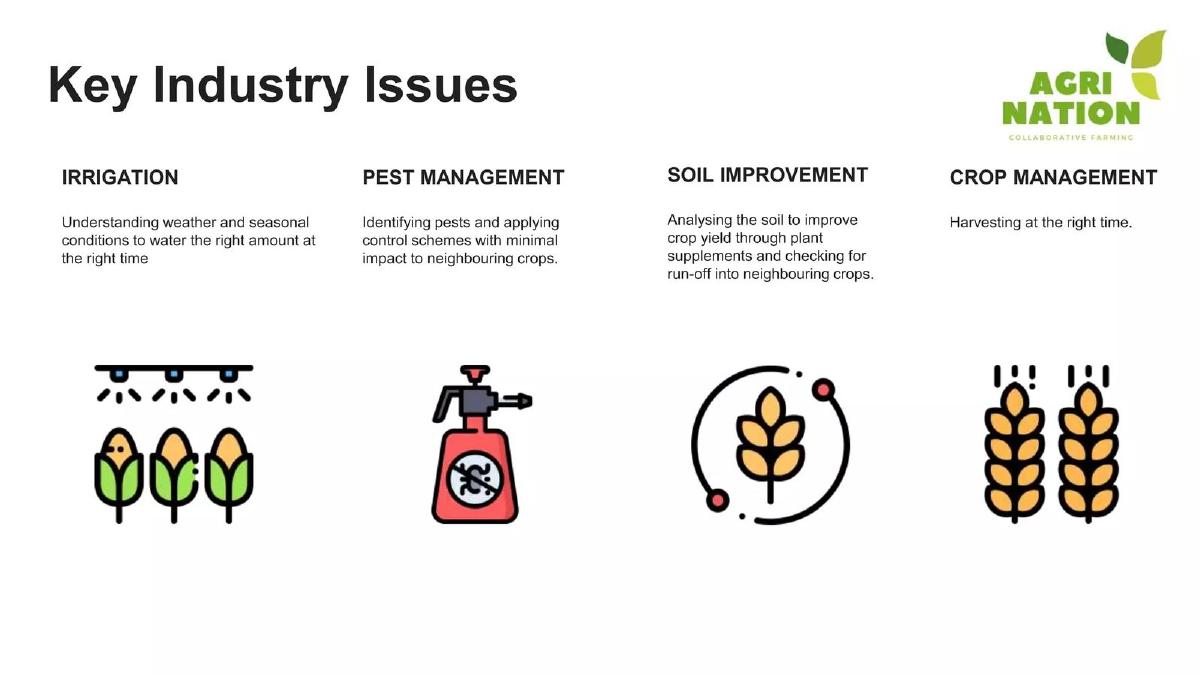
- AgriNation identifies four core industry pain points: Irrigation, Pest Management, Soil Improvement, and Crop Management (Slide 3).
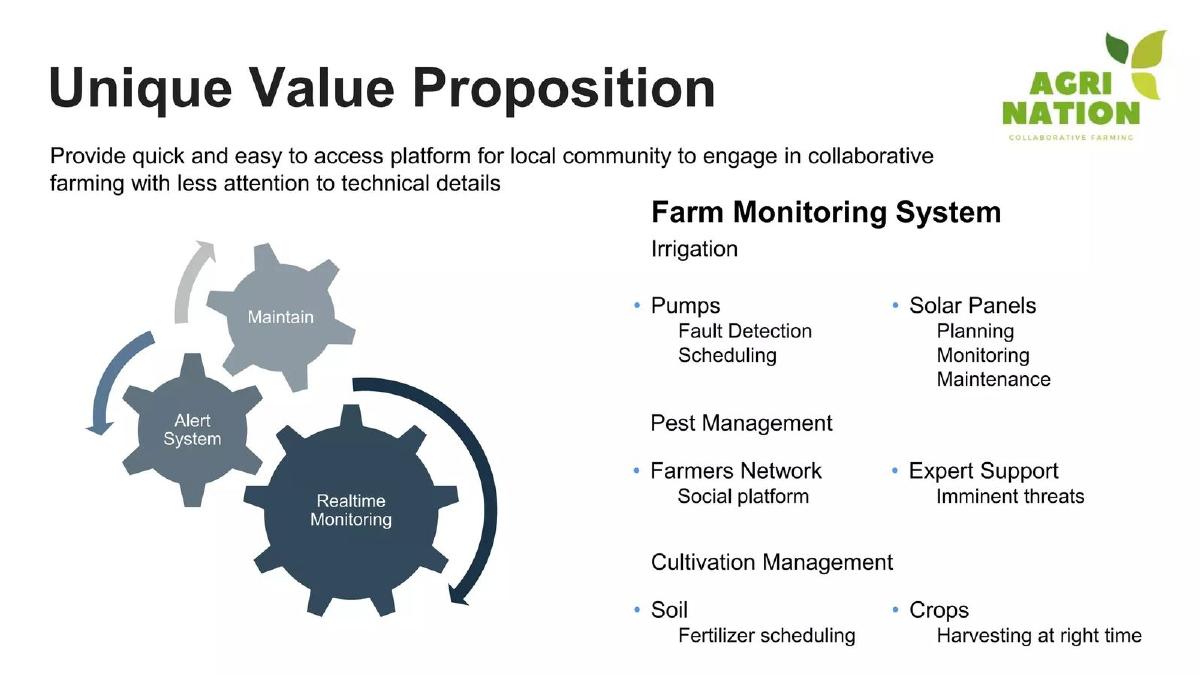
- The technical solution relies on a 'Farm Monitoring System' covering pumps, solar panels, and social networking for farmers (Slide 4).
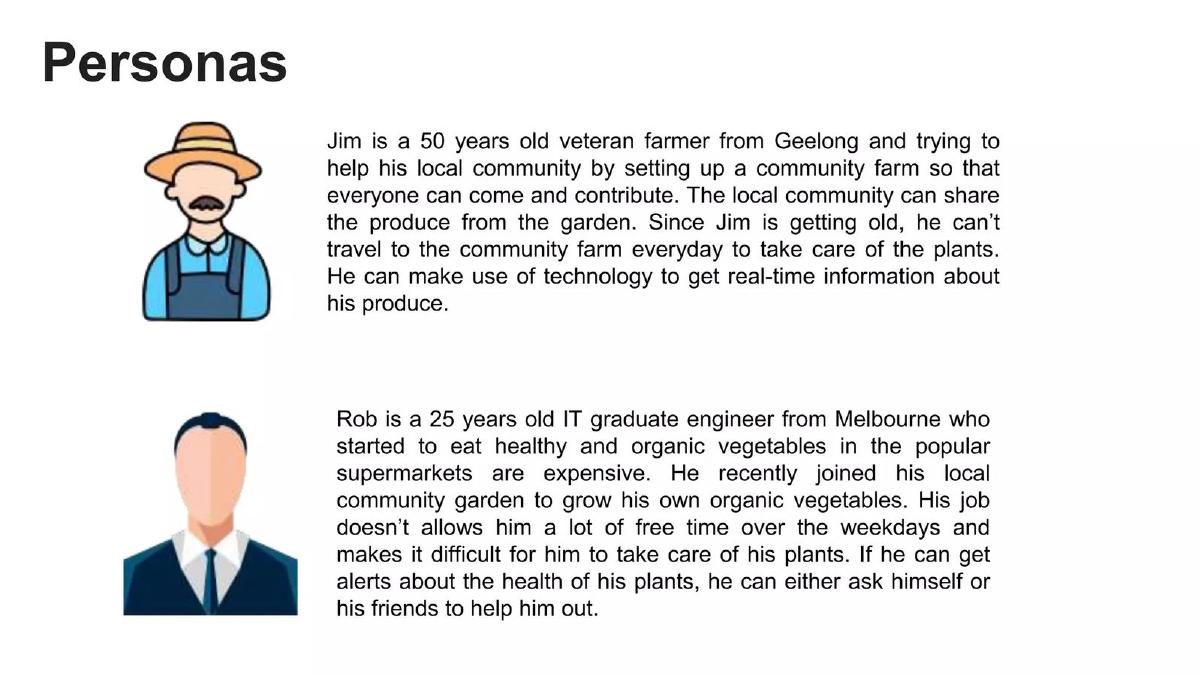
- User personas focus on Geelong-based veteran farmers and Melbourne-based IT graduates, highlighting a regional Australian focus (Slide 5).
- The tech stack utilizes Telstra’s T.DEV API and Arduino-based IoT hardware for field data collection (Slide 7).
- Product mockups show a 'Crop Monitor' dashboard with specific dates for watering and harvesting (Slide 8).
- The solution includes an SMS alert system that notifies users of pump faults and specific water requirements per crop (Slide 9).
- The deck contains no information regarding the founding team, their experience, or their track record.
Slide-by-Slide Teardown
Slide 1: Title Slide
The cover slide introduces AgriNation with the tagline "Enabling Community-Supported Agriculture." The logo features a stylized leaf design and the sub-header "Collaborative Farming." It is a clean, professional start that clearly defines the niche the company intends to occupy.
Slide 2: The Market
This slide breaks down the potential customer base into four categories: Local Community , Retirement Villages , Enterprises , and Schools . Below these categories, the slide defines four operational models for Community-Supported Agriculture (CSA): Farmer managed, Shareholder/subscriber, Farmer cooperative, and Farmer-shareholder cooperative. This is a useful taxonomy, but it lacks any data on the size of these markets or the specific geographic regions targeted beyond the general definitions.
Slide 3: Key Industry Issues
AgriNation identifies four technical hurdles in farming: Irrigation (timing and amount), Pest Management (identification and minimal impact), Soil Improvement (analysis and run-off prevention), and Crop Management (harvesting timing). The use of simple icons makes the slide readable, though the problems described are very broad and apply to almost all forms of agriculture, not just community gardens.
Slide 4: Unique Value Proposition
The UVP is stated as providing a "quick and easy to access platform for local community to engage in collaborative farming with less attention to technical details." The slide lists components of their "Farm Monitoring System," including fault detection for pumps, solar panel monitoring, a social platform for farmers, and fertilizer scheduling. This slide attempts to bridge the gap between the broad problems on Slide 3 and the specific technical features of the product.
Slide 5: Personas
The deck uses two specific personas to illustrate the user journey. Jim is a 50-year-old veteran farmer from Geelong who needs technology to manage a farm as he gets older. Rob is a 25-year-old IT graduate from Melbourne who wants organic food but lacks time. These personas are helpful for understanding the intended user experience, though they are highly localized to the Victoria, Australia region.
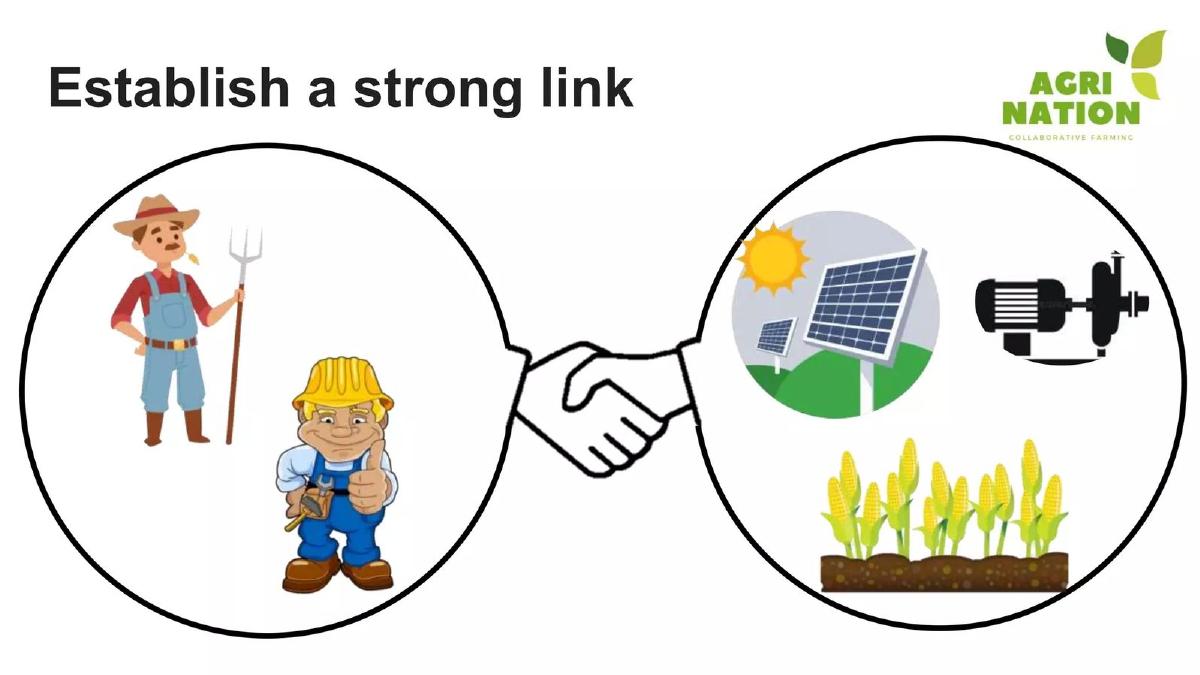
Slide 6: Establish a Strong Link
This is a purely conceptual graphic slide. It shows a handshake between two circles: one containing illustrations of workers (a farmer and a maintenance worker) and the other containing farm infrastructure (solar panels, pumps, and crops). It reinforces the theme of "collaborative farming" but adds no new information to the pitch.
Slide 7: Tech Stack
This slide provides a high-level architectural overview. It shows a UI (phone and laptop) connecting via the Internet to the AgriNation Cloud . The cloud utilizes "T.DEV Telstra’s 127.0.0.1 for API." The cloud then connects via IoT to Equipments , which include water pumps, sensors, and an Arduino board. The mention of Telstra's T.DEV suggests the project may have been developed in an Australian incubator or hackathon environment.
Slide 8: Solution (Web Interface)
Slide 8 displays mockups of the web platform. It shows a "Crop Monitor" table listing crops like Carrot, Apple, Orange, and Potato. The table tracks "Waterrequirement," "LastWatered," and "NextWateringDate," with a "Subscribe" button for each. The UI appears to be a functional prototype rather than a finished commercial product.
Slide 9: Solution (Mobile & SMS)
The final slide shows an "Irrigation Monitor" dashboard and an SMS alert interface. The SMS messages are specific: "Dear User, Pump: P006, in grid 5 has fault" and "Dear User, Your Carrot needs some love today. Please water them about 20.0 litres of water." This demonstrates the granular level of data the system aims to provide to the end-user.
What AgriNation Does Well
The deck is highly effective at explaining what the product is and how it works. By using specific personas and clear UI mockups, the founders make the abstract concept of "IoT for community farming" very tangible. The technical architecture slide (Slide 7) provides enough detail to show that the team has thought through the hardware-to-software pipeline, specifically mentioning Arduino and Telstra APIs.
The segmentation of the market into schools, retirement villages, and enterprises is also a strong point. It shows that the founders recognize that "community farming" isn't just a hobby for individuals but can be an institutional or commercial offering. The specific SMS examples on Slide 9 are excellent for demonstrating the actual value provided to a non-technical user like "Rob" or an aging user like "Jim."
What is Missing from the Deck
As a fundraising document, this deck is incomplete. The most glaring omissions include:
The Team: There is no mention of who is building this. Investors invest in people first, especially at the early stage. Without bios or a list of founders, there is no way to verify execution capability. · Business Model: How does AgriNation make money? Is it a hardware sale, a SaaS subscription for the monitoring platform, or a percentage of the CSA share price? The deck is silent on revenue. · Market Size: While the deck identifies segments, it provides no data on the Total Addressable Market (TAM). How many CSAs exist? How many retirement villages are in the target region? · Competition: The deck assumes AgriNation is operating in a vacuum. There is no mention of existing farm management software or simple DIY IoT solutions. · The Ask: There is no final slide stating how much money the company is looking for, what the valuation is, or what the milestones for the funding will be.
What a Founder Should Copy
Founders should look at Slide 5 (Personas) as a model for how to humanize a technical product. Instead of just listing features, AgriNation explains why those features matter to two very different types of people. This makes the "why" behind the product much more compelling.
Additionally, the Solution slides (8 and 9) are a great example of showing rather than telling. Instead of saying "our system sends alerts," they show the actual text of the alert. This level of specificity helps investors visualize the product in the hands of a customer. The use of a clear, consistent color palette and simple iconography also makes the deck easy to digest quickly.
Final Analysis
AgriNation is a well-structured product proposal that fails to function as a professional investment deck. It succeeds in defining a niche problem and a technical solution but fails to address any of the commercial questions an investor would ask. It appears to be a project from a technical incubator or a university competition rather than a startup ready for a seed round. To become a viable pitch, the founders would need to add at least five more slides covering the team, the business model, the competitive landscape, the market size, and the financial ask.
Frequently asked questions
- What is AgriNation's primary product?
- AgriNation is an IoT-enabled platform for collaborative farming. It uses sensors and cloud-based software to monitor farm health, providing users with real-time alerts via SMS and a web dashboard. The system tracks irrigation pumps, soil moisture, and crop growth to help community members manage gardens with minimal technical expertise.
- Who is the target audience for this platform?
- The deck identifies two primary personas: 'Jim,' a 50-year-old veteran farmer who needs technology to manage his community farm remotely as he ages, and 'Rob,' a 25-year-old IT professional who wants to grow organic vegetables but lacks the time for daily manual maintenance.
- What hardware does AgriNation use?
- According to the Tech Stack slide (Slide 7), the system uses Arduino boards, moisture sensors, and IoT-connected water pumps. These devices communicate via an IoT gateway to a cloud server, which then pushes data to a web UI and mobile devices.
- Is there any evidence of market traction in the deck?
- No. The deck does not list any current users, pilot programs, or revenue figures. The 'Solution' slides feature mockups with dates from 2017 and 2018, suggesting the deck may have been created as a prototype or for a hackathon-style presentation rather than a formal seed round.
- What are the biggest risks identified in this teardown?
- The primary risks are the lack of a business model and the absence of a team. Without knowing how the company intends to make money or who is building the technology, it is impossible for an investor to evaluate the project's long-term sustainability or execution capability.