AI Beauty Bot is positioning itself as the essential 'AI Administrator' for the global beauty salon market, valued at $122B. The deck highlights a clear transition from a reactive booking tool to a proactive management platform, which they term a 'Beauty OS.' With a team boasting significant experience in B2B SaaS and software development, the company reports achieving positive unit economics as of September 2025. The deck effectively uses data to show a 6x reduction in CoGS and a doubling of ARPPU over a six-month period. While the product demo slides show strong multi-language and audio sup…
Key takeaways
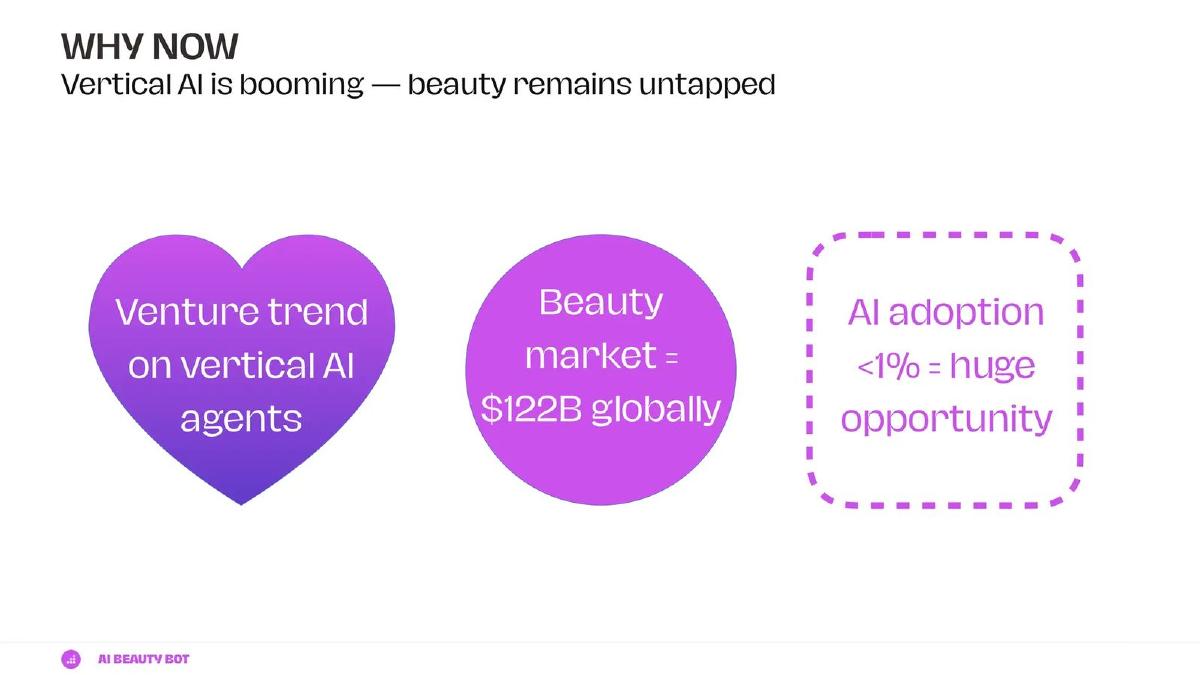
- The company targets a $122B global beauty market with less than 1% AI adoption (Slide 3).
- Reported achieving positive unit economics in September 2025, with a profit of $12.8 per unit (Slide 5).
- CoGS was reduced by 6 times between March and September 2025 (Slide 5).
- The product supports multi-language interactions and can process audio messages for bookings (Slide 10).
- Pricing is tiered from $79 to $219 per month per branch, with additional fees for extra channels and dialogs (Slide 6).
- The roadmap outlines a shift from 'Admin level' (booking) to 'Manager level' (full AI Operating System) by 2026 (Slide 7).
- The core team includes founders with 13-18 years of experience in startups and B2B SaaS (Slide 4).
- The deck omits a specific funding amount or use-of-funds breakdown (All slides).
Executive Summary: The Vertical AI Opportunity
AI Beauty Bot (AIBB) is a vertical AI play targeting the beauty salon industry. The deck, dated September 2025, positions the company as a solution to the high administrative overhead and limited availability of human salon managers. By automating client consultations, bookings, and CRM updates, AIBB claims to offer a '24/7 administrator' that scales more efficiently than traditional staff.
Slide 1-2: The Hook and Value Proposition
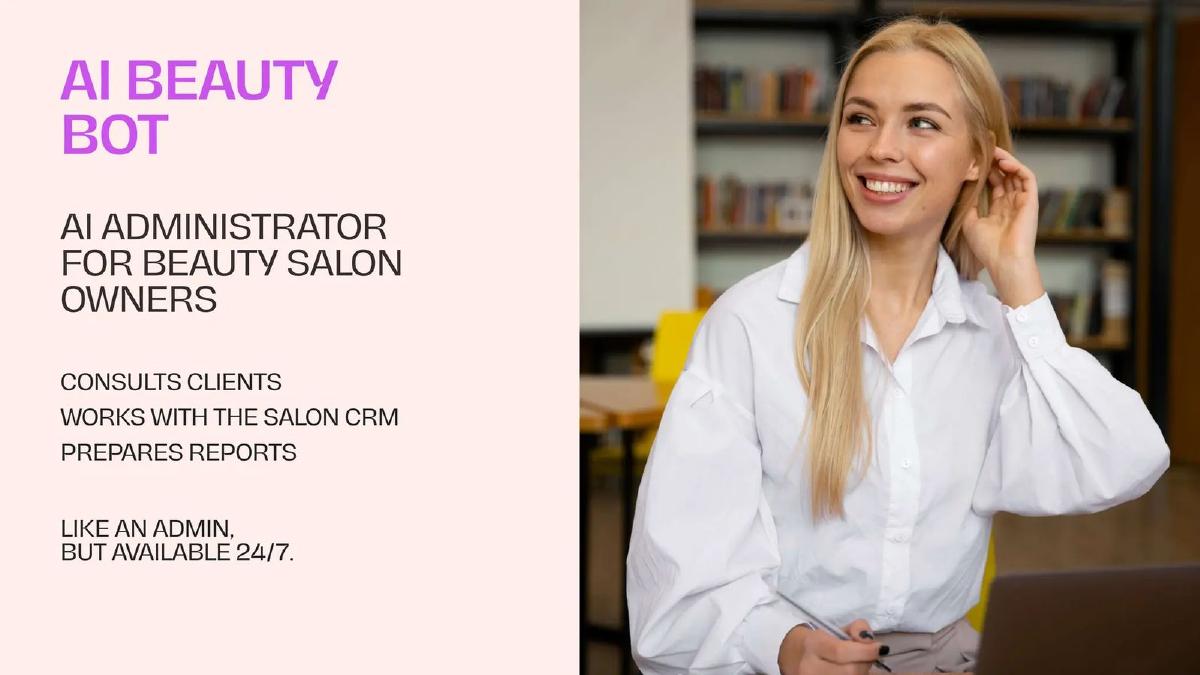
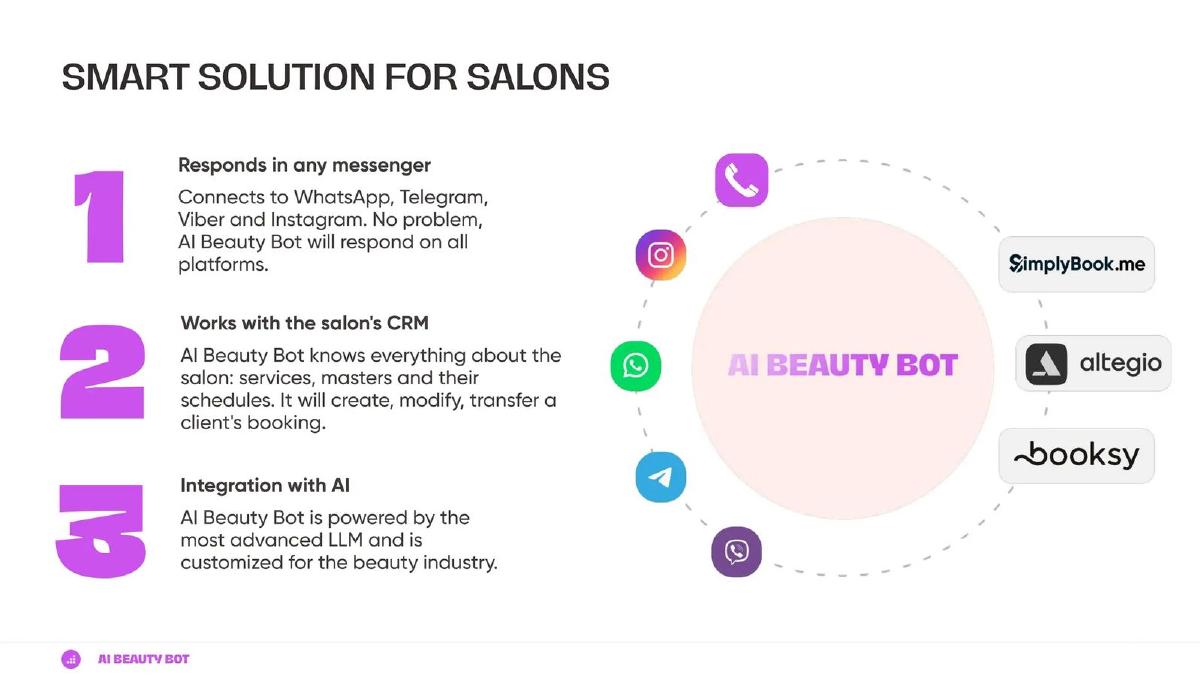
The opening slides establish the brand identity and the core product function. Slide 1 introduces Mike Avdeev as the Co-founder and sets the stage for a 'September 2025' update. Slide 2 defines the product's scope: consulting clients, integrating with salon CRMs, and preparing reports. The tagline 'Like an admin, but available 24/7' clearly defines the replacement value for a salon owner.
Slide 3: Market Context and 'Why Now'
Slide 3 utilizes a 'Why Now' framework, citing a $122B global beauty market . The key insight here is the claim that AI adoption in this vertical is currently less than 1% . By framing vertical AI agents as a booming venture trend, the founders are attempting to ride the broader market tailwinds of generative AI while focusing on an 'untapped' niche.
Slide 4: The Core Team
The team slide is a highlight of the deck, showcasing deep domain expertise. Mike Avdeev brings 13 years of startup experience, including a previous venture with 300K+ active users. Andrey Tomachinskiy adds B2B SaaS product development weight, claiming to have generated $4.5M+ in revenue across 20+ products. Maxim Karmatskikh , the CTO, brings 18 years of development experience. The inclusion of two angel investors, Sergey Budyakov and Aleksey Kulakov, adds institutional credibility, as both are listed as CEOs or founders of other tech firms.
Slide 5: Traction and Unit Economics
Slide 5 is the most data-dense part of the presentation. It tracks performance from March 2025 to September 2025. The chart shows a clear path to profitability:
ARPPU: Increased from $51.2 to $84.3. · CoGS: Decreased significantly (though the chart shows a 6x reduction in the text, the visual bars show a reduction from $84.3 to $71.5). · Profit: Moved from a loss of -$33.1 per unit to a profit of $12.8 .
The slide also notes a 33% conversion rate from trial to payment and a presence in 20+ countries , suggesting the product has international appeal.
Slide 6: The Business Model
AIBB uses a standard SaaS tiered pricing model. The 'Light' plan starts at $79/month for up to 225 dialogs, while the 'Platinum' plan at $219/month offers unlimited employees and 675 dialogs. The model is built for expansion, with add-ons for extra channels ($8/month) and dialog packages ($30 per 100 dialogs). This structure allows the company to capture value from both small independent salons and larger chains.
Slide 7: Product Evolution and Roadmap
The roadmap (Slide 7) visualizes the transition from a reactive 'Admin level' tool (booking, rescheduling) to a 'Manager level' tool. By 2026, the goal is to become a 'Full AI Operating System for salons,' incorporating proactive features like segmentation, offers, and re-engagement. This is a critical slide for investors as it moves the company from a 'feature' to a 'platform' play.
Slide 8-10: Product Demo and Contact
Slide 10 provides a visual demonstration of the bot in action via a messaging interface. It highlights three key technical capabilities: 24/7 availability with 1-minute response times, the ability to understand audio messages , and multi-language support. Slide 8 is a placeholder/conceptual 'holy grail' graphic, and Slide 9 serves as the closing contact page with a QR code for an AI-driven FAQ about the company.
What Works in This Deck
1. Clear Unit Economics: Slide 5 is exceptionally strong. It doesn't just show growth; it shows the efficiency of that growth. Seeing a company move from negative to positive unit economics in a six-month window is a powerful signal for Series A or late-seed investors.
2. Vertical Focus: The deck does not try to be an AI bot for everyone. By focusing strictly on beauty salons and integrating with industry-specific CRMs like Altegio and Simplybook , they demonstrate a 'moat' built on workflow integration rather than just raw AI capability.
3. Experienced Team: The combined 40+ years of experience listed on Slide 4 reduces execution risk. The founders have clearly built and scaled products before, which makes the ambitious roadmap to a 'Beauty OS' more believable.
What Is Missing
1. The Ask: There is no slide stating how much money the company is raising, at what valuation, or what the milestones for the next 18 months will be. This is a major omission for a fundraising deck.
2. Competitive Landscape: While they mention the market is 'untapped,' they don't address existing incumbents or other AI startups entering the space. A 'Competitor Matrix' would help define their unique edge.
3. Churn and Retention Data: While Slide 5 mentions '85% retention during scaling,' it doesn't specify if this is gross or net revenue retention, or if it refers to user retention. More granular cohort data would strengthen the traction claims.
Founder's Playbook: What to Copy
Use 'Vertical AI' Framing: If you are building an AI tool, don't just call it 'AI.' Call it an 'AI Administrator' or 'AI Lawyer.' AIBB succeeds by giving the bot a job title that every salon owner understands.
Visualizing the Shift from Feature to OS: Slide 7 is a great template for showing how a simple tool becomes an indispensable platform. Start with the 'utility' (booking) and show how it leads to 'intelligence' (segmentation and offers).
Direct Unit Economic Tracking: Most early-stage decks hide their losses. AIBB's willingness to show the negative profit months leading up to the positive ones builds trust and demonstrates that the management team is focused on the right metrics.
Frequently asked questions
- What is the core problem AI Beauty Bot solves?
- AI Beauty Bot addresses the administrative burden on beauty salon owners by providing a 24/7 AI administrator. According to Slide 2, the bot consults clients, works with salon CRMs like Simplybook and Altegio, and prepares reports. It aims to replace or augment human administrators who are not available around the clock, handling tasks like booking, rescheduling, and client support.
- How does the company generate revenue?
- The business model is subscription-based, as shown on Slide 6. They offer three tiers: Light ($79/month), Standard ($149/month), and Platinum ($219/month). Revenue is also bolstered by add-ons, such as $8/month for additional communication channels (WhatsApp, Telegram, etc.), $30 for extra dialog packages, and $25/month for notifications.
- What does the traction data show about their efficiency?
- Slide 5 shows significant operational improvements over six months in 2025. They reduced CoGS from $84.3 in March to $71.5 in September, while simultaneously doubling ARPPU from $51.2 to $84.3. This resulted in a swing from a $33.1 loss per unit to a $12.8 profit, indicating a move toward scalable profitability.
- Who are the key people behind the project?
- The team (Slide 4) consists of Co-founders Mike Avdeev (13 years in startups, ex-CEO of ETransport) and Andrey Tomachinskiy (13 years in B2B SaaS), and CTO Maxim Karmatskikh (18 years in software development). They are supported by angel investors Sergey Budyakov and Aleksey Kulakov, both of whom have founder-level experience in the tech sector.
- What is missing from this pitch deck?
- The most notable omission is a formal 'Ask' slide. While the deck builds a strong case for the business, it does not state how much capital they are seeking or how it will be allocated. Additionally, there is no detailed competitive landscape analysis or a deep dive into the specific 'proprietary sales methodology' mentioned on the team slide.