Filio’s pitch deck is a deep dive into the workflow inefficiencies of construction site documentation. The company targets the manual, error-prone process of capturing and organizing site photos, proposing an AI-driven alternative that automates metadata tagging—including GPS, weather, and wind speed. While the deck provides excellent visual proof of the platform’s capabilities, such as KML/KMZ layer integration and interactive reporting, it is notably missing core investment metrics. There is no mention of market size (TAM/SAM/SOM), current revenue, customer logos, or a specific funding ask.…
Key takeaways
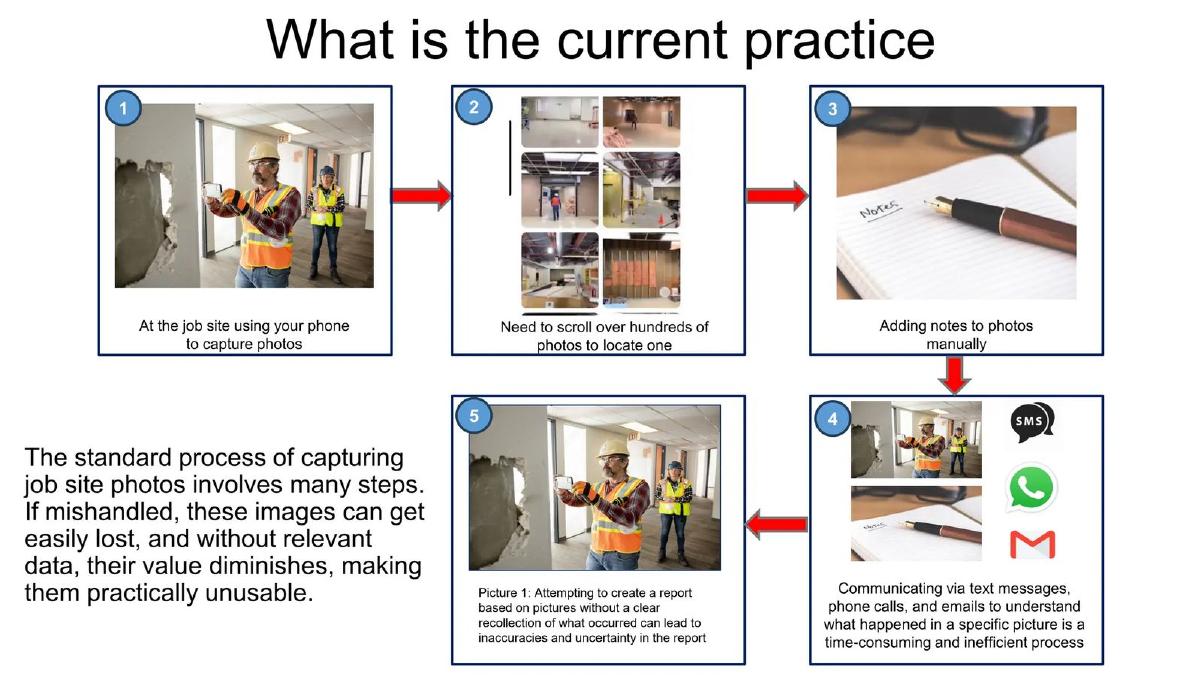
- The deck identifies a five-step manual process for site documentation that leads to 'practically unusable' data on Slide 2.
- Filio automates the capture of metadata including date, time, GPS coordinates, bearing, weather, and wind speed as shown on Slide 3.
- The platform supports advanced GIS features, allowing users to add customized KML/KMZ geographical layers to their project maps on Slide 4.
- A key competitive advantage claimed on Slide 5 is a 'five-minute' learning curve for site personnel compared to extensive training for other platforms.
- The software provides offline functionality, ensuring documentation continuity in remote areas without internet access according to Slide 5.
- The deck includes a detailed five-step onboarding workflow, emphasizing a 'Data Collector App' available on iOS and Android on Slide 7.
- Despite the technical detail, the deck omits all financial projections, team bios, and market size analysis.
- The product features AI-driven multilingual voice captioning and image labeling to simplify search and filtering on Slide 5.
Executive Summary: The Product-Led Documentation Pitch
Filio’s deck is a quintessential example of a product-first presentation. It spends the majority of its real estate explaining the 'how' and 'what' of the platform. The company targets the construction industry, specifically focusing on the massive volume of visual data generated during a project. By automating the metadata attachment process, Filio aims to turn a folder full of random photos into a structured, searchable database. While the technical value proposition is clear, the business case—market opportunity, competitive landscape, and financial trajectory—remains unaddressed in these slides.
Slide 1: Title and Introduction
The deck opens with a clean, minimalist title slide. It identifies Filio as a "Cutting-Edge Platform for Collaborative Visual Asset Management." Notably, it includes the name of Max Mahdi Roozbahani, PhD, suggesting a founder-led technical pedigree. The inclusion of the URL (www.filio.io) immediately directs interested parties to the live product, which aligns with the deck's overall focus on the existing software rather than a conceptual future build.
Slide 2: The Current Practice (The Problem)
Slide 2 uses a flow-chart style to illustrate the pain points of current construction documentation. It breaks the problem down into five steps: 1. Capturing photos on a phone, 2. Scrolling through hundreds of images to find one, 3. Manually adding notes, 4. Communicating via SMS/WhatsApp/Email, and 5. Attempting to create reports from memory. The slide concludes that without relevant data, these images become "practically unusable." This is a strong problem statement because it highlights not just a lack of data, but the wasted labor costs associated with manual organization.
Slide 3: The Filio Solution
This slide introduces the "Everything Automated and Simple" approach. It showcases three primary interfaces: a blueprint view where photos are pinned to specific locations, a map view utilizing geofencing, and an interactive report generator. The bottom of the slide lists the specific metadata captured automatically: date, time, GPS coordinates, direction, weather, and wind speed. By listing these specific data points, Filio demonstrates a deep understanding of what is required for legal and insurance documentation in construction (e.g., knowing the wind speed during a crane lift or exterior painting).
Slide 4: Platform Interface and GIS Integration
Slide 4 provides a high-resolution screenshot of the web dashboard. It emphasizes the ability to "add your own customized KML/KMZ layers." This is a sophisticated feature that appeals to civil engineering and large-scale infrastructure projects where standard Google Maps views are insufficient. The dashboard also shows a timeline histogram, allowing users to see photo volume over time, which serves as a proxy for project activity levels. The UI appears modern and data-dense, supporting the claim of being a professional-grade tool.
Slide 5: Value Proposition and Competitive Differentiators
This slide is the most text-heavy and serves as the core argument for why Filio wins against incumbents. It lists six key pillars:
Simplicity: Claims a learning curve of under five minutes. · AI-Driven: Mentions multilingual voice captioning and image labeling. · Customizable Reporting: Contrasts their "interactive" reports against the "static PDFs" of competitors. · Smartphone Reliance: No extra hardware required. · Offline Functionality: Critical for remote job sites. · Scalability: Claims to grow with project size.
The comparison to "standard project management tools" (likely referring to giants like Procore or Autodesk) suggests Filio views itself as a specialized best-of-breed solution that can integrate with or replace the documentation modules of larger suites.
Slide 6: Filio Videos & Academy
This slide functions as a resource directory. It provides links to an intro video, tutorials, plans/costing, and the "Filio Academy." While useful for a sales deck, in a fundraising context, this slide feels like filler. Investors generally prefer to see these links in an appendix or a follow-up email rather than taking up a primary slide in a 21-slide deck.
Slide 7: Onboarding and Workflow
The final slide in this set outlines the user journey from registration to report sharing. It highlights the "Data Collector App" available on major app stores and shows a project manager in an office environment reviewing real-time uploads. The mention of "Automated upload to the cloud" via a satellite icon emphasizes the seamless transition from field to office. This slide reinforces the "Simplicity" value prop mentioned earlier by showing a clear, linear path to value.
What Works in the Filio Deck
Granular Problem Definition: The deck does an excellent job of breaking down a messy, real-world workflow into discrete, painful steps. By showing the transition from a physical notebook (Slide 2) to a digital dashboard (Slide 4), the value of the software is immediately apparent without needing a sales pitch.
Feature Specificity: Instead of just saying "we capture data," the deck lists specific environmental variables like wind speed and bearing. For the construction industry, these details are not just features; they are critical for risk mitigation and dispute resolution.
UI Transparency: Many decks hide the product behind mockups. Filio shows the actual dashboard, including the search filters, map layers, and report templates. This builds credibility, suggesting the product is mature and ready for deployment.
What is Missing from the Filio Deck
The Business Case: There is no mention of the Total Addressable Market (TAM). While we know construction is a multi-trillion dollar industry, the deck fails to quantify how much of that spend goes toward documentation or how much money is lost due to poor reporting.
Traction and Social Proof: The deck lacks customer logos, case studies, or testimonials. There are no metrics regarding the number of photos processed, the number of active users, or the number of projects currently using the platform. Without this, it is impossible to tell if this is a prototype or a scaling enterprise.
The Team: While the founder's name and PhD are on the title slide, there is no team slide detailing the engineering or industry expertise of the broader organization. In early-stage fundraising, the team is often as important as the product.
The Ask: The deck does not state how much capital is being raised, what the valuation expectations are, or how the funds will be allocated (e.g., sales hiring vs. R&D). This is a critical omission for any fundraising document.
Founder's Playbook: What to Copy
Use the 'Before and After' Visuals: The contrast between Slide 2 (The Current Practice) and Slide 3 (With Filio) is a masterclass in clear communication. Founders should use this side-by-side comparison to make the benefits of their technology tangible.
Highlight Offline Capabilities: If you are building for the 'deskless worker' or field industries (construction, mining, oil & gas), always highlight offline functionality. It shows you have spent time on actual job sites and understand the infrastructure limitations your users face.
Focus on Metadata, Not Just Data: Filio realizes that a photo is just a file, but a photo with GPS, weather, and time data is a legal record. Founders should look for ways to show how their platform adds 'intelligence' to raw data through automated tagging.
Frequently asked questions
- What specific problem does Filio solve for construction firms?
- Filio addresses the 'unusable' nature of manual job site photos. Currently, workers capture photos on phones, scroll through hundreds to find one, manually add notes, and communicate via fragmented channels like SMS and email. Filio automates this by tagging every photo with precise GPS, weather, and directional data, making them searchable and report-ready instantly.
- How does Filio use AI in its platform?
- According to Slide 5, Filio utilizes AI for multilingual voice captioning and automated image labeling. This allows field workers to speak descriptions that are transcribed and indexed, and the system automatically identifies objects or conditions in photos to make the entire visual database searchable by keywords rather than just dates.
- What are the technical requirements for using Filio in the field?
- Filio is designed to be hardware-agnostic, relying solely on smartphones rather than specialized cameras or sensors. Slide 5 highlights that it works offline, which is critical for construction sites in remote areas or sub-grade locations where cellular signals are unreliable or non-existent.
- Does the deck provide evidence of market traction or revenue?
- No. The provided slides focus exclusively on product features, workflow, and the value proposition. There are no mentions of current Annual Recurring Revenue (ARR), the number of active projects, specific construction firm clients, or growth percentages. This is a significant omission for a fundraising teardown.
- What reporting capabilities does the platform offer?
- Filio moves away from 'static PDF reports' common in the industry. As shown on Slides 3 and 4, it generates interactive reports with drag-and-drop features and live editing. These reports include interactive maps, timeline filters, and detailed metadata for every visual asset included in the documentation.