AGV Protocol is positioning itself as a decentralized infrastructure layer for Real-World Assets (RWA), specifically targeting the intersection of clean energy, agriculture, and AI compute. The deck outlines a model where physical assets—such as solar farms and edge compute clusters—are tokenized via NFTs to provide on-chain yield. With a targeted internal rate of return (IRR) of 18-26%, the company seeks to solve the global bottleneck in AI power infrastructure. The fundraising ask is specific: $1 million for 4% of the GVT token supply at a $25 million valuation. While the deck provides clea…
Key takeaways
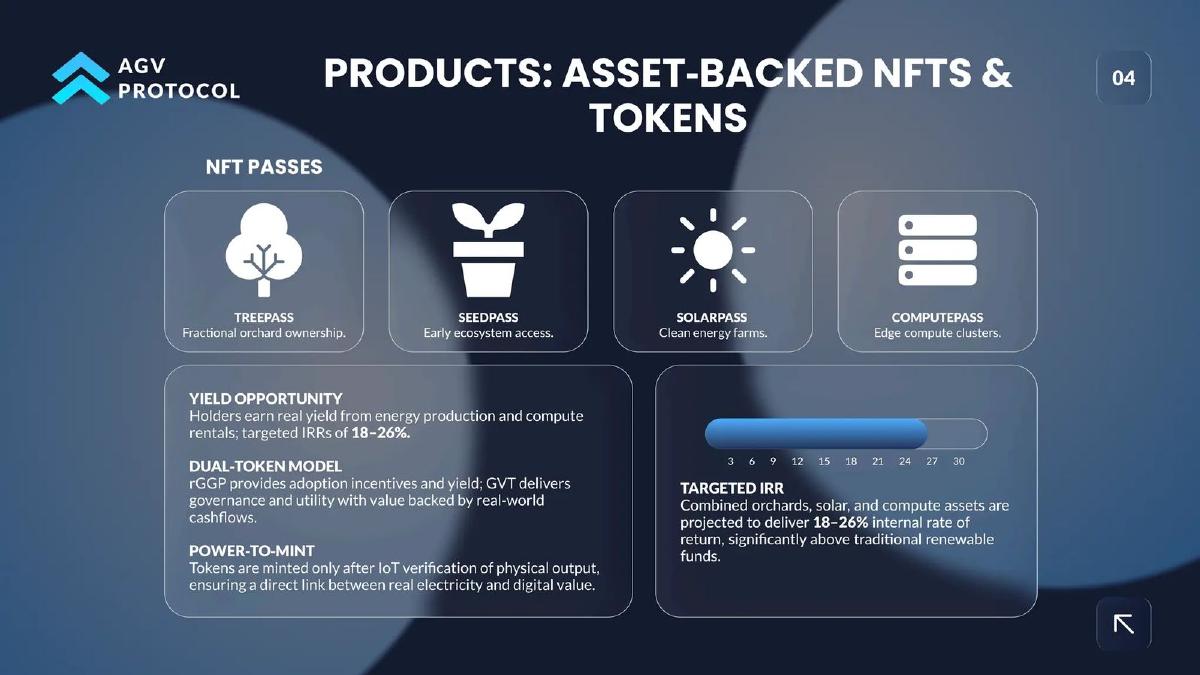
- The protocol targets a high internal rate of return (IRR) of 18-26% by combining yields from orchards, solar farms, and compute assets (Slide 04).
- A dual-token model is utilized: rGGP for adoption incentives and yield, and GVT for governance and utility backed by cashflows (Slide 04).
- Phase 1 cashflow projections estimate $0.52M in total net annual cashflow from solar, orchards, and compute assets (Slide 06).
- The team claims early traction with over 7,800 TaskOn participants and smart contracts audited by Beosin as of August 2025 (Slide 08).
- Token allocation is distributed across Community (30%), Ecosystem (20%), Private/Public Sales (20%), Team/Advisors (15%), and Treasury/DAO (15%) (Slide 08).
- The current pre-seed ask is $1 million for 4% of GVT supply, implying a $25 million valuation (Slide 12).
- Long-term valuation targets range from $120-200 million once AI power assets are fully priced in (Slide 12).
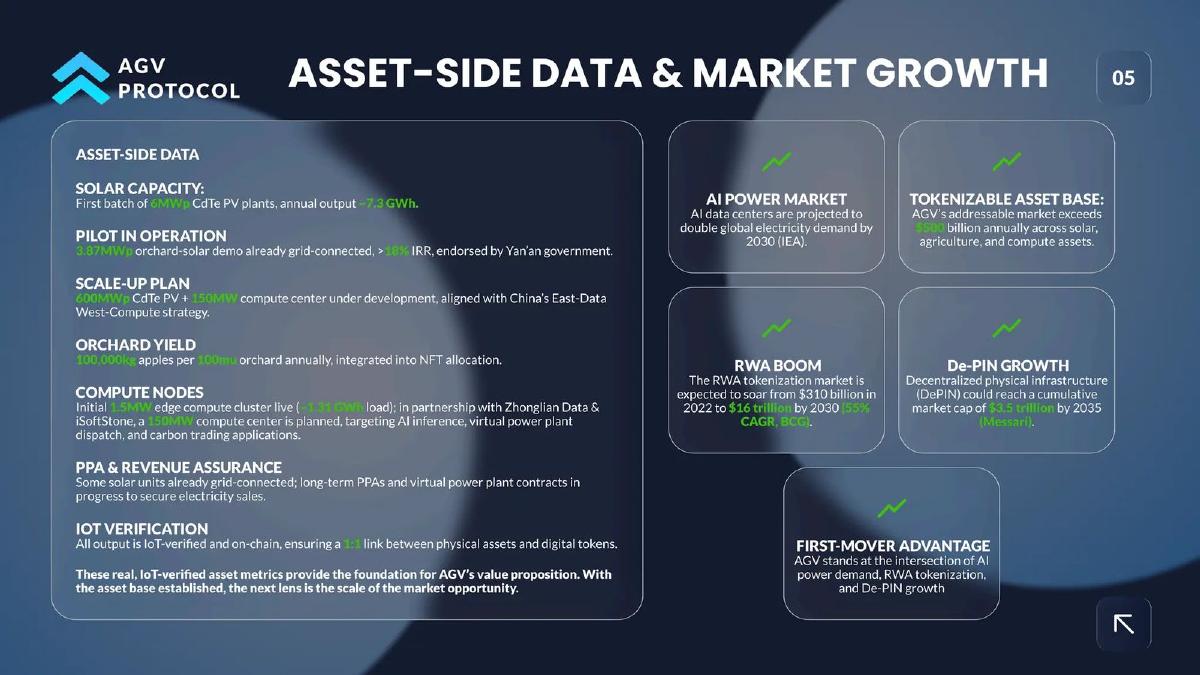
- Strategic partnerships are mentioned with Zhonglian Data and iSoftStone for compute services (Slide 06).
Slide-by-Slide Analysis
Slide 01: Title Slide
The title slide introduces AGV Protocol with the subtitle "Real Energy. Real Yield. Real Assets — On-chain." It is dated September 2025 and labeled as the "AI Power Pitch Deck." The visual split-screen contrasts industrial energy infrastructure with digital server racks, establishing the core theme of bridging physical energy with digital compute.
Slide 02: Global Dilemma & Emerging Capital Markets
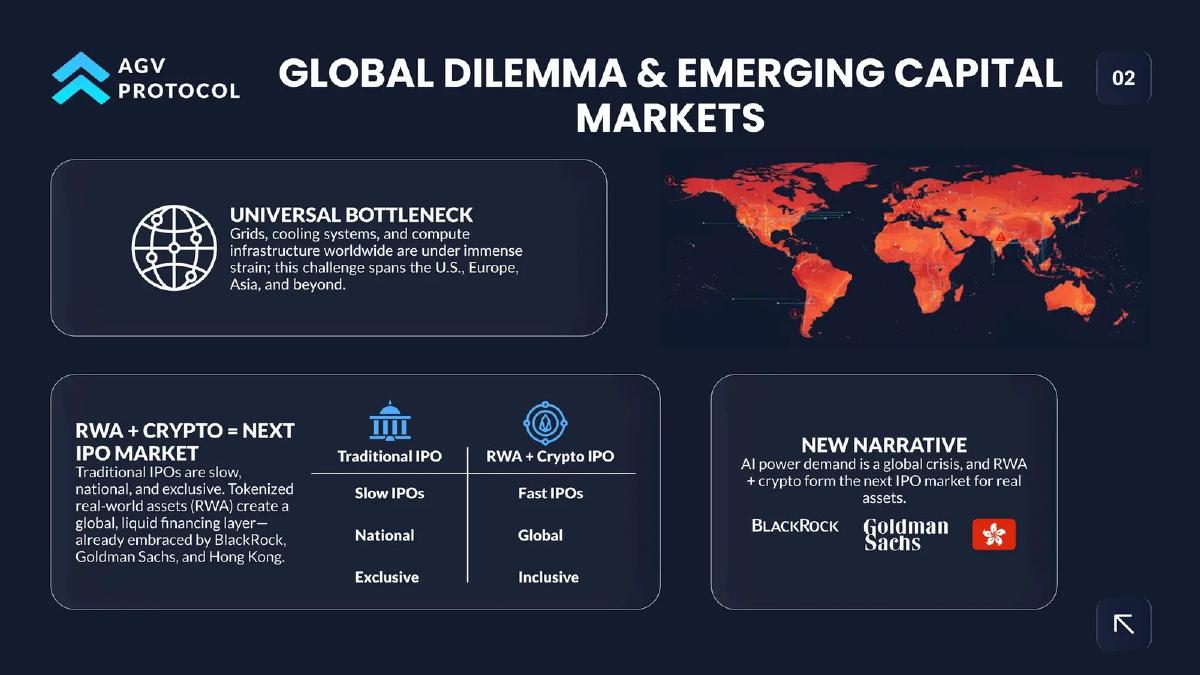
This slide frames the problem as a "Universal Bottleneck" involving grids, cooling systems, and compute infrastructure under strain globally. It positions Real-World Assets (RWA) combined with crypto as the "Next IPO Market," claiming this model is faster, global, and more inclusive than traditional IPOs. It references BlackRock, Goldman Sachs, and Hong Kong as entities already embracing this narrative.
Slide 04: Products: Asset-Backed NFTs & Tokens
AGV details its product suite consisting of four "NFT Passes": TreePass (orchards), SeedPass (ecosystem access), SolarPass (clean energy), and ComputePass (edge compute). The slide introduces a dual-token model (rGGP and GVT) and a "Power-to-Mint" mechanism verified by IoT. A targeted IRR of 18-26% is highlighted, which the deck claims is significantly above traditional renewable funds.
Slide 06: Business Model & Revenue
The business model is presented as a circular economy involving recurring yield fees, NFT sales, compute services, and token buybacks. A "Phase 1 Cashflow Projection" table estimates total net cashflow at ~$0.52M annually. Specific asset capacities are listed: 6MWp for solar, 100 MU for orchards, and 1.5MW for compute. Partnerships with Zhonglian Data and iSoftStone are mentioned under compute services.
Slide 08: Tokenomics & Community Traction
This slide provides a breakdown of token allocation: 30% Community, 20% Ecosystem Development, 20% Private & Public Sales, 15% Team & Advisors, and 15% Treasury/DAO. Traction metrics include 7,800+ TaskOn participants and a smart contract audit by Beosin completed in August 2025. It also mentions the formation of KOL clusters via the G3 Fund.
Slide 10: Team Execution Strength
The team slide lists seven individuals with specific roles. Notable mentions include Susan Zheng (Strategy & Capital Markets, ex-IB), Yini Wang (Institutional Capital, ex-Quant Fund Manager with >¥10B AUM track), and Winnie Wu (DAO & KOL Ecosystem). Technical roles cover smart contracts (Yasir), front-end (Robin Wu), and security (Phantom). No surnames are provided for Tyler, Yasir, or Phantom.
Slide 12: Investment Ask & Roadmap
The roadmap is divided into three phases spanning 24 months. The "Pre-Seed Raise" section asks for $1 million in exchange for approximately 4% of the GVT supply, which implies a $25 million valuation. Use of funds includes acquiring assets, regulatory audits, and seeding market liquidity. A future valuation outlook targets $120-200 million.
Slide 15: Mission, Vision, and Invitation
The final slide defines the mission to build programmable on-chain infrastructure for electricity, agriculture, and compute. The vision is to become the "world's first decentralized AI Power ETF." Contact information and the website (www.agvprotocol.org) are provided.
What AGV Protocol Does Well
Specific Financial Targets: Unlike many Web3 decks that remain vague on returns, AGV Protocol explicitly targets an 18-26% IRR (Slide 04) and provides a granular breakdown of net cashflow projections across three different asset classes (Slide 06). This allows investors to model the business against traditional infrastructure benchmarks.
Hardware-Software Linkage: The inclusion of an "IoT verification" step for token minting (Slide 04) addresses a common criticism of RWA projects: the "oracle problem." By specifying that tokens are only minted after physical output is verified, they provide a layer of transparency regarding the underlying asset value.
Clear Valuation Logic: The deck doesn't just ask for money; it explains the math. By asking for $1M for 4% of the supply, they establish a $25M valuation and then provide a "Valuation Outlook" (Slide 12) that explains how they expect to reach a $120-200M market cap, giving investors a clear view of the intended exit or growth trajectory.
What is Missing from the AGV Protocol Deck
Regulatory Detail: While Slide 12 mentions "regulatory audits" and Slide 02 mentions Hong Kong, the deck lacks a specific legal framework for how these asset-backed NFTs are structured. Tokenizing real-world assets like solar farms and orchards typically involves complex securities laws that vary by jurisdiction.
Competitive Landscape: The deck operates in a vacuum. There is no mention of other RWA protocols (like Centrifuge or Goldfinch) or decentralized compute projects (like Render or Akash). A slide comparing AGV's yields or technology to these existing players would help validate their market position.
Asset Ownership Structure: It is unclear if AGV Protocol owns the physical assets (orchards, solar farms) directly or if they act as a financing middleman. Slide 06 mentions "partnerships" for compute but doesn't clarify the ownership of the 6MWp solar capacity or the 100 MU orchards.
Founder Takeaways: What to Copy
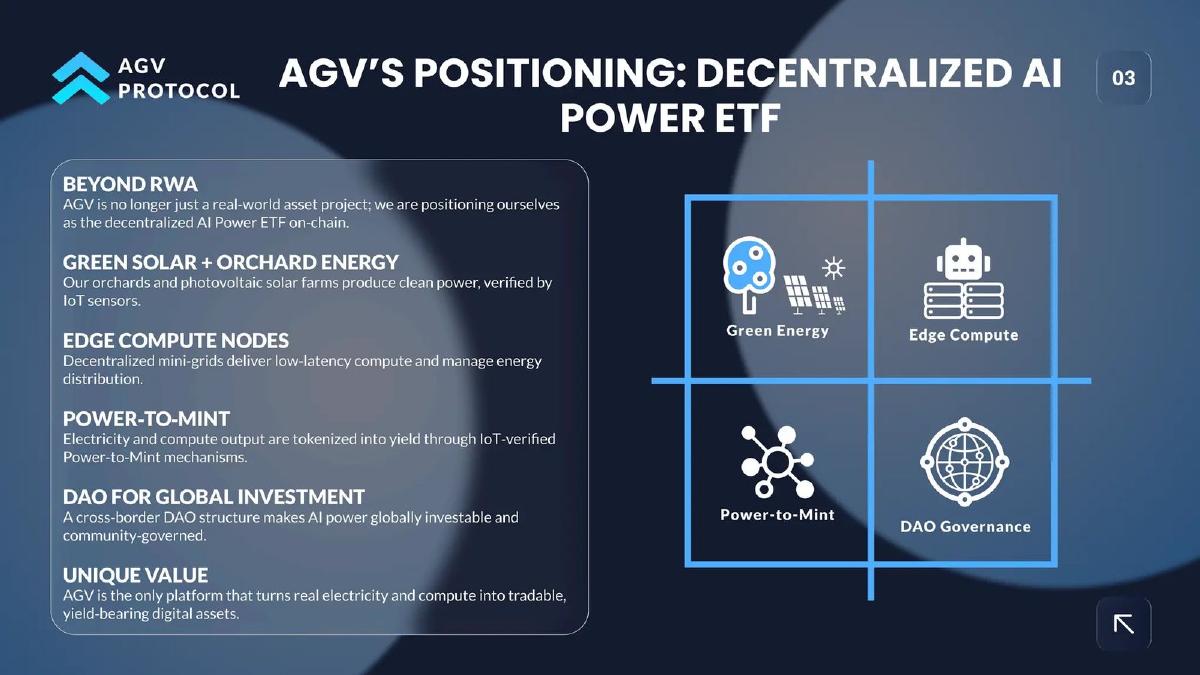
The 'Narrative Bridge': AGV successfully bridges two high-interest sectors: AI and RWA. By positioning energy and compute as the "bottleneck" for AI (Slide 02), they make a traditional infrastructure play feel urgent and high-growth. Founders should look at how they can frame their existing technology within a larger, trending macro problem.
Phased Capital Requirements: The roadmap (Slide 12) is effectively tied to capital needs. Phase 3 explicitly states a need for $15-20 million to scale to 50+ assets. This shows a long-term capital strategy beyond the immediate $1M pre-seed ask, which signals to investors that the founders are thinking about the full lifecycle of the project.
Asset Diversification: By bundling agriculture (orchards), energy (solar), and tech (compute), the protocol creates a diversified yield profile. This is a smart way to mitigate the risk of any single sector underperforming. Founders in the DeFi or RWA space should consider how multi-asset baskets can make their tokens more attractive to risk-averse investors.
Frequently asked questions
- What specific assets does AGV Protocol tokenize?
- According to Slide 04, the protocol tokenizes four distinct categories: TreePass (fractional orchard ownership), SeedPass (early ecosystem access), SolarPass (clean energy farms), and ComputePass (edge compute clusters). These are represented as asset-backed NFTs that allow holders to earn yield from physical production and rentals.
- How does the 'Power-to-Mint' mechanism work?
- Slide 04 explains that tokens are only minted after IoT verification of physical output. This ensures a direct link between real-world electricity production or digital value creation and the on-chain tokens, preventing the issuance of unbacked digital assets.
- What are the projected revenues for the initial phase?
- Slide 06 projects a total net cashflow of ~$0.52M annually for Phase 1. This is broken down into net returns of $318K from Solar (6MWp), $35K from Orchards (100 MU), and $165K from Compute (1.5MW). The deck claims this covers 2.5x projected OPEX.
- Who is leading the technical and financial execution?
- Slide 10 lists a specialized team including Susan Zheng (Strategy & Capital Markets, ex-IB), Yini Wang (Institutional Capital, ex-Quant Fund Manager with >¥10B AUM track), and technical leads like Yasir (Smart Contracts) and Tyler (Tech & Compliance).
- What is the roadmap for the next 24 months?
- Slide 12 outlines a three-phase plan: Phase 1 (0-6M) focuses on compliance and initial NFT deployment; Phase 2 (6-12M) involves expanding into test markets and growing the user base; Phase 3 (12-24M) aims to invest $15-20 million to reach 50+ energy assets and onboard institutional investors.