Agreatculture presents a 15-slide pitch deck for their platform, AGRIN, targeting the Indonesian agricultural sector. The deck identifies five core problems: price uncertainty, environmental degradation, quality-productivity trade-offs, information gaps, and a declining farmer population. The proposed solution is a multi-functional app that includes harvest estimation, a marketplace (Pasar Tani), land identification, and pest management tools. With a target market of 4.5 million internet-using farmers and 276,000 millennial farmers in Indonesia, the team is seeking a modest pre-seed investmen…
Key takeaways
- The startup identifies a specific target market of 4.5 million internet-using farmers in Indonesia based on 2018 BPS data (Slide 9).
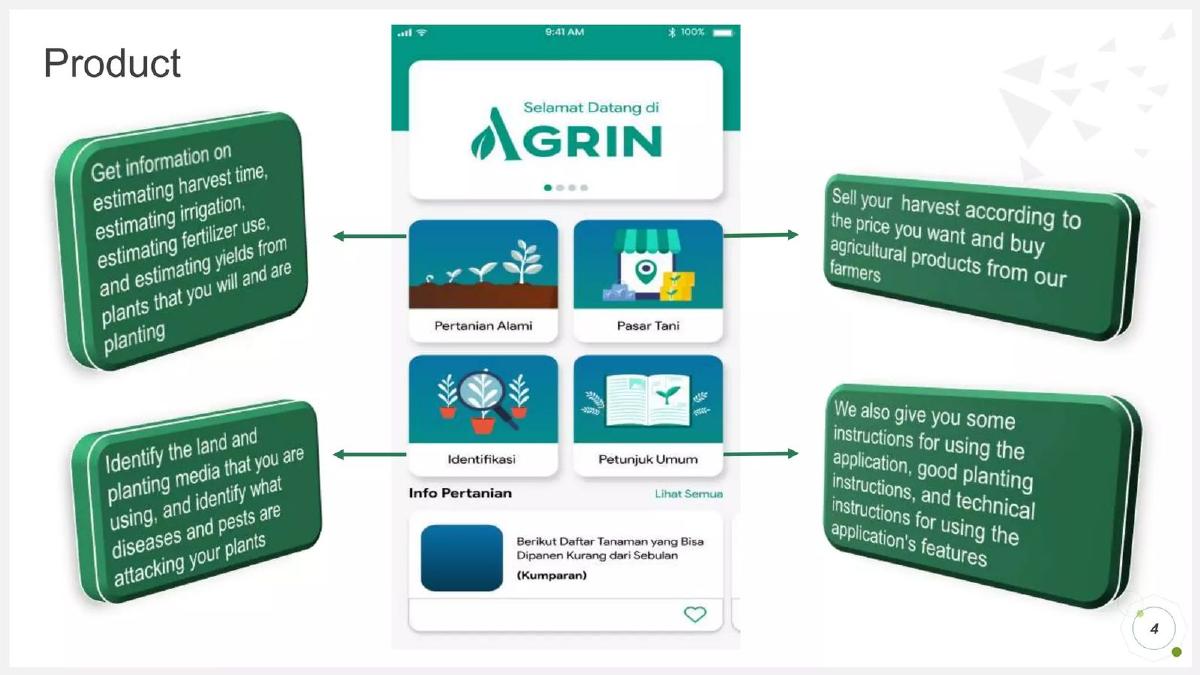
- The product, AGRIN, features four main modules: Pertanian Alami, Pasar Tani, Identifikasi, and Petunjuk Umum (Slide 4).
- Agreatculture is seeking a very specific, low-range pre-seed investment of $32K to $63K (Slide 13).
- The team is composed of nine members, including specialists in agriculture, software engineering, and marketing, primarily from IPB University (Slide 2, 14).
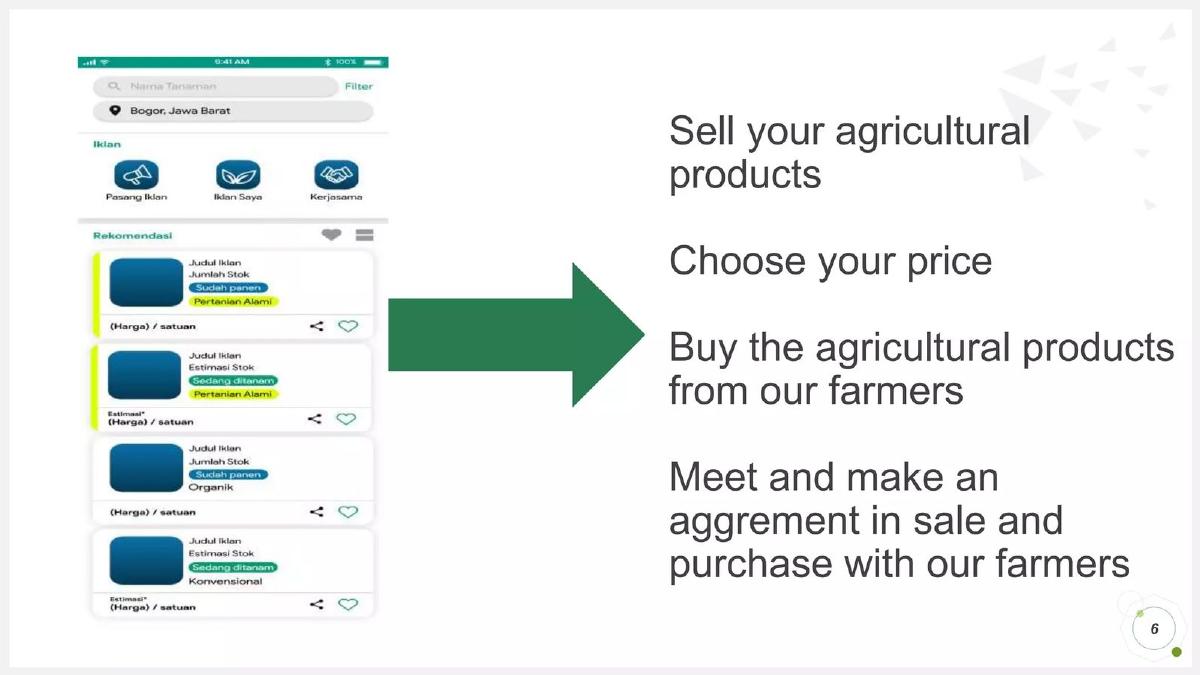
- The marketplace component allows farmers to set their own prices and meet buyers to make sales agreements (Slide 6).
- The deck includes a detailed competition slide listing 14 current competitors and identifying SIPINDO by SMARTSeeds as the primary threat (Slide 10).
- The growth strategy relies heavily on digital marketing, premium features for land identification, and government partnerships (Slide 11).
- A one-year action plan was established starting in January 2020, with a first launch scheduled for May 2020 (Slide 12).
Executive Summary: The AGRIN Platform
Agreatculture Indonesia presents a vision for 'natural agriculture based on environmental engineering.' Their primary vehicle for this is AGRIN, a mobile application designed to serve as a technical assistant and a commercial bridge for Indonesian farmers. The deck is structured as a classic problem-solution narrative, focusing heavily on the social and environmental impact of their technology in a region where agriculture is a primary economic pillar but faces significant modernization hurdles.
Slide 1: Title and Branding
The cover slide introduces the brand 'AGRIN,' noted as being 'Powered by Agreatculture Indonesia.' The visual backdrop is an aerial view of terraced rice paddies, immediately establishing the geographic and sectoral focus. The branding uses a green and teal color palette, reinforcing the agricultural and environmental themes.
Slide 2: About Us, Vision, and Mission
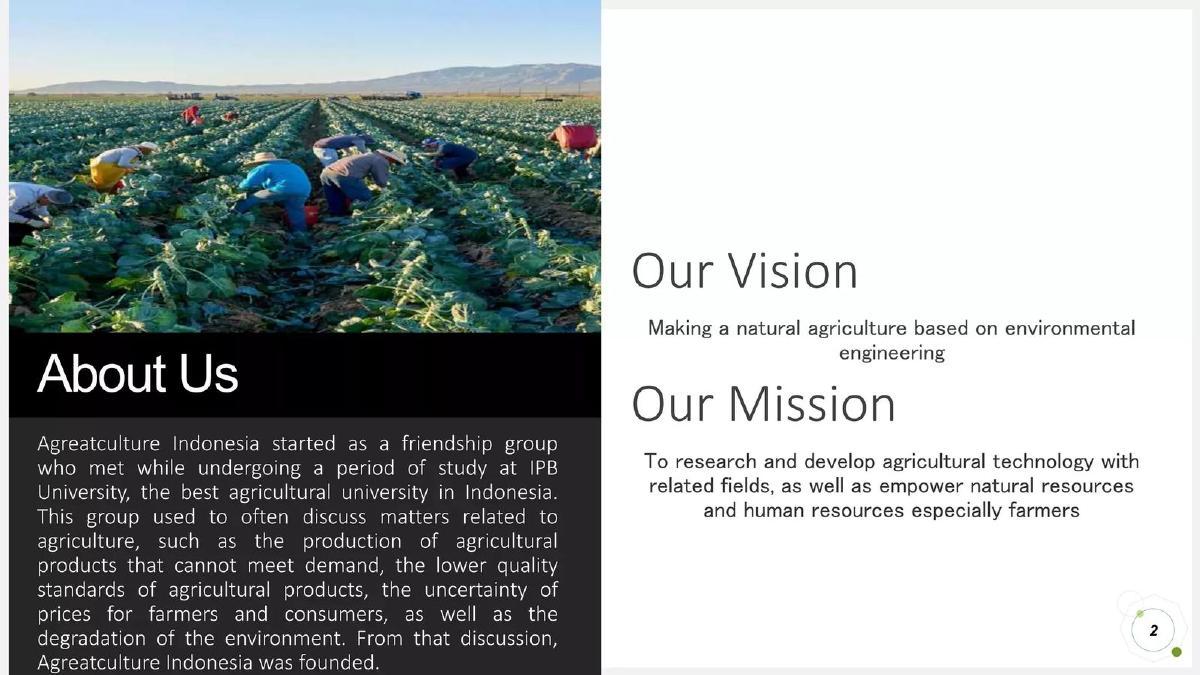
This slide provides the origin story. The founders met at IPB University (Institut Pertanian Bogor), which they claim is the 'best agricultural university in Indonesia.' Their vision is 'Making a natural agriculture based on environmental engineering,' and their mission involves researching agricultural technology and empowering both natural and human resources, specifically farmers. This slide establishes the team's academic pedigree in the field.
Slide 3: Indonesia Agricultural Problems
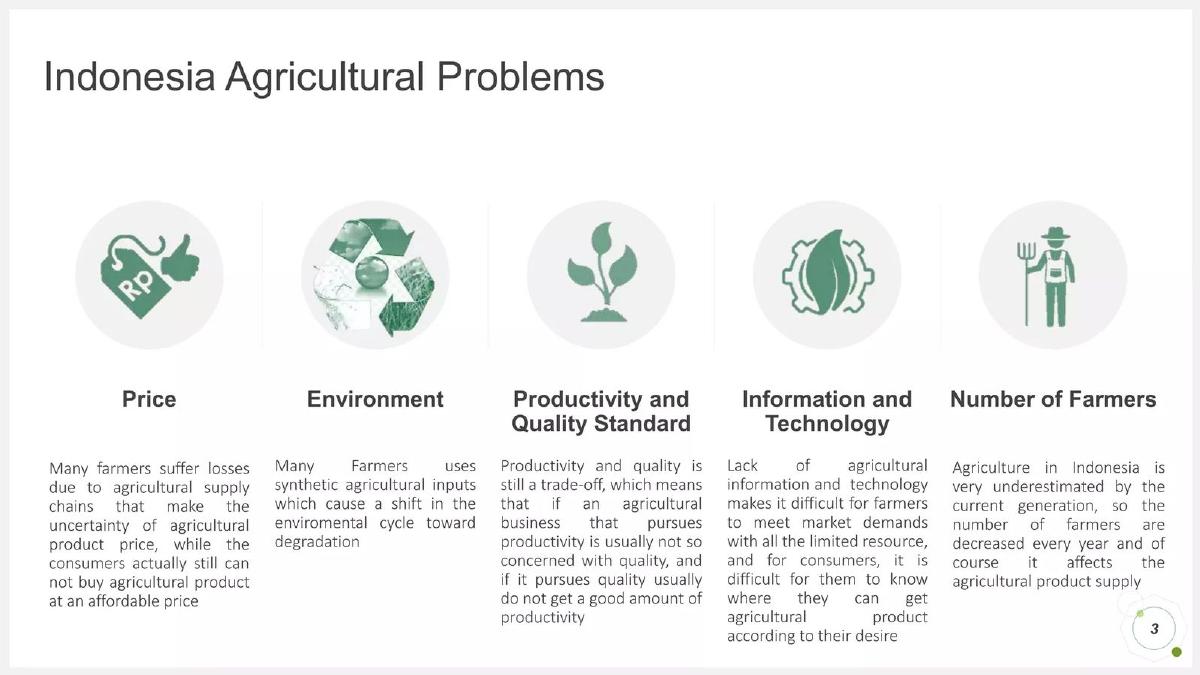
The deck identifies five macro problems: Price (losses due to supply chains), Environment (degradation from synthetic inputs), Productivity and Quality Standard (the trade-off between the two), Information and Technology (lack of data for farmers and consumers), and Number of Farmers (the profession is underestimated by the current generation). This slide sets a broad stage, though it lacks specific data points to quantify these losses at this stage of the deck.
Slide 4: Product Overview
Slide 4 introduces the AGRIN app interface. It highlights four main functions: 1) Information on harvest, irrigation, and fertilizer estimation; 2) Identification of land media, diseases, and pests; 3) A marketplace to 'sell your harvest according to the price you want'; and 4) Technical instructions for using the application. The UI shown is in Indonesian, indicating a local-first market strategy.
Slide 5: Technical Estimation Features
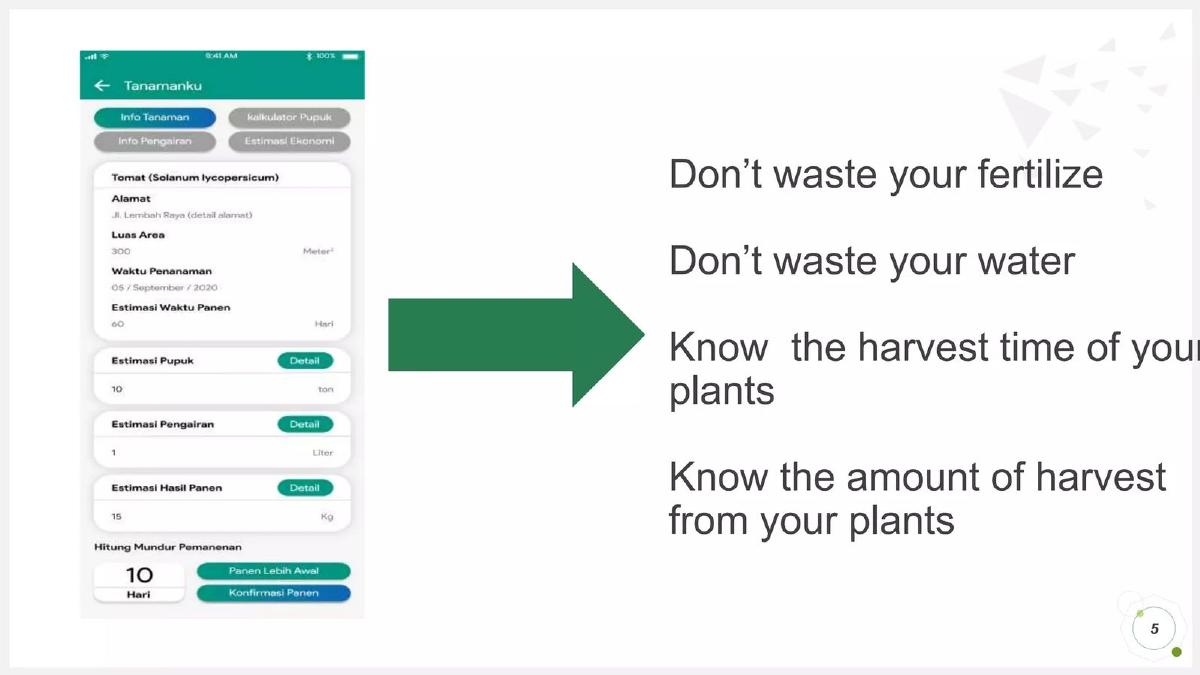
This slide focuses on the 'Don't waste' value proposition. It shows a screen for 'Tomat' (Tomato) cultivation, providing fields for area size, planting time, and estimated harvest time. It claims to help farmers avoid wasting fertilizer and water while knowing exactly when and how much they will harvest. The slide uses a large green arrow to point toward these efficiency gains.
Slide 6: The Marketplace (Pasar Tani)
The marketplace feature is detailed here. It allows farmers to 'Choose your price' and 'Meet and make an agreement in sale and purchase.' The screenshot shows listings with labels like 'Sudah panen' (Already harvested) and 'Sedang ditanam' (Currently planted), suggesting a forward-contracting or pre-sale capability within the app.
Slide 7: Land Identification
Slide 7 showcases the 'Identifikasi Lahan' feature. It appears to use a camera interface to analyze soil or land conditions. The text promises a 'scientific explanation that we present in easy language' regarding soil slope (Kemiringan tanah) and planting media. This represents the 'environmental engineering' aspect of their vision.
Slide 8: Pest and Disease Identification
Similar to the land identification, this slide shows a diagnostic tool for pests (Hama) and diseases (Penyakit). Users can select the type of plant and the symptoms to receive explanatory information and handling instructions. This is a critical utility feature for crop protection.
Slide 9: Market Opportunity
The deck provides two key figures sourced from BPS (Indonesia Central Bureau of Statistics) 2018: 4.5M farmers using the internet and 276K millennial farmers. While these numbers define the 'reachable' market, the deck does not provide a Total Addressable Market (TAM) in dollar terms, focusing instead on user counts.
Slide 10: Competition
This is a comprehensive list of 14 competitors, including notable Indonesian AgTech names like iGrow, Tani Hub, Sayur Box, and PanenID . The slide singles out SIPINDO by SMARTSeeds as the 'best competitor' because it provides a similar end-to-end service from land management to marketplace. Acknowledging such a crowded field is honest, but the deck lacks a clear 'differentiation' matrix to show how AGRIN wins against these established players.
Slide 11: Growth Strategy
The strategy is split into three pillars: Marketing & Sales (SEO, SEM, influencers, and seminars), Product Development (premium features and real-time climate data), and Partnership (working with government and other startups). The mention of 'premium features' is the first hint at a revenue model, though it is not expanded upon.
Slide 12: Timeline
The 'first year action plan' is presented as a linear timeline for 2020 and early 2021. Key milestones include: Company Founded (Jan 2020), Design (March 2020), Trial (April 2020), and First Launch (May 2020). The timeline concludes with 'One Year Feedback' in May 2021. This suggests the deck was likely produced in early to mid-2020.
Slide 13: Seeking for Funding
The 'Ask' is stated as a range: $32K - $63K for a Pre-Seed funding stage. This is a very low capital requirement for a team of nine, suggesting the funds are intended for initial pilot operations or MVP refinement rather than aggressive scaling.
Slide 14: The Team
The team consists of nine members: Denis (CEO), Calvin (Business/Media), Hisam (Agri Specialist/RnD), Haykal (Software/IT), Devi (Secretary/Treasurer), Adjie (Marketing), Karman (Instrument Specialist), Budi (Database Analyst), and Yustan (Software Engineer). The large team size relative to the small funding ask is notable.
Slide 15: Contact Information
The final slide provides contact details for Calvin Natanael Tampubolon, including a phone number, email, and Instagram handle. The background image of a beach is a departure from the agricultural theme of the rest of the deck.
What Agreatculture Does Well
The deck is highly functional and clear about what the product actually does. By showing specific screenshots for land identification, pest management, and the marketplace, the founders move beyond vague 'platform' talk and demonstrate a tangible tool. The identification of a specific 'best competitor' (SIPINDO) shows a level of market awareness that is often missing in early-stage decks. Furthermore, the focus on 'millennial farmers' as a specific sub-segment of the 4.5 million internet-using farmers shows a strategic understanding of who their early adopters will be.
What is Missing from the Deck
The most significant omission is a clear Business Model . While 'premium features' are mentioned in the growth strategy, there is no explanation of how much these features cost, what the marketplace transaction fees are, or how the company intends to reach profitability. There are no Unit Economics or financial projections. Additionally, the Use of Funds is not broken down; an investor seeing a request for $32K-$63K would want to know exactly how that money is split between R&D, marketing, and operations, especially with a nine-person team to support. Finally, the deck lacks Traction Metrics —even if the company was pre-launch at the time of the deck, data from the 'Focus Group & Research' mentioned in the timeline would have strengthened the case.
Founder Takeaways: What to Copy and What to Avoid
Copy the specific problem breakdown: Slide 3 does an excellent job of categorizing the pain points of the industry. Instead of saying 'farming is hard,' they break it down into price, environment, quality, information, and demographics. This allows the solution slides to map directly back to these problems.
Avoid the 'Wall of Competitors' without differentiation: Listing 14 competitors (Slide 10) can actually scare away investors if you don't immediately follow it with a slide showing your 'Unfair Advantage.' Agreatculture identifies the competitors but doesn't explicitly state why a farmer would choose AGRIN over Tani Hub or Sayur Box.
Be specific with your 'Ask': While the range of $32K-$63K is specific, it is better to ask for a single number or a 'up to' amount with a clear milestone attached to it. A range this wide on such a small total amount can signal uncertainty about the actual costs of the business plan.
Include a 'Use of Funds' slide: Never ask for money without showing a pie chart or list of where it goes. With nine people on the team slide, an investor's first thought will be that the $63K won't even cover three months of salaries, let alone marketing and server costs.
Frequently asked questions
- What is the primary problem Agreatculture is trying to solve?
- According to Slide 3, the company addresses five key issues in Indonesian agriculture: price volatility due to supply chain issues, environmental degradation from synthetic inputs, the trade-off between productivity and quality, lack of technical information for farmers, and the declining number of younger people entering the agricultural profession.
- How does the AGRIN app actually help a farmer increase their income?
- Slide 6 explains that the 'Pasar Tani' (Farmer Market) feature allows farmers to sell products at their chosen price and buy from other farmers. Additionally, Slide 5 suggests cost savings by providing estimates for fertilizer and water use, which prevents waste and improves harvest timing.
- What is the size of the investment Agreatculture is looking for?
- Slide 13 states the company is in its pre-seed funding stage and is seeking between $32,000 and $63,000. This is an unusually small and specific range for a tech startup, suggesting a highly localized or lean initial operation.
- Who are the founders and what is their background?
- Slide 2 notes the group met while studying at IPB University, described as the best agricultural university in Indonesia. The team slide (Slide 14) lists nine individuals, led by CEO Denis, with roles covering R&D, IT, and marketing.
- What technical features does the app offer beyond a marketplace?
- Slides 7 and 8 detail 'Identifikasi Lahan' (Land Identification) and 'Identifikasi Hama/Penyakit' (Pest/Disease Identification). These features provide scientific explanations in easy language regarding soil slope, planting media impact, and instructions on how to handle specific agricultural pests.