Agtech Competition Slides: 6 Real Pitch Deck Examples
How farming and agtech startups show competition in a pitch deck: scorecards, feature tables, rival lists and logo walls.
Agtech Competition Slide: Show Where You Fit Among Farm Tech Rivals
Farming startups compete with more than other startups. A farmer can keep doing things by hand, buy from a local trader, ask a government extension officer, hire a drone service once a season, or simply wait and see. Large equipment makers, seed companies and fertiliser suppliers also sell advice and software alongside their products. That makes an agtech competition slide harder than it looks. It has to show investors who the farmer pays today, what the farmer would stop doing, and why the startup can reach farmers that bigger companies already visit. This guide compares six real competition slides from farming and agtech decks in Indonesia, India, Israel and South Africa. They use five different formats: a scorecard, a feature table, a grouped list, short lists with advantages, and a wall of logos. One of them is included as a warning.
TL;DR
Name the options a farmer uses today, including doing nothing or doing it by hand, and say plainly what you do better and what it costs. Sensilize scores itself and five crop-monitoring rivals out of 5 on four measures, but gives one rival 6 out of 5, a mistake readers notice. Agreatculture lists fourteen Indonesian farming apps and names the one it fears most. Farm Bazaar names three Indian supply rivals and lists four advantages. Fundnesia shows five logos with no explanation. Lusabo Group, planning a greenhouse farm in South Africa, lists three farms in Wisconsin as its competitors, which tells investors nothing about its own market.
Agtech competition slides from real pitch decks
Each example shows the exact stored slide above its analysis and links to the full teardown. The slides that explain the company's position come first; weaker ones follow for contrast. Claims are as shown on the slides; comments are ours.
Sensilize competition slide — slide 20
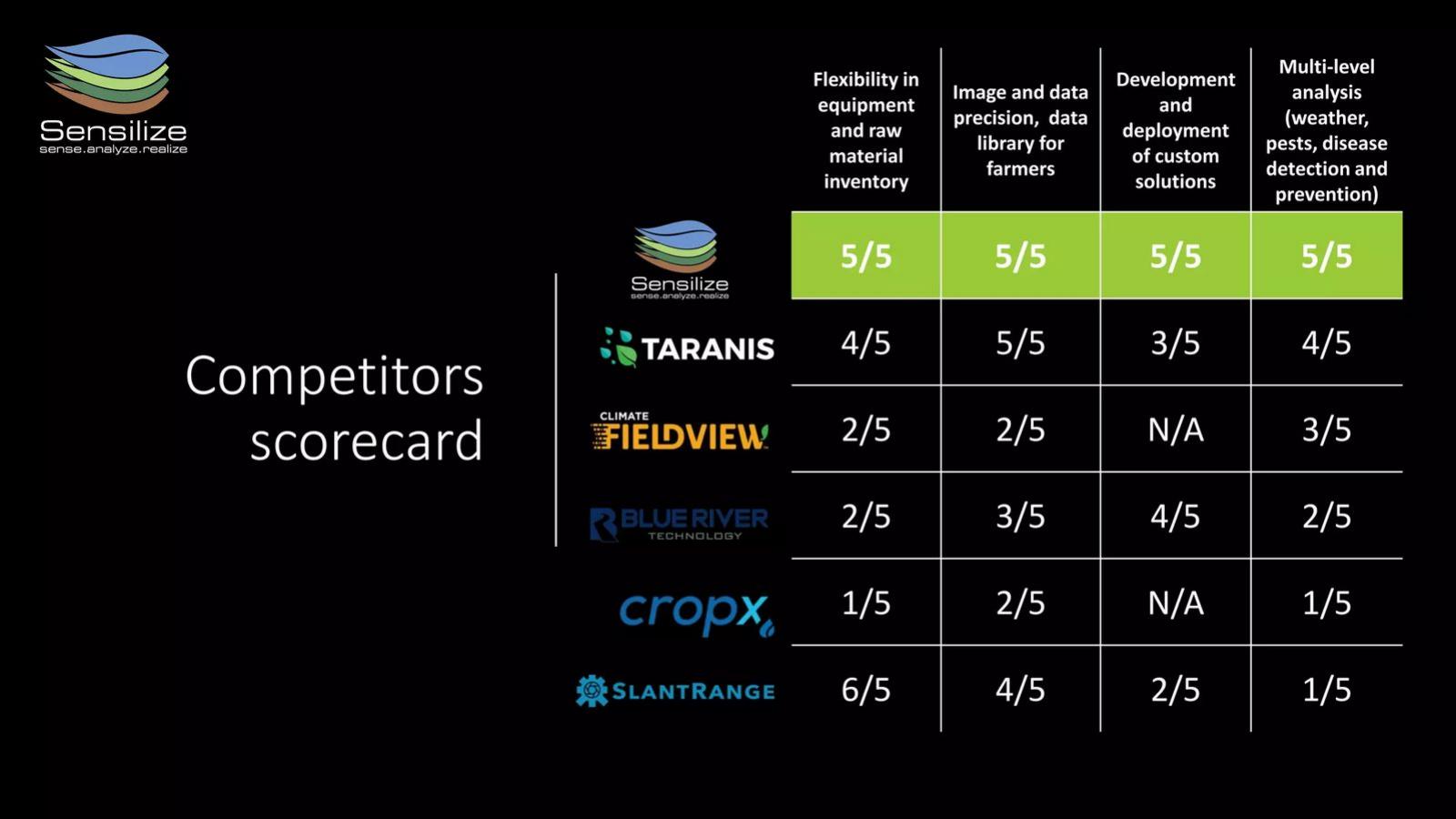
Israeli crop-monitoring company founded in 2013, using drone and satellite images with analysis software. Slide titled "Competitors scorecard".
Sensilize deck, slide 20. Exact stored slide matched to this analysis.
Our analysis: It argues that well-known crop-technology rivals each do well on one or two measures, while Sensilize does well on all four.
Evidence and limitation: Scores are the company's own; no method given. SlantRange's 6/5 on the first measure appears to be an error. Sensilize's site, checked on 2026-10-01, describes a satellite and AI crop platform, and ISRAEL21c covered its drone launch in 2015.
What a founder can adapt: Explain how each score was reached, replace vague measures such as "flexibility" with farmer results, and check every number before sending.
Supporting analysis
What the deck claims: Four measures: "Flexibility in equipment and raw material inventory", "Image and data precision, data library for farmers", "Development and deployment of custom solutions", "Multi-level analysis (weather, pests, disease detection and prevention)". Sensilize scores 5/5 on all four. Taranis 4/5, 5/5, 3/5, 4/5. Climate FieldView 2/5, 2/5, N/A, 3/5. Blue River 2/5, 3/5, 4/5, 2/5. Cropx 1/5, 2/5, N/A, 1/5. SlantRange 6/5, 4/5, 2/5, 1/5.
Presentation choice: The rivals are real and recognisable, and scoring Taranis highly on image precision is more honest than marking every rival low.
When it does not fit: A score above the maximum; once a reader spots 6 out of 5, they doubt the other twenty-three scores too.
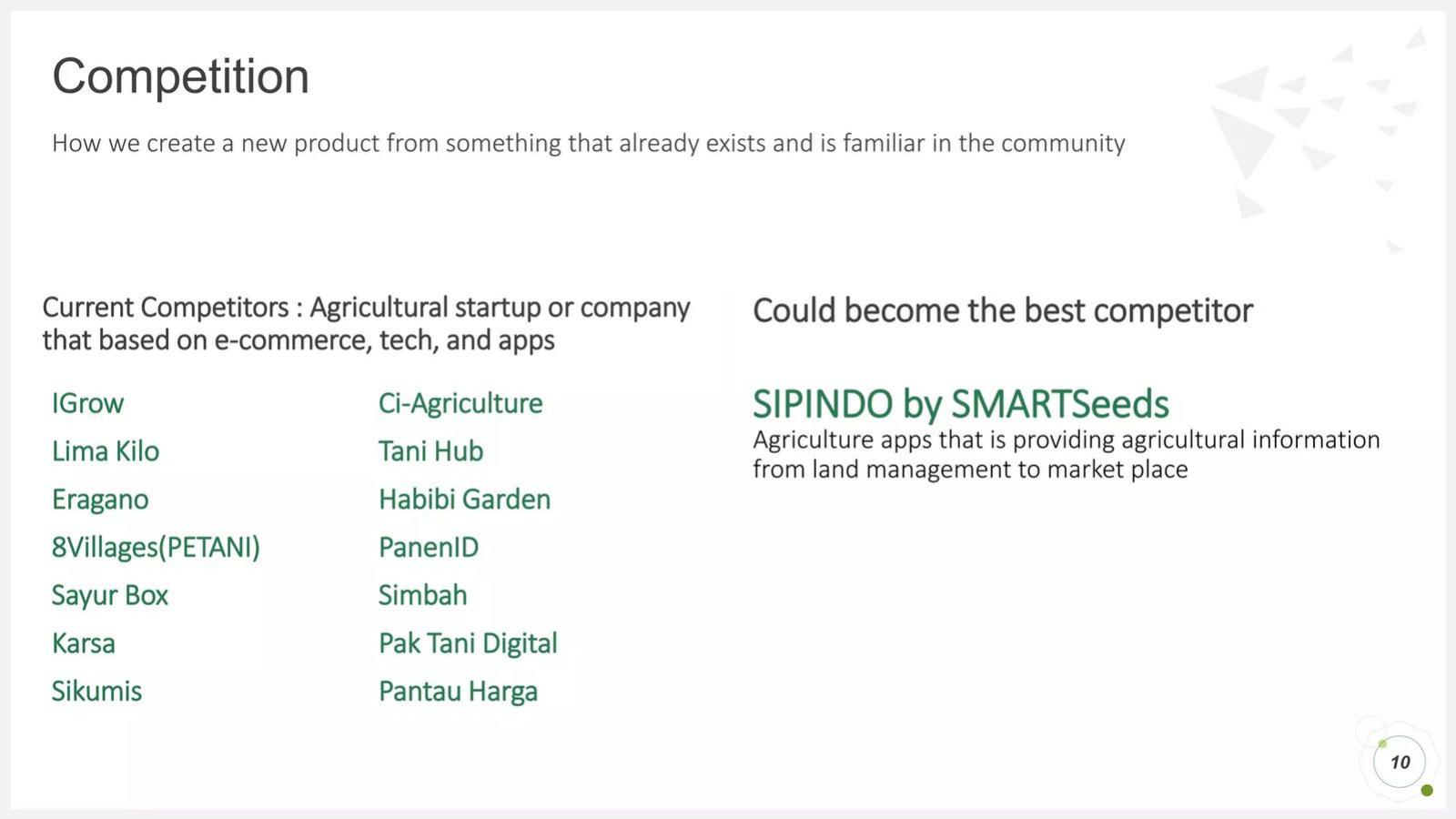
Indonesian farming app built by a university team, seeking a $32K to $63K pre-seed round in 2020. Slide titled "Competition".
Agreatculture (AGRIN) deck, slide 10. Exact stored slide matched to this analysis.
Our analysis: It shows a crowded local market and singles out the one rival whose product most resembles its own.
Evidence and limitation: Names only; no figures or comparison. Outcome unknown; we found no public record after the deck.
What a founder can adapt: Group the fourteen by what they do (marketplace, advice, funding, sensors), and add one line on what AGRIN does that SIPINDO doesn't.
Supporting analysis
What the deck claims: Subtitle: "How we create a new product from something that already exists and is familiar in the community". "Current Competitors: Agricultural startup or company that based on e-commerce, tech, and apps": IGrow, Lima Kilo, Eragano, 8Villages (PETANI), Sayur Box, Karsa, Sikumis, Ci-Agriculture, Tani Hub, Habibi Garden, PanenID, Simbah, Pak Tani Digital, Pantau Harga. "Could become the best competitor: SIPINDO by SMARTSeeds. Agriculture apps that is providing agricultural information from land management to market place".
Presentation choice: Naming fourteen local rivals shows the founders know their market, and picking out the biggest threat is a useful habit many decks skip.
When it does not fit: A long list with no comparison; investors can't tell which rivals matter or how AGRIN differs.
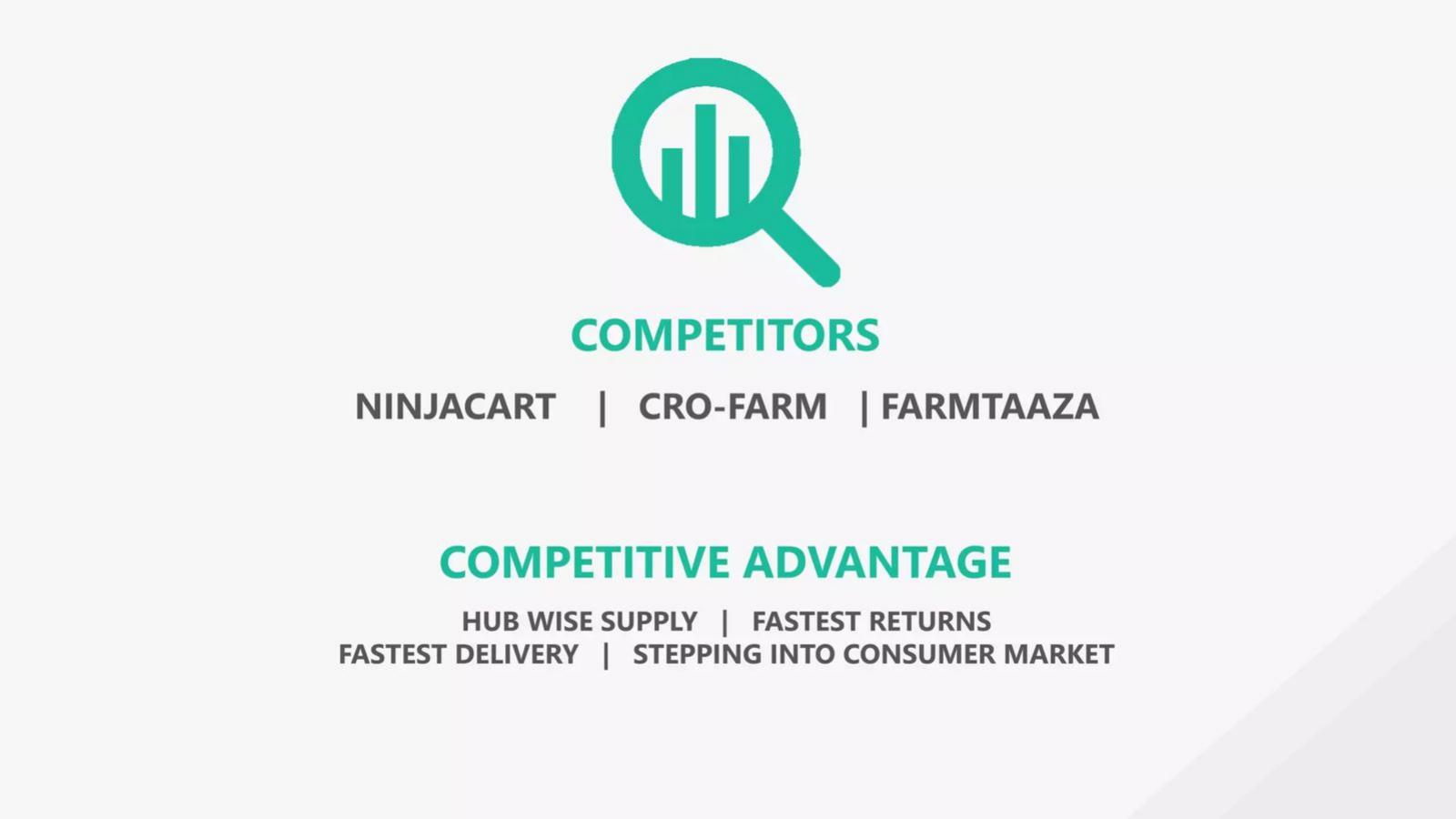
Bangalore company supplying produce from farmers to retailers, 2019 deck. Slide titled "Competitors" with "Competitive Advantage" below.
Farm Bazaar deck, slide 17. Exact stored slide matched to this analysis.
Our analysis: It names three local supply-chain rivals and claims to be faster and closer to retailers through local hubs.
Evidence and limitation: Claimed; no figures for delivery time or returns. Farm Bazaar's site, checked on 2026-10-01, now describes a market-data, trading and finance platform for farmers and mandis.
What a founder can adapt: Put a number on each advantage, such as delivery hours or days to pay farmers, set against Ninjacart's.
Supporting analysis
What the deck claims: "Competitors: Ninjacart | Cro-Farm | FarmTaaza". "Competitive Advantage: Hub wise supply | Fastest returns | Fastest delivery | Stepping into consumer market".
Presentation choice: The rivals are the right ones for a Bangalore produce supplier, and "hub wise supply" hints at a distribution difference investors care about.
When it does not fit: Advantages like "fastest delivery" with no figure; every rival claims the same.
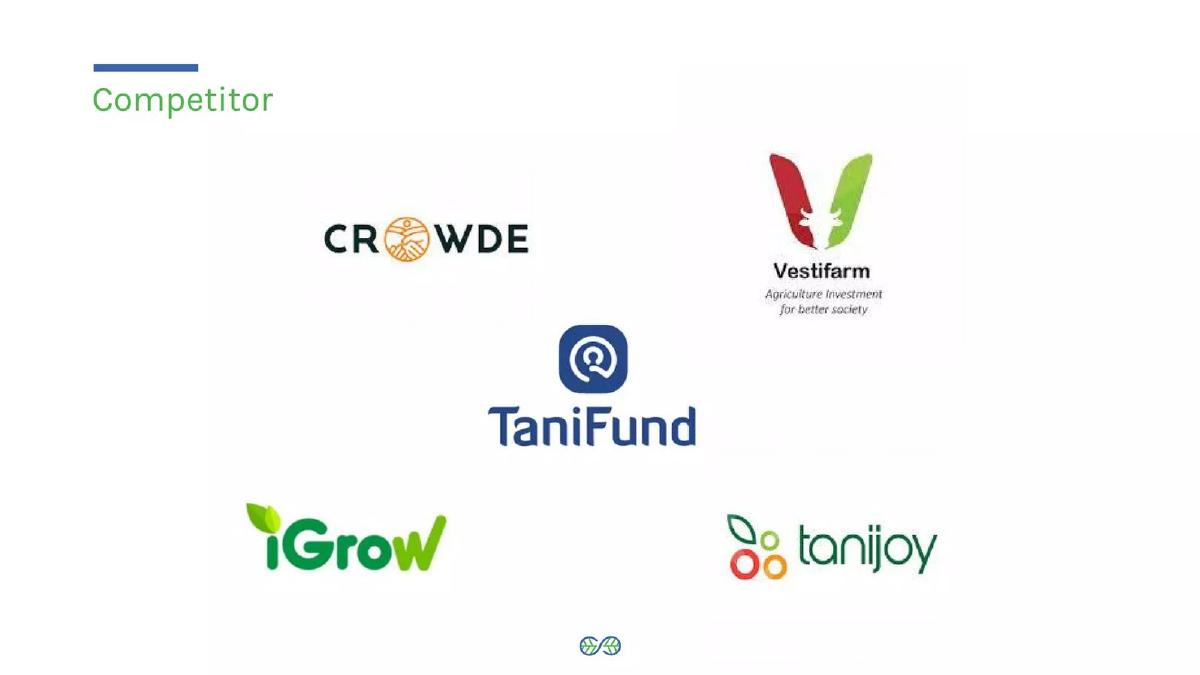
Indonesian platform from around 2018 letting investors fund small farmers. Slide titled "Competitor", a wall of logos.
Fundnesia deck, slide 6. Exact stored slide matched to this analysis.
Our analysis: It shows that the company knows the other Indonesian farm-funding platforms.
Evidence and limitation: Logos only. Two companies with almost the same name appear in public records, and we could not confirm which one made this deck, so we make no claim about its outcome.
What a founder can adapt: Add a short table: minimum investment, returns offered, crops covered and how farmers are chosen, for each platform.
Supporting analysis
What the deck claims: Five logos: Crowde, Vestifarm, TaniFund, iGrow, Tanijoy.
Presentation choice: Shown for contrast: the five rivals are the right ones, but with no comparison a reader learns nothing about how Fundnesia differs.
When it does not fit: A logo wall as the whole competition slide.
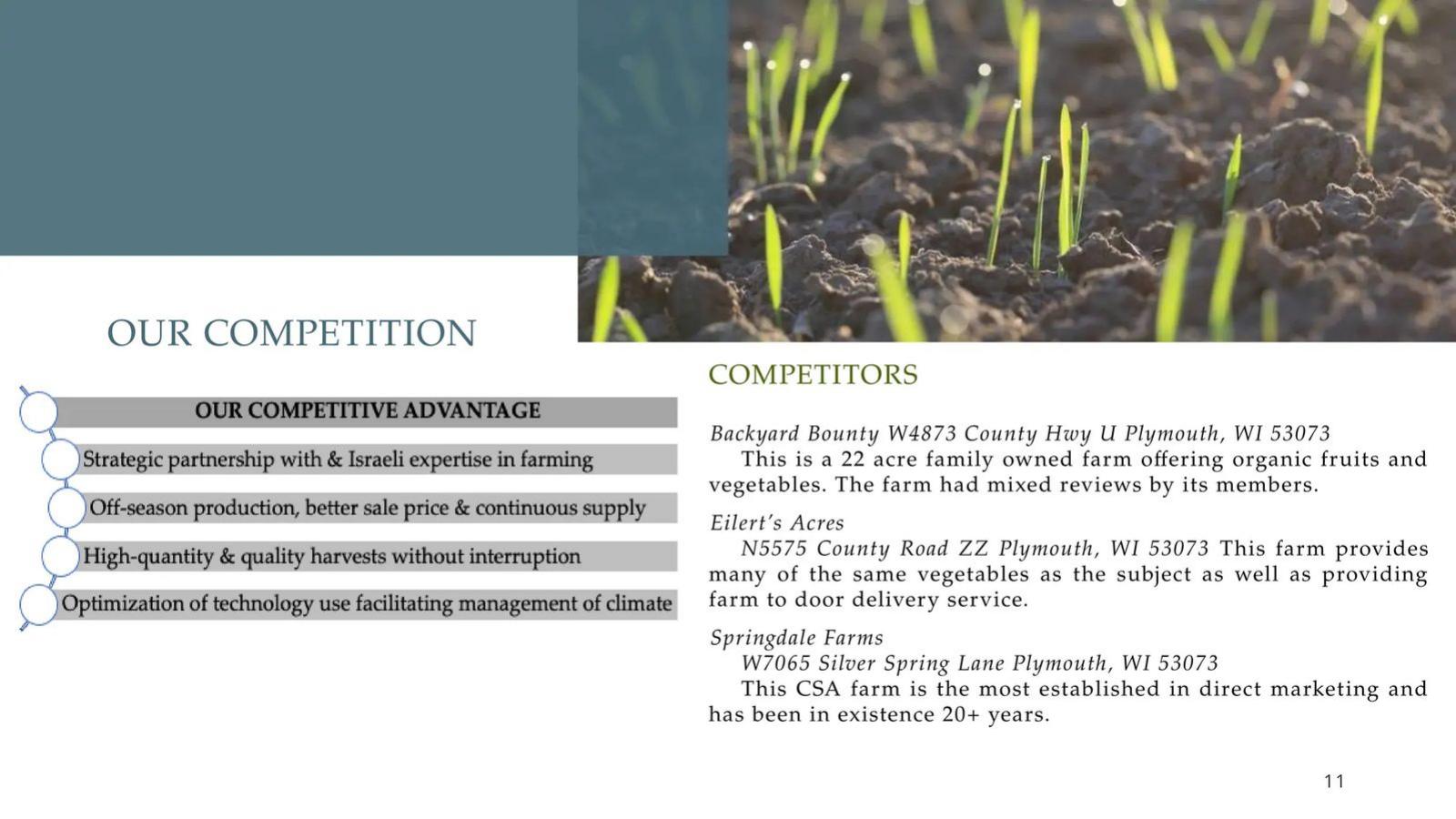
Planned hydroponic greenhouse and shade-net farm in KwaZulu-Natal, South Africa, seeking about $35.4M. Slide titled "Our Competition".
Lusabo Group deck, slide 11. Exact stored slide matched to this analysis.
Our analysis: It lists its advantages and names three farms as competitors.
Evidence and limitation: Claimed; no figures. The listed rivals are small farms in the USA, while the project is in South Africa. Outcome unknown.
What a founder can adapt: Name South African greenhouse growers and the exporters it would compete with in the USA, Canada and the EU, with their scale.
Supporting analysis
What the deck claims: "Our competitive advantage": "Strategic partnership with & Israeli expertise in farming", "Off-season production, better sale price & continuous supply", "High-quantity & quality harvests without interruption", "Optimization of technology use facilitating management of climate". "Competitors": Backyard Bounty, Ellert's Acres and Springdale Farms, each with an address in Plymouth, Wisconsin, and a short description such as "This CSA farm is the most established in direct marketing and has been in existence 20+ years".
Presentation choice: Shown as a warning: the advantages are reasonable, but rivals from another country, apparently copied from elsewhere, make readers question how well the founders know their market.
When it does not fit: Listing rivals that don't operate in your market; it suggests the slide was copied from a template.
Whether each slide names rivals, shows the company's own position, and gives something a reader could check.
Example
Rivals named
Own position shown
Checkable basis
Sensilize
Yes (five)
Yes (scores)
No (self-scored, one error)
Agreatculture
Yes (fifteen)
No
No
Farm Bazaar
Yes (three)
Partly (advantages listed)
No
Fundnesia
Yes (five logos)
No
No
Lusabo Group
Yes (wrong market)
Partly (advantages listed)
No
Key Takeaways
Include manual work and local traders as real alternatives.
Compete on a farmer outcome: yield, water, labour or price.
Name rivals the farmer in your region would recognise.
Check every score and number on the slide before sending.
A logo wall with no comparison tells investors little.
Build your agtech competition slide
Start from what the farmer does today.
Farmer. Who is the farmer: crop, farm size, region, and who decides on purchases?
Today. What do they use now: manual work, a trader, a dealer, an app, a service?
Local rivals. Which companies in your region sell something similar?
Route. How do you reach farmers, and how does that compare with rivals?
Proof. Can you show yield, water, labour or price against the current option, from a real farm?
Copyable framework: Today [farmer] in [region] uses [current option] at a cost of [figure] per [season or acre]. Rivals such as [names] offer [what]. We [difference], and on [number] pilot farms [measure] changed from [figure] to [figure] over [period].
Illustrative example 1 — written by us
Before: Competitors: five logos.
After: Small rice farmers in North Sumatra borrow from traders at high rates before planting. Crowde and TaniFund lend through field agents; we lend against a buyer's purchase agreement, so farmers repay at harvest. In our first season, 40 farmers repaid 38 loans on time.
What improved: Our illustrative rewrite; figures are invented for the example. It names the farmer's current option, says how rivals work, and gives one result a reader could ask about.
What this guide adds
The general competition slide guide covers any kind of business. Agtech adds its own problems. The buyer is often a small farmer with thin margins and little spare cash, so the real rival is frequently the cheapest option, not the best one. Farming is seasonal, so a product may get one chance a year to prove itself. Farmers often rely on a trusted dealer, cooperative or extension officer, which means the route to the farmer can matter more than the features. And the largest companies in farming, such as equipment makers and seed and fertiliser suppliers, already have sales staff in every farming region.
The agtech problem and solution guides cover how these decks describe the farmer's pain and the product. Here we look only at how each deck handles rivals: who it names, how it compares itself, where it places itself and what a reader could check.
How we read each slide
We quote the text on the stored slide images, read at full size. We have not checked any rival's features, prices or performance as shown on the slides. "Claimed" means the company states something on the slide without a source. Where we checked what happened to a company after its deck, we say what we found and where; where we found nothing, we say the outcome is unknown.
These decks span roughly 2015 to 2021. Several rivals have since grown, merged, changed focus or closed, and several of the startups themselves now sell something different from what their decks describe. Readers should judge each slide against its own time and place.
Five formats, and what each one shows
Scorecards (Sensilize) give a quick sense of strengths and weaknesses across rivals, but the founder chooses both the measures and the scores, so they need a stated basis. Feature tables suit a physical product with clear functions, and they work best when one column shows the manual option the farmer uses today. A grouped list (Agreatculture) shows how crowded the market is and can single out the biggest threat. Short lists with advantages (Farm Bazaar, Lusabo Group) are quick to read but rarely tie each advantage to a named rival. A logo wall (Fundnesia) shows that the company knows its rivals and nothing more.
Whichever format you pick, a reader needs three things: who the rivals are, where you sit among them, and what that position is based on. All five slides name rivals. Three show at least part of a position. None gives a basis a reader could test.
The farmer's real alternatives
A useful test for any farm competition slide: does it include the option most farmers actually use today? In much of the world that is manual work, such as switching an irrigation pump on and off by hand. A slide that compares only against other products leaves out the alternative that decides whether a farmer pays. (General guidance; none of the five slides below has a manual-option column.)
The same idea applies to other farm products. A crop-monitoring service competes with a farmer walking the field. A marketplace app competes with the trader who buys at the farm gate and often lends money too. A farm funding platform competes with family loans, cooperatives and government credit schemes. None of the other five slides here names these alternatives, and investors from outside farming may not know them.
Local rivals, not famous ones
Agtech is local. Soil, crops, weather, land sizes, power supply and buying habits change from one region to the next. A rival that matters in Iowa may be irrelevant in Java or Maharashtra. The best slides here name rivals a farmer in the startup's own region would recognise: Agreatculture lists Indonesian apps such as TaniHub, 8Villages and Sayur Box; Farm Bazaar names Indian supply companies Ninjacart, Cro-Farm and FarmTaaza.
Lusabo Group shows the opposite. Its farm is planned for KwaZulu-Natal in South Africa, and it says 95% of produce is for export to the USA, Canada and the EU. Its competition slide lists three small farms in Plymouth, Wisconsin, with their addresses. These look like local American farms that sell to nearby families, not exporters. A reader is left to ask who the company will really compete against, both in South Africa and in the export markets.
Questions investors ask about an agtech competition slide
What does the farmer do today? If the honest answer is "nothing" or "by hand", put that on the slide, with what it costs the farmer.
Why can you reach farmers more cheaply than rivals? Distribution often decides agtech. A partnership with a cooperative, dealer network or government programme can matter more than a feature.
Why won't a big supplier copy you? Equipment, seed and fertiliser companies already visit farmers. Investors want one sentence on why they won't add your service.
Is the comparison accurate? A score above the maximum or rivals from the wrong country undermines everything else on the slide.
Mistakes agtech slides make most often
The most common gap is evidence. None of the five slides gives a price, a yield gain, water saving or labour saving measured against a named rival. A single farm result, such as water used per acre before and after, would make almost every slide here stronger.
The second gap is care. Sensilize scores SlantRange 6 out of 5 on its first measure. Lusabo lists rivals in another country. Fundnesia shows logos without saying how it differs from any of them. Each of these is easy to fix before sending, and each costs credibility when an investor spots it.
The third gap is distribution. Farm Bazaar's "hub wise supply" hints at how it reaches farmers, but no slide compares its route to market with a rival's. In farming, where the cost of reaching a small farmer is high, that comparison is often what investors want most.
Common mistakes
Ignoring manual work. Most farmers' real alternative is doing it by hand.
Rivals from another market. Lusabo lists Wisconsin farms for a South African project.
Scores that don't add up. Sensilize gives one rival 6 out of 5.
Logo walls. Fundnesia names rivals but compares nothing.
Advantages with no numbers. "Fastest delivery" needs hours or days.
Skipping distribution. Say how you reach farmers more cheaply than rivals.
Diagnostic checklist
Names what the farmer uses today, including manual work.
Names rivals in your own region.
Puts your company on the slide.
Compares on a farmer result: yield, water, labour or price.
Includes at least one area where a rival is stronger.
Says how you reach farmers.
Checks every score and figure before sending.
Frequently asked questions
Who should an agtech startup list as competitors?
The options a farmer in your region uses today, including manual work, local traders and dealers, plus companies selling similar products there.
Is a scorecard a good agtech competition slide?
It can be, if you explain how scores were reached and check them. Sensilize's scorecard names strong rivals and gives one a high score, but a 6 out of 5 undermines the rest.
Should I include large companies like equipment or seed makers?
Yes, if they sell something similar to your farmers. Investors will ask why they won't add your feature, so answer that in one sentence.
Can I list rivals from other countries?
Only if they sell in your market or you compete with them for the same buyers. Lusabo Group lists three Wisconsin farms for a South African project, which tells investors nothing about its real rivals.
How we chose these examples
Corpus: published pitch deck teardowns on StartupFundraising.com. Founder-uploaded private decks are excluded.
Selection (2026-10-01; v2 2026-10-05 removed Intech Harness because a page of its deck carries a restriction notice): we searched extracted slide text across the full corpus for competition and competitor wording near farm, crop and agriculture terms. Eight candidates were viewed at full size; six farming and agtech competition slides that no other guide uses were kept.
Not used: McLovin p12 (freeze-dried pet food, and already in the food competition draft); BBGS p17 (crypto mining, no rivals named).
Status checks (2026-10-01): Sensilize's site and ISRAEL21c; Farm Bazaar's site; public company records for Fundnesia. No public outcome was found for Agreatculture, Fundnesia or Lusabo Group.
Review: stored slide text and images were checked on 2026-10-01 against company, deck and slide number (editorial model review). No person has yet completed an editorial review of this page. We make no claim that any slide caused a fundraising outcome.