Food & Beverage Competition Slides: 10 Real Pitch Deck
How food, beverage and farming startups show competition in a pitch deck: compare against the shelf option buyers already pick, give numbers per rival.
Food and Beverage Competition Slide: Compare Against What Buyers Already Pick
Food and beverage buyers rarely lack options: a supermarket brand, a cafe, a cheaper shelf-stable pack, or making it at home. A good competition slide names those real options and shows, in a way a reader can check, why a buyer would switch. This guide compares ten real competition slides from food, beverage, pet food and food delivery decks, from a rivalry table and a positioning map to a slide that claims almost no competition.
TL;DR
Name the options buyers already pick and say where each one wins. Parfait lists yogurt brands, cafes, fast food and DIY with each rival's advantage, its own, and how intense the rivalry is. Once Upon a Farm compares its cold-pressed baby food with an unnamed shelf-stable brand. GrowOn gives a yield figure for itself and two named rivals. Fetch ticks every row against three apps. Nutripride explains in one sentence why each group of rivals misses its buyer, schools. Tomato Sherpa places itself on a two-axis map with reasons. McLovin lists eleven freeze-dried pet food brands but leaves itself out, GoApe scores itself against five delivery apps without saying where the scores come from, Chick-in compares itself with conventional farms, and Samosa King claims "almost nil competition".
Food and beverage competition slides from real pitch decks
Each example shows the exact stored slide above its analysis and links to the full teardown. The most complete comparisons come first; weaker ones follow for contrast. Claims are as shown on the slides; comments are ours.
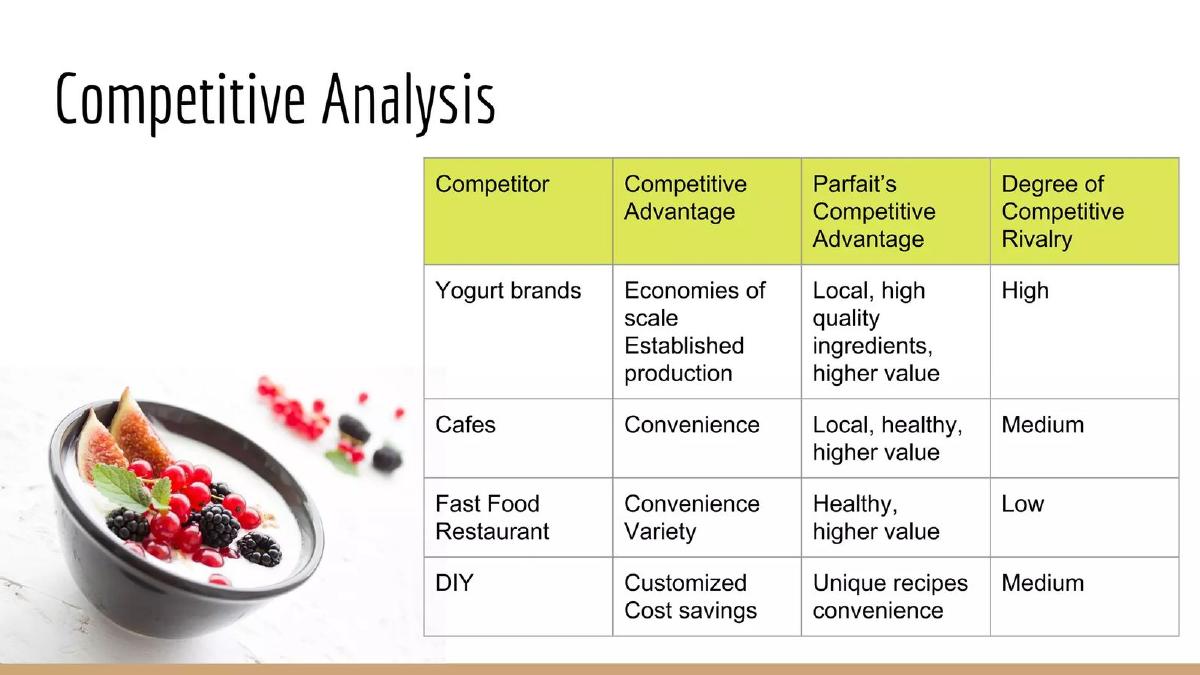
Parfait competition slide — slide 5
Local yogurt parfait brand. Slide titled "Competitive Analysis", shown as a four-column table.
Parfait deck, slide 5. Exact stored slide matched to this analysis.
Our analysis: It covers every way a customer might get a parfait, including making it at home, and says what each option does well.
Evidence and limitation: No brands, prices or figures; the rivalry ratings are the company's own judgement.
What a founder can adapt: Keep the four columns, then name one brand per row and add a price per serving so "higher value" can be checked.
Supporting analysis
What the deck claims: Columns: Competitor, Competitive Advantage, Parfait's Competitive Advantage, Degree of Competitive Rivalry. Yogurt brands: "Economies of scale, Established production" vs "Local, high quality ingredients, higher value"; High. Cafes: "Convenience" vs "Local, healthy, higher value"; Medium. Fast Food Restaurant: "Convenience, Variety" vs "Healthy, higher value"; Low. DIY: "Customized, Cost savings" vs "Unique recipes, convenience"; Medium.
Presentation choice: Admitting that yogurt brands have scale and DIY saves money makes Parfait's claims easier to believe, and the rivalry column shows where the fight is hardest.
When it does not fit: "Higher value" in three rows without a price; it is the claim a buyer will test first.
Refrigerated organic baby food. Slide titled "HPP versus Shelf Stable Mango", with both pouches in one photo.
Once Upon a Farm deck, slide 4. Exact stored slide matched to this analysis.
Our analysis: It compares the same product, 100% mango, made two ways, so the only difference is the process.
Evidence and limitation: No nutrient measurements; the rival brand is not named.
What a founder can adapt: Compare the same item with the option buyers pick today, and add one lab figure, such as vitamin C per serving, with its source.
Supporting analysis
What the deck claims: Once Upon a Farm HPP Baby Food, 100% Mango: "Cold Pressure Pressed; Never Heated; Made from Whole Fruit; Maintains Nutrient Value; Maintains Color; Maintains Flavors, Textures and Aromas." Popular Organic Shelf Stable Baby Food, 100% Mango: "Heat Pasteurized; Cooked Multiple Times; Made from pre-processed Purees; Flavor, Texture, and Nutrient Value are not maintained."
Presentation choice: Parents choose between the pouch in the fridge and the pouch on the shelf; a like-for-like comparison makes that choice concrete.
When it does not fit: Claims such as "nutrient value not maintained" without a test; a rival brand could dispute them.
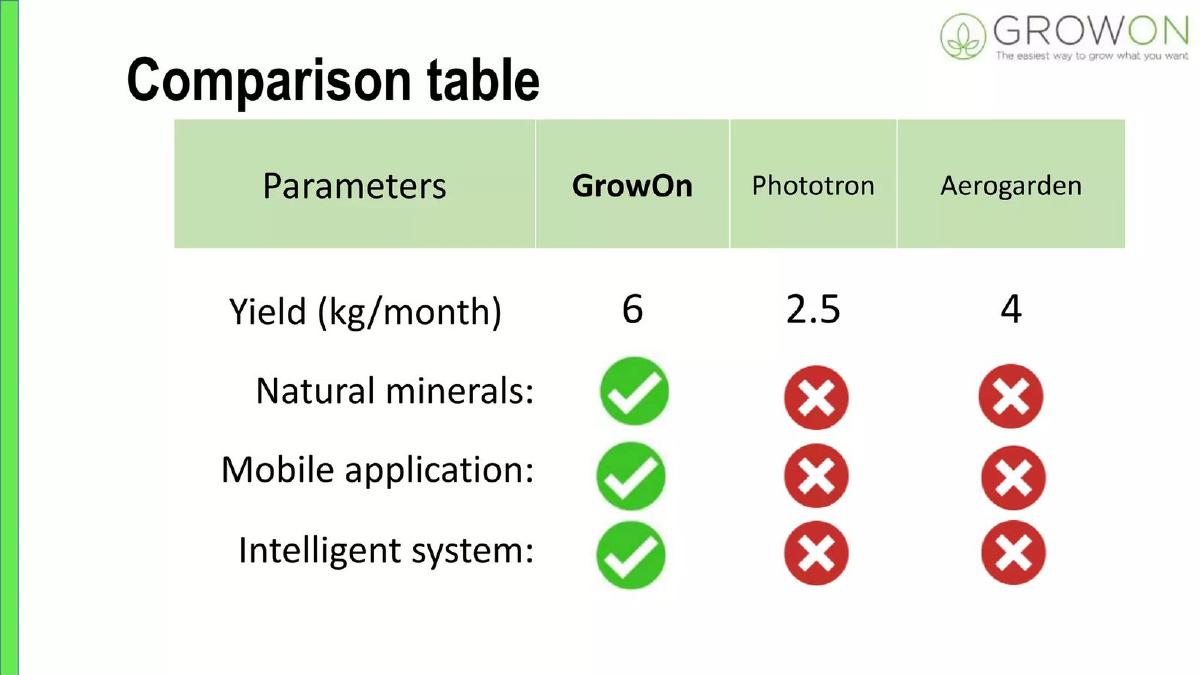
Indoor home growing system for food plants, tagged as food and beverage in our library. Slide titled "Comparison table".
GrowOn deck, slide 5. Exact stored slide matched to this analysis.
Our analysis: It names two real rivals and leads with a number, yield per month, that a buyer can compare.
Evidence and limitation: No source or test conditions for the yield figures; no price for any system.
What a founder can adapt: Keep the yield row, and add how it was measured (plant, space, weeks) and each system's price.
Supporting analysis
What the deck claims: Parameters: GrowOn, Phototron, Aerogarden. Yield (kg/month): 6, 2.5, 4. Natural minerals, Mobile application, Intelligent system: ticked for GrowOn, crossed for both rivals.
Presentation choice: Yield is what a home grower wants; one figure per product says more than a feature list.
When it does not fit: Crossing every rival on every other row; it reads as selective, and Aerogarden has had an app.
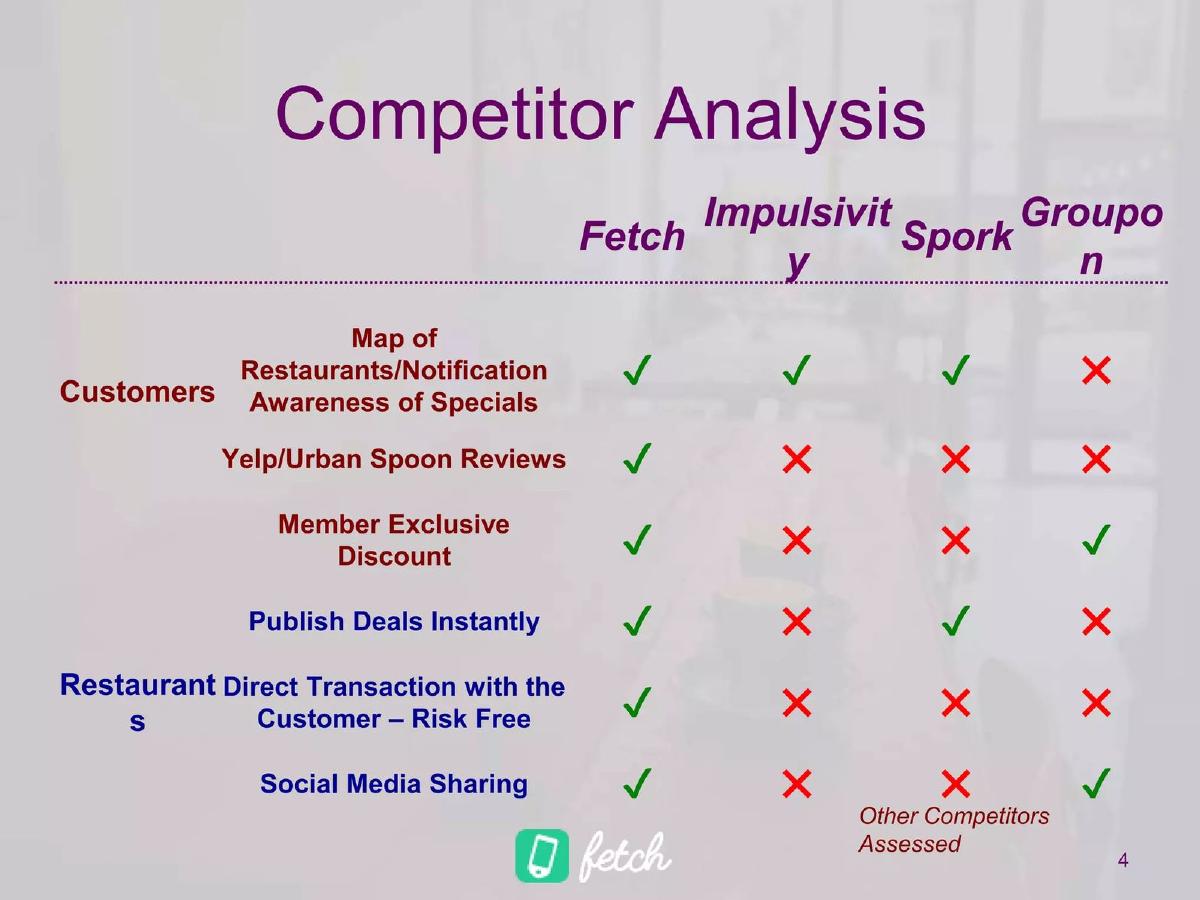
Restaurant deals app for diners and restaurants. Slide titled "Competitor Analysis".
Fetch deck, slide 5. Exact stored slide matched to this analysis.
Our analysis: Splitting rows between diners and restaurants shows it understands both sides of the app.
Evidence and limitation: Ticks are the company's own reading; no date or source.
What a founder can adapt: Keep the two-sided rows, name the other rivals, and add one figure restaurants care about, such as the fee each app takes.
Supporting analysis
What the deck claims: Columns: Fetch, Impulsivity, Spork, Groupon. Customer rows: Map of Restaurants/Notification Awareness of Specials; Yelp/Urban Spoon Reviews; Member Exclusive Discount. Restaurant rows: Publish Deals Instantly; Direct Transaction with the Customer – Risk Free; Social Media Sharing. Fetch ticks all six. "Other Competitors Assessed."
Presentation choice: Shown as a middle example: Groupon ticks two rows and Spork two, which helps, but Fetch ticking every row and "other competitors assessed" without names weakens it.
When it does not fit: A column of all ticks for yourself; a row where a rival wins makes the grid more credible.
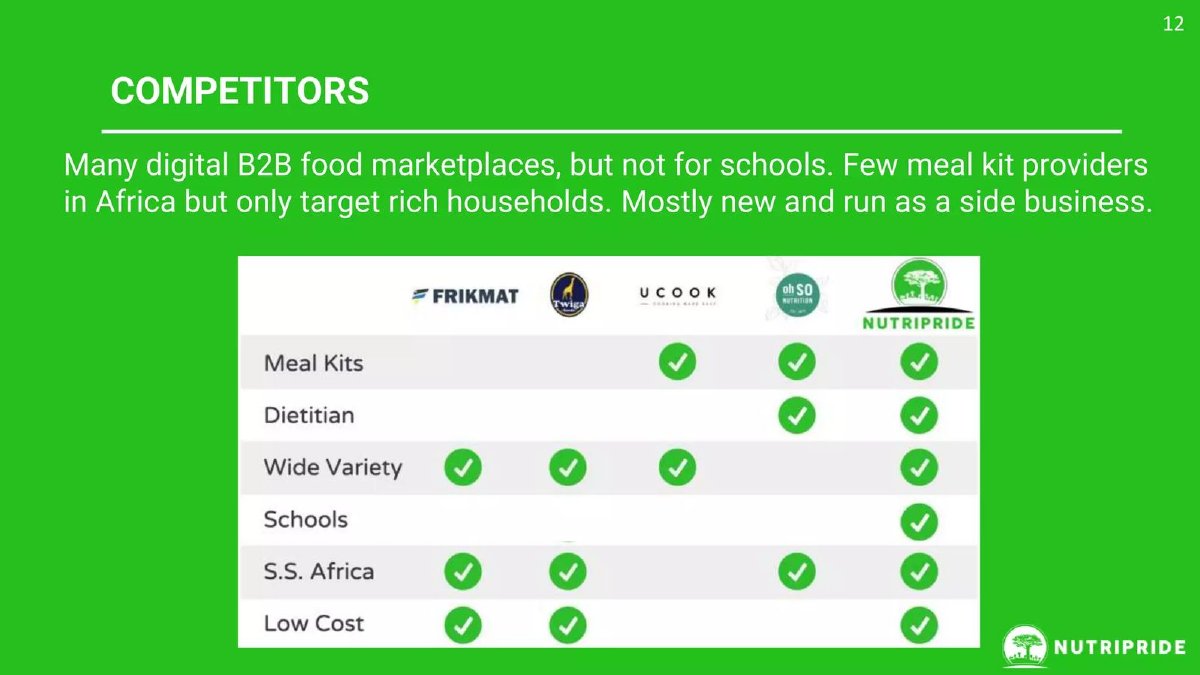
Meal kit and food supply service for schools in Africa. Slide titled "Competitors" (numbered 12 on the slide; page 13 of the deck).
Nutripride deck, slide 13. Exact stored slide matched to this analysis.
Our analysis: The opening sentence does the real work: it groups rivals and says why each group misses Nutripride's buyer.
Evidence and limitation: Claimed. Four rivals are named, so their features can be checked; no prices or customer numbers.
What a founder can adapt: Keep the sentence, then replace "Low Cost" ticks with a price per meal for each rival so the claim can be compared.
Supporting analysis
What the deck claims: "Many digital B2B food marketplaces, but not for schools. Few meal kit providers in Africa but only target rich households. Mostly new and run as a side business." A grid compares Frikmat, Twiga, Ucook, Oh So Nutrition and Nutripride on Meal Kits, Dietitian, Wide Variety, Schools, S.S. Africa and Low Cost. Nutripride ticks all six; Schools is ticked only for Nutripride.
Presentation choice: Naming schools as the buyer nobody serves gives investors a specific claim to test, and the sentence about rich households explains why existing meal kits are not a substitute.
When it does not fit: A grid where only you tick the row that defines your market; it proves the segment exists in your framing, not that schools will buy.
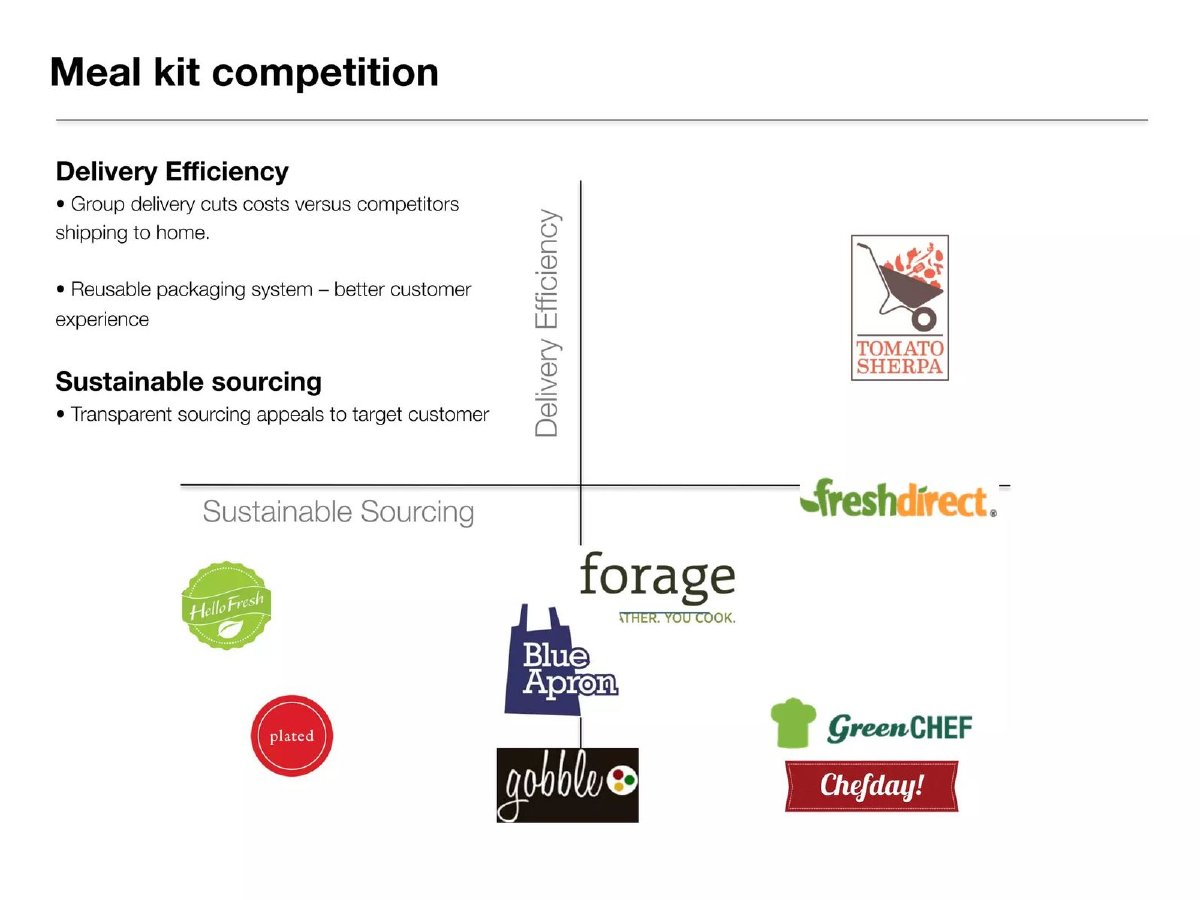
Meal kit service with group delivery. Slide titled "Meal kit competition", shown as a two-axis map.
Tomato Sherpa deck, slide 7. Exact stored slide matched to this analysis.
Our analysis: Unlike most maps, it explains each axis in words, so the reader knows why the company placed itself where it did.
Evidence and limitation: Claimed. Nine rivals named; positions on the map are the company's judgement, with no cost or sourcing figures.
What a founder can adapt: Add one figure per axis, such as delivery cost per box against a home-shipped rival, so the top-right position rests on evidence.
Supporting analysis
What the deck claims: Axes: Delivery Efficiency and Sustainable Sourcing. Tomato Sherpa sits alone at the top right; FreshDirect is high on sourcing near the middle line; HelloFresh, Plated, Blue Apron, Forage, Gobble, Green Chef and Chefday sit lower. Text: "Group delivery cuts costs versus competitors shipping to home." "Reusable packaging system – better customer experience." "Transparent sourcing appeals to target customer."
Presentation choice: Naming every well-known meal kit brand shows the founders know the field, and the delivery-cost reason is specific enough to test.
When it does not fit: Picking axes on which you alone win; investors will ask about price, menu range and scale, where the larger brands are strong.
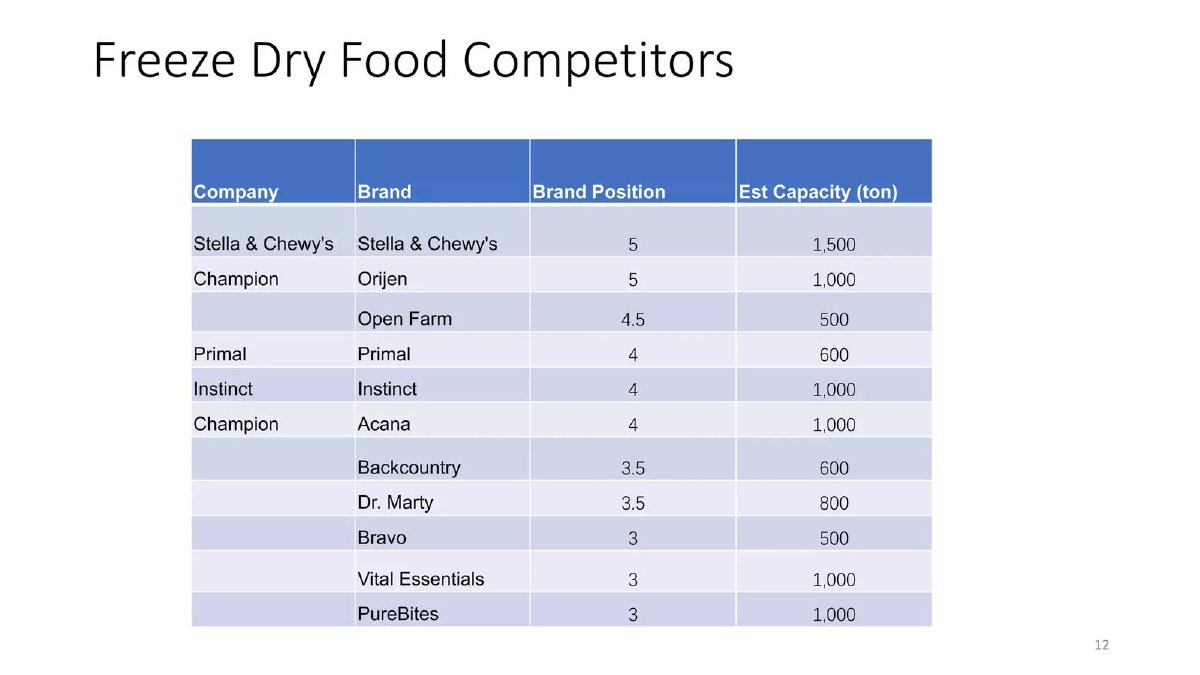
Freeze-dried pet food brand. Slide titled "Freeze Dry Food Competitors", shown as a table.
McLovin deck, slide 12. Exact stored slide matched to this analysis.
Our analysis: It is one of the most thorough rival lists in this guide: eleven named brands with an owner and a size figure for each.
Evidence and limitation: Estimate (the slide labels capacity "Est"). Brand Position has no stated scale or source. McLovin itself does not appear in the table.
What a founder can adapt: Add a McLovin row with planned capacity and price per pound, say what Brand Position means and who scored it, and cite where the capacity estimates come from.
Supporting analysis
What the deck claims: Columns: Company, Brand, Brand Position, Est Capacity (ton). Rows include Stella & Chewy's (5; 1,500), Champion's Orijen (5; 1,000), Open Farm (4.5; 500), Primal (4; 600), Instinct (4; 1,000), Champion's Acana (4; 1,000), down to Bravo, Vital Essentials and PureBites (3 each).
Presentation choice: Shown for contrast. The research is useful, but without a McLovin row a reader cannot see where it would rank, how much it could produce, or what the 3 to 5 position score measures.
When it does not fit: A rival table that leaves you out; the reader's first question is where you fit.
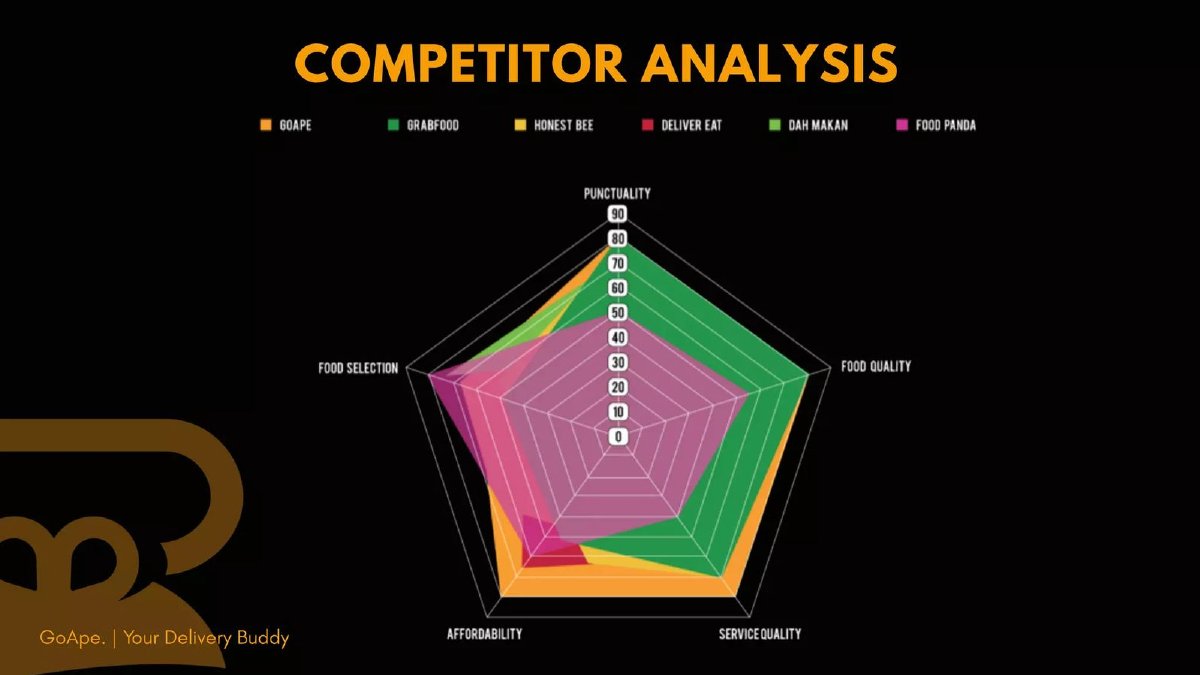
Food delivery app in Malaysia. Slide titled "Competitor Analysis", shown as a radar chart.
GoApe deck, slide 19. Exact stored slide matched to this analysis.
Our analysis: It names the main local delivery apps and the factors buyers care about, which is a good start.
Evidence and limitation: Claimed. No source or method is given for the scores, and the overlapping colours make most rivals hard to read.
What a founder can adapt: Use a simple table with the source of each score, for example average delivery time from test orders or app-store ratings with a date.
Supporting analysis
What the deck claims: Five axes from 0 to 90: Punctuality, Food Quality, Service Quality, Affordability and Food Selection. Six overlapping shapes: GoApe, GrabFood, Honest Bee, Deliver Eat, Dah Makan and Food Panda.
Presentation choice: Shown as a weak example: the scores look measured but have no basis, and the reader cannot tell which shape beats which on each axis.
When it does not fit: Precise-looking scores with no method; investors will treat them as opinion.
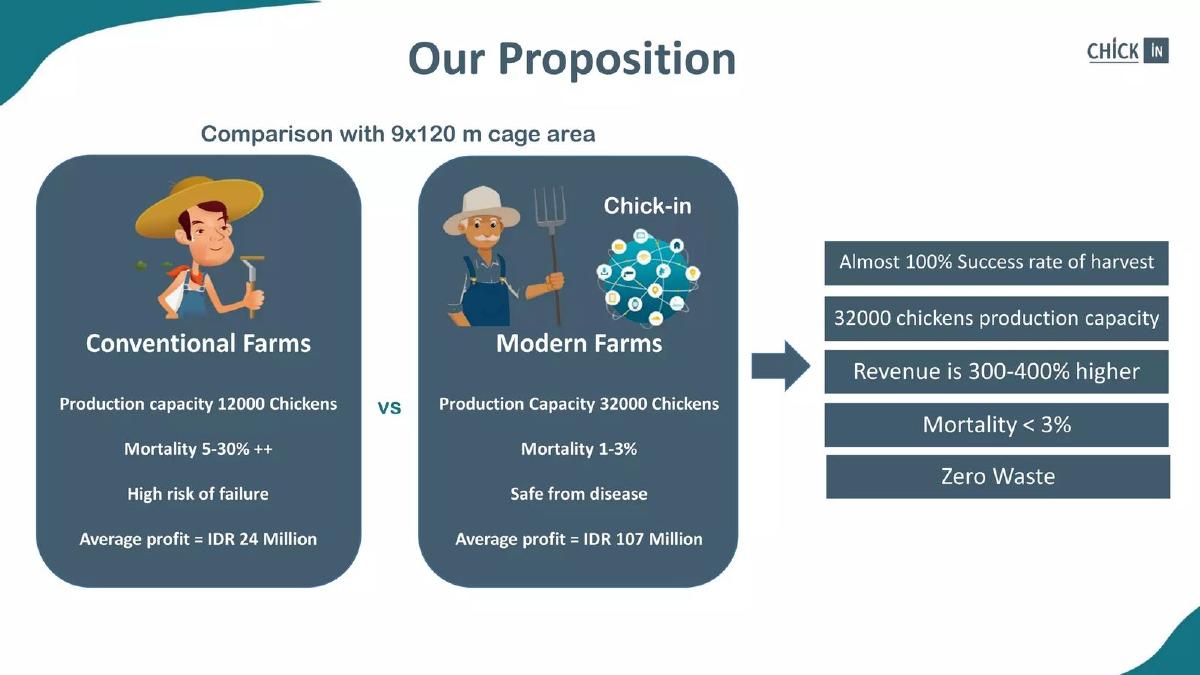
Poultry farm technology, tagged as food and beverage in our library. Slide titled "Our Proposition".
Chick-in deck, slide 6. Exact stored slide matched to this analysis.
Our analysis: It compares against the way farmers work today, using the same shed size, with figures for capacity, mortality and profit.
Evidence and limitation: No source, period or farm count behind the figures.
What a founder can adapt: Keep the same-shed comparison, say which farms and cycles the figures come from, and name the other systems a farmer could buy.
Supporting analysis
What the deck claims: "Comparison with 9x120 m cage area." Conventional Farms: production capacity 12,000 chickens; mortality 5-30%++; high risk of failure; average profit IDR 24 million. Modern Farms (Chick-in): capacity 32,000 chickens; mortality 1-3%; safe from disease; average profit IDR 107 million. "Almost 100% Success rate of harvest", "Revenue is 300-400% higher", "Zero Waste".
Presentation choice: Shown for contrast: the like-for-like shed is a good idea, but no other technology provider is named, and the figures carry no source.
When it does not fit: Stacking claims like "zero waste" and "almost 100%" without evidence.
Samosa franchise starting in Hyderabad. Slide titled "About Samosa King".
Samosa King deck, slide 2. Exact stored slide matched to this analysis.
Our analysis: It sees competition as other samosa-only chains, not every snack shop and street stall selling samosas.
Evidence and limitation: No rivals named; no figures.
What a founder can adapt: Name where customers buy samosas today, with their price, and show what 22 varieties or hygiene standards change for the buyer.
Supporting analysis
What the deck claims: "SAMOSA as the Core Cuisine, SAMOSA KING has limited competition and almost nil competition in Telangana." "We have been able to expertise 22 Varieties of tasty and Hygiene Samosas." Several bullets appear twice.
Presentation choice: Shown as the weakest: samosas are sold widely, so "almost nil competition" invites doubt, and repeated bullets suggest a rushed slide.
When it does not fit: Claiming no competition for a common food; define your category honestly.
Whether each slide names rivals, compares itself with them, and gives something a reader could check.
Example
Rivals named
Own column or head-to-head
Checkable basis
Parfait
Partly (four categories)
Yes (with rivals' strengths)
No
Once Upon a Farm
No (unnamed brand)
Yes (same product)
Partly (process is public)
GrowOn
Yes (two systems)
Yes (yield figures)
Partly (unsourced)
Fetch
Yes (three apps)
Yes (six features)
Partly (features are public)
Nutripride
Yes (four)
Yes (six features)
Partly (features are public)
Tomato Sherpa
Yes (nine)
Yes (map with reasons)
No
McLovin
Yes (eleven)
No (company not in table)
Partly (capacity marked estimated)
GoApe
Yes (five)
Yes (scored chart)
No
Chick-in
No (conventional farms)
Yes (same shed)
No
Samosa King
No
No
No
Key Takeaways
Include home cooking, cafes and store brands, not only startups.
Say what each rival does well; it makes your advantage believable.
One measured figure per rival beats a column of ticks.
Name the brand you compare with, or say why you cannot.
"No competition" tells investors you have not looked.
Build your food competition slide
Start from what your buyer eats, drinks or grows today.
Buyer. Is your customer the shopper, a restaurant, a retailer or a farmer?
Options. Which brands, store labels, cafes or home methods would they use if you did not exist?
Their strength. What does each option do well: price, scale, convenience?
Proof. Can you show a price per serving, a lab result, a taste test or a yield figure with a source?
Where you lose. Where is a big brand or private label ahead, and why will buyers still switch?
Copyable framework: Buyers today pick [option A] ([price/strength]) or [option B] ([price/strength]). We offer [our price] plus [measured difference]. Source: [test or data], [date].
Illustrative example 1 — written by us
Before: Limited competition and almost nil competition in our region.
After: Customers buy samosas from street stalls (about 15 rupees) and sweet shops (about 25). Our 22 varieties sell at 30, in sealed, freshly fried portions; 40% of trial customers returned within a week.
What improved: Our illustrative rewrite; figures are invented for the example. It names the real alternatives, prices them, and backs the claim with a return rate.
What this guide adds
The general competition slide guide covers any business. Food adds a specific problem: rivals include big brands with scale, cheap private labels and simply making it at home. The strongest slides here admit what those options do well, such as scale, price or convenience.
The food problem, solution, product, market and traction guides cover other slides from similar decks. Here we look only at how each deck handles rivals.
How we read each slide
We quote the text on the stored slide images. We have not checked any yield, mortality, profit, capacity, score or product claim, or any rival's features. Labels: "claimed" means stated by the company without a source on the slide; "estimate" means the slide itself marks the figure as estimated.
Tables, maps and charts: which format helps
The ten slides use four formats. Tables of words (Parfait) explain trade-offs. Tick grids (Fetch, Nutripride) are quick to read but only as fair as the rows chosen. Positioning maps (Tomato Sherpa) show a gap in one glance but depend on axes the founder picked. Charts with scores (GoApe) look precise, yet nobody can check a score of 80 out of 90 without knowing who gave it.
Whatever the format, the reader needs three things: who the rivals are, where the company sits among them, and what the comparison is based on. McLovin gives a careful rival list but omits the second; GoApe gives a chart but omits the third.
Questions investors ask about a food competition slide
Where does the company sit? A list of rivals with no row for the company leaves the reader to guess its position, price and size.
Who chose the rows and axes? If the company wins every row or sits alone in the best corner, investors will ask what was left out, such as price, scale or delivery range.
What are the numbers based on? Scores, capacities and ratings need a source: a survey, a market report, a store audit or the founders' own estimate, stated as such.
Is the target buyer different? Nutripride's sentence that rivals do not serve schools is the kind of claim investors can test by calling a few schools.
Common mistakes
Forgetting home and store brands. Making it yourself and private labels are often the biggest rivals.
Ticking every row. A grid where you win everything looks selective.
Unnamed rivals. "A popular brand" is hard to check; name it or explain why not.
Numbers without a source. Yield, mortality and profit figures need a test or farm record behind them.
Leaving yourself off. McLovin lists eleven rivals with no row for itself.
Scores with no method. GoApe rates six apps from 0 to 90 without saying how.
"No competition". For common foods, it signals that the market has not been studied.
Diagnostic checklist
Names the options buyers pick today, including home and store brands.
Says what each rival does well.
Includes one measured figure per rival, with a source.
Compares like with like (same product, same shed, same serving).
Admits where a bigger brand is ahead.
Puts your own company on the slide, in the same terms as rivals.
States who chose any scores, positions or axes, and on what basis.
Frequently asked questions
Who should a food or beverage startup list as competitors?
Every option buyers use today, including big brands, private labels, cafes and making it at home. Parfait lists yogurt brands, cafes, fast food and DIY.
How can a small food brand compare itself with a big one?
Compare the same product made two ways, or one measured figure per rival. Once Upon a Farm compares 100% mango pouches, and GrowOn compares yield per month with two named systems.
Should a food startup use a positioning map or a table?
Either works if it shows where you sit and why. Tomato Sherpa explains both axes in words; GoApe's scored chart gives no basis for its numbers and is hard to read.
Is it good to say a food business has no competition?
Rarely. Samosa King claims "almost nil competition" for samosas, which are sold widely; naming where customers buy today is more convincing.
How we chose these examples
Update (2026-10-01): added Nutripride p13, Tomato Sherpa p7, McLovin p12 and GoApe p19 after searching the full slide corpus for competition wording near food, meal, restaurant, grocery, snack and beverage terms. Not used: Eziban p12 (names three delivery apps with no comparison), Blackpepper p8 (a restaurant-review app already used in other food guides), CaddySnack p15 (used in another guide), Better Choice p9 and Celsius p4 (publicly listed companies), and market or problem slides that only mention competition in passing.
Corpus: published pitch deck teardowns on StartupFundraising.com. Founder-uploaded private decks are excluded.
Selection (2026-09-27): we searched extracted slide text in decks tagged food and beverage for competition, competitors, competitive analysis, comparison, alternatives, differentiation and "vs". About 35 slides matched; most were market, problem or product slides.
Kept six with stored slide images in the first version. Excluded: slides already used in other guides (Crowdfunding p6, Smalls p5 and p6, Brunch Box p6), Chobani p6 (a performance review in an investor-meeting deck marked confidential, not a positioning slide), Cosimo Drinks p3 (press headlines), and slides without stored images (no new uploads requested).
GrowOn (a home growing system) and Chick-in (poultry farm technology) are tagged food and beverage in our library, and the guide says so.
Review: stored slide text and images were checked on 2026-09-27 (first six) and 2026-10-01 (four added) and matched to company, deck and slide number (editorial model review). No person has yet completed an editorial review of this page. We make no claim that any slide caused a fundraising outcome.