GrowOn’s 2014 pitch deck outlines a vision for a fully automated, app-controlled indoor growing system. The company positions itself as a high-yield alternative to established players like Aerogarden, claiming a production rate of 6 kg per month. At the time of the pitch, the startup was transitioning from a large-scale 'proof of concept' prototype to a refined market-ready industrial design. The deck seeks a modest 50,000 Euro investment to fund final design testing, prototype development, and a Kickstarter launch. While the deck is lean on financial projections and market sizing, it provide…
Key takeaways
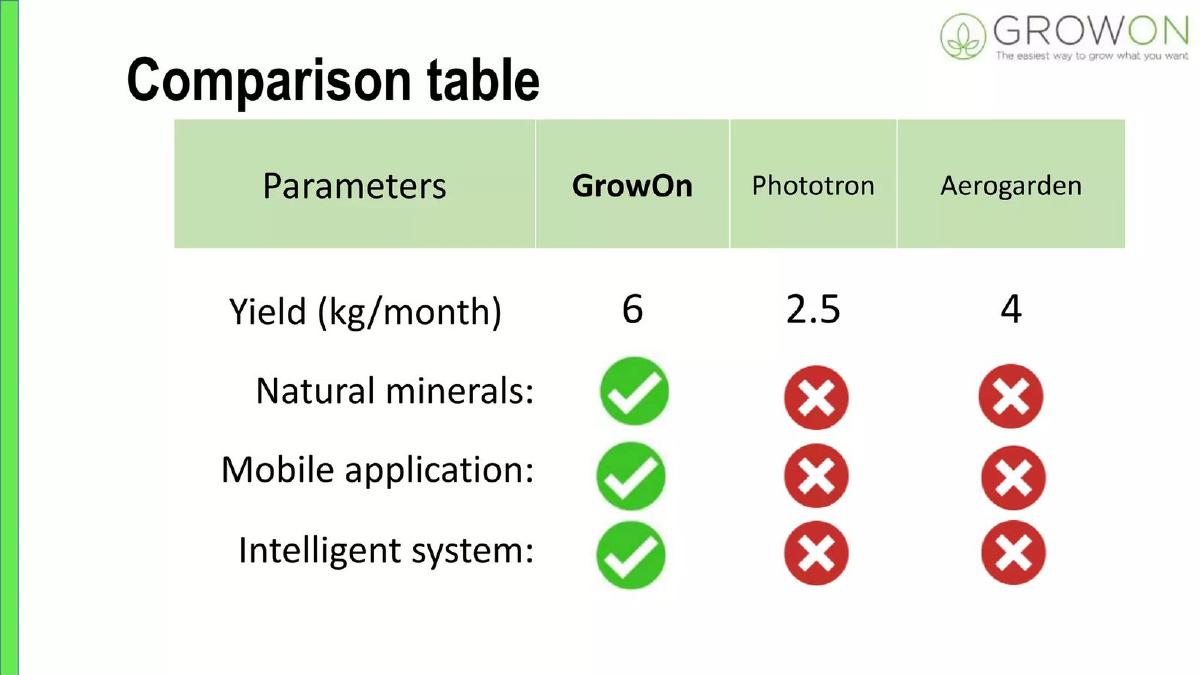
- The system is designed for high efficiency, claiming a yield of 6 kg per month, which exceeds competitors Phototron (2.5 kg) and Aerogarden (4 kg) as shown on slide 3.
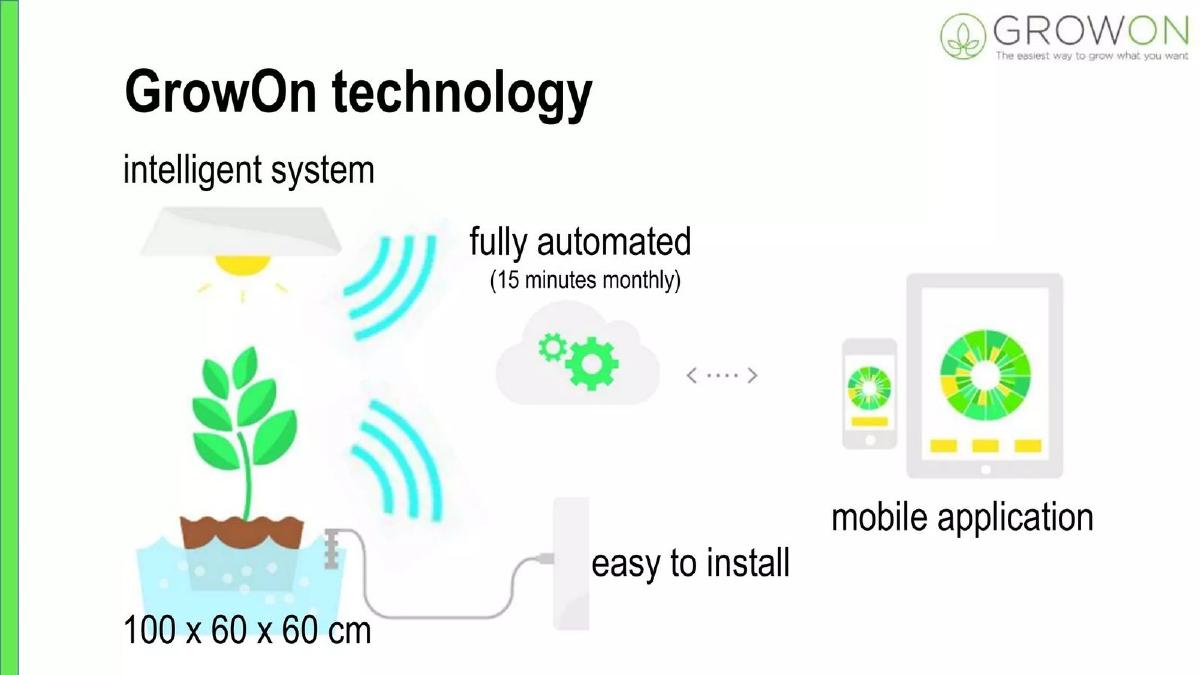
- Automation is a core selling point, with the deck stating the system requires only 15 minutes of monthly maintenance on slide 2.
- The physical footprint of the device is specified as 100 x 60 x 60 cm on slide 2.
- The company is in the early prototype phase, moving from a large cabinet-style 'proof of concept' to a sleek 'market prototype' as illustrated on slide 4.
- The investment ask is 50,000 Euro, specifically earmarked for industrial design, testing, and a Kickstarter campaign on slide 5.
- GrowOn differentiates itself through the use of 'natural minerals' and an 'intelligent system' that competitors allegedly lack, according to the comparison table on slide 3.
- The deck omits critical business data including market size (TAM/SAM/SOM), revenue models, team biographies, and unit economics.
- The contact information on slide 6 points to a Latvian origin, indicated by the +371 country code.
Executive Summary: The Automated Home Garden
GrowOn’s 2014 pitch deck is a classic example of a pre-seed hardware presentation. It focuses heavily on the 'what' and the 'how' of the technology while remaining largely silent on the 'who' and the 'how much.' The company aims to solve the friction of home gardening by introducing a 'fully automated' system that promises high yields with minimal human intervention. With a modest ask of 50,000 Euro, the deck is clearly positioned as a bridge to a crowdfunding campaign rather than a traditional venture capital round.
Slide 1: Title and Branding
The cover slide introduces the GrowOn logo—a stylized green leaf inside a circle—and the tagline: "The easiest way to grow what you want." The branding is clean and minimalist, signaling a consumer-facing product. A small logo in the bottom right corner indicates the company was "Born in Commercialization Reactor," a technology commercialization platform. This suggests the startup may have originated from a research or incubator environment rather than a purely independent venture.
Slide 2: Technology and Automation
Slide 2, titled "GrowOn technology," breaks down the system's components. The slide identifies the product as an "intelligent system" that is "fully automated," specifically claiming it requires only "15 minutes monthly" of the user's time. The visual diagram shows a plant in a water-based medium (suggesting hydroponics), sensors, a cloud-based control system, and a "mobile application." Crucially, the slide provides the physical dimensions of the unit: "100 x 60 x 60 cm." This is a substantial piece of furniture, roughly the size of a small refrigerator, which places it in a different category than small countertop herb gardens.
Slide 3: Competitive Landscape
The "Comparison table" on slide 3 is the deck's primary attempt at establishing a value proposition. GrowOn compares itself against two established brands: Phototron and Aerogarden . The metrics are specific:
Yield (kg/month): GrowOn claims 6 kg , while Phototron is listed at 2.5 kg and Aerogarden at 4 kg . · Natural minerals: GrowOn marks this with a check, while competitors receive an 'X'. · Mobile application: GrowOn claims to be the only one with an app. · Intelligent system: Again, GrowOn claims exclusivity here.
While these claims are bold, the deck does not provide the source for the competitor data or define what constitutes an 'intelligent system' versus the automated timers used by competitors.
Slide 4: Development Progress
Slide 4, "Current position," provides a transparent look at the hardware's evolution. On the left is a photo of a "Proof of concept prototype," which looks like a large, industrial metal locker with a small screen at the bottom. On the right, the deck shows 3D CAD renders for "Market prototype full drawings" and "Industrial design development." The renders show a much more attractive, transparent cylindrical or rectangular unit with integrated lighting and plants. This slide is vital for hardware investors as it shows the team has moved past the theoretical phase and is now focused on manufacturability and aesthetics.
Slide 5: The Ask
The "Investment" slide is straightforward. The company is seeking "50,000 €." The use of funds is categorized into three areas:
Industrial design development and testing. · Market prototype development. · Kickstarter campaign.
The inclusion of a Kickstarter campaign as a primary goal for the funding suggests that the founders view crowdfunding as their primary go-to-market strategy and a way to validate demand before seeking larger institutional checks.
Slide 6: Contact Information
The final slide provides contact details for Pavels Zagrebins . The email address uses a custom domain (growon.co), and the phone number begins with the +371 country code, identifying the startup as being based in Latvia . Social media handles for Facebook (/GrowOn) and Twitter (@Getgrowon) are also included, though the deck does not mention any existing following or community engagement.
What Works in This Deck
Specific Technical Metrics: By providing the exact dimensions (100x60x60 cm) and a specific yield (6 kg/month), the founders give investors something concrete to evaluate. Many hardware decks remain too vague about the physical reality of the product.
Honest Prototype Progression: Showing the 'ugly' proof-of-concept prototype alongside the 'pretty' renders builds credibility. It proves that the technology actually works in a physical form, even if the final enclosure isn't finished yet.
Focused Use of Funds: The ask is small and the goals are highly specific. 50,000 Euro is a realistic amount to get a hardware product through the industrial design phase and into a Kickstarter launch.
What Is Missing
The Team: This is the most significant omission. In a pre-seed hardware play, the technical capability of the founders is everything. There is no mention of who is building the sensors, who is designing the app, or who has experience in manufacturing.
Market Size: The deck assumes the reader agrees that home growing is a large and growing market. There is no data on the 'urban farming' trend, the 'organic food' market, or the specific segment of consumers likely to spend money on a large indoor appliance.
Business Model: How much will the unit cost? Is there a recurring revenue component (e.g., selling seed pods or nutrient solutions)? Without a price point, the '6 kg/month' yield metric lacks financial context.
Unit Economics: For hardware, investors need to see an estimated Bill of Materials (BOM). If the unit costs 1,000 Euro to build but only sells for 500 Euro, the business is not viable. This deck offers no insight into production costs.
Founder Takeaways
Use Comparison Tables Wisely: GrowOn’s comparison table is effective because it uses a quantifiable metric (kg/month) rather than just subjective features. If you are going to use a 'check-mark' table, ensure at least one row is a hard number that proves your technical superiority.
Define Your 'Automation': GrowOn claims '15 minutes monthly.' This is a powerful hook for a busy consumer. If your product saves time, quantify exactly how much time is saved compared to the status quo.
Hardware Needs a Path to Market: Linking the investment to a Kickstarter campaign is a smart move for early-stage hardware. It tells the investor that you have a plan to get to 'revenue' and 'market validation' without needing millions of dollars in venture capital first.
Don't Forget the People: Never leave out a team slide. Even if you are a solo founder, list your advisors or the 'Commercialization Reactor' mentors to show that there is human capital behind the CAD drawings.
Frequently asked questions
- What is the primary product GrowOn is developing?
- GrowOn is developing an automated indoor hydroponic or aeroponic growing system. According to slide 2, the 'intelligent system' is fully automated, requiring only 15 minutes of monthly attention from the user. It integrates with a mobile application to monitor growth and manage the environment within a 100 x 60 x 60 cm enclosure.
- How does GrowOn compare to existing competitors like Aerogarden?
- GrowOn claims significant advantages in yield and technology. Slide 3 features a comparison table showing GrowOn produces 6 kg/month, compared to Aerogarden’s 4 kg/month and Phototron’s 2.5 kg/month. Additionally, GrowOn claims to be the only one among the three to offer a mobile application, an intelligent system, and the use of natural minerals.
- What is the current stage of the product's development?
- As of the deck's publication, the product was in the transition from functional prototype to industrial design. Slide 4 shows a 'Proof of concept prototype' which appears to be a large metal cabinet, alongside 3D renders for a 'Market prototype' that is significantly more aesthetic and consumer-friendly.
- What are the specific funding requirements and intended uses?
- The startup is seeking 50,000 Euro. Slide 5 details that these funds will be used for three specific milestones: industrial design development and testing, the creation of the market-ready prototype, and the preparation/execution of a Kickstarter campaign to generate initial sales and validation.
- What essential information is missing from this pitch deck?
- The deck is missing several components standard in modern fundraising. There is no 'Team' slide to validate the founders' expertise, no 'Market' slide to show the total addressable market, and no 'Business Model' slide explaining the price point or margins. It also lacks a timeline for production or a breakdown of the 50,000 Euro spend beyond three bullet points.