Gushwork’s pitch deck is a masterclass in demonstrating rapid market pull and operational efficiency. By positioning themselves as an AI-native alternative to traditional B2B agencies and talent aggregators, they achieved $1.5M ARR within one year of launch, maintaining a 20% month-over-month growth rate. The core of their thesis lies in 'productizing the strategy'—using AI agents to handle the bulk of SEO and lead generation tasks, which reduces human labor by 75% and increases content throughput by 4x. This shift allows for a significantly lower price point for customers ($700-$2k/mth) whil…
Key takeaways
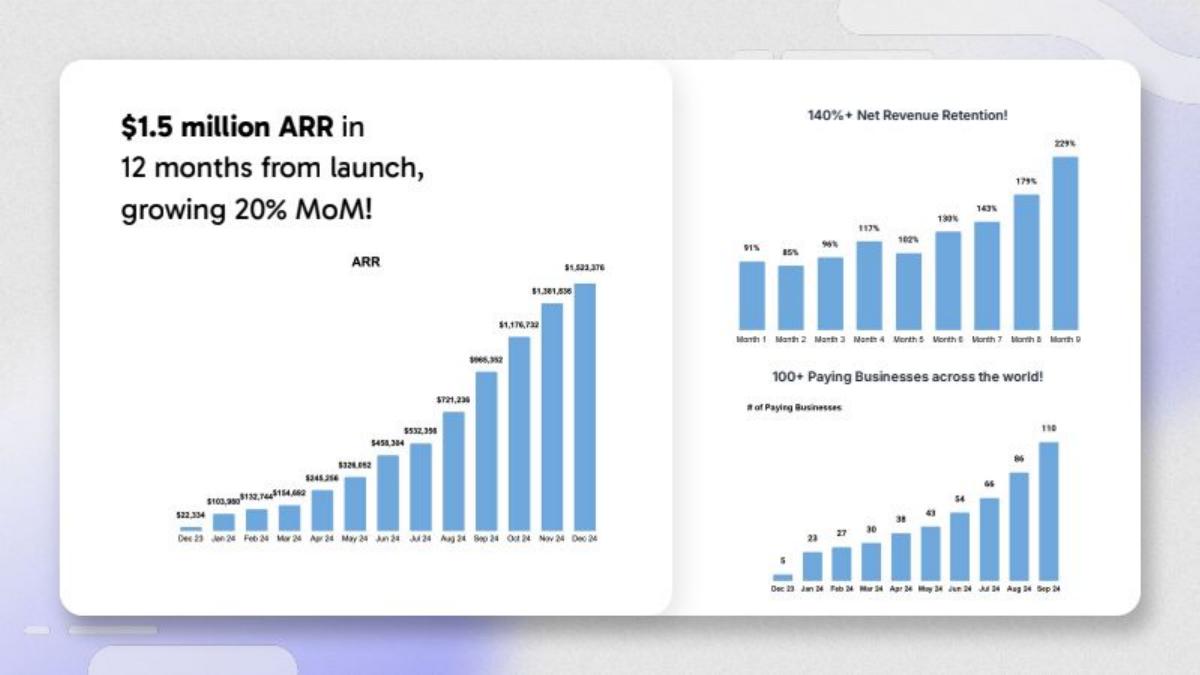
- The company achieved $1.5M ARR within 12 months of launch with 20% MoM growth (Slide 2).
- Net Revenue Retention (NRR) climbed significantly, reaching 229% by Month 9 (Slide 2).
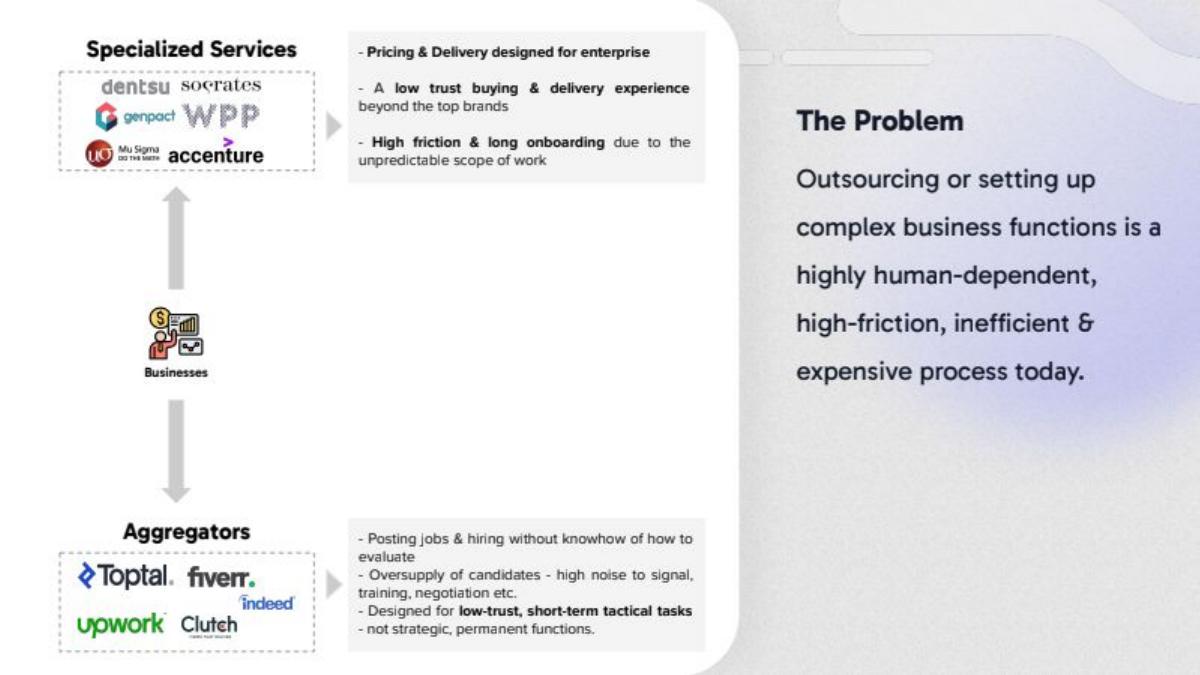
- Gushwork identifies the problem as high-friction, human-dependent outsourcing processes in traditional agencies and aggregators (Slide 4).
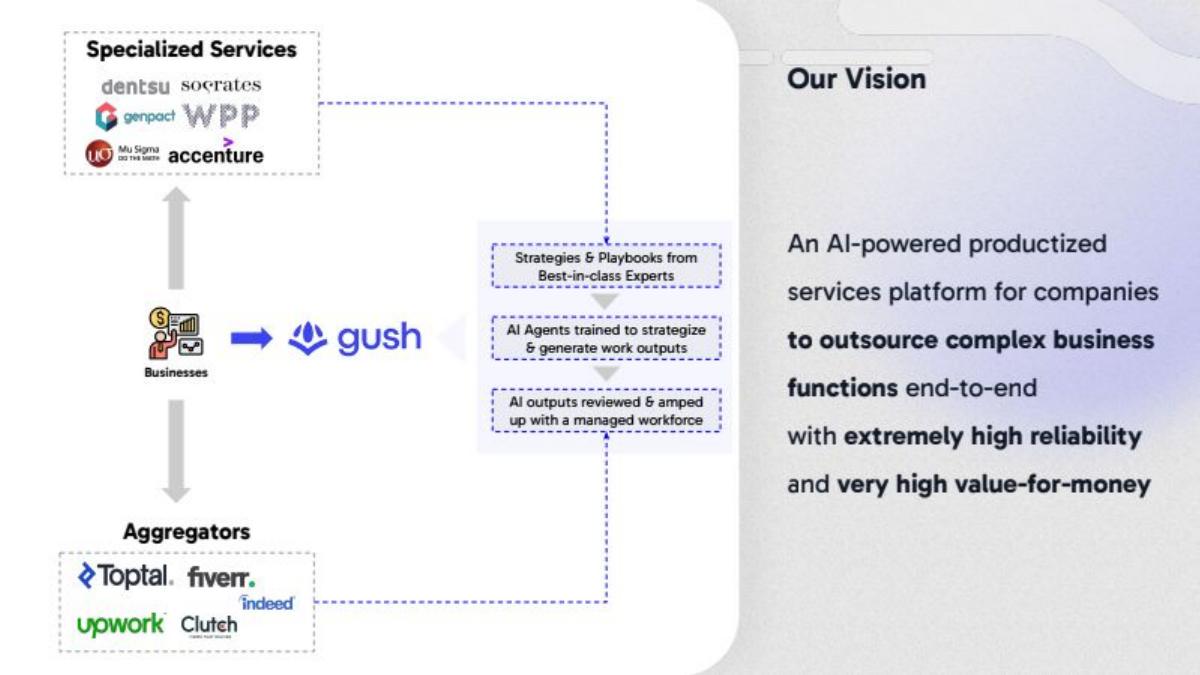
- The platform utilizes AI agents to strategize and generate work, which is then reviewed by a managed workforce (Slide 5).
- Ideal customers are B2B services/software companies with $1M-$100M in revenue and no in-house marketing team (Slide 6).
- The service model slashes man-hours per customer from 285 hours to 70 hours, a 75% reduction (Slide 9).
- Gushwork claims a 47% gross margin compared to the 25% average of traditional SEO agencies (Slide 9).
- The roadmap includes owning the entire GTM funnel, including SEM, Paid Social, and ABM by 2026 (Slide 8).
Executive Summary: The Rapid Ascent to $1.5M ARR
Gushwork’s pitch deck is a high-velocity narrative that focuses heavily on traction and operational transformation. In an era where 'AI services' are often dismissed as mere wrappers, Gushwork provides a compelling data-backed argument for how AI can fundamentally restructure the unit economics of the agency world. By the time an investor reaches the end of the 12-slide deck, the company has demonstrated a clear path from a specialized SEO service to a full-stack Go-To-Market (GTM) platform.
Slide 1: Title Slide
The deck opens with a minimalist title slide featuring the Gushwork logo and the tagline: "Reimagining the future of outsourcing with AI." It sets a broad vision, positioning the company not just as a marketing tool, but as a replacement for traditional outsourcing models.
Slide 2: Traction and Growth Metrics
This is arguably the most important slide in the deck. Gushwork leads with its strongest evidence: "$1.5 million ARR in 12 months from launch, growing 20% MoM!" The slide contains three charts:
ARR Chart: Shows a steady climb from $22,334 in December 2023 to $1,523,376 in December 2024. · Net Revenue Retention (NRR): Displays a remarkable trend, starting at 91% in Month 1 and skyrocketing to 229% by Month 9. This suggests massive expansion revenue within their existing customer base. · Paying Businesses: Shows growth from 5 businesses in December 2023 to 110 businesses by September 2024.
Slide 3: The Team
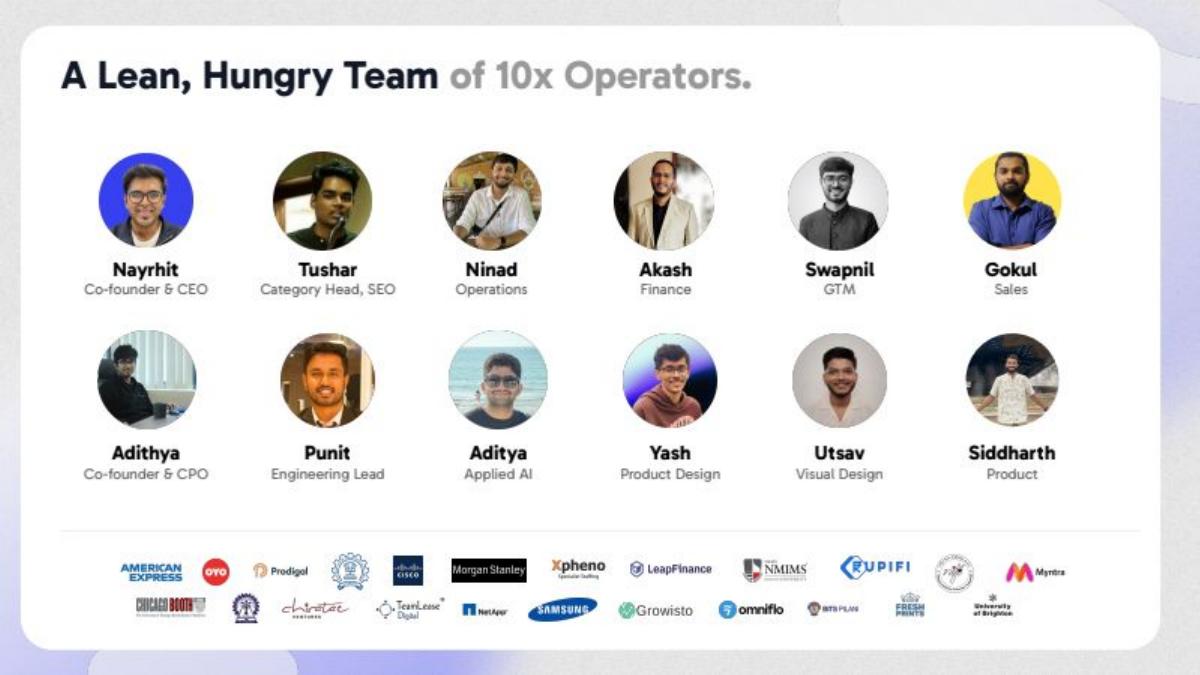
The team slide features 12 members, led by Nayrhit (Co-founder & CEO) and Adithya (Co-founder & CPO). The slide emphasizes a "Lean, Hungry Team of 10x Operators." Below the headshots is a dense 'logo wall' of previous experiences, including American Express, OYO, Cisco, Morgan Stanley, Samsung, and various venture funds like Chiratae Ventures. This establishes the pedigree of the operators behind the rapid growth.
Slide 4: The Problem
Gushwork identifies a gap between two existing models: Specialized Services (Dentsu, Accenture, WPP) and Aggregators (Upwork, Fiverr, Toptal). The problem with specialized services is cited as high friction, long onboarding, and being designed for enterprise. Aggregators are criticized for being 'low-trust,' designed for short-term tactical tasks, and requiring the buyer to have the 'know-how' to evaluate talent. The slide summarizes the problem as a "highly human-dependent, high-friction, inefficient & expensive process."
Slide 5: Our Vision
The vision slide introduces Gushwork as the middle ground: "An AI-powered productized services platform." The workflow is described in three steps: Strategies & Playbooks from best-in-class experts, AI Agents trained to strategize and generate work, and AI outputs reviewed by a managed workforce. This slide clarifies that they are not 100% automated, but rather 'AI-amped.'
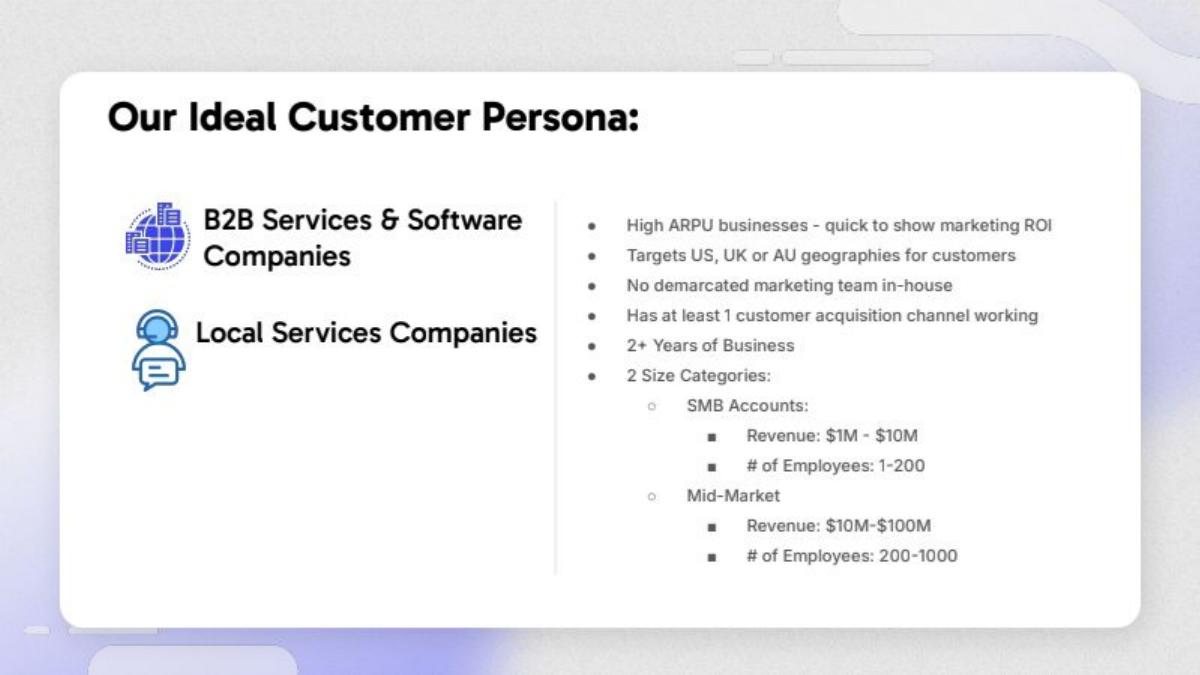
Slide 6: Ideal Customer Persona (ICP)
Gushwork is highly specific about who they serve. They target B2B Services & Software and Local Services companies in the US, UK, or AU. They define two size categories:
SMB Accounts: $1M - $10M Revenue, 1-200 employees. · Mid-Market: $10M - $100M Revenue, 200-1000 employees.
The key qualifier is that these companies have "no demarcated marketing team in-house."
Slide 7: The Here & Now
This slide outlines their current service offerings, which they describe as "Building a full-stack Marketing Org for SMBs." The four pillars are Search Engine Optimization (Outcome: Organic Traffic), Performance Marketing (Outcome: MQLs), Organic Socials (Outcome: Followers), and Intent-based Outbound (Outcome: SQLs).
Slide 8: The 3-Year Roadmap
Gushwork visualizes their expansion into the entire GTM funnel. While SEO is currently 'Launched' (green), they plan to launch SEM, Paid Social, and Cold Outreach in 2025 (orange), followed by Organic Social, Influencer Marketing, and Social Listening in 2026 (yellow). The goal is to own the entire journey from visibility to SQLs.
Slide 9: Case Study - SEO as a Service
This slide provides a side-by-side comparison of a Traditional SEO Agency vs. Gushwork . The metrics are stark:
Man-hours: Slashed from 285 hours/month to 70 hours/month (75% reduction). · Throughput: Increased from 10 content assets to 40 content assets per month (4x increase). · Time to go live: Reduced from 1.5 months to less than 7 days. · Pricing: Gushwork charges $700-$2k/mth vs. the agency average of $3k-$15k/mth. · Margins: Gushwork achieves 47% Gross Margins vs. the 25% agency average.
Slide 10: The Moat
The company defines its moat as "Productizing the Strategy." A diagram shows that while traditional agencies scale by adding more human strategists in a 1:1 manual service model, Gushwork takes the expertise of one SEO strategist and replicates it in the product. This allows for a 1:Many productized service that is "SEO on Demand."
Slide 11: The Ask
The deck concludes with a simple, direct ask: "Raising $8M to build & grow faster." Note that the catalogue facts indicate they eventually closed $9M, suggesting a slight oversubscription or a valuation adjustment during the round.
Slide 12: Thank You
A standard closing slide with the company logo and the phrase "Let's build something awesome together."
What Works in This Deck
The Traction-First Approach: By putting the $1.5M ARR and 229% NRR on Slide 2, Gushwork immediately answers the question of market-product fit. For a Seed round, these numbers are so strong that they buy the founders the right to explain a complex operational model in the subsequent slides.
Clear Unit Economics: Slide 9 is a masterclass in competitive positioning. It doesn't just say they are 'better' or 'faster'; it uses specific man-hour and margin percentages to prove why their business model is superior to the status quo. Investors love seeing a 75% reduction in labor costs alongside a 4x increase in output.
Specific ICP: Many startups fail by trying to be everything to everyone. Gushwork’s detailed breakdown of revenue ranges, employee counts, and geographic targets (Slide 6) shows they have a repeatable sales motion.
What Is Missing
Technology Deep-Dive: While the deck mentions "AI Agents," it provides very little detail on the proprietary nature of these agents. Are they using LLM wrappers, or is there a custom agentic framework? For a $9M Seed round in the AI space, some technical defensibility beyond 'productized strategy' would typically be expected.
Churn Data: While NRR is 229%, the deck does not explicitly state gross churn. In a service-heavy model targeting SMBs, churn is usually the 'silent killer.' High expansion might be masking a high turnover of smaller accounts.
The 'Managed Workforce' Details: Slide 5 mentions a "managed workforce" that reviews AI outputs. The deck doesn't explain where this workforce is located, how it is managed, or what the long-term plan is for this human element. If the goal is a software-like margin, the human-in-the-loop component needs a clear path to further reduction.
What a Founder Should Copy
The 'Problem/Vision' Diagram: The way Slide 4 and 5 use the same visual structure to show how Gushwork fits between 'Specialized Services' and 'Aggregators' is excellent. It helps investors categorize the company in an existing market landscape while highlighting its unique positioning.
The Roadmap as a Funnel: Using a marketing funnel (Slide 8) to show a product roadmap is a clever way to align product expansion with the customer's value journey. It makes the expansion into new categories feel inevitable rather than scattered.
Leading with NRR: Most founders lead with revenue growth. Leading with Net Revenue Retention (Slide 2) is a much stronger signal for a B2B business because it proves that the product is 'sticky' and that customers are finding more ways to spend money with the company over time.
Frequently asked questions
- What is Gushwork's primary value proposition?
- Gushwork provides an AI-powered productized services platform that allows B2B companies to outsource complex functions like SEO and lead generation. By using AI agents to replace human managers and strategists, they offer a 4x increase in output at a fraction of the cost of traditional agencies, with a focus on high reliability and 'value-for-money'.
- How does Gushwork's financial performance compare to typical startups?
- Their performance is exceptionally strong for a Seed-stage company. Reaching $1.5M ARR in 12 months with 20% monthly growth places them in the top tier of SaaS-like service businesses. Furthermore, an NRR of 229% suggests that once a business starts using Gushwork, they rapidly expand their usage across more services or volume.
- What is the 'Moat' described in the deck?
- The moat is defined as 'Productizing the Strategy.' Unlike traditional agencies where an SEO strategist manages a small handful of clients 1:1, Gushwork replicates the strategist’s expertise within their product. This allows one human to oversee many more accounts, making the service 'on-demand' and highly scalable compared to manual labor models.
- Who is the target customer for Gushwork?
- They target B2B services and software companies, as well as local services companies, specifically in the US, UK, and Australia. They look for businesses with $1M to $100M in revenue that do not have a dedicated in-house marketing team but have at least one acquisition channel already working.
- How does Gushwork use AI in its delivery process?
- Gushwork uses 'AI SEO Agents' and 'AI Writing Agents' to handle tasks that usually require SEO Managers and Content Writers. These agents perform the bulk of the work (0 human hours for these specific roles), while a human Customer Success Manager and a human Content Writer provide the final 25% of labor for review and 'amping up' the output.