The GTX pitch deck is a 14-slide document from January 2023, designed to raise $25 million in seed funding. The core thesis is that the $20 billion crypto claims market belongs on a public marketplace rather than in opaque, over-the-counter transactions. The deck leans heavily on the founders' experience in the crypto ecosystem—specifically Kyle Davies and Su Zhu of Three Arrows Capital and Mark Lamb and Sudhu Arumugam of CoinFLEX. It positions the bankruptcy of FTX as a 'power vacuum' and a primary acquisition channel. While the deck is visually clean and provides a clear roadmap from claims…
Key takeaways
- The company identifies a $20 billion market opportunity in estimated notional value of crypto claims (Slide 7).
- The roadmap follows a four-stage expansion: Claims, then Crypto, then Stocks Trading & Lending, and finally FX (Slide 3).
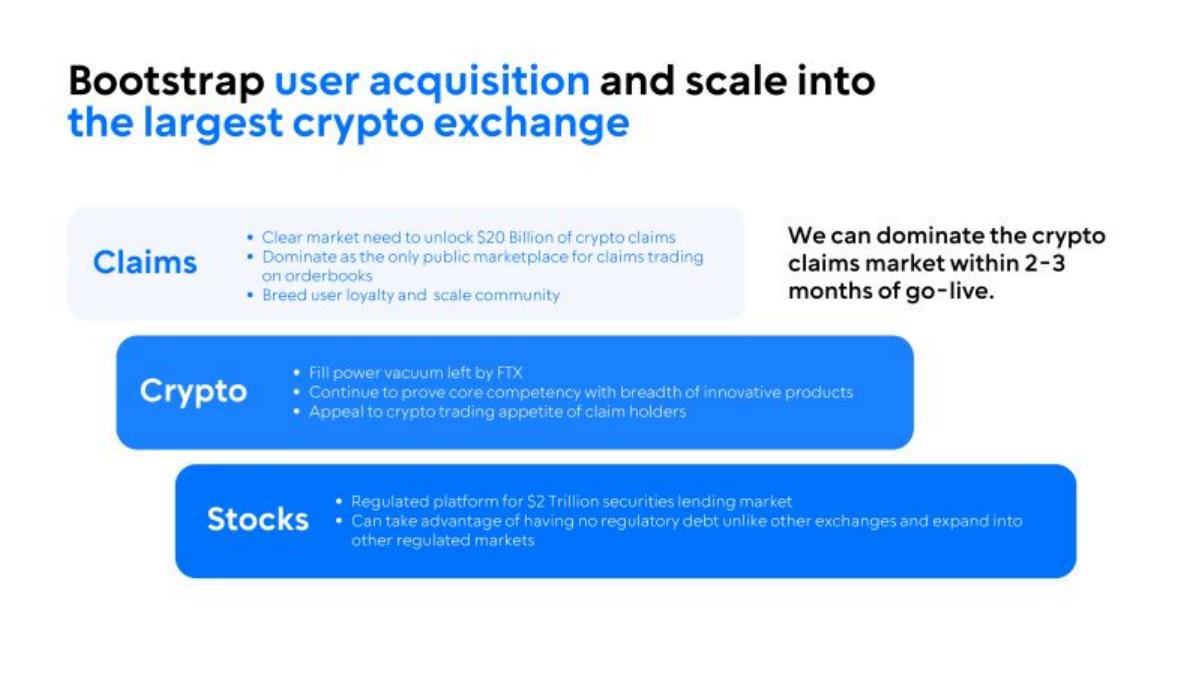
- GTX aims to dominate the crypto claims market within 2-3 months of going live (Slide 4).
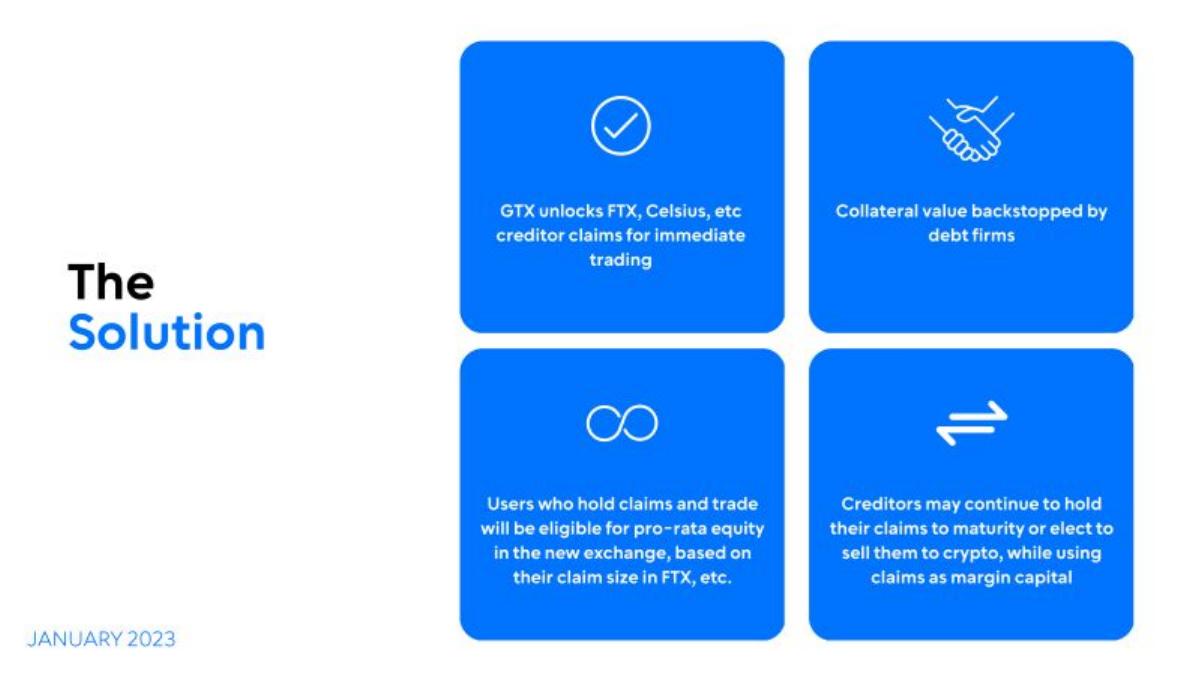
- The platform intends to use claims as margin capital, allowing creditors to trade while holding their claims to maturity (Slide 6).
- The deck highlights a team of 60+ developers and 10 years of experience operating a crypto exchange (Slide 10).
- Founders Kyle Davies and Su Zhu are credited with growing 3AC from $1.2M to $4B+ before it 'went bust in 2022' (Slide 11).
- GTX claims a fee advantage, targeting 0.25%-0.50% compared to 5-10% at competitors like XClaims (Slide 9).
- The $25M seed round is intended to fund legal setup, tech stack completion, and marketing strategy (Slide 13).
GTX Pitch Deck Analysis
The GTX pitch deck, dated January 2023, represents a bold attempt to monetize the wreckage of the 2022 crypto collapse. By positioning themselves as the primary liquidity provider for bankruptcy claims, the founders sought to raise $25 million to build what they termed a 'public marketplace' for distressed digital assets. The deck is structured to move the investor from a niche immediate problem (illiquid claims) to a massive long-term vision (a global cross-asset exchange).
Slide 1: Title Slide
The deck opens with the logo and the tagline: "Cross-asset trading on a public marketplace" . It explicitly lists "Claims | Crypto | Stocks" as the core pillars. The date, January 2023, places this deck just months after the FTX collapse, indicating a high-speed response to market conditions.
Slide 2: The Thesis
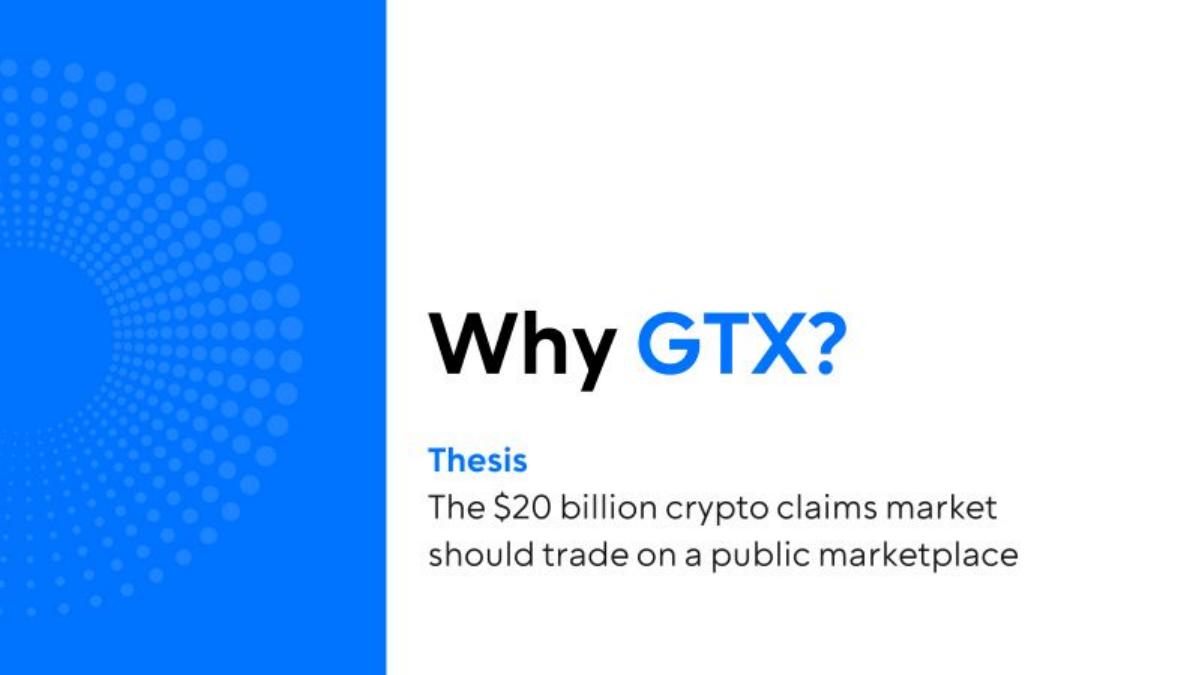
Slide 2 presents the core argument: "The $20 billion crypto claims market should trade on a public marketplace." This is a classic 'Why Now' slide, identifying a specific, large-scale inefficiency in the market that the company intends to solve.
Slide 3: Our Roadmap
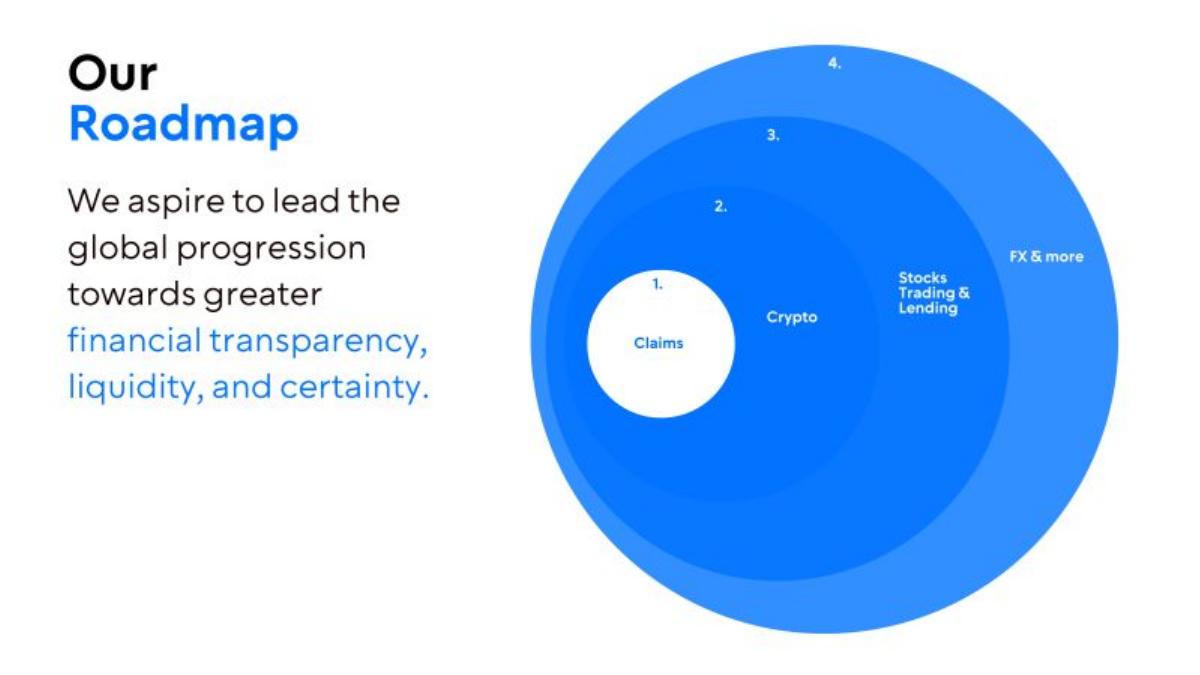
The roadmap is visualized as concentric circles, suggesting an expansionary strategy. It starts with 1. Claims at the center, moving outward to 2. Crypto , 3. Stocks Trading & Lending , and finally 4. FX & more . The stated aspiration is to lead the global progression toward "financial transparency, liquidity, and certainty."
Slide 4: User Acquisition and Scaling
This slide details the 'bootstrap' strategy. GTX intends to use the "clear market need to unlock $20 Billion of crypto claims" to acquire users. A bold claim on this slide states: "We can dominate the crypto claims market within 2-3 months of go-live." It also positions the move into crypto as a way to "fill power vacuum left by FTX" and the move into stocks as taking advantage of having "no regulatory debt unlike other exchanges."
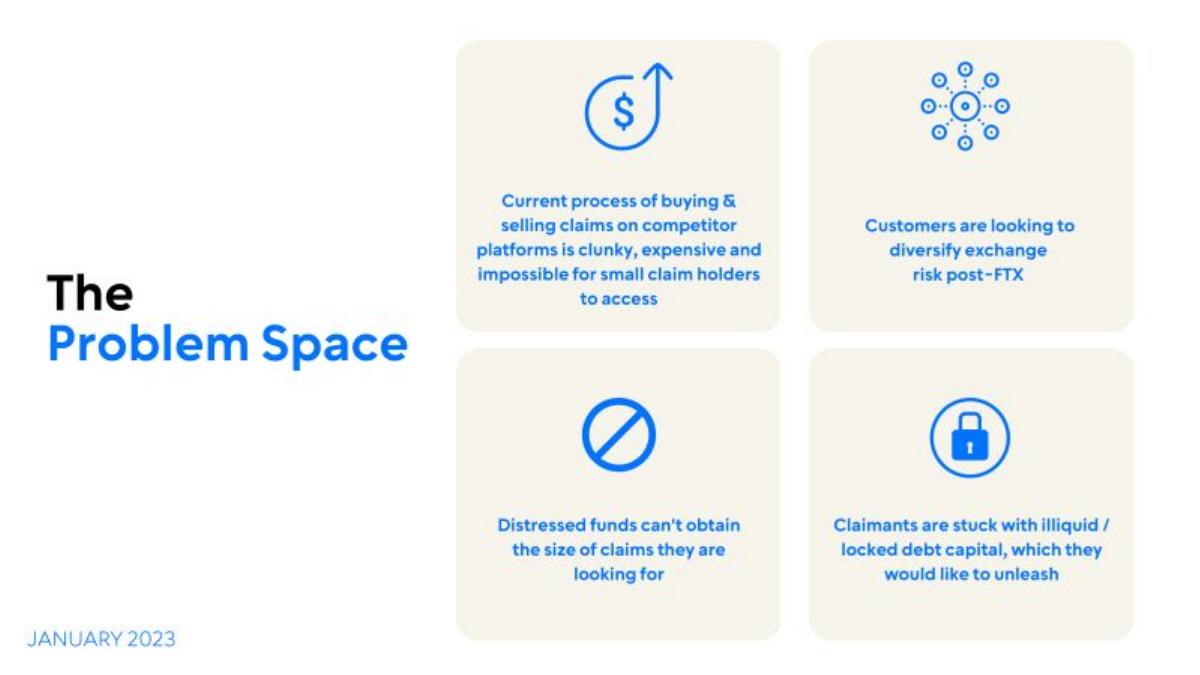
Slide 5: The Problem Space
Current buying/selling of claims is "clunky, expensive and impossible for small claim holders to access." · Customers want to "diversify exchange risk post-FTX." · Distressed funds cannot find the "size of claims they are looking for." · Claimants are stuck with "illiquid / locked debt capital."
Slide 6: The Solution
The solution slide mirrors the problem slide with four corresponding boxes:
Unlocking FTX, Celsius, etc., claims for "immediate trading." · Collateral value "backstopped by debt firms." · Users holding claims are eligible for "pro-rata equity in the new exchange." · Claims can be used as "margin capital" for trading.
Slide 7: Claims Market Size
This slide quantifies the opportunity. It cites "Over 1 million depositors on FTX" and an "Estimated notional value of $20 Billion" for crypto claims. It notes that users are currently selling claims at "~10% face value" or waiting 10+ years for bankruptcy disbursements.
Slide 8: GTX Claims Market
This slide focuses on the mechanics of the claims market. It lists FTX, Celsius, BlockFi, and Mt. Gox as the primary targets for listing. It distinguishes between who qualifies (regular users) and who does not (employees of bankrupt companies). It emphasizes that the "legal team will streamline and automate claims onboarding."
Slide 9: Claims Market Comparison
A competitive matrix compares GTX against XClaims and Claims-Market . GTX claims to be the only one offering an "Orderbook-based Marketplace" and the ability to "Use claims as collateral for trading." Most notably, it lists its fees at 0.25%-0.50% , whereas XClaims is listed at 5-10%.
Slide 10: Battle-tested Technology
To address execution risk, the deck claims a team of "60+ developers and 10 years of experience operating a crypto exchange." It lists four technical components: a Cross Collateral Margining System, a Risk/Matching Engine, API access (Rest/WebSocket/FIX), and Post-trade technology for clearinghouse integration.
Slide 11: Founding Team
Kyle Davies & Su Zhu: Co-Founders of Three Arrows Capital (3AC). The slide notes they grew the fund to $4B+ before it "went bust in 2022." · Mark Lamb & Sudhu Arumugam: Co-Founders of CoinFLEX. It mentions Lamb built the exchange to a "$300M valuation."
Slide 12: Executive Team
Kent Deng (CTO): Ex-Oracle, formerly at Alibaba, Tencent, and Huawei. · Leslie Lamb (CMO): Creator of the Crypto Unstacked Podcast and former Head of Institutional Sales at Amber Group. · Ewelina Mielecka (CDO): 10 years of experience in crypto custody and settlement.
Slide 13: The Ask
The company is "Raising $25M seed." The timeline is aggressive: "Time to market is ASAP by end of February." The funds are earmarked for:
Complete legal setup and tech stack. · Streamline claims onboarding. · Establish marketing strategy. · One-stop shop for crypto and stock trading.
Slide 14: Thank You
The final slide repeats the logo and tagline, maintaining the blue and white minimalist aesthetic used throughout the deck.
What Works in the GTX Deck
The deck excels at identifying a timely market opportunity . By launching in January 2023, the founders tapped into the immediate pain of millions of creditors. The roadmap (Slide 3) is logically sequenced, showing how a niche entry point (claims) can lead to a broad market play (stocks and FX). The competitive comparison (Slide 9) is also effective, highlighting a massive fee discrepancy that would appeal to any distressed seller. Finally, the team slide (Slide 11) is remarkably transparent about the 3AC bankruptcy, framing it as a growth story that ended in a market-wide 'bust' rather than hiding it.
What is Missing from the GTX Deck
The most glaring omission is detailed financial projections . While the $20B market size is mentioned, there is no forecast of how much volume GTX expects to capture or what the resulting revenue would be. The use of funds (Slide 13) is also extremely vague; $25 million is a large seed round, and investors would typically expect a breakdown of headcount, infrastructure costs, and legal reserves. Additionally, the regulatory strategy for the stock lending market is glossed over. Entering regulated securities markets is a multi-year, multi-million dollar endeavor, yet the deck treats it as a simple next step in the roadmap.
What Founders Should Copy
Founders should emulate the clarity of the 'Problem Space' (Slide 5) . It uses simple icons and concise text to explain a complex market situation. The 'Solution' slide (Slide 6) is also a great example of how to present value propositions that directly answer the problems identified. Furthermore, the visual consistency of the deck—using a limited color palette and plenty of white space—makes it highly readable and professional, which is essential when pitching a high-risk or controversial business model.
Final Analyst Thoughts
The GTX deck is a masterclass in 'opportunistic pitching.' It takes a catastrophic industry event and rebrands it as a $20 billion acquisition channel. While the pedigree of the founders is a double-edged sword, the deck leans into their experience to argue that they are the only ones with the technical and legal 'battle-testing' to handle such a complex product. However, the lack of granular financial and regulatory detail makes this a high-conviction bet on the team rather than a data-driven investment in a business model.
Frequently asked questions
- What is the primary business model of GTX according to the deck?
- GTX operates as a public marketplace for trading crypto bankruptcy claims. According to Slide 9, they generate revenue through transaction fees, targeting a range of 0.25% to 0.50%. The model also involves allowing users to use their illiquid claims as margin capital to trade other assets like crypto and eventually stocks, as detailed on Slide 6.
- Who are the founders and what is their track record?
- The founding team consists of Kyle Davies and Su Zhu (founders of Three Arrows Capital) and Mark Lamb and Sudhu Arumugam (founders of CoinFLEX). Slide 11 acknowledges that 3AC 'went bust in 2022' but emphasizes their growth from $1.2M to $4B+. Mark Lamb is credited with building CoinFLEX to a $300M valuation and previously founding Coinfloor.
- How does GTX plan to acquire users?
- The strategy is to 'bootstrap user acquisition' by targeting the over 1 million depositors caught in the FTX bankruptcy (Slides 4 and 7). By offering a streamlined onboarding process for claims from FTX, Celsius, BlockFi, and Mt. Gox, they aim to build a loyal community that will eventually transition into their crypto and stock trading products.
- What competitive advantages does the deck claim?
- Slide 9 lists several advantages over competitors like XClaims and Claims-Market, including an orderbook-based marketplace, the ability to use claims as collateral for trading, a streamlined onboarding process, and significantly lower fees (0.25%-0.50% vs. up to 10% elsewhere). They also claim to have no 'regulatory debt' compared to existing exchanges (Slide 4).
- What are the biggest omissions in this pitch deck?
- The deck lacks a detailed financial forecast, including projected revenue or volume targets. It does not provide a specific breakdown of how the $25M seed investment will be spent. Furthermore, while it mentions a 'regulated platform' for the $2 trillion securities lending market on Slide 4, it provides no details on which jurisdictions they will seek licenses in or the current status of those applications.