GRUBBRR’s 23-slide deck is a masterclass in positioning a solution against macroeconomic headwinds. Raising $35M in 2022, the company leaned heavily into the 'labor shortage' narrative, presenting its self-ordering kiosks and software ecosystem as the only viable path for the Quick Service Restaurant (QSR) industry. The deck is notably light on internal financial metrics—omitting ARR, burn, and CAC—but compensates with heavy-hitting social proof and strategic moats. Their partnership with Samsung, which includes a proprietary OS lock-in, serves as the primary competitive advantage. By focusin…
Key takeaways
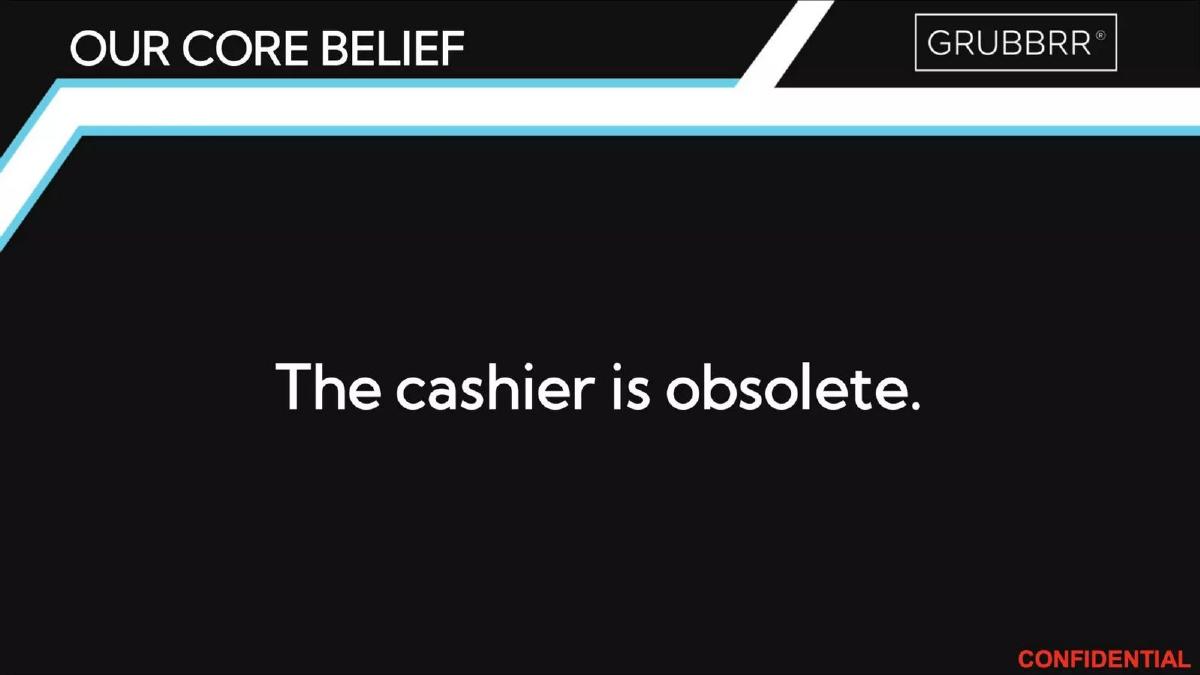
- The core thesis is stated bluntly on Slide 2: 'The cashier is obsolete,' setting a high-stakes tone for the entire presentation.
- GRUBBRR claims a significant revenue impact for customers, citing a 12-22% average ticket increase through automated upselling on Slide 7.
- The company identifies a massive market opportunity in the U.S. QSR space, noting 860,000 restaurants and a projected $55B tech spend by 2024 on Slide 8.
- A strategic moat is highlighted on Slide 13: GRUBBRR software is the only solution that works on Samsung's Tizen-based kiosks, providing a two-year head start.
- Enterprise traction is validated on Slide 14 through a partnership with Square that led to implementation at SoFi Stadium.
- The revenue model is diversified across nine streams, including SaaS fees, hardware, and payment processing, as shown on Slide 22.
- The deck completely omits current revenue figures, growth rates, and specific fundraising terms or 'the ask.'
- The competitive landscape on Slide 11 positions GRUBBRR as the only 'Affordable' and 'Enterprise' grade solution, contrasting it with 'Costly' peers like Acrelec and Tilster.
The Macro Thesis: Labor and Obsolescence
Slides 1-5: Setting the Stage
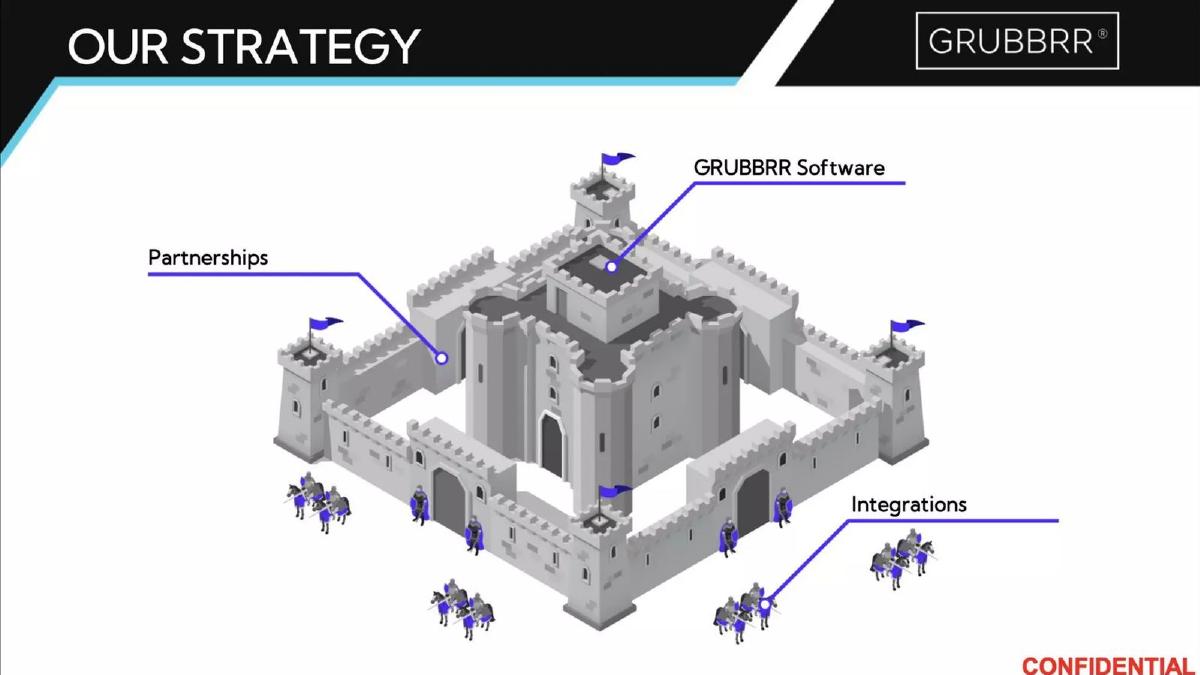
GRUBBRR opens with a bold, minimalist declaration on Slide 2 : "The cashier is obsolete." This is a classic 'Change in the World' opening. It doesn't start with what they do, but with a fundamental shift in the economy. Slide 3 introduces their strategy through a 'Castle and Moat' visual, labeling their software as the keep, protected by walls of partnerships and integrations. This suggests that their value isn't just in the code, but in the ecosystem they've built around it.
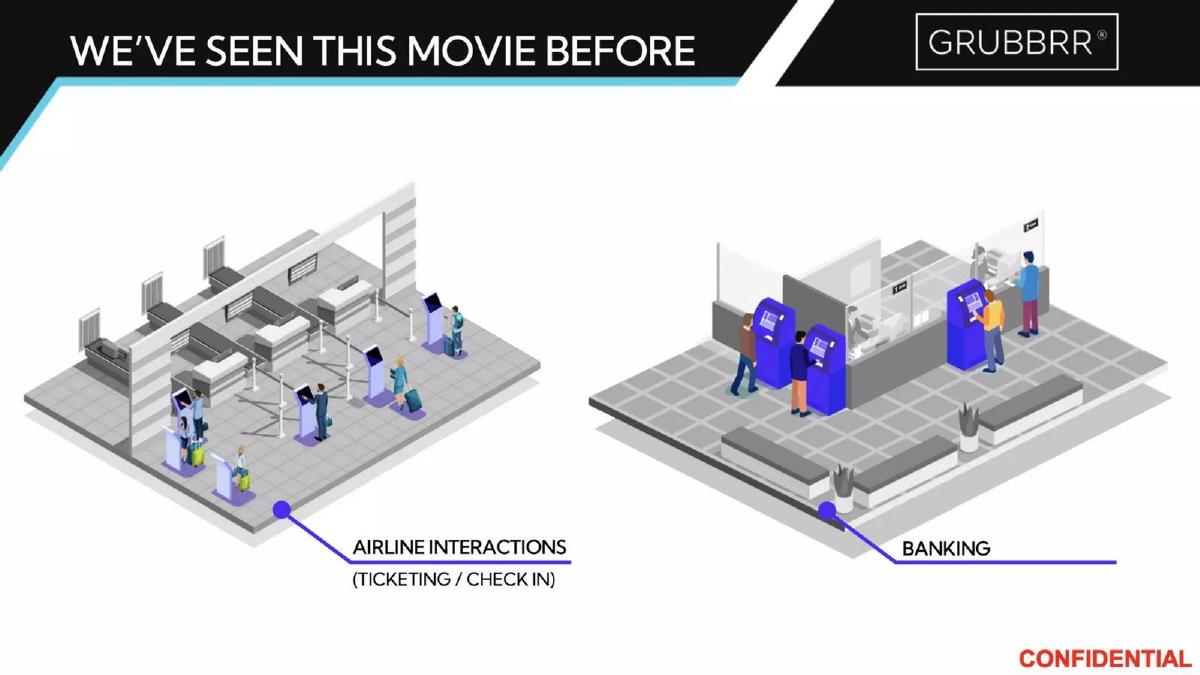
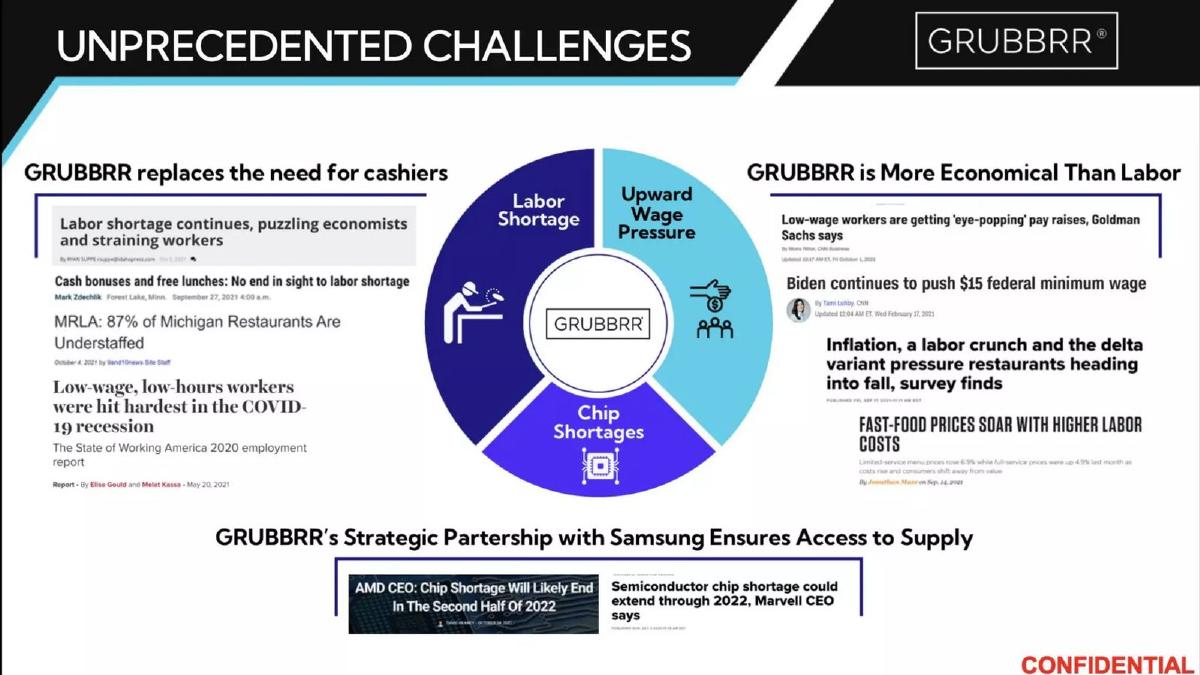
On Slide 4 , they use an analogy titled "We've seen this movie before," comparing the restaurant industry's current state to the digital transformation of airline check-ins and banking ATMs. This is a powerful way to de-risk the investment by showing that while the application is new, the pattern of automation is proven. Slide 5 grounds this in 2022 reality, citing "Unprecedented Challenges" like labor shortages, upward wage pressure (referencing the $15 federal minimum wage push), and chip shortages. Notably, they use these headlines to position their Samsung partnership as a supply chain advantage, ensuring they have hardware when others don't.
The Solution and Quantifiable ROI
Slides 6-7: Product and Value
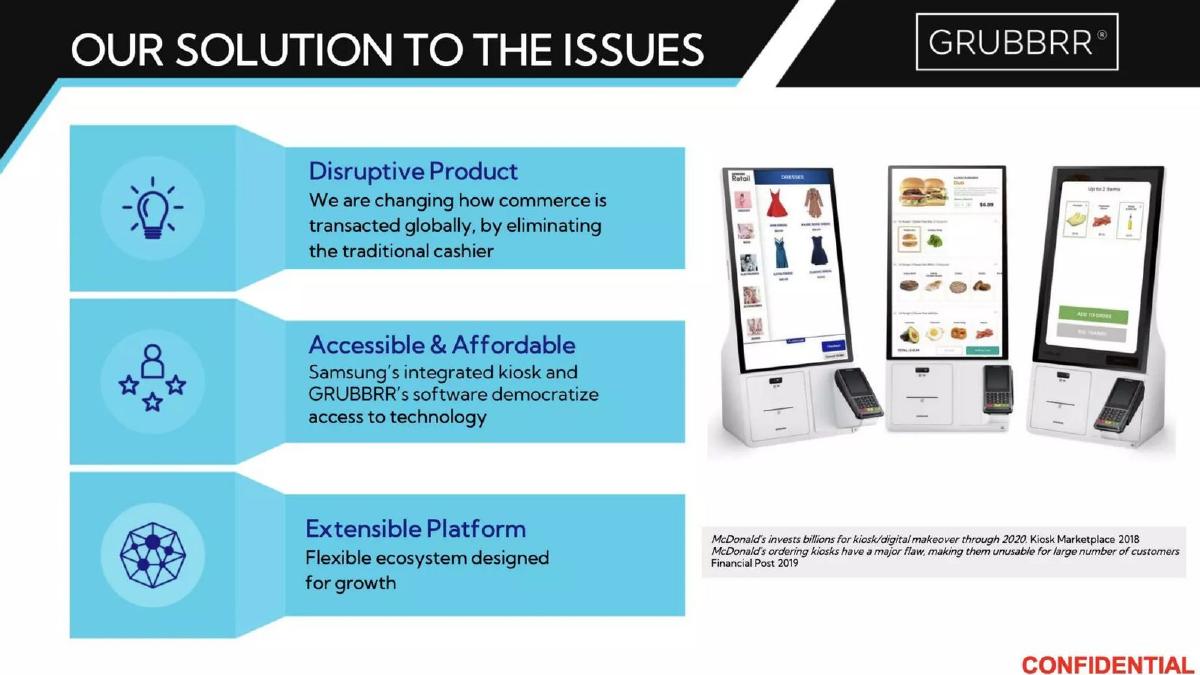
Slide 6 introduces the physical product: sleek, Samsung-integrated kiosks. They describe the product as "Disruptive," "Accessible & Affordable," and an "Extensible Platform." They take a direct shot at McDonald's on this slide, noting that while the giant invested billions in kiosks, their systems have "major flaws" that GRUBBRR claims to have solved.
Slide 7 is arguably the most important slide for a B2B buyer or investor. It quantifies the ROI. They claim a 12-22% average ticket increase because "customers buy with their eyes" and the system uses "customized automated upsells." More importantly, they claim to eliminate ~$6,000 or more per month in expenses per cashier position. By framing the software as a 100% available employee that never takes PTO, they make the purchase seem like a mathematical inevitability for a struggling restaurant owner.
Market Opportunity and Go-To-Market
Slides 8-9: TAM and Strategy
Slide 8 defines the target markets. They focus on the U.S. QSR market (860,000 restaurants) with a projected tech spend of $55B by 2024 . They also highlight the Petro/C-Store market with 150,274 locations. The numbers are large enough to justify a venture-scale return, but specific enough to show they aren't just 'boiling the ocean.'
Slide 9 outlines the Go-To-Market (GTM) strategy. They segment by location count: Enterprise (100+) and Mid-Market (10-99). Their "Points of Differentiation" focus on a "no need to rip and replace" philosophy, claiming integration with existing POS, payment, and loyalty providers. This reduces friction for enterprise adoption, which is often the biggest hurdle in hospitality tech.
The Ecosystem and Competitive Moat
Slides 10-13: Technical and Strategic Advantage
Slide 10 displays the "GRUBBRR Ecosystem," which spans from self-ordering kiosks and mobile apps to kitchen display systems (KDS) and food lockers. This slide communicates that they aren't just a 'kiosk company' but a full-stack operational OS for the restaurant. Slide 11 is their competitive matrix. They position themselves in the top-right quadrant: the only solution that is both "Enterprise" grade and "Affordable." They place legacy competitors like Acrelec as "Costly" and SMB players like Toast as unsuitable for large-scale enterprise needs.
Slide 13 dives deep into the Samsung partnership, which appears to be their primary 'unfair advantage.' They state that Samsung's kiosk uses Tizen , a proprietary OS, and that "only GRUBBRR software will work on Samsung's kiosk." This creates a massive barrier to entry. If a large chain wants to use Samsung hardware (the global leader), they are effectively forced to use GRUBBRR software. They claim this accelerated their GTM by "at least two years."
Social Proof and Execution
Slides 14-17: Partnerships and Traction
Slide 14 highlights their work with Square, specifically mentioning the implementation at SoFi Stadium . For an enterprise tech company, a stadium is the ultimate stress test. If the software can handle 70,000 people during a football game, it can handle a lunch rush at a suburban taco shop. Slide 15 mentions a partnership with Fiserv, giving them access to a vast client base for self-ordering tech. Slide 16 uses social media screenshots to show market sentiment, including a LinkedIn post from a VP at Capriotti's Sandwich Shop. This 'voice of the customer' adds a layer of authenticity that corporate slides often lack.
Operational Scalability
Slides 18-21: The Machine Behind the Product
The deck spends a significant amount of time (four slides) on how they actually deliver the product. Slide 18 introduces the "IDC" (Implementation, Deployment, Customer Success) department. Slide 19 shows the handoff between R&D and Operations. Slide 20 illustrates a global cloud platform structure with clusters in the US, Europe, and Asia. This is intended to signal to enterprise investors that the company is ready to scale globally tomorrow. It’s not a 'move fast and break things' startup; it’s a structured organization designed for 'Seamless Client Experience.'
Revenue Model and Team
Slides 22-23: The Business and The People
Slide 22 shows a multi-faceted revenue model. While they are primarily SaaS, they also capture revenue from payment processing, hardware, marketing data, and even "Leasing & Financing." This diversification suggests a high Lifetime Value (LTV) per customer. Finally, Slide 23 introduces the Executive Team. CEO Sam Zietz is noted as an 8-time INC500 winner and founder of TouchSuite, bringing significant industry experience. The team includes veterans from IBM, Deloitte, and Salesforce, reinforcing the 'Enterprise' focus of the company.
What GRUBBRR Does Well
Urgency Creation: By leading with the labor crisis and the 'obsolescence' of the cashier, they make their product feel like a survival tool rather than a luxury. · Strategic Lock-in: The Samsung/Tizen exclusivity is a brilliant moat that investors love to see. It’s a clear answer to "Why can't a giant just build this?" · Quantified Value: They don't just say "we make things better"; they say "we save $6,000 per month and increase tickets by 12-22%." · Enterprise Readiness: The detailed slides on deployment (IDC) and cloud architecture (Slide 20) reassure big-ticket investors that the company can handle 1,000-unit rollouts.
What is Missing from the Deck
Hard Financials: There is zero mention of current ARR, Net Revenue Retention (NRR), or gross margins. For a $35M round, investors usually expect to see a 'Financials' slide. · The Ask: The deck never specifies how much they are raising or what the valuation is. It functions more as a 'Company Overview' than a specific 'Pitch.' · Unit Economics: While they show the customer's ROI, they don't show their own. What is the CAC (Customer Acquisition Cost) for an enterprise deal? How long is the payback period? · Churn Data: In the competitive restaurant tech space, churn is the silent killer. The deck omits any mention of retention rates.
What Other Founders Should Copy
The 'Movie' Analogy: Using Slide 4 to show that your industry is just following the path of other successfully automated industries is a great way to overcome skepticism. · Partner-Led Growth: Instead of just listing logos, Slide 13 explains exactly why the Samsung partnership is a technical moat. Founders should explain the mechanics of their partnerships, not just the names. · Segmented GTM: Slide 9's clear distinction between Mid-Market and Enterprise tactics shows a level of sales maturity that many early-stage decks lack. · Visualizing the 'Ecosystem': Slide 10 effectively shows how a single entry point (the kiosk) leads to a total platform takeover. Founders should show the 'land and expand' potential of their product suite.
Frequently asked questions
- What is GRUBBRR's primary value proposition to restaurant owners?
- According to Slide 7, the value proposition is three-fold: increasing revenue via 12-22% higher ticket sizes through automated upselling, solving labor issues by eliminating ~$6,000 in monthly costs per cashier position, and improving customer experience through faster service and 100% order accuracy.
- How does GRUBBRR differentiate itself from competitors like Toast or Square?
- Slide 11 positions Toast and Square as 'Small Business' solutions. GRUBBRR targets the 'Enterprise' market. Furthermore, Slide 13 emphasizes their exclusive software integration with Samsung’s kiosk hardware, which runs on a proprietary OS (Tizen), creating a technical barrier to entry for other software providers.
- What specific market segments is the company targeting?
- Slide 8 identifies two primary focus markets: Quick Service Restaurants (QSR), with 860,000 U.S. locations, and the 'Petro' segment (Gas stations/C-stores), which includes over 150,000 locations. They also mention large-scale venues like stadiums on Slide 14.
- What does the 'IDC' department do within the company?
- As detailed on Slide 18, IDC stands for Implementation, Deployment, and Customer Success. This department handles everything from project management and integrations to training and support, ensuring that the 'Scalable Platform' can be rolled out across large enterprise footprints effectively.
- Is there any financial data or a specific 'ask' in this deck?
- No. The deck is a strategic overview and does not include a slide for the funding ask, use of proceeds, or historical financial performance. It focuses entirely on the product-market fit, the partnership ecosystem, and the operational scalability of the platform.