Grom's 15-slide pitch deck is characterized by its clean, minimalist aesthetic and a heavy emphasis on growth metrics. The deck opens with a series of revenue slides that build anticipation, culminating in a reported 81% month-over-month growth rate. By positioning themselves against the 'hype' of 3D printing—which they label as non-scalable and low quality—Grom carves out a niche in the $8.1 billion customizable smartphone case market. With 43% margins and a pilot program that moved over 9,000 units, the deck presents a compelling case for a scalable consumer product business. The inclusion…
Key takeaways
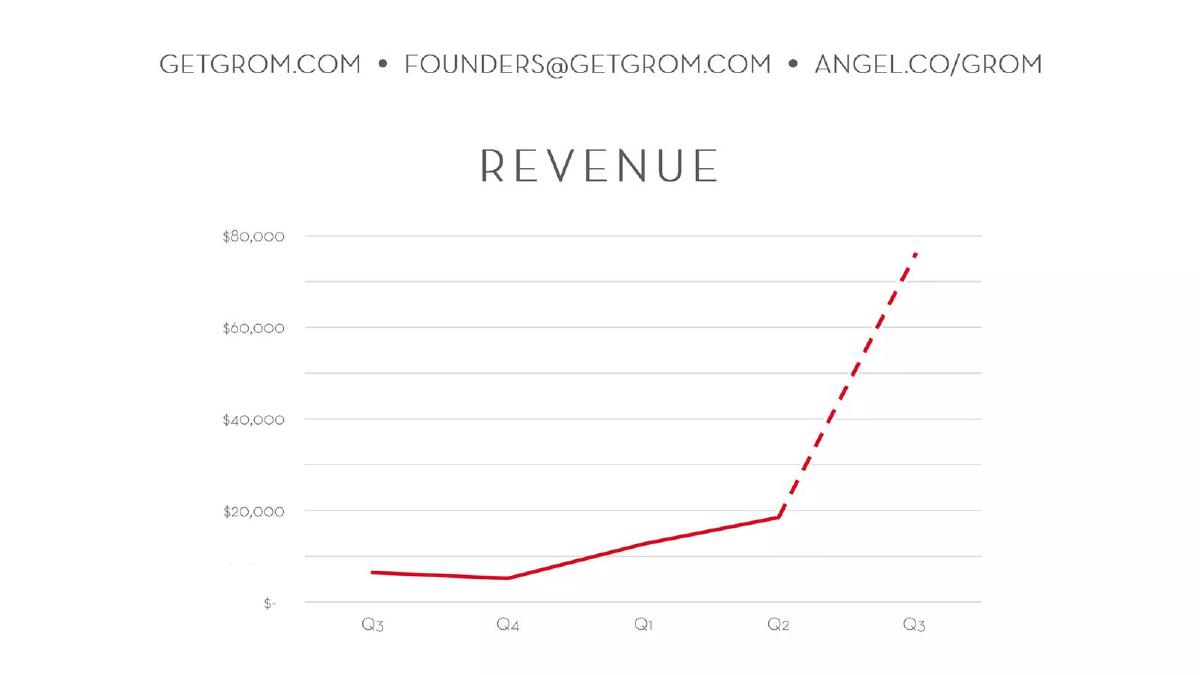
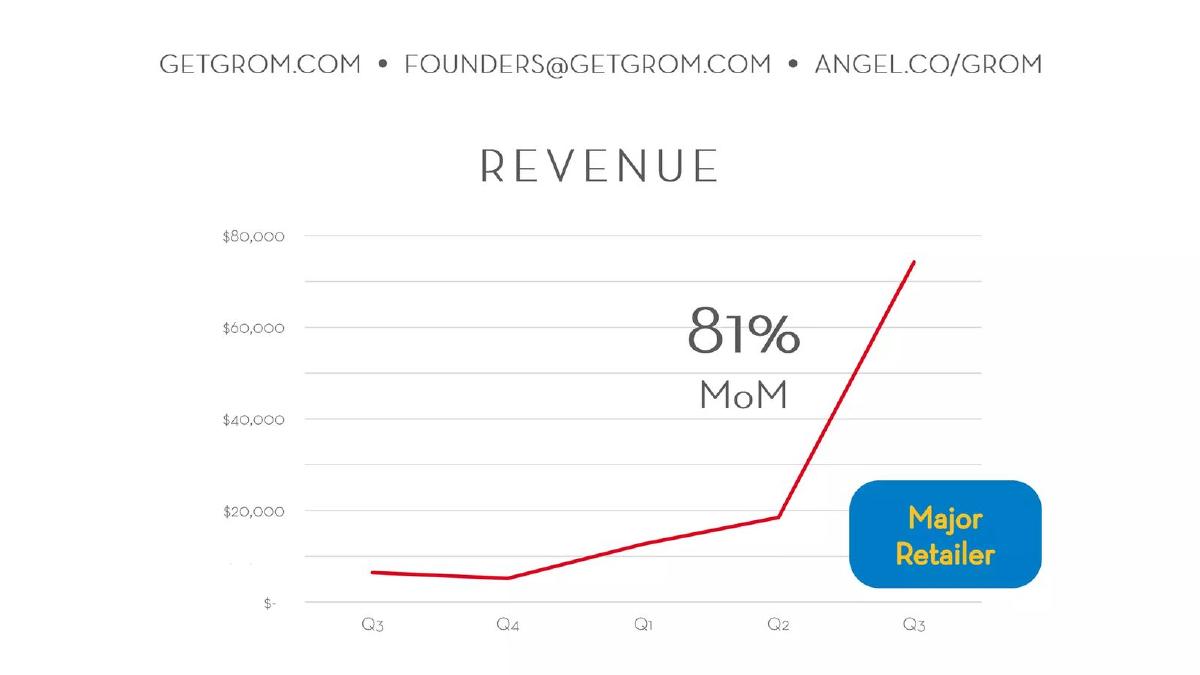
- The deck uses a progressive reveal strategy for revenue, starting with a dotted projection on Slide 2 and ending with a solid 81% MoM growth figure on Slide 4.
- Grom explicitly distances itself from 3D printing, calling it 'Not Scalable' and 'Bad Quality' on Slides 7 through 9.
- The total addressable market for mobile accessories is cited at $51 billion, with a specific $8.1 billion niche for customizable cases on Slide 11.
- A pilot program successfully sold over 9,000 units with 43% margins, as shown on Slide 12.
- The deck highlights a 'Freaking Huge Retailer' partnership on Slide 13, alongside logos for Amazon, HEMA, and Bol.com.
- The team slide (Slide 14) features four key members with backgrounds at Mashery, Disney, Vodafone, and AOL.
- The final slide (Slide 15) summarizes the core investment thesis: 43% margins, 81% MoM growth, and the hashtag #GROMINATION.
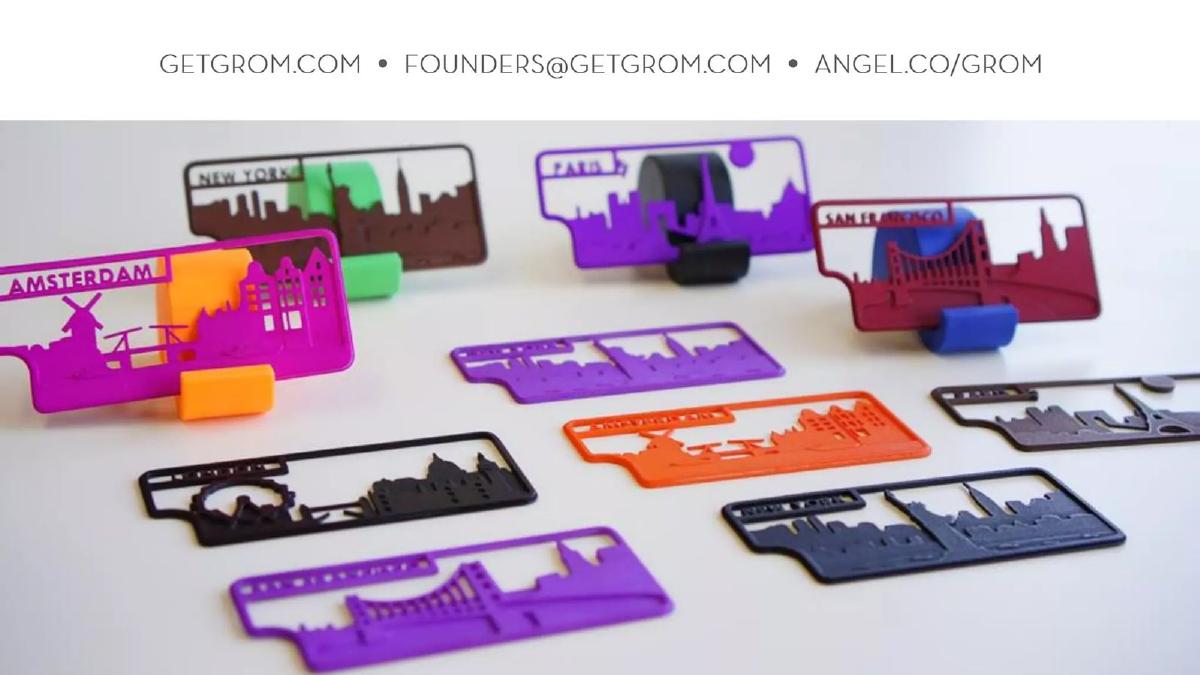
- Visual product evidence is provided through high-quality photography of skyline-themed cards (Slide 5) and personalized phone cases (Slide 10).
Grom Pitch Deck Teardown: Visualizing Growth and Market Disruption
Grom's pitch deck is a focused, 15-slide presentation that prioritizes traction and market positioning over technical jargon. The deck is structured to build momentum, starting with financial performance and moving into the specific product and market opportunity. It serves as a strong example of how to use minimalist design to highlight key business metrics.
Slides 1-4: The Hook - Dramatic Revenue Growth
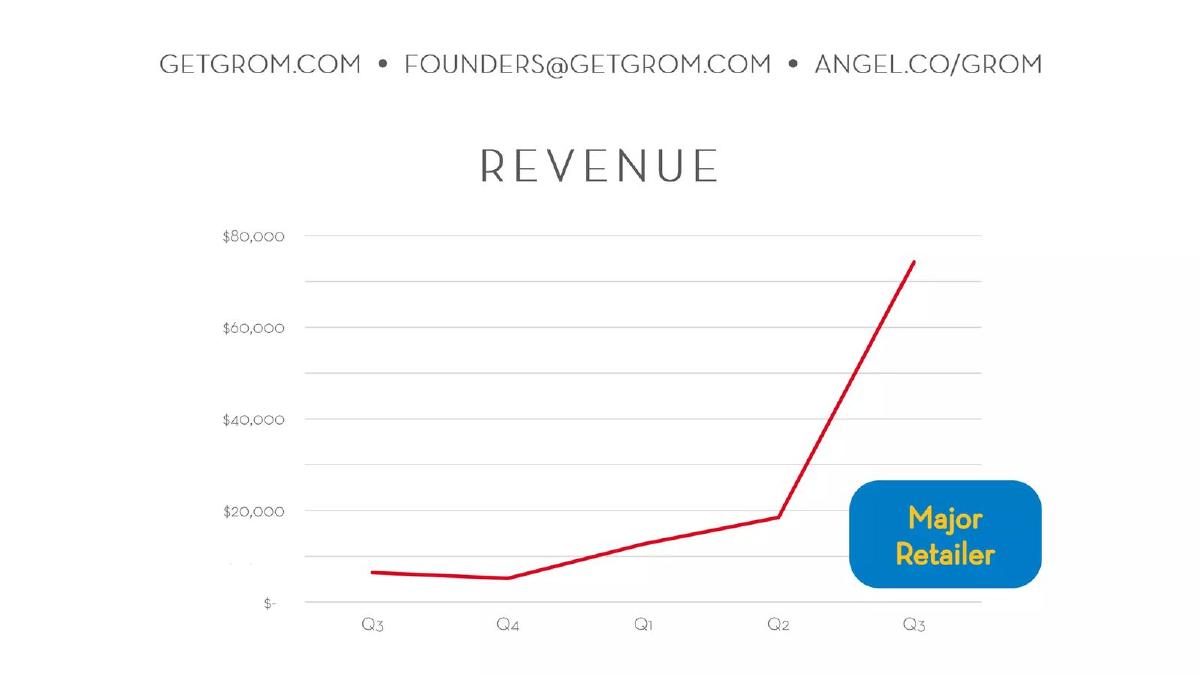
The deck opens with a simple title slide featuring the Grom logo and the tagline 'Make Things Personal.' Immediately following this, Slides 2, 3, and 4 use a progressive reveal technique to showcase revenue. Slide 2 shows a revenue chart with a dotted line indicating a sharp upward trend in Q3, reaching nearly $80,000. Slide 3 replaces the dotted line with a solid red line and adds a blue callout for a 'Major Retailer.' Slide 4 completes the sequence by adding the metric '81% MoM' (Month-over-Month) growth. This three-slide build effectively captures investor attention by proving immediate market demand and successful retail integration before even explaining the product.
Slide 5: Product Introduction - The Aesthetic
Slide 5 provides the first visual look at Grom's output. It features a high-quality photograph of various colorful, laser-cut cards. These cards depict famous city skylines, including Amsterdam, New York, Paris, and San Francisco. The slide contains no text other than the recurring header, letting the product's design and craftsmanship speak for itself. This visual evidence establishes the 'personal' and 'customizable' nature of the brand mentioned on the title slide.
Slides 6-9: The Anti-Thesis - Why 3D Printing Fails
In a bold move, Grom spends three slides (7, 8, and 9) critiquing the 3D printing industry. Under the heading '3D PRINTING HYPE,' the deck lists three major flaws: 'Not Scalable,' 'High Prices,' and 'Bad Quality.' By explicitly attacking a popular but often flawed technology, Grom positions its own (unnamed) manufacturing process as the superior, scalable alternative for mass-market customization. This creates a 'gap' in the market that Grom is uniquely positioned to fill.
Slide 10: The Core Product - Personalized Cases
Slide 10 brings the focus back to the primary revenue driver: smartphone cases. The slide shows six different iPhone and Android cases, each featuring intricate designs and personalized names like 'Eva,' 'Ben & Steph,' and 'Samantha.' This slide bridges the gap between the artistic cards shown earlier and the $8.1 billion market opportunity described in the next slide.
Slide 11: Market Opportunity - The $51 Billion Prize
Slide 11 quantifies the market. It uses two simple circles to represent the 'Customizable Smartphone Cases' market at $8.1 billion and the broader 'Mobile Accessories' market at $51 billion. By showing both, Grom demonstrates a clear niche where they currently operate, while also hinting at a much larger total addressable market (TAM) for future expansion.
Slide 12: Proof of Concept - The Pilot Program
Slide 12 provides the 'hard' data to back up the revenue growth shown at the beginning of the deck. It reports that a 'Pilot Program' resulted in '9,000+ Units Sold' with '43% Margins.' The use of a laptop graphic suggests that these sales were likely driven through an e-commerce platform, proving the direct-to-consumer (D2C) viability of the product alongside their retail partnerships.
Slide 13: Validation - Retail Partnerships
Slide 13 is a classic 'logo slide' that provides social proof. It features the logos of major European and global retailers: Amazon, HEMA, Bol.com, Coolblue, and MediaMarkt. The central element is a large blue button labeled 'FREAKING HUGE RETAILER,' which likely refers to the partner responsible for the Q3 revenue spike shown on Slide 3. This slide confirms that Grom has moved beyond the pilot phase and is successfully navigating complex retail distribution channels.
Slide 14: The Team - Experience Matters
The team slide (Slide 14) introduces four key members: Koen Munneke, Vincent van de Poll, Clay Loveless, and Isabel Virag. Their roles cover the essential pillars of a hardware/consumer goods startup: Production, Sales, Development, and Design. The inclusion of logos for Mashery, Disney, Vodafone, and AOL provides the necessary 'pedigree' to reassure investors that the founders have the experience to scale a global brand.
Slide 15: The Summary - #GROMINATION
The final slide serves as a summary and a call to action. It repeats the most impressive metrics—43% Margins and 81% MoM growth—alongside the revenue chart. The hashtag #GROMINATION adds a touch of brand personality and ambition, leaving investors with a clear picture of a fast-growing, profitable company ready for further expansion.
What Works in the Grom Pitch Deck
1. Data-First Storytelling: By leading with revenue growth rather than a long-winded problem statement, Grom immediately establishes credibility. The progressive reveal of the revenue chart is a clever way to build engagement.
2. Clear Differentiation: The explicit attack on 3D printing is a smart strategic move. It identifies a known industry trend, explains why it hasn't worked for mass-market consumer goods, and positions Grom as the solution.
3. High-Quality Visuals: The product photography is excellent. In the consumer goods space, the 'look and feel' of the product is paramount, and the deck successfully conveys a premium, well-designed brand.
4. Strong Unit Economics: Highlighting a 43% margin alongside high growth is a powerful combination. It shows that the company isn't just buying growth but has a sustainable, profitable business model.
What is Missing from the Grom Pitch Deck
1. The 'How': While the deck criticizes 3D printing, it never explicitly explains what Grom's manufacturing process actually is. Investors would likely want to know if there is proprietary technology or a unique supply chain advantage that allows for such high margins and scalability.
2. The Ask: There is no slide detailing how much money is being raised or how the funds will be used. This is a critical omission for a fundraising deck, as it leaves the 'next steps' for the investor unclear.
3. Competition: Beyond the general '3D printing' category, the deck does not mention specific competitors in the smartphone case market, which is notoriously crowded. A slide addressing how they win against established players like Casetify or OtterBox would have been valuable.
4. Customer Acquisition Cost (CAC): While margins and growth are clear, the cost to acquire those customers (especially in the D2C pilot) is not mentioned. Understanding the LTV/CAC ratio is essential for evaluating the long-term scalability of a B2C brand.
Founder Takeaway: Copy the Traction, Clarify the Tech
Founders should take note of how Grom uses a minimalist aesthetic to make their data pop. The 'less is more' approach works exceptionally well here because the data is strong. If you have a 'hockey stick' growth curve, don't bury it on slide 12—put it front and center as Grom did.
However, founders should also ensure they include a clear 'Ask' slide and at least a high-level explanation of their competitive advantage or 'secret sauce.' While Grom's deck was successful enough to lead to an acquisition by Unilever, providing more detail on the underlying technology and the specific funding requirements would make for a more complete investment case.
Frequently asked questions
- What is Grom's primary product?
- Based on the visual evidence in the deck, Grom produces customizable smartphone cases and accessories. Slide 5 shows thin, laser-cut cards featuring city skylines like New York, Paris, and Amsterdam, while Slide 10 displays personalized smartphone cases with names like 'Eva' and 'Samantha' integrated into intricate, colorful designs.
- How does Grom differentiate itself from 3D printing competitors?
- Grom takes a hard stance against 3D printing in Slides 7, 8, and 9. They label the technology as 'Not Scalable,' 'High Prices,' and 'Bad Quality.' By doing so, they imply that their own manufacturing process—likely laser cutting or injection molding—solves these specific industry pain points.
- What are the key financial metrics mentioned in the deck?
- The deck highlights three major financial milestones. First, Slide 4 and Slide 15 report an 81% month-over-month (MoM) growth rate. Second, Slide 12 and Slide 15 state a 43% profit margin. Finally, Slide 12 notes that the company has sold over 9,000 units through its pilot program.
- Which retailers are associated with Grom?
- Slide 13 lists several prominent retail partners, including Amazon, HEMA, Bol.com, Coolblue, and MediaMarkt. The slide also features a large blue button labeled 'Freaking Huge Retailer,' suggesting a significant, possibly exclusive, partnership that was a key driver of their Q3 revenue spike.
- Who are the founders and what is their background?
- Slide 14 introduces the core team: Koen Munneke (Production), Vincent van de Poll (Sales), Clay Loveless (Development), and Isabel Virag (Design). The slide includes logos for Mashery, Disney, Vodafone, and AOL, indicating that the team has collective experience at these major technology and media corporations.