InnerTrends positions itself as a bridge between basic data analytics and high-level data science for mid-to-large SaaS companies. The deck follows a classic narrative arc: identifying a massive market ($6.9 billion spent on product analytics in 2019, Slide 3), highlighting a talent shortage (only 1% of product teams have a data scientist, Slide 7), and presenting an automated solution. With a reported $15k MRR and 30% quarter-over-quarter growth (Slide 11), the company demonstrates early product-market fit. While the deck is visually clean and narrative-driven, it lacks specific details on u…
Key takeaways
- The deck identifies a $6.9 billion market spend for product analytics as of 2019 (Slide 3).
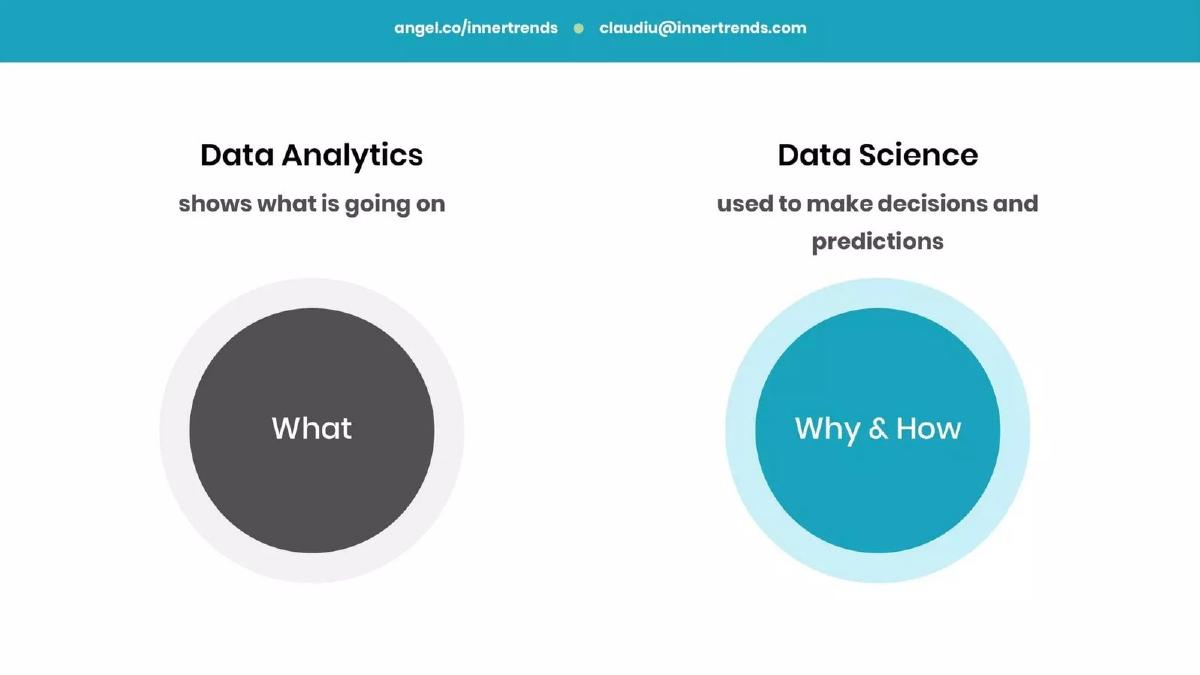
- It creates a clear distinction between 'Data Analytics' (the What) and 'Data Science' (the Why & How) to define its value proposition (Slides 5-6).
- The problem is framed as a talent scarcity issue, stating only 1% of product teams have access to a data scientist (Slide 7).
- InnerTrends targets the '99%' of middle and large SaaS companies that lack internal data science resources (Slide 8).
- The product interface focuses on answering specific business questions like churn drivers and AdWords performance (Slide 9).
- Traction is evidenced by a list of 10 success stories including major brands like Lenovo, Orange, and Avon (Slide 10).
- Financial metrics show a 30% quarter-over-quarter growth rate and $15,000 in Monthly Recurring Revenue (Slide 11).
- The founding team claims 20 years of collective experience with backgrounds at Intel, Samsung, and Bitdefender (Slide 12).
InnerTrends: The Bridge Between Data and Decisions
InnerTrends entered the market during a period where 'Big Data' was transitioning from a buzzword to a functional requirement for product teams. Their 13-slide seed deck, used to raise $652,800, is a study in narrative simplicity. It avoids technical jargon in favor of a clear 'Problem/Solution' framework that focuses on the scarcity of human talent in the data science field. By positioning their software as an automated replacement for a $150k-a-year data scientist, InnerTrends makes a compelling case for ROI before even mentioning their own pricing.
The Market Context and Problem Definition (Slides 1-4)
Slide 1 introduces the company with the tagline 'Data Science for Product Teams.' This is a strategic choice; they aren't just 'analytics,' which is a crowded category, but 'Data Science,' which implies a higher level of intelligence and utility. Slide 2 uses a simple graphic of a group of people pointing toward a dollar sign, representing the conversion of users into revenue—the ultimate goal of any product team.
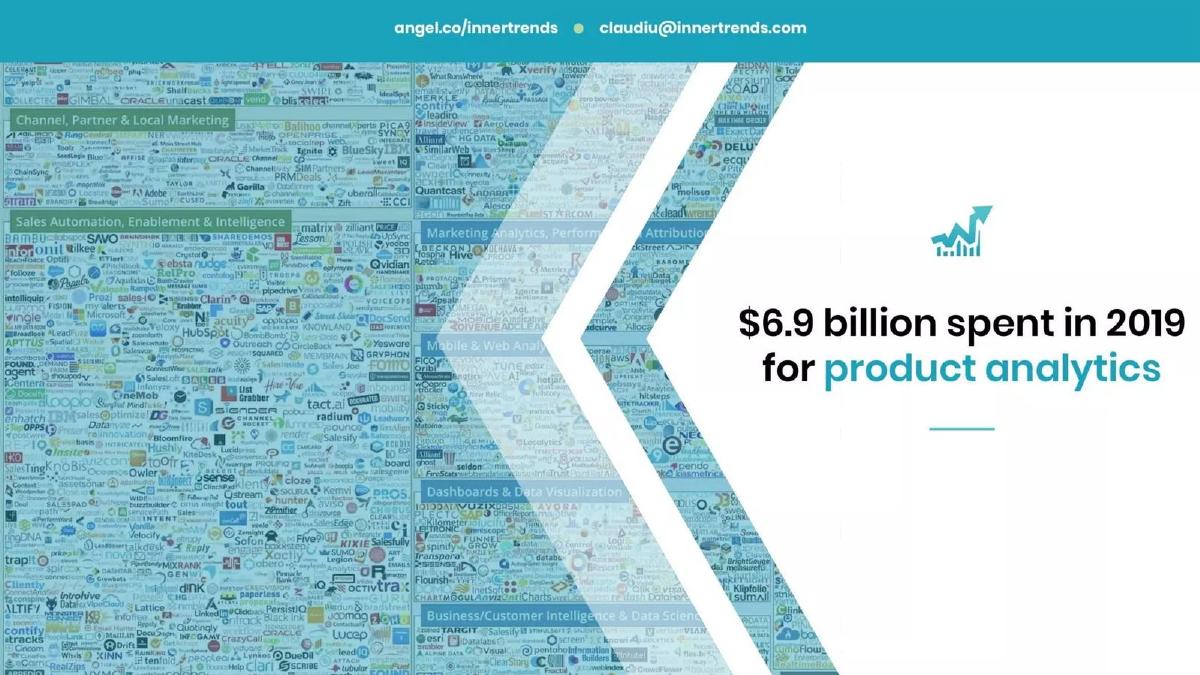
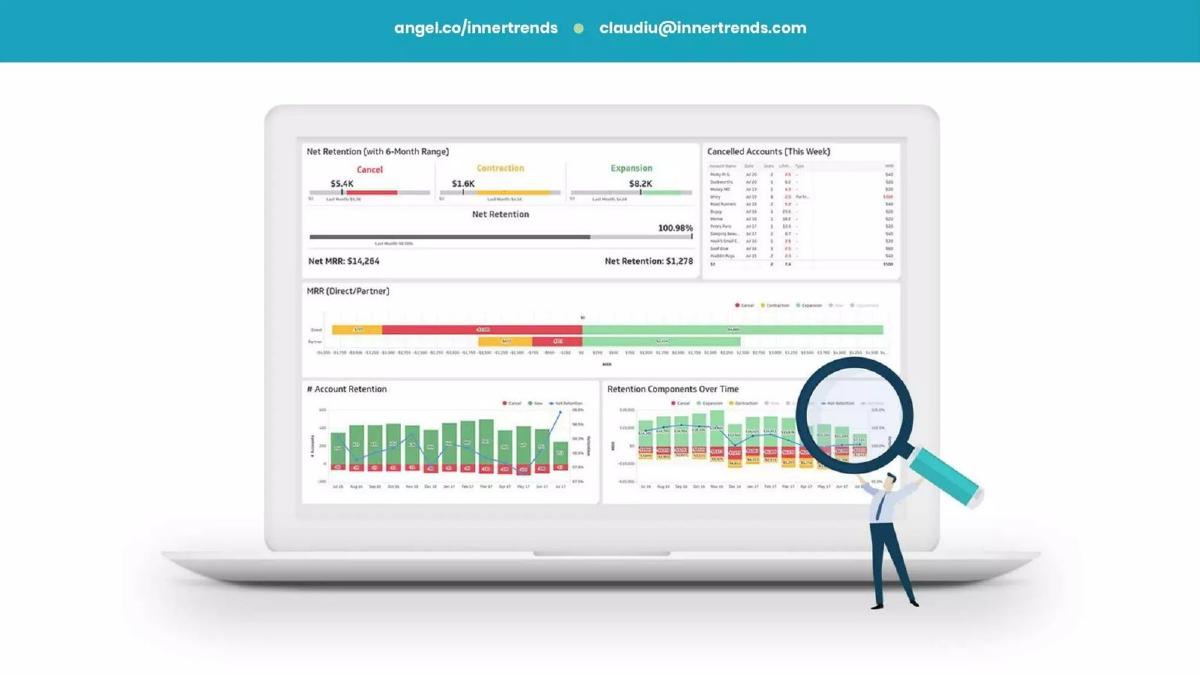
Slide 3 provides the market validation, stating that $6.9 billion was spent in 2019 for product analytics. By using a collage of logos from the marketing and analytics landscape, they acknowledge the crowded space but use the sheer scale of spending to justify another entry. Slide 4 shows a product screenshot focused on 'Net Retention' and 'MRR,' signaling that their tool is designed for business outcomes, not just vanity metrics like page views.
The 'Why' vs. The 'What' (Slides 5-8)
This section is the heart of the InnerTrends pitch. Slide 5 defines 'Data Analytics' as showing 'what is going on.' Slide 6 contrasts this with 'Data Science,' which is used to 'make decisions and predictions' by answering 'Why & How.' This distinction is crucial because it moves the product from a 'nice-to-have' reporting tool to a 'must-have' decision-making engine.
Slide 7 introduces the 'scarcity' element of the pitch: '1% of product teams have access to a data scientist,' noting these are mostly enterprise companies. Slide 8 then claims the remaining '99%' of middle and large SaaS companies as their target market. This creates a massive, underserved 'Blue Ocean' for InnerTrends to occupy. It frames the product not as a competitor to Google Analytics, but as a democratizer of data science for the masses.
Product Utility and Social Proof (Slides 9-10)
Slide 9 moves from theory to practice. It presents a query-based interface where a user can 'Ask the hard questions' and 'Easily get the answers.' The slide lists three specific examples: identifying actions that prevent churn, measuring AdWords performance, and onboarding influence. This slide is effective because it speaks directly to the daily pain points of a Product Manager.
Slide 10 provides the 'Success Stories.' The inclusion of household names like Lenovo and Orange, alongside respected SaaS brands like Customer.io, provides significant credibility. For a seed-stage company, having ten recognizable logos suggests that the product is already stable and providing value to sophisticated buyers. This slide acts as a de-risking mechanism for potential investors.
Traction and Team (Slides 11-13)
Slide 11 displays the hard numbers. The company shows a 30% Quarter-over-Quarter (QOQ) growth rate and a Monthly Recurring Revenue (MRR) of $15,000. The customer growth chart shows a steady, non-volatile climb over six quarters. While $15k MRR is modest, the consistency of the growth trend is what matters most at the seed stage. It proves that the sales process is repeatable.
Slide 12 introduces the team: Claudiu Murariu (CEO), Alex Stoia (CTO), and Iuliana Murariu (CPO). They emphasize '20 years of experience in building data science products' and display logos of former employers or partners like Intel and Samsung. This reinforces the 'expert-led' nature of the automated tool. Finally, Slide 13 concludes with a mission statement: 'Help your companies grow faster by giving them not just the Whats, but the Hows and the Whys.'
What Works in the InnerTrends Deck
The 'Why vs. What' Narrative: By categorizing their competitors as 'What' tools and themselves as a 'Why' tool, they successfully differentiate in a saturated market. · Focus on Outcomes: The deck repeatedly mentions growth, retention, and decision-making rather than technical features or data processing speeds. · Logo Density: For a seed round, the caliber of logos on Slide 10 is exceptional. It proves the product can scale from small startups to global enterprises. · Visual Simplicity: The deck uses a consistent color palette and minimal text, making it easy to digest in a three-minute skim.
What is Missing from the InnerTrends Deck
The Ask: There is no slide stating how much money they are raising, the terms of the round, or what the milestones for the next 18 months look like. · Business Model: It is unclear how InnerTrends charges. Is it per seat, per event, or per insight? Investors need to see the path to $100M in revenue. · Competition: While they imply a difference between themselves and basic analytics, they don't address direct competitors in the automated insights space (e.g., early versions of Pendo or Mixpanel's predictive features). · Unit Economics: There is no mention of Customer Acquisition Cost (CAC) or Lifetime Value (LTV), which are standard requirements for evaluating SaaS scalability.
What a Founder Should Copy
The Problem Scarcity Hook: Identifying that only 1% of the market has a specific resource (data scientists) and offering a software version of that resource to the other 99% is a classic, effective pitch structure. · Question-Based Product Slides: Instead of showing a complex dashboard, Slide 9 shows the questions the dashboard answers. This is much more relatable to a buyer's needs. · Growth Visualization: The traction slide (Slide 11) is clean and highlights the most important metric for a seed investor: the growth rate (QOQ). · Strategic Taglining: 'Data Science for Product Teams' is a high-value positioning statement that immediately tells an investor the category, the user, and the sophistication level of the product.
Frequently asked questions
- What is the core problem InnerTrends is solving?
- InnerTrends addresses the gap between basic data reporting and actionable insights. According to Slide 6, standard analytics only show 'what' is happening, whereas data science is required to understand 'why' and 'how' to make decisions. The deck argues that because 99% of product teams lack a dedicated data scientist (Slide 7), they cannot effectively grow their apps without an automated solution.
- How much revenue did InnerTrends have at the time of this deck?
- Slide 11 reports that InnerTrends had reached $15,000 in Monthly Recurring Revenue (MRR). This is paired with a 30% Quarter-over-Quarter (QOQ) growth rate, showing steady upward momentum from Q1 2018 through Q2 2019. The customer count graph on the same slide shows a climb from under 10 customers to nearly 30 over that period.
- Who is the target customer for InnerTrends?
- The deck specifically targets middle and large SaaS companies (Slide 8). The 'Success Stories' slide (Slide 10) validates this by showing a mix of enterprise giants like Lenovo and Orange alongside established tech companies like Customer.io and 2checkout. This suggests a horizontal application across different industries that share a common need for product growth insights.
- What is missing from the InnerTrends pitch deck?
- The deck is missing several critical components for a seed round. There is no 'Ask' slide detailing how much capital is being raised or how it will be spent. It also lacks a competitive landscape analysis, unit economics (like CAC or LTV), and a detailed roadmap. The business model—how they actually charge—is also left to the imagination.
- What is the background of the InnerTrends founding team?
- The team consists of three co-founders: Claudiu Murariu (CEO), Alex Stoia (CTO), and Iuliana Murariu (CPO). Slide 12 highlights 20 years of experience building data science products and lists previous experience or affiliations with major corporations including Bitdefender, T-Mobile, Intel, Samsung, and 2checkout.