Jimini Health’s 22-slide pitch deck successfully secured $8M in Seed funding by positioning itself as the next evolution in mental health technology. Unlike the 'previous generation' of telehealth companies that focused on access, Jimini emphasizes a hybrid 'CBT-AI' model. The deck leans heavily on clinical validation, citing specific meta-regression analyses to prove that traditional therapy outcomes have stagnated for decades. By integrating an AI assistant named Sage to provide 24/7 support between human-led sessions, Jimini demonstrates high engagement—with over 50% of clients engaging 3+…
Key takeaways
- The deck identifies a stagnation in therapy outcomes, citing research that response and remission rates haven't improved in decades (Slide 16).
- Jimini differentiates itself from 'previous generation' companies that only solved for access and insurance, focusing instead on the care model itself (Slide 4).
- The core product value proposition is 'CBT-AI,' a combination of human therapists and 24/7 AI augmentation (Slide 7).
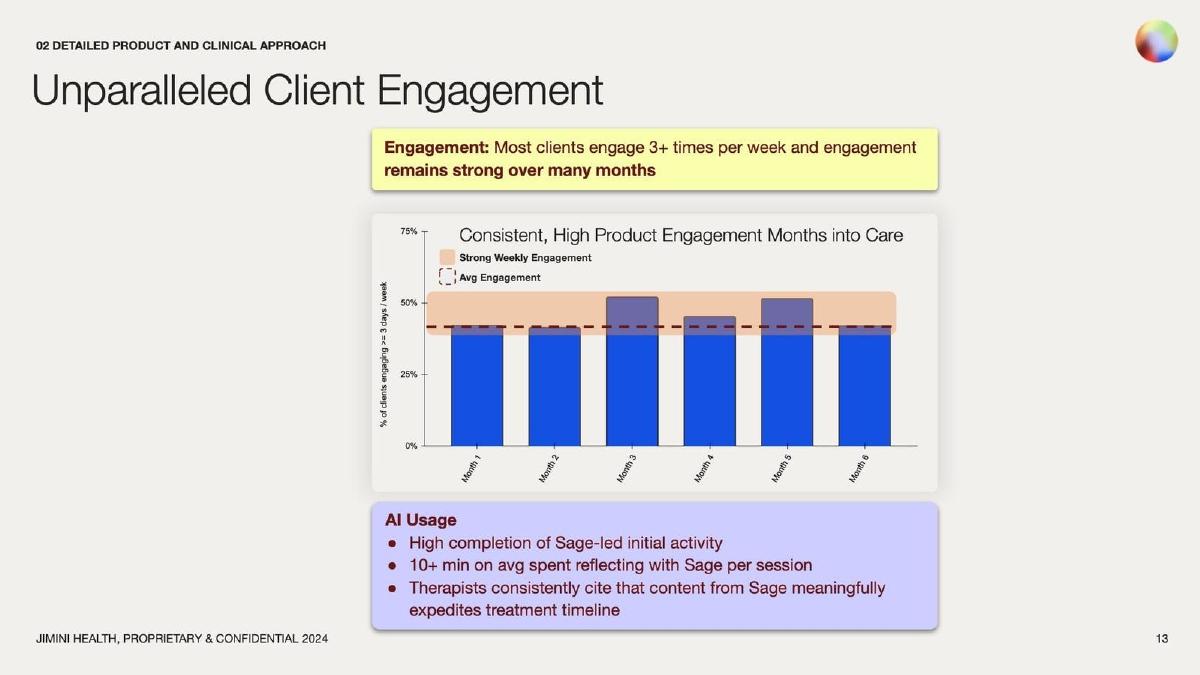
- Engagement data shows that most clients interact with the platform 3+ times per week, maintaining this level for over six months (Slide 13).
- The AI, named Sage, facilitates a 'magical first week' by helping therapists understand patient complexity faster (Slide 10).
- Safety is addressed by contrasting Jimini's goal-specific LLM approach with the pitfalls of generic mental health bots (Slide 18).
- The deck includes specific data on 'cognitive-restructuring' exercises, showing a 67.64% positive distribution in emotion intensity reduction (Slide 19).
- Despite the detailed clinical and product slides, the deck omits a specific 'Ask' slide detailing how the $8M will be allocated.
The Evolution of Mental Health Tech: A Hybrid Approach
Jimini Health’s pitch deck represents a shift in the digital health narrative. For the last decade, mental health startups focused on the 'access' problem—connecting patients to therapists via video. Jimini argues that access is a solved problem and that the real issue is the efficacy of the therapy itself. By raising $8M in a Seed round in 2023, they proved that investors are ready for 'Care 2.0.' The deck is clinical, data-heavy, and focused on the 'continuous care' model enabled by AI.
Slide 1-3: The Stagnation Narrative
The deck opens with a bold claim: 'Therapy hasn't improved in decades.' Slide 2 and Slide 3 establish the 'Why Now' by pointing out a lack of innovation in clinical outcomes. By framing the problem as a lack of improvement in actual patient health rather than just a lack of therapists, Jimini sets the stage for a technology-led clinical solution. The visual style is minimalist, using high-quality photography and clean typography to establish a premium, trustworthy brand identity.
Slide 4-5: Positioning Against the 'Old Guard'
Slide 4 is a crucial positioning slide. It categorizes 'Previous Generation of Mental Health Companies' as those that innovated on access, telehealth, and insurance facilitation. Jimini positions itself in a green box on the right, 'Innovating on Care, Patient Journey.' The slide explicitly states that Jimini is a 'category-shifting, technology-led, high-outcome therapy model.' This is a classic 'Red Ocean vs. Blue Ocean' strategy, telling investors that while the telehealth market is crowded, the high-outcome care market is wide open.
Slide 6-8: The CBT-AI Solution
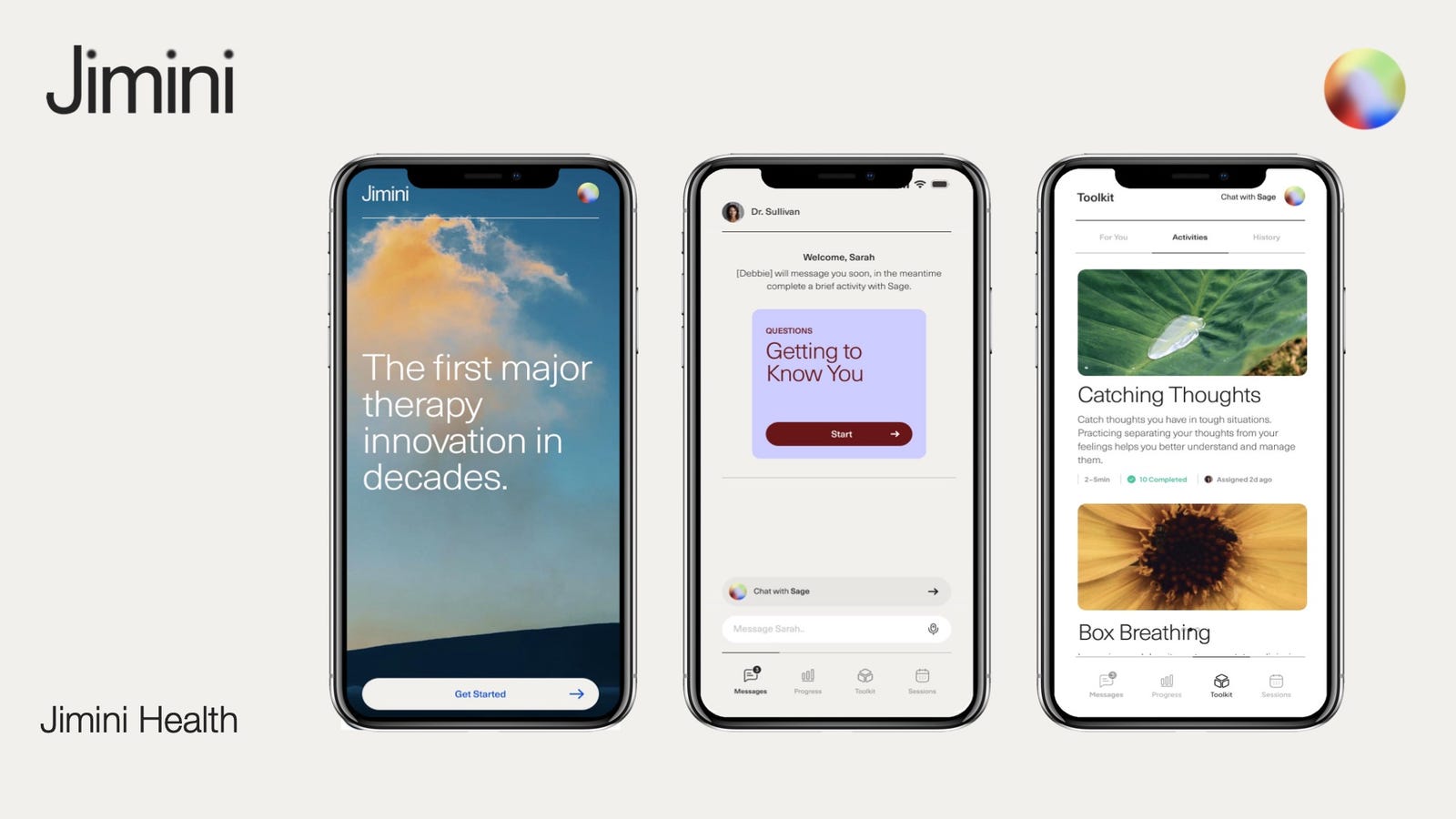
Slide 7 introduces the core product: 'CBT-AI.' It defines this as 'Best-in-Class Therapists' plus 'A.I. Augmentation.' The deck is careful not to suggest that AI replaces humans. Instead, it emphasizes that the AI is 'always available,' enabling 24/7 care that clinicians cannot provide alone. Slide 8 calls this 'The first major therapy innovation in decades,' reinforcing the opening hook. The use of a human face (the therapist) alongside an abstract AI gradient orb suggests a harmonious relationship between technology and empathy.
Slide 9-12: The Patient Journey and 'Sage'
Slides 10 through 12 walk through the 'Magical First Week of Therapy.' The deck introduces 'Sage,' the AI assistant. According to Slide 10, Sage helps therapists 'understand the patient’s full complexity more quickly.' This addresses a common pain point in therapy: the slow intake process. Slide 12 highlights 'Continuous support,' arguing that behavior change requires daily intervention, not just a weekly 50-minute session. This is the 'continuous care' hook that justifies the use of AI in a clinical setting.
Slide 13: The Proof of Engagement
Slide 13 is the 'money slide' for a Seed deck. It shows a bar chart titled 'Unparalleled Client Engagement.' The data indicates that over 50% of clients engage 3+ days per week, and this engagement remains strong through Month 6. It also notes that clients spend an average of '10+ min' reflecting with Sage per session. For investors, this proves that the AI isn't just a gimmick—patients are actually using it as a core part of their treatment plan.
Slide 14: The Team
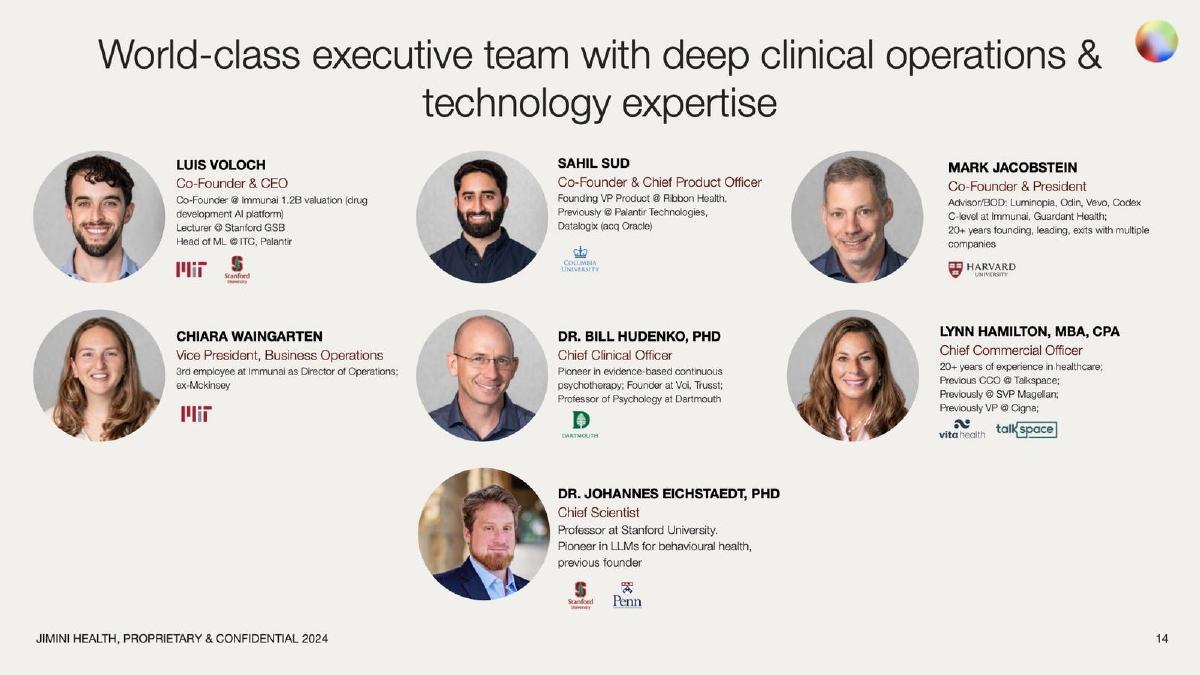
Slide 14 presents a 'World-class executive team.' While the specific names and backgrounds are not detailed in the text provided, the slide claims 'deep clinical operations and technology expertise.' In healthcare, the 'Clinical' part of the team is just as important as the 'Tech' part, and Jimini emphasizes this balance.
Slide 15-21: Clinical Deep Dives and Safety
The final third of the deck is unusually academic for a Seed pitch, which serves to build massive credibility. Slide 16 cites a 2024 meta-regression analysis from the Journal of Affective Disorders to prove that response rates in 'care-as-usual' haven't improved. Slide 17 and 18 tackle the 'AI Safety' elephant in the room. They acknowledge the 'Safety and clinical pitfalls of mental health bots' and contrast them with Jimini’s 'goal-specific approach.' Slide 19 shows a chart where 67.64% of users saw a reduction in emotion intensity through AI-led cognitive restructuring. This level of granular clinical data is rare in Seed decks and likely played a major role in the $8M raise.
What Jimini Health Does Well
Clinical Credibility: By citing peer-reviewed journals and providing p-values (Slide 19, p Use data to prove the problem is unsolved. Many founders assume the 'Problem' is obvious. Jimini used academic research to prove that the current status quo (therapy) is actually failing to improve, which makes their solution feel necessary rather than just 'nice to have.'
Balance the 'Human' and the 'AI.' In sensitive industries like healthcare, going 'full AI' can be a red flag. Jimini’s 'CBT-AI' branding (Slide 7) keeps the human therapist at the center, using AI as an 'augmentation' rather than a replacement. This is a safer and more scalable narrative for early-stage fundraising.
Show, don't just tell, engagement. If you have a product in the wild, Slide 13 is your template. Don't just show total users; show how often they come back and how much time they spend. High-frequency engagement in a 'low-frequency' industry (like therapy) is a powerful signal to VCs.
Frequently asked questions
- What is Jimini Health's primary innovation?
- Jimini Health introduces 'CBT-AI,' a hybrid model that pairs human therapists with an AI assistant named Sage. The AI provides 24/7 support between weekly sessions, facilitating 'continuous practice' and helping therapists understand patient complexity more quickly. This approach aims to move beyond the 'access-only' innovation of previous telehealth companies.
- How does Jimini Health address the safety of AI in mental health?
- The deck explicitly addresses safety on Slide 18, discussing the 'safety and clinical pitfalls of mental health bots.' Jimini differentiates its approach by using clinically integrated, goal-specific LLMs rather than open-ended conversational bots, focusing on specific exercises like cognitive restructuring to ensure clinical purpose and safety.
- What evidence does the deck provide for patient engagement?
- Slide 13 provides a bar chart showing 'Consistent, High Product Engagement.' It reports that over 50% of clients engage 3+ days per week in months 3 and 5, with an average engagement of 10+ minutes per session spent reflecting with the AI assistant, Sage.
- Who is the target audience for this pitch deck?
- Given the heavy emphasis on clinical outcomes, meta-regression analysis, and 'saving money for payers' (Slide 4), the deck is targeted at healthcare-focused venture capitalists and potentially insurance payers who are looking for high-outcome, scalable mental health solutions.
- What is missing from the Jimini Health pitch deck?
- The deck is notably missing a financial slide, a clear 'Ask' (specifying the $8M target or use of funds), and a competitive landscape map. While it mentions 'previous generations,' it does not name current competitors or provide a detailed go-to-market strategy or unit economics.