Smartcar's Series B deck is a highly stylized, 15-slide presentation that prioritizes visual storytelling and technical categorization over dense financial reporting. Raising $36 million in 2015, the deck positions the company as the essential infrastructure for the 'Self-Driving System' era. While the version analyzed contains significant placeholder text (Lorem Ipsum), the structural intent is clear: it moves from high-level market sizing ($3.8T) to specific technical 'Key Points' like Level 4 development and deep learning. The deck is notable for its inclusion of a SWOT analysis and a deta…
Key takeaways
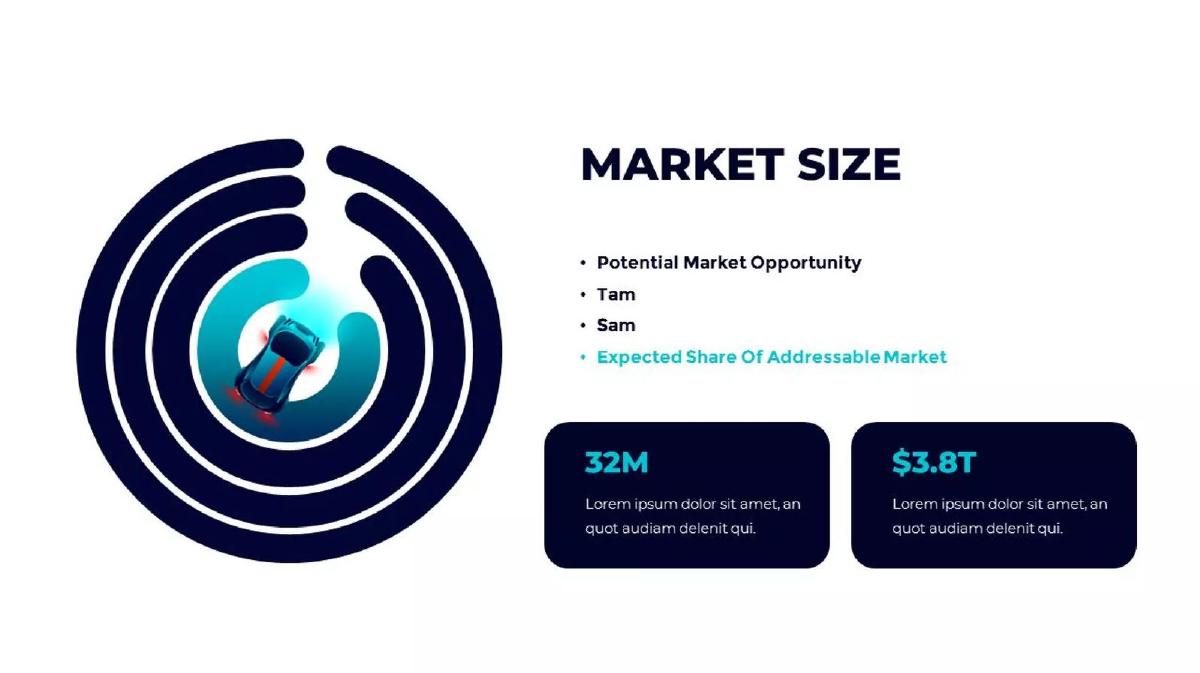
- The deck identifies a massive total addressable market (TAM) valued at $3.8T on slide 3.
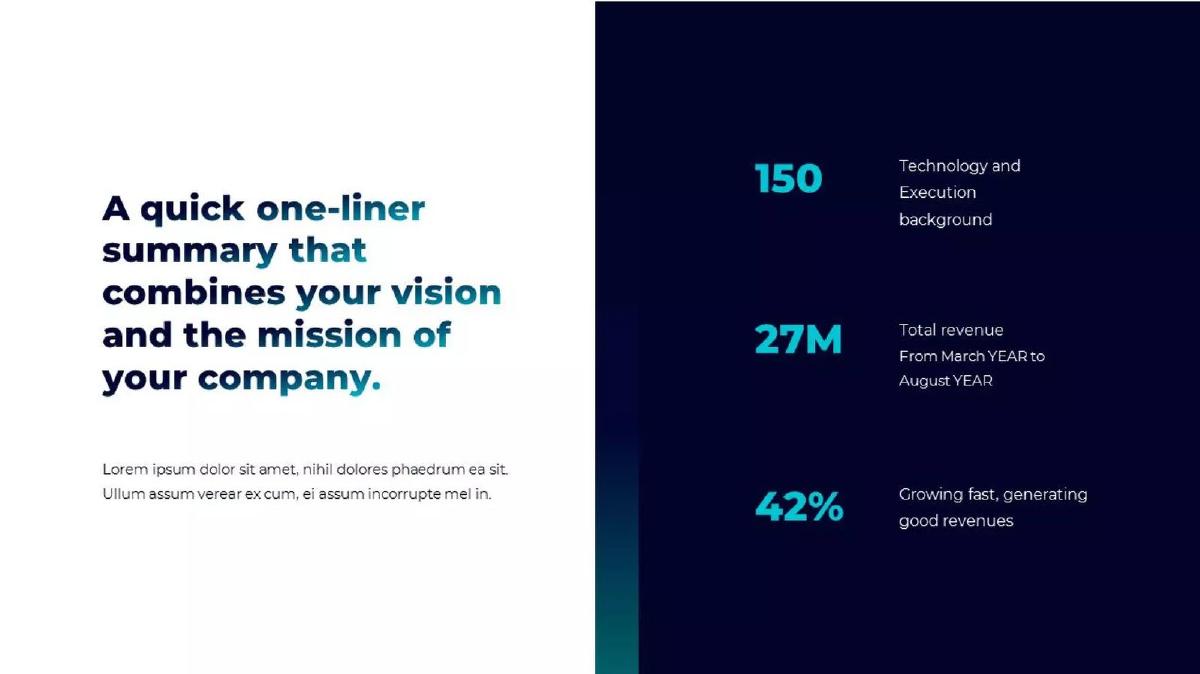
- Revenue traction is highlighted on slide 2, claiming $27M in total revenue from March to August of an unspecified year.
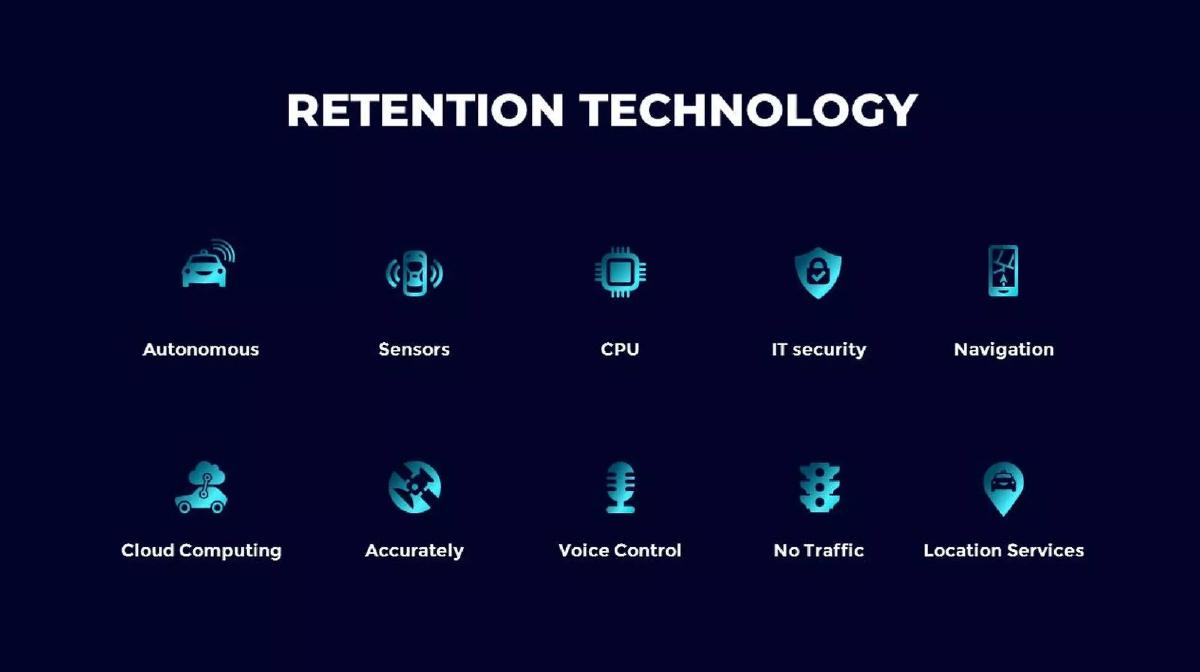
- Technical focus is categorized under 'Retention Technology' on slide 6, covering 10 areas including Sensors, CPU, and IT Security.
- The company explicitly targets 'Lv 4. Development' as a key point for its self-driving system on slide 7.
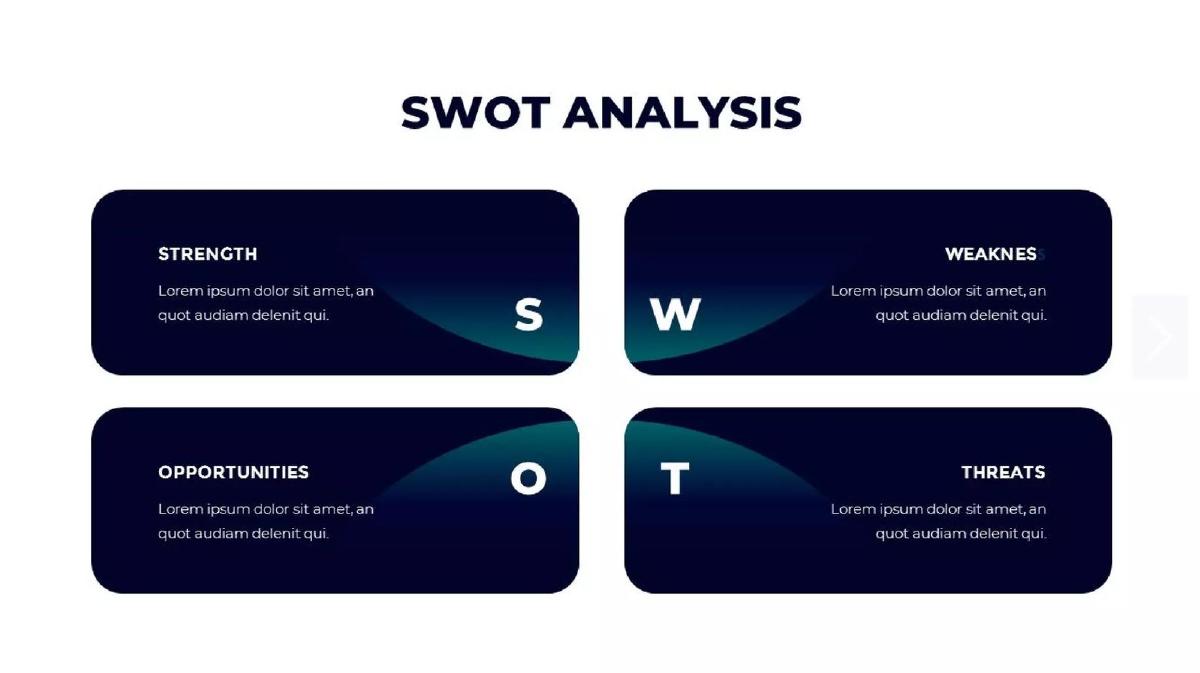
- A SWOT analysis (slide 4) is used to provide a balanced view of the company's internal strengths and external threats.
- The 'Range Graph' on slide 10 suggests a performance comparison between 'combustion' and 'intelligent' systems, peaking at 900 units.
- Investment utilization is granularly planned, with 72% allocated to 'Product Simulation' according to slide 14.
- The deck lacks a dedicated team slide, omitting the backgrounds and expertise of the founders and key engineers.
Smartcar Pitch Deck: The Infrastructure of Connectivity
Smartcar’s 15-slide deck is a study in high-concept visual communication for the automotive technology sector. Raised in 2015, this Series B deck focuses on the transition from traditional combustion vehicles to 'intelligent' self-driving systems. The deck is heavily stylized, using a dark-mode aesthetic with neon accents to emphasize its forward-looking, high-tech nature.
The Opening: Vision and Market Scale
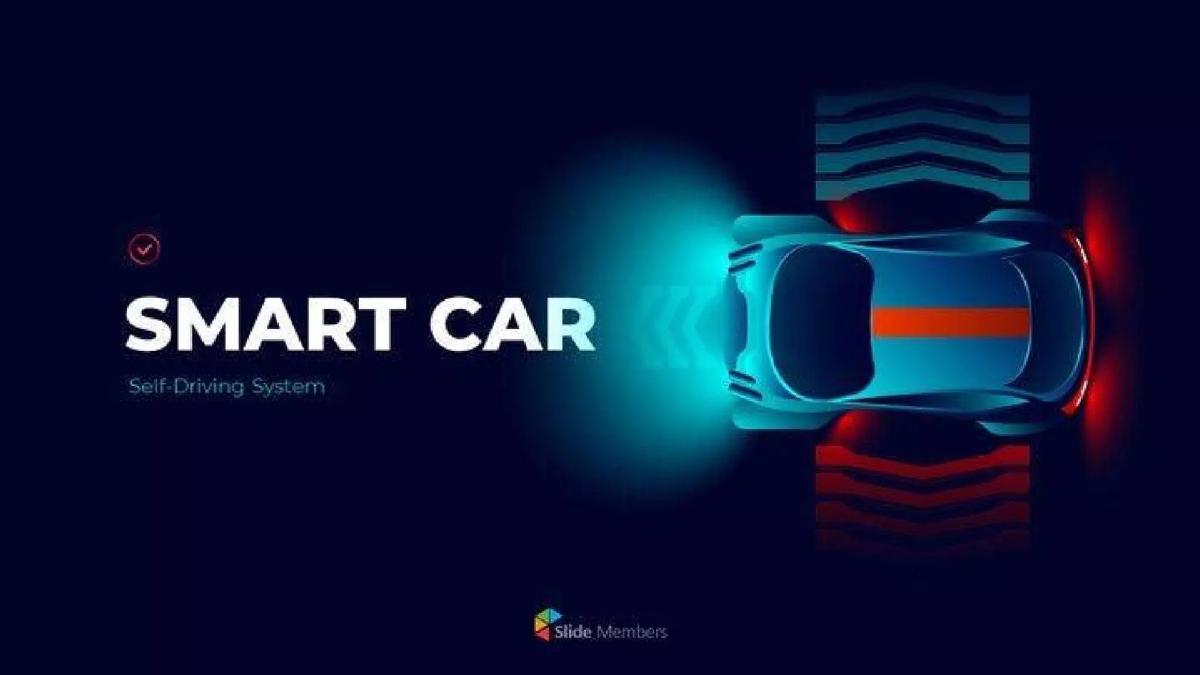
Slide 1: Title The deck opens with a minimalist title slide featuring the company name 'SMART CAR' and the subtitle 'Self-Driving System.' The imagery of a car from a top-down perspective with sensor-like pulses sets the stage for a technical infrastructure play.
Slide 2: Executive Summary This slide provides a high-level overview of the company's momentum. It cites a 'Technology and Execution background' of 150 (likely referring to team size or years of collective experience). Most notably, it claims $27M in total revenue for a six-month period (March to August), with a growth rate of 42% described as 'generating good revenues.'
Slide 3: Market Size Smartcar positions itself in a massive market. The slide lists a 'Potential Market Opportunity' of 32M and a Total Addressable Market (TAM) of $3.8T. By using such a large TAM, the company is signaling that its infrastructure is applicable to the entire global automotive industry, not just a small subset of electric vehicles.
Strategic Analysis and Advantages
Slide 4: SWOT Analysis The inclusion of a SWOT analysis is a standard but effective way to show investors that the founders have a realistic view of their environment. While the text is placeholder, the categories (Strengths, Weaknesses, Opportunities, Threats) are clearly defined, providing a framework for discussing competitive moats and external risks like regulatory changes or hardware dependencies.
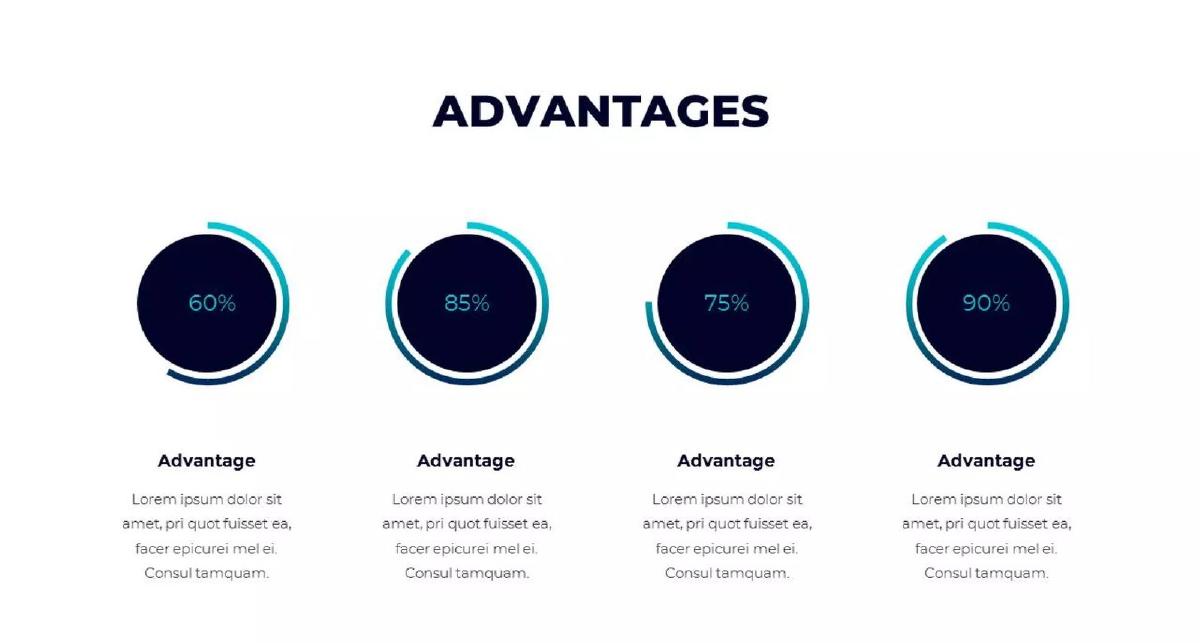
Slide 5: Advantages This slide uses four radial charts to quantify the company's edge. The percentages shown are 60%, 85%, 75%, and 90%. In a live pitch, these would typically correspond to metrics like cost reduction, speed to market, or data accuracy compared to legacy solutions.
Technical Infrastructure and Key Points
Slide 6: Retention Technology This is a critical slide for an infrastructure company. It breaks down the 'Retention Technology' into ten icons: Autonomous, Sensors, CPU, IT security, Navigation, Cloud Computing, Accurately (likely data precision), Voice Control, No Traffic, and Location Services. This suggests Smartcar is building the connective tissue that allows these disparate systems to talk to each other.
Slide 7: Key Point The deck highlights six technical pillars: Self-Driving, Artificial Intelligence, Voice Recognition, Open Source, Deep Learning, and Lv 4. Development. Level 4 autonomy refers to 'high automation' where the car can handle all driving tasks under specific conditions, a bold claim for 2015.
Slide 8: Description This slide features a futuristic car rendering with a circular UI element. It likely describes the user interface or the developer API that Smartcar provides to third-party apps wanting to interact with the vehicle.
Product Visualization and Performance
Slide 9: Intelligent Transportation System This slide provides a 'driver's eye' view of the product in action. It shows a digital dashboard and a tablet labeled 'SMART CAR ASSISTANCE.' The imagery includes a glass of wine in the center console, a classic trope used to signify the freedom provided by Level 4 or Level 5 autonomy.
Slide 10: Range Graph This slide compares 'combustion' vehicles to 'Intelligent' vehicles. The graph shows the intelligent system reaching a value of 900, significantly outperforming the combustion baseline. This likely refers to efficiency, range, or data throughput rather than physical distance.
Slide 11: Mobile Integration A hand holding a smartphone shows the Smartcar app interface, displaying vehicle status (17% charge, 100% health). The figure '608M' is prominent, possibly referring to the projected number of connected mobile users or vehicle pings the system handles.
Execution Roadmap and Financials
Slide 12: Process Chart This is a project management slide showing completion percentages for various workstreams: Marketing or Sales Tools (91%), Target Market & Customers (84%), Product Capabilities (38%), Rep Performance (24%), and Sales Process & Cycle (12%). It shows a company that is strong on marketing and market identification but still in the early-to-mid stages of product and sales development.
Slide 13: Expected Profit The deck includes a financial projection slide with a bar chart and two key figures: 13274.85 Users and 13274.85 Funding. The identical numbers suggest these are placeholders for the Series B round's specific targets.
Slide 14: Investment Utilization This slide breaks down how the capital will be spent. It lists four categories: Product funding (35%), Product due diligence (48%), Product Simulation (72%), and Product submission (59%). The high allocation for simulation reflects the heavy R&D costs associated with autonomous vehicle software.
Slide 15: Thanks The final slide provides contact information with placeholders for address, phone number, and email.
What Works in This Deck
Visual Consistency: The dark, neon-accented theme is consistent throughout, creating a 'premium tech' feel that suits a Series B infrastructure company. · Categorization: By breaking technology down into 'Retention Technology' and 'Key Points,' the deck makes a complex subject (connected car APIs) digestible for generalist investors. · Transparency: Including a SWOT analysis and a detailed Process Chart shows a level of operational maturity often missing in earlier-stage decks.
What Is Missing
Team Slide: This is a major omission. For a $36M round, investors are betting heavily on the engineering talent. The absence of founder bios or an org chart is a missed opportunity to build trust. · The 'Ask': While the 'Investment Utilization' slide shows where money will go, the deck never explicitly states the total amount being raised or the valuation sought. · Unit Economics: While revenue is mentioned on slide 2, there is no breakdown of Customer Acquisition Cost (CAC), Lifetime Value (LTV), or the specific pricing model (e.g., per vehicle, per API call).
What a Founder Should Copy
The Process Chart (Slide 12): Showing exactly how much of your internal 'to-do' list is finished is a great way to demonstrate execution capability. · Investment Utilization (Slide 14): Don't just say 'we are hiring engineers.' Break down the budget into functional areas like simulation, compliance, and product development. · Market Tiers (Slide 3): Using the TAM/SAM/SOM framework (even if labeled differently) helps investors understand the scale of the vision versus the immediate addressable reality.
Frequently asked questions
- What is the primary business model of Smartcar according to the deck?
- While the deck uses placeholders, the catalogue listing describes Smartcar as building the 'infrastructure for the connected car.' The slides support this by highlighting 'Intelligent Transportation Systems' (slide 9) and 'Retention Technology' (slide 6) that includes cloud computing and location services, suggesting a platform-as-a-service or API-driven model for vehicle data.
- How does Smartcar quantify its market opportunity?
- Smartcar uses a tiered market sizing approach on slide 3. It lists a potential market opportunity of 32M (likely units or users) and a monetary TAM of $3.8T. This massive figure positions the company within the broader global automotive and transportation shift rather than a narrow software niche.
- What are the specific technical pillars mentioned in the deck?
- Slide 7 outlines six 'Key Points': Self-Driving, Artificial Intelligence, Voice Recognition, Open Source, Deep Learning, and Level 4 Development. Slide 6 further expands this into infrastructure components like Sensors, CPU, IT Security, and Cloud Computing, indicating a full-stack approach to vehicle connectivity.
- What is missing from the Smartcar pitch deck?
- The most significant omission is a Team slide. There is no mention of the founders, their previous exits, or technical pedigree. Additionally, the deck lacks a clear 'Ask' slide specifying the exact dollar amount being raised in this round, though the catalogue confirms a $36M total raise.
- How does the company plan to use the funds?
- Slide 14, 'Investment Utilization,' provides a percentage-based breakdown: 35% for Product Funding, 48% for Product Due Diligence, 72% for Product Simulation, and 59% for Product Submission. Note: These percentages do not sum to 100%, suggesting they represent progress targets or independent budget allocations.