Smartlane’s 14-slide deck is a highly focused presentation targeting the inefficiencies of the logistics industry, specifically for Less Than Truckload (LTL) freight forwarders. By highlighting the transition from error-prone manual planning to AI-based automated dispatching, the company presents a compelling case for cost reduction and capacity optimization. The deck relies heavily on specific performance metrics, such as a 90% reduction in dispatching effort and a 21% increase in shipment volume with existing resources. While the deck lacks a formal 'Ask' slide and detailed financial projec…
Key takeaways
- The deck identifies a specific high-potential niche in LTL (Less Than Truckload) freight forwarders on slide 7.
- Operational efficiency is quantified as a 90% reduction in dispatching effort on slide 9.
- The product claims to enable 21% more shipments using existing resources, effectively increasing capacity without adding fleet costs (slide 9).
- A customer success story with Cargoline demonstrates a tangible saving of 19 vehicles and 19% in costs (slide 11).
- The technology is positioned as the result of over 28 years of R&D, providing a significant barrier to entry (slide 8).
- The team slide highlights a mix of academic rigor from TUM and industrial experience from companies like BMW and Linde (slide 13).
- The deck omits a specific funding ask, valuation, or roadmap for the use of proceeds.
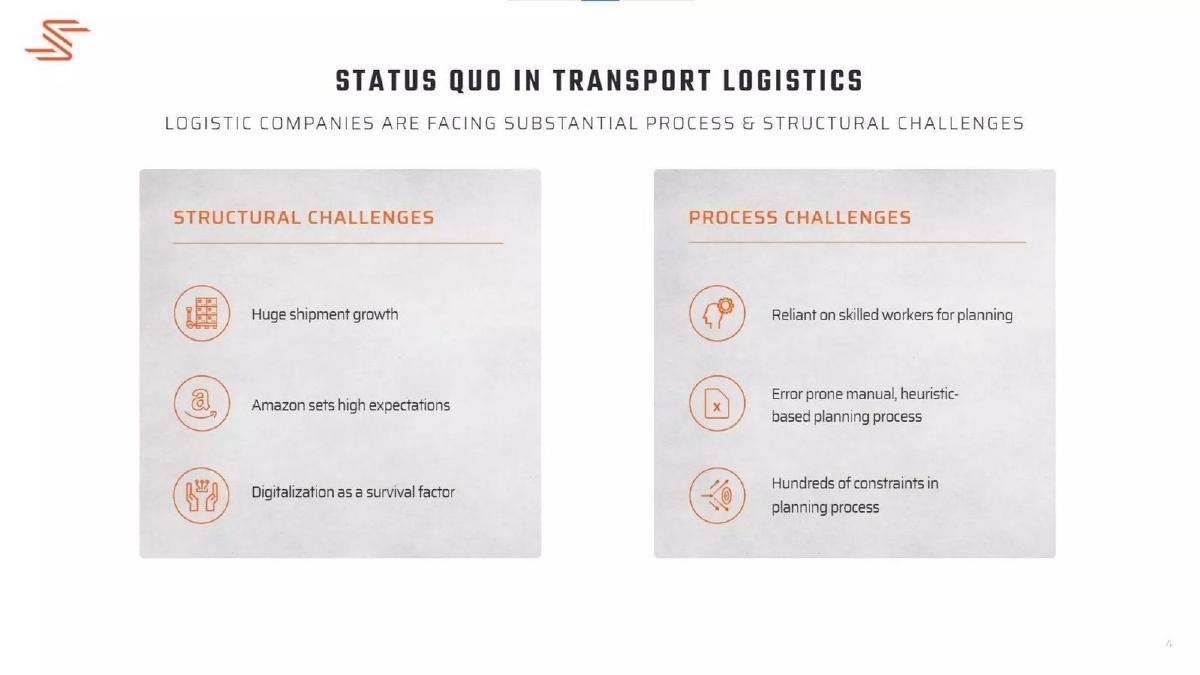
- The 'Status Quo' slide (slide 4) effectively uses the 'Amazon effect' to create urgency for digitalization among traditional logistics players.
Introduction: The Logistics Efficiency Gap
Smartlane’s 2015 seed deck is a focused, 14-slide presentation that targets a very specific pain point in the global supply chain: the manual inefficiency of freight dispatching. At a time when 'AI' was just beginning to become a standard pitch deck buzzword, Smartlane grounded its claims in decades of research and specific, measurable outcomes for freight forwarders. The deck is notable for its clean aesthetic and its ability to translate complex algorithmic optimization into simple business benefits like 'vehicles saved' and 'time reduced.'
Slides 1-3: The Hook and Mission
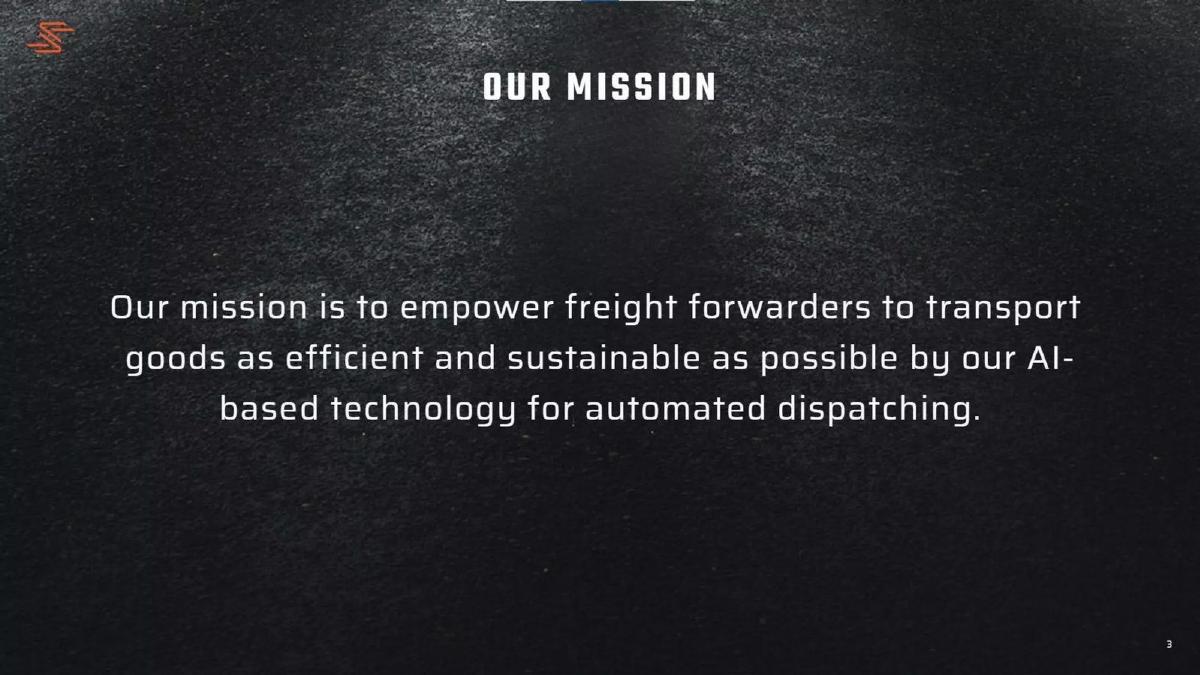
The deck opens with high-quality aerial photography of logistics in action. Slide 1 and 2 establish the brand identity and the core product name: Smartlane Transport Intelligence . The subtitle, 'AI-Based Transport Optimization,' immediately tells the investor what the category is. Slide 3 presents a concise mission statement: 'To empower freight forwarders to transport goods as efficient and sustainable as possible by our AI-based technology for automated dispatching.' This slide is effective because it identifies the customer (freight forwarders), the method (AI-based automated dispatching), and the dual benefit (efficiency and sustainability).
Slides 4-7: Defining the Problem and the Niche
Slide 4, titled 'Status Quo in Transport Logistics,' breaks the problem into two categories: Structural Challenges and Process Challenges. Under structural, it cites 'Huge shipment growth' and the 'Amazon effect'—a common trope in 2015 decks to signal market urgency. Under process, it highlights the reliance on 'skilled workers' and 'error-prone manual, heuristic-based planning.' This sets the stage for a software solution that replaces human intuition with data-driven logic.
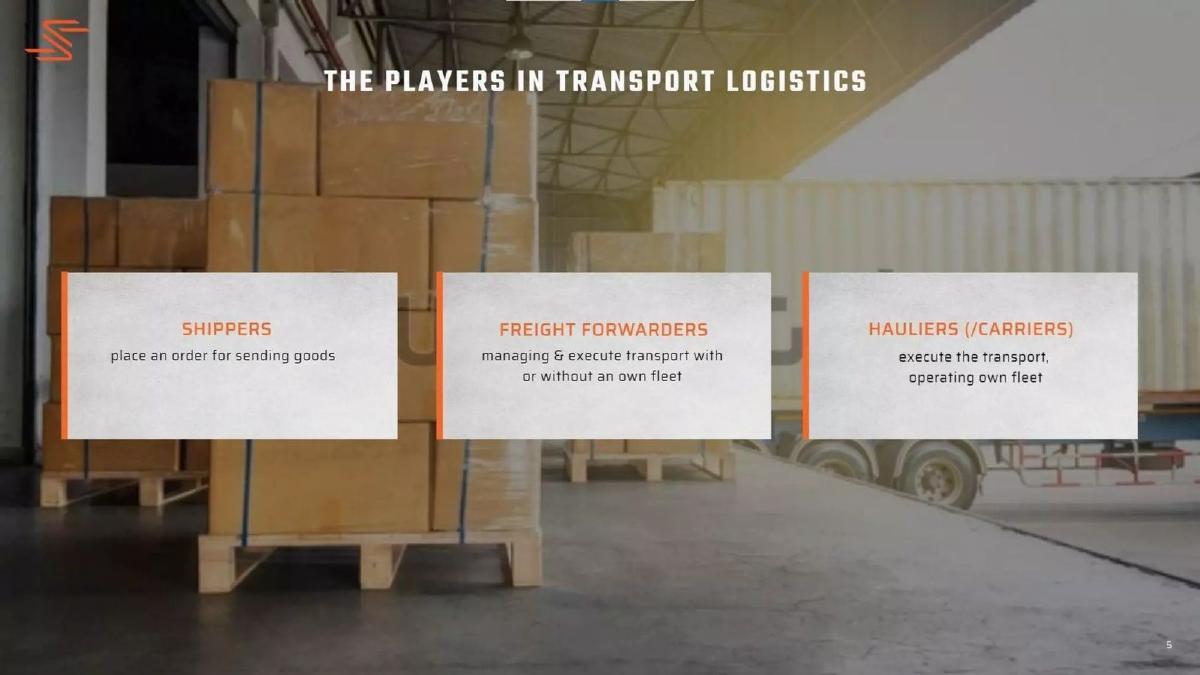
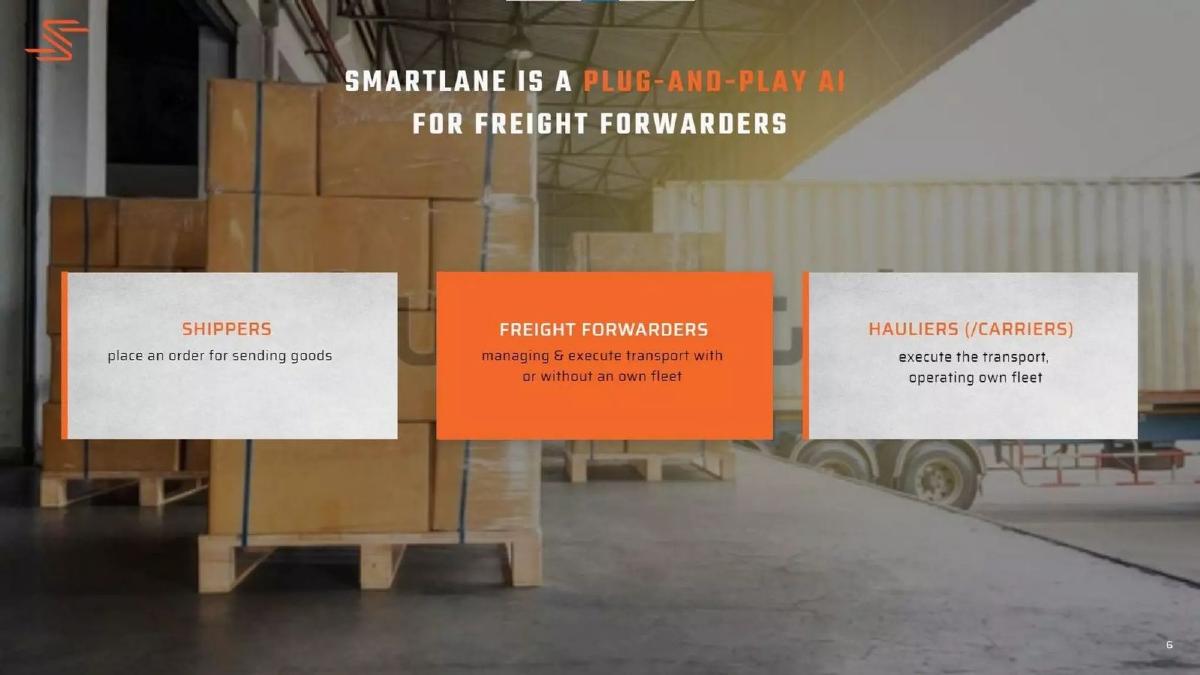
Slides 5 and 6 define the players in the ecosystem: Shippers, Freight Forwarders, and Hauliers. Smartlane explicitly highlights 'Freight Forwarders' as their primary target. Slide 7 is perhaps the most important strategic slide in the deck. It differentiates between LTL (Less Than Truckload) and FTL (Full Truckload). By stating that LTL forwarders have the 'biggest optimization potential,' Smartlane narrows its focus to the most complex part of the market where their AI can provide the most value. This shows investors that the founders understand where the 'low hanging fruit' of high-margin optimization lies.
Slides 8-9: The Product and Value Proposition
Slide 8 introduces the software interface. It claims '>28 years of R&D' , a significant figure that suggests a deep moat. The product features listed include automated dispatching, self-learning optimization, and 'what-if' analyses. The screenshot shows a dashboard with metrics like '99% Utilisation' and '100% Compliance,' giving a sense of the tool's operational depth.
Slide 9 quantifies the Unique Value Proposition . It uses three large, bold figures: +21% more shipments with existing resources (or -20% operative costs), -90% dispatching effort, and 100% meeting customers' wishes. These are 'hero metrics'—the kind of numbers that end up in an investor's internal memo. By framing the 21% increase as 'with existing resources,' they are pitching a massive increase in margin without a corresponding increase in CAPEX for the customer.
Slides 10-11: Validation Through Social Proof
Slide 10 features a quote from Uwe Lachmann, COO of Hartmann International, stating that the software reduced dispatching time by 4 hours a day . Real-world quotes from C-level executives in the target industry are high-signal evidence for Seed-stage investors. Slide 11 doubles down on this with a 'Customer Success Story' for Cargoline. It lists specific results: 19 vehicles saved , 19% cost saving , and 70% time saving for dispatching. Providing the exact number of vehicles saved makes the cost-saving claim much more believable than a generic percentage.
Slides 12-14: Vision, Team, and Contact
Slide 12 briefly touches on the vision: 'Fully Autonomous Transport Optimization.' This suggests the current product is just the first step toward a larger, more automated future. Slide 13 introduces the team. It emphasizes the Munich roots (founded 2015) and the 30 years of research background. The team is shown in branded hoodies, a classic startup aesthetic, but their credentials (Dr. rer. nat., M.Sc. TUM BWL) and backgrounds (BMW, Audi, Linde, Capgemini) provide the necessary corporate and academic gravitas. The deck concludes on Slide 14 with contact information for CEO Monja Mühling.
What Works in the Smartlane Deck
The most successful element of this deck is its specificity . Rather than claiming to 'fix logistics,' Smartlane identifies the exact segment (LTL Freight Forwarders) and the exact process (manual dispatching) they are targeting. The use of hard numbers—specifically the '19 vehicles saved' on slide 11—provides a tangible ROI that is easy for an investor to model. The deck also does a great job of establishing a 'moat' by citing 28 years of R&D, which helps counter the common investor concern that a competitor could simply build a similar algorithm overnight.
What is Missing from the Smartlane Deck
While the product and value proposition are strong, the deck is missing several standard fundraising components:
The Ask: There is no slide stating how much money the company is looking to raise or what the terms are. · Use of Proceeds: Investors want to know if their money is going toward engineering, sales, or international expansion. This is absent. · Business Model: While it mentions a 'SaaS solution' in the description, the slide deck itself doesn't explicitly detail the pricing structure (e.g., per vehicle, per month, or a percentage of savings). · Competition: There is no competitive landscape slide. Acknowledging incumbents or other startups in the space is usually necessary to show market awareness. · Roadmap: There is no timeline showing what the company has achieved so far or what the next 12-24 months look like in terms of product development or market entry.
What a Founder Should Copy
Founders in technical or industrial sectors should emulate Smartlane's Problem-Solution-Validation flow. Specifically:
The 'Status Quo' Slide: Grouping challenges into 'Structural' and 'Process' categories is a clean way to explain a complex industry to a generalist investor. · The Niche Identification: Explicitly stating why one segment (LTL) is better than another (FTL) shows deep domain expertise. · The Hero Metrics: Using large, bold percentages for the three most important outcomes (Slide 9) ensures that even a distracted investor remembers the core value proposition. · The Case Study: If you have a pilot or an early customer, dedicate a full slide to their specific results. '19 vehicles saved' is a much more powerful statement than 'we improve fleet efficiency.'
Frequently asked questions
- What is the primary problem Smartlane is solving?
- Smartlane addresses the 'Status Quo' in transport logistics, which is characterized by manual, error-prone, heuristic-based planning processes. According to slide 4, companies face hundreds of constraints in the planning process and are overly reliant on a dwindling pool of skilled workers. The rise of Amazon has also set high expectations for speed and transparency that traditional forwarders struggle to meet without digitalization.
- How does Smartlane define its target market?
- The deck specifically targets freight forwarders, particularly those operating in the 'Less Than Truckload' (LTL) segment. Slide 7 explains that LTL forwarders have the 'biggest optimization potential' compared to Full Truckload (FTL) operators because their cargo configurations are more complex, requiring more sophisticated planning to maximize vehicle utilization and minimize empty runs.
- What are the key performance indicators (KPIs) mentioned in the deck?
- Smartlane highlights several transformative metrics on slide 9: a 21% increase in shipments with existing resources, a 20% reduction in operative costs, and a 90% reduction in dispatching effort. Additionally, slide 11 features a case study with Cargoline showing 19 vehicles saved and a 70% time saving for the dispatching team.
- What is the technical background of the Smartlane team?
- The team is positioned as highly technical and research-oriented. Slide 13 notes that the company is founded on more than 30 years of leading-edge research in transportation analytics. The CTO, Dr. Mathias Baur, holds a doctorate, and the founders have backgrounds at institutions like TUM (Technical University of Munich) and major corporations like BMW, Audi, and Capgemini.
- What essential fundraising information is missing from this deck?
- This deck is primarily a product and value proposition showcase. It lacks a 'The Ask' slide detailing how much capital is being raised and how it will be spent. It also omits a competitive landscape analysis, detailed financial projections (revenue/ARR), and a clear product roadmap or milestone timeline for the next 18-24 months.