SmartHost's 16-slide deck focuses on the data asymmetry in the vacation rental industry. While hotels use sophisticated dynamic pricing, vacation rental hosts often guess, resulting in an 18% price swing compared to the 124% swing seen in hotels (Slide 4). The company positions itself as a 'recommendation engine for real estate,' starting with an $85 billion vacation rental vertical before eyeing the $12.1 trillion residential sales market (Slide 3). With a lean team out of Techstars Austin, they demonstrated early traction with 190 properties and a highly efficient customer acquisition cost…
Key takeaways
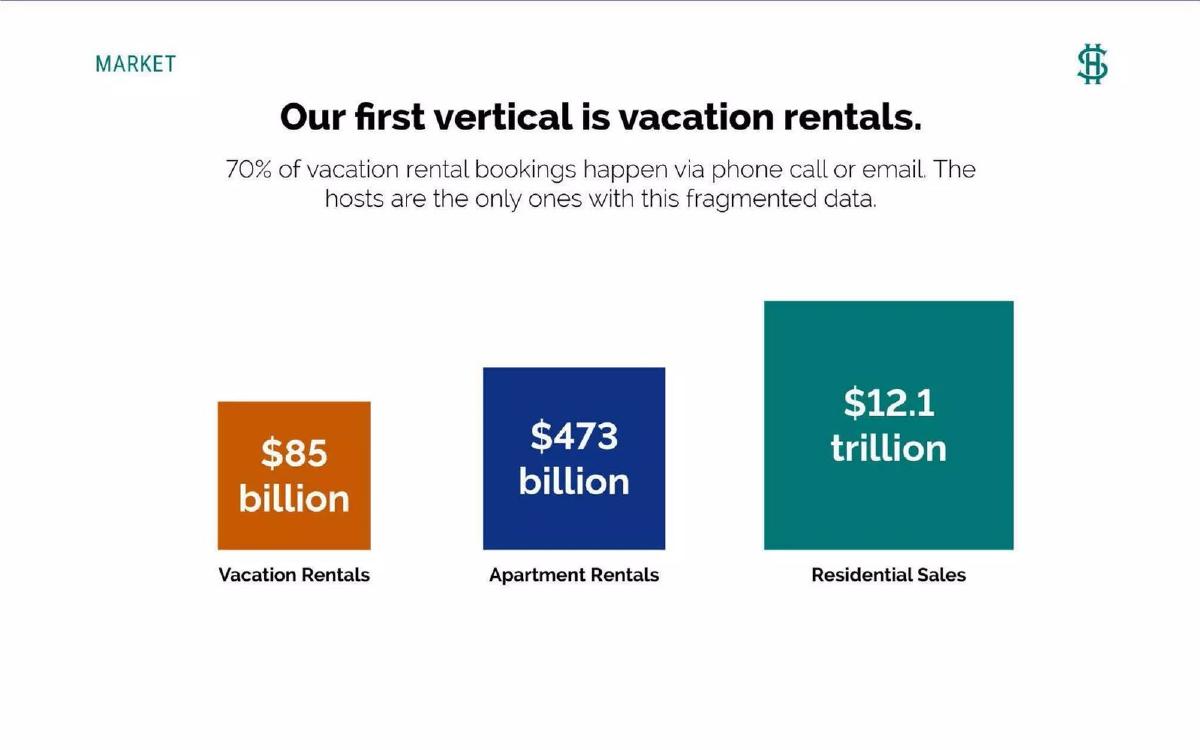
- The vacation rental market represents an $85 billion opportunity, serving as the entry point for a larger $12.1 trillion residential sales vision (Slide 3).
- A significant data gap exists because 70% of vacation rental bookings occur via phone or email, making hosts the sole owners of this fragmented data (Slide 3).
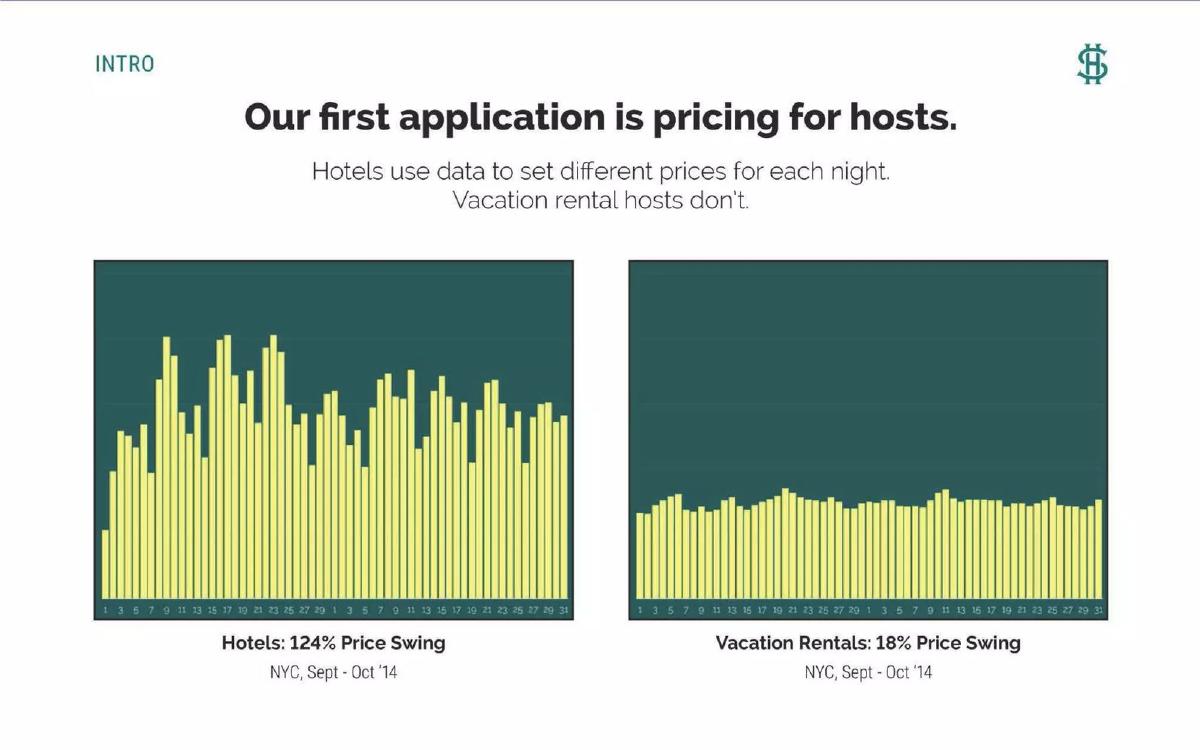
- Hotels achieve a 124% price swing through data-driven pricing, while vacation rentals only see an 18% swing, indicating massive left-on-the-table revenue (Slide 4).
- SmartHost achieved early traction by selling subscriptions for 190 properties through 19 vacation rental managers (Slide 7).
- Unit economics are strong, with a stated acquisition cost of $200 to acquire a $4,500 customer (Slide 8).
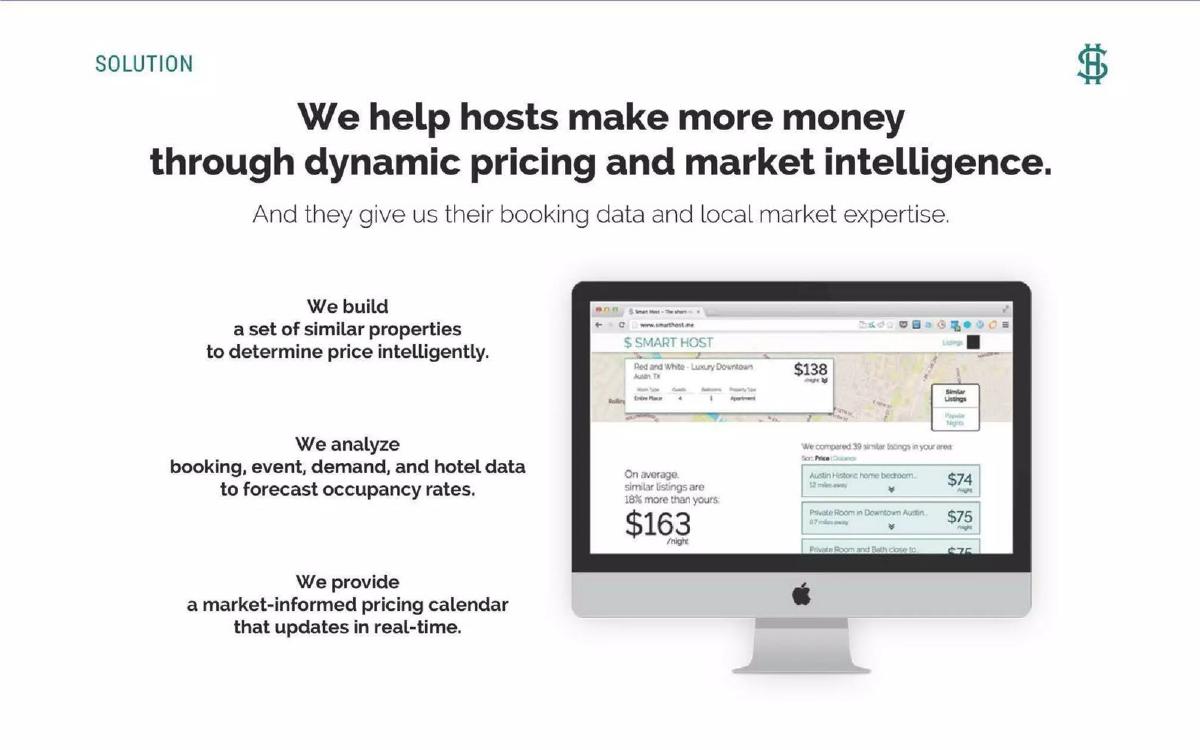
- The product uses a 'similar properties' algorithm that incorporates local host expertise to forecast occupancy and set prices (Slide 6).
- The company projects reaching profitability by February 2016 with $90k MRR and 7,000 properties (Slide 10).
- Competitive advantage is defined by being 'host-centric' rather than 'guest-centric,' allowing them to recommend turning down bookings to maximize total revenue (Slide 12).
SmartHost: Bringing Hotel-Grade Analytics to the Fragmented Rental Market
SmartHost positions itself as a sophisticated data layer for the real estate industry, starting with the vacation rental market. The deck is structured to highlight a massive discrepancy between how professional hotels price their inventory versus how individual hosts and property managers handle theirs. By focusing on the 'messy' nature of real estate data, the company establishes a clear need for a centralized database and a human-like algorithm to interpret property value.
The Vision and Market Opportunity
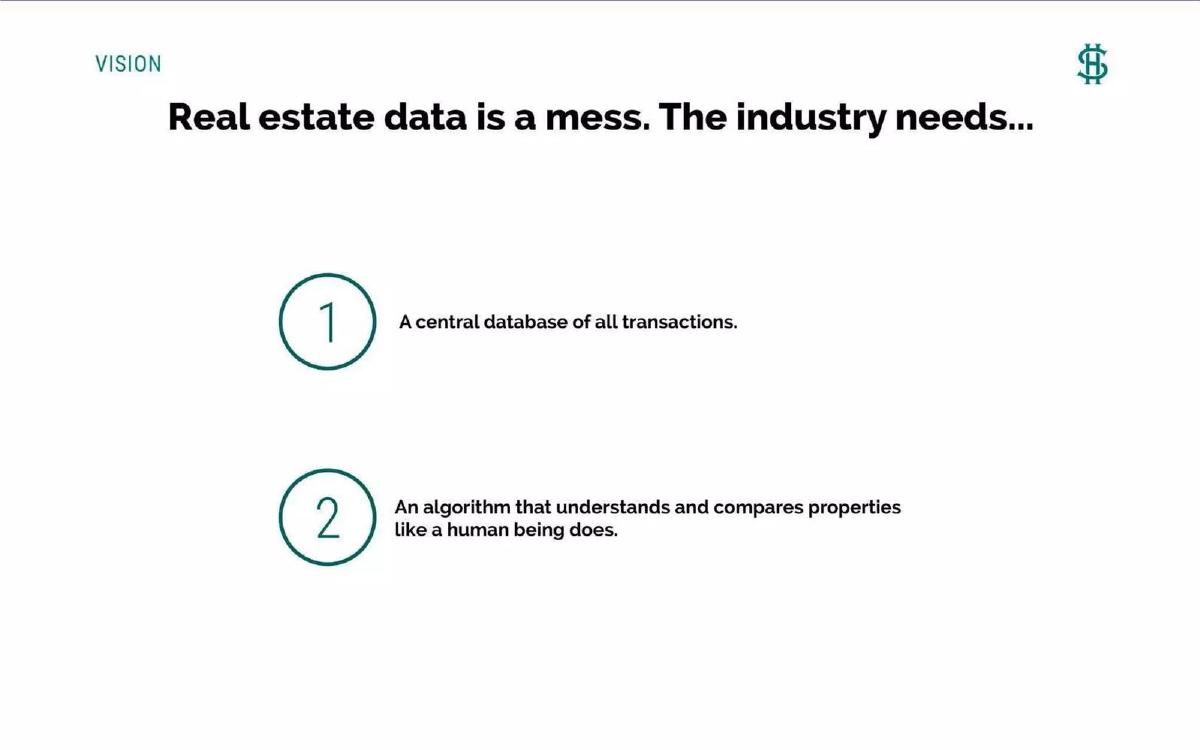
Slide 1 introduces the company as 'A Recommendation Engine for Real Estate.' This is a broad vision that is immediately narrowed down in the following slides. Slide 2 identifies the core problem: real estate data is a mess and requires a central database of transactions and an algorithm that understands properties like a human does. Slide 3 defines the first vertical as vacation rentals, valued at $85 billion. However, the slide also hints at the massive scale of the long-term play, showing Apartment Rentals at $473 billion and Residential Sales at $12.1 trillion. The key insight here is that 70% of vacation rental bookings happen via phone or email, meaning the data is fragmented and only accessible through the hosts themselves.
The Pricing Gap: Hotels vs. Vacation Rentals
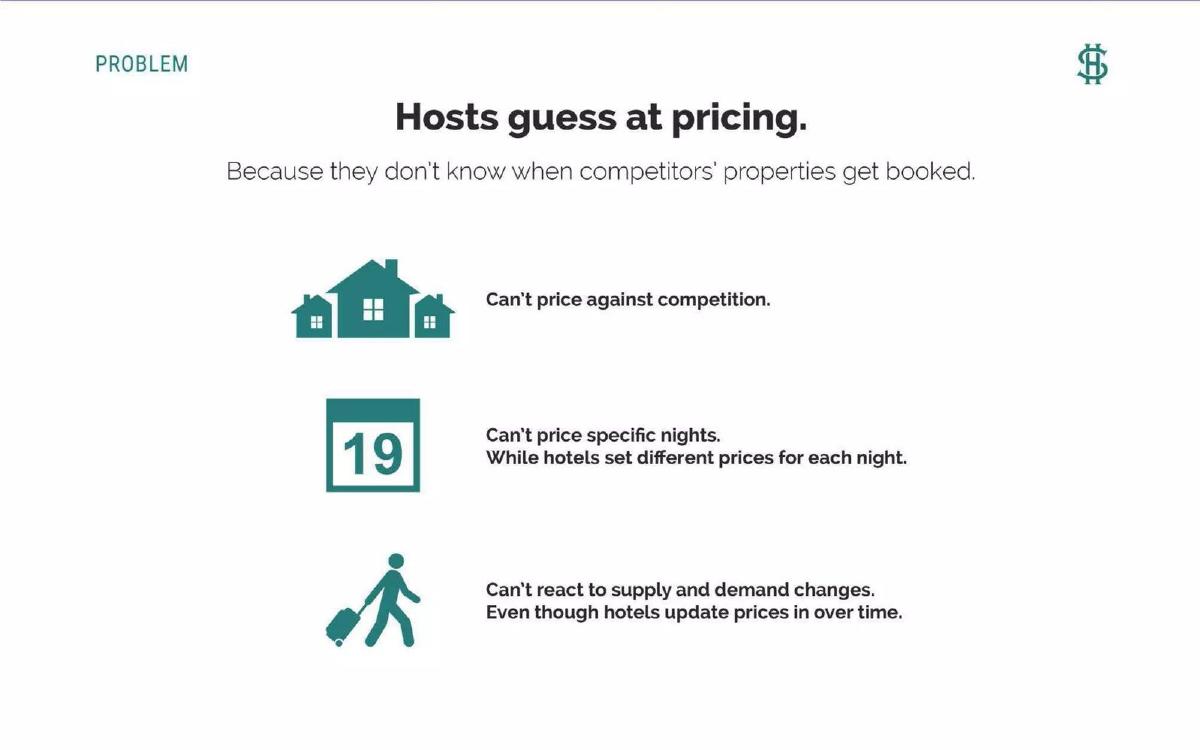
Slide 4 is perhaps the most compelling in the deck. It uses a side-by-side bar chart comparison of price swings in New York City during September and October 2014. Hotels showed a 124% price swing, reacting to demand, while vacation rentals showed only an 18% swing. This visual proof suggests that hosts are leaving a massive amount of money on the table. Slide 5 reinforces this by stating that 'Hosts guess at pricing' because they cannot see competitor booking data, cannot price specific nights effectively, and cannot react to supply and demand changes in real-time.
The Solution and Product Experience
Slide 6 outlines the SmartHost solution: dynamic pricing and market intelligence. The process involves building a set of similar properties, analyzing booking and event data to forecast occupancy, and providing a real-time pricing calendar. The slide includes a product mockup showing a recommended price of $163/night compared to a current price of $138/night. The appendix slides (14 and 15) provide deeper dives into the product, showing how the algorithm builds property sets and how the pricing calendar integrates external events like 'Labor Day Weekend' or 'Expedia Searches' to justify price hikes.
Traction and Unit Economics
Slide 7 highlights early success, stating they have sold subscriptions for 190 properties across 19 vacation rental managers. The average subscription is cited as $109 per month. A testimonial from Ben Edwards, an investor and President of the Vacation Rental Managers Association, adds significant industry credibility. Slide 8 focuses on the 'Go-To-Market' strategy, claiming a highly efficient acquisition model: 'It costs us $200 to acquire a $4500 customer.' The slide features a photo of co-founder Nick Persico making sales calls, emphasizing a hands-on, outbound sales approach to property managers who control 10 to 100 properties each.
The Team and Growth Projections
Slide 9 introduces the team, noting their participation in Techstars Austin 2014. The founders have relevant backgrounds in sales engineering, operations, and software engineering from companies like Autonomy and Krossover. The inclusion of a Predictive Analytics Advisor with a PhD from Columbia strengthens their technical claims. Slide 10 presents the growth forecast, projecting profitability by February 2016. The chart shows a dramatic revenue jump from 2016 to 2017, aiming for the $30 million mark. The headline '25% of managers gets us $120M annual revenue' provides a clear, if ambitious, target for market penetration.
Competitive Positioning
The appendix slides (12 and 13) address competition. Slide 12 explains why marketplaces like Airbnb cannot maximize host revenue: they lack offline booking data and are 'guest-centric.' Slide 13 uses a standard 2x2 matrix to position SmartHost as the only company focused on 'Data Analytics' specifically for 'Vacation Rental Managers,' distinguishing them from individual-host-focused tools like PriceLabs or Beyond, and operational tools like Guesty.
What Works in This Deck
The comparison between hotel price swings and vacation rental price swings (Slide 4) is a masterclass in establishing a 'gap' in the market. It takes a complex data problem and makes it visually obvious. Furthermore, the unit economics presented on Slide 8 ($200 CAC for $4,500 LTV) are incredibly attractive to investors, as they suggest a highly scalable and profitable business model. The deck also does a great job of explaining why they have a 'data moat'—by collecting the 70% of bookings that happen offline, they possess information that the major platforms do not.
What is Missing from This Deck
The most notable omission is a 'Funding Ask' slide. There is no mention of how much money the company is looking to raise, the valuation, or how the funds will be allocated. While this information is often shared in person, its absence in a standalone deck leaves a critical question unanswered. Additionally, while the deck mentions a 'central database,' it doesn't go into detail about the technical hurdles of integrating with various fragmented property management systems, which is a significant operational challenge in this industry. There is also no mention of churn rates or retention data, which is vital for validating the $4,500 customer value claim.
Founder Takeaways: What to Copy
The 'Gap' Visualization: Use side-by-side comparisons to show how a professional industry handles a problem versus your target market. It creates an immediate 'aha' moment for the investor. · Specific Unit Economics: Don't just say your CAC is low; give the exact numbers and the resulting LTV. It shows you have a firm grasp on your sales funnel. · The 'Vertical to Horizontal' Strategy: SmartHost shows a massive TAM ($12.1T) but focuses its immediate energy on a specific, solvable niche ($85B). This builds confidence that the team is focused but ambitious. · Address the 'Platform Risk': By explaining why Airbnb and HomeAway can't easily replicate their data, SmartHost preemptively answers the most common investor objection regarding competition from incumbents.
Frequently asked questions
- How much did SmartHost raise with this deck?
- According to the catalogue listing from pitchdeckhunt.com, SmartHost raised $100,000 in a Pre-Seed round. The deck itself does not explicitly state the funding goal or the terms of the round, which is a common omission in early-stage decks used for verbal presentations or specific investor meetings.
- What is the primary problem SmartHost is solving?
- The primary problem is that vacation rental hosts 'guess at pricing' because they lack visibility into when competitors' properties are booked (Slide 5). Unlike hotels, which update prices in real-time based on supply and demand, hosts often maintain static pricing, missing out on significant revenue during peak demand periods.
- What is SmartHost's competitive advantage over marketplaces like Airbnb?
- SmartHost argues that marketplaces are 'guest-centric' and lack the 'right data' (Slide 12). Because 69-70% of bookings happen offline (phone/email), marketplaces only see a fraction of the data. SmartHost gets the full transaction history directly from managers, allowing for more accurate revenue maximization.
- Who are the founders and what is their background?
- The team includes CEO Evan Hammer (ex-Autonomy sales engineer, Brown CS), Sales lead Nick Persico (ex-Krossover and Elastic), and Engineering lead Dave Redding (ex-Touchlab). They are supported by Predictive Analytics Advisor Steve Atlas, who holds a PhD in Marketing/Behavioral Pricing from Columbia (Slide 9).
- What are the company's long-term growth projections?
- SmartHost projected a steep revenue curve, aiming for nearly $30 million in annual revenue by 2017 (Slide 10). They claimed that capturing just 25% of rental managers would result in $120 million in annual revenue, predicated on an average subscription of $109 per month per manager.